The celestial tapestry that unfolds above us each night, a canvas of impenetrable darkness punctuated by distant pinpricks of light, has captivated humanity for millennia. This vast expanse, referred to as the dark night sky, is more than a mere backdrop; it is a repository of cosmic history, a laboratory for scientific inquiry, and a profound source of existential contemplation. To unravel its mysteries requires a journey through the principles of physics, the mechanics of light, and the very fabric of the universe itself.
The apparent darkness of the night sky is, paradoxically, a consequence of light. Specifically, it is the result of Earth’s orientation relative to the Sun and the properties of the intervening atmosphere.
Earth’s Obscuring Veil
During daylight hours, the Earth’s atmosphere, a gaseous envelope surrounding the planet, scatters sunlight, making the sky appear blue. This scattering is more pronounced for shorter wavelengths of light, like blue and violet. When the Sun sets and Earth rotates, the direct path to the Sun is obstructed.
The Role of Atmospheric Attenuation
Even when direct sunlight is absent, some light from the Sun continues to interact with the upper atmosphere. However, the intensity of this scattered light diminishes significantly. Furthermore, light from distant stars and galaxies must traverse vast distances, encountering interstellar dust and gas that can absorb and scatter a fraction of their photons. This attenuation contributes to the overall perception of darkness.
The Olbers’ Paradox Conundrum
A fundamental question regarding the dark night sky is encapsulated in Olbers’ Paradox, a thought experiment proposed by Heinrich Wilhelm Olbers in 1823. This paradox posits that if the universe were infinite, eternal, and uniformly filled with stars, then every line of sight should eventually terminate on the surface of a star. Consequently, the night sky should appear uniformly bright, akin to the surface of the Sun, rather than dark.
The Expanding Universe Solution
The resolution to Olbers’ Paradox lies in several key astronomical discoveries. Firstly, the universe is not infinitely old; it has a finite age, approximately 13.8 billion years. This means light from extremely distant stars and galaxies has not yet had sufficient time to reach Earth.
Redshift and Diminishment
Secondly, the universe is expanding, a phenomenon described by Hubble’s Law. As the universe expands, light emitted from distant objects is stretched, causing its wavelength to increase. This effect, known as cosmological redshift, shifts visible light into the infrared or even radio spectrum, rendering it invisible to the human eye. This redshift also diminishes the energy of the photons, further contributing to the perceived darkness.
In exploring the mysteries of the cosmos, a fascinating companion article titled “The Science Behind Light Pollution and Its Effects on Astronomy” delves into how artificial light impacts our perception of the night sky. This article complements the discussion in “The Truth About Why the Night Sky is Dark,” as it highlights the contrast between natural darkness and the encroachment of urban illumination. For those interested in understanding the broader implications of light in our environment, you can read more about it here: The Science Behind Light Pollution and Its Effects on Astronomy.
Observing the Cosmic Canvas
The observation of the dark night sky is fundamental to astronomical research, yet it is significantly impacted by anthropogenic light pollution.
Celestial Wonders Visible to the Naked Eye
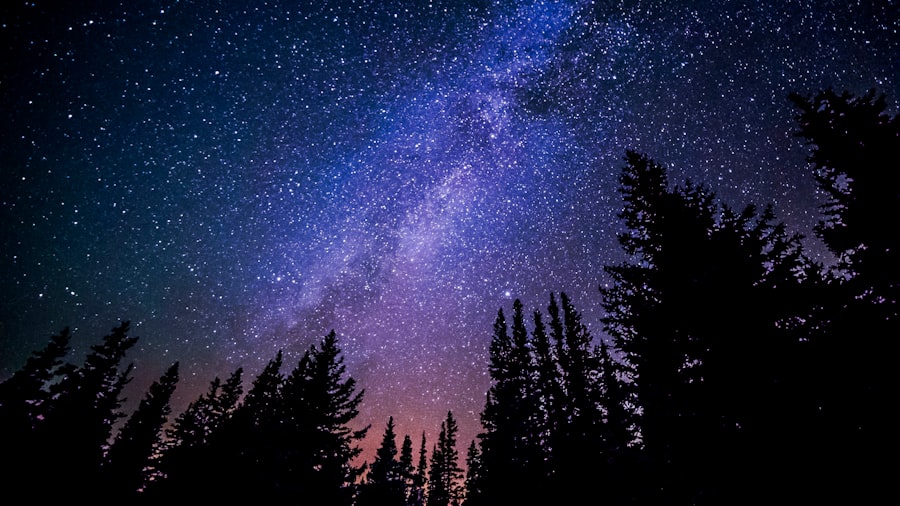
Under truly dark skies, away from urban centers, the human eye can discern a remarkable array of celestial objects. These include thousands of individual stars, constellations forming recognizable patterns, and the ethereal glow of the Milky Way galaxy, our cosmic home. Planets like Venus, Mars, Jupiter, and Saturn are also visible at various times of the year, appearing as particularly bright “stars.”
The Milky Way’s Grandeur
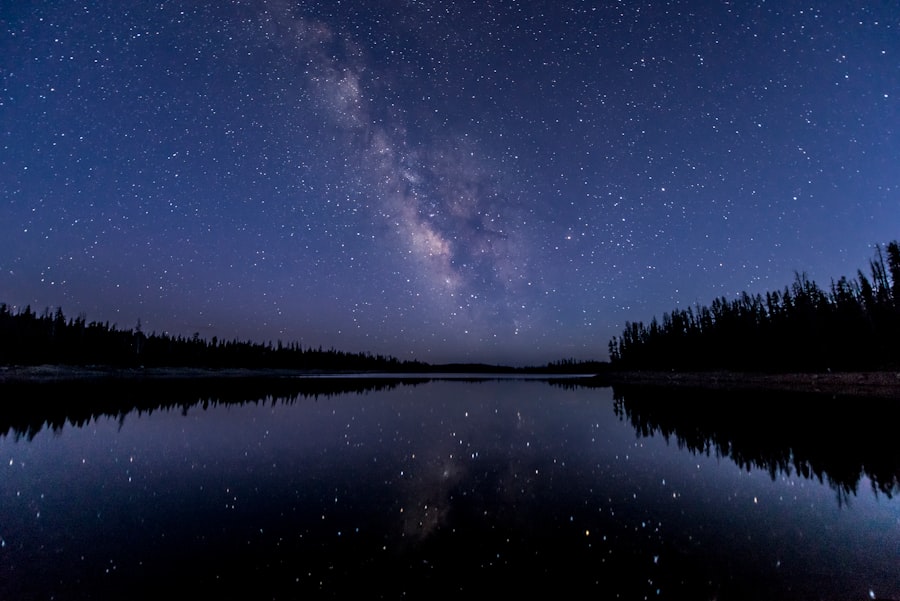
The Milky Way, an estimated 100-400 billion stars strong, appears as a luminous band stretching across the night sky. Its discernible structure, including darker lanes caused by interstellar dust, offers a glimpse into the spiral arms of our galaxy. The observation of the Milky Way’s intricate details is a stark reminder of the depth and complexity of the universe that surrounds us.
Nebulae and Star Clusters
While most nebulae (clouds of gas and dust) and star clusters require telescopic aid, some, like the Andromeda Galaxy (M31) and the Pleiades star cluster (M45), are visible as faint smudges or distinct groupings of stars, respectively, to the unaided eye under optimal conditions. These objects provide compelling evidence of ongoing star formation and galactic evolution.
The Impact of Light Pollution
Artificial light emitted by human settlements, such as streetlights, billboards, and buildings, scatters in the atmosphere, creating a diffuse glow known as skyglow. This phenomenon significantly reduces the visibility of fainter stars and celestial objects, effectively erasing vast portions of the night sky for most of the global population.
Consequences for Astronomy
Light pollution poses a substantial challenge to professional astronomers. Observatories are increasingly located in remote, high-altitude regions to minimize its effects. Even then, advanced filtering techniques and adaptive optics are often employed to mitigate the interference. The loss of dark skies directly impacts the ability to study faint galaxies, distant quasars, and the early universe.
Ecological Implications
Beyond astronomy, light pollution has demonstrable ecological consequences. It disrupts circadian rhythms in both humans and animals, disorients migratory birds, and alters predator-prey dynamics. The natural cycles dictated by the moon and stars are becoming increasingly obscured, impacting delicate ecosystems.
Unveiling Deep Space Objects
To truly penetrate the veil of darkness and explore the most distant and faint objects, specialized astronomical instruments are indispensable.
Telescopes: Our Eyes on the Universe
Telescopes, from ground-based giants to orbiting observatories, are the primary tools for collecting and focusing light from celestial sources. Their ability to gather more light than the human eye and resolve finer details allows astronomers to study objects billions of light-years away.
Refracting Telescopes
These telescopes utilize lenses to gather and focus light. While historically significant, large refracting telescopes suffer from chromatic aberration (where different colors of light are focused at different points) and the practical limitations of manufacturing large, perfect lenses.
Reflecting Telescopes
Modern large telescopes predominantly use mirrors to collect and focus light. Reflecting telescopes overcome the limitations of refractors, allowing for much larger apertures and minimizing optical defects. Examples include the Hubble Space Telescope and the upcoming James Webb Space Telescope.
Radio Telescopes
Unlike optical telescopes that detect visible light, radio telescopes detect radio waves emitted by cosmic sources. These waves can penetrate interstellar dust and gas, providing insights into phenomena like pulsars, quasars, and the cold gas clouds where stars are born, which are often invisible in optical wavelengths.
Spectroscopy: Decoding Starlight
Spectroscopy is a powerful technique that involves splitting light from celestial objects into its constituent wavelengths, much like a prism separates white light into a rainbow. The resulting spectrum reveals an abundance of information about the source.
Chemical Composition
Each element and molecule has a unique spectral fingerprint, appearing as distinct emission or absorption lines in the spectrum. By analyzing these lines, astronomers can determine the chemical composition of stars, nebulae, and planetary atmospheres.
Radial Velocity and Motion
The Doppler effect, familiar from sound waves, also applies to light. If a celestial object is moving towards Earth, its spectral lines will be shifted towards shorter wavelengths (blueshift). If it is moving away, the lines will be shifted towards longer wavelengths (redshift). This allows astronomers to precisely measure the radial velocity of objects, providing crucial data for understanding galactic dynamics and the expansion of the universe.
Temperature and Pressure
The intensity and width of spectral lines are also indicative of the temperature and pressure conditions within a celestial object. Hotter, denser objects tend to produce broader and more intense lines.
The Dark Night Sky as a Scientific Laboratory
Far from being an empty void, the dark night sky is a dynamic and evolving laboratory for fundamental physics and cosmology.
Unraveling the Universe’s Expansion
Observations of distant galaxies and the measurement of their redshifts have been instrumental in confirming the expansion of the universe. This expanding cosmic canvas provides direct evidence for the Big Bang theory, the prevailing cosmological model for the universe’s origin.
Cosmic Microwave Background Radiation
A crucial piece of evidence for the Big Bang is the Cosmic Microwave Background (CMB) radiation, a faint glow of microwave radiation permeating the entire universe. This radiation is the residual heat from the early universe, a fossilized imprint of a time when the universe was hot and dense. Its discovery and detailed study have been pivotal in refining our understanding of cosmic evolution.
Dark Matter and Dark Energy
Paradoxically, the majority of the universe’s mass and energy remain invisible and undetectable through conventional means. Dark matter, a mysterious substance that does not interact with light, is inferred from its gravitational effects on visible matter. Dark energy, an even more enigmatic force, is believed to be responsible for the accelerating expansion of the universe. The dark night sky, therefore, presents the ultimate challenge: to peer into the unseen and understand the fundamental constituents that govern the cosmos.
The Search for Extraterrestrial Life
The sheer vastness of the dark night sky, with its billions of galaxies each containing billions of stars, compels humanity to ponder the possibility of life beyond Earth. The search for exoplanets, planets orbiting stars other than our Sun, has intensified significantly in recent decades.
Exoplanet Detections
Thousands of exoplanets have been discovered, utilizing various techniques such as the transit method (observing dips in starlight as a planet passes in front of its star) and the radial velocity method (detecting wobbles in a star’s motion caused by a planet’s gravitational pull). The detection of exoplanets, particularly those within the habitable zones of their stars, fuels the hope of discovering extraterrestrial life.
Biosignatures and Technosignatures
Future astronomical missions aim to analyze the atmospheres of exoplanets for biosignatures – chemical indicators of life, such as oxygen or methane. Additionally, the Search for Extraterrestrial Intelligence (SETI) program actively listens for technosignatures – artificial signals that could indicate the presence of technological civilizations. The dark night sky is thus not only a window to the distant past but also a potential conduit to future encounters.
In exploring the mysteries of the universe, one might find it intriguing to read about the reasons behind the darkness of the night sky. A related article that delves deeper into this topic can be found at My Cosmic Ventures, where the complexities of cosmic phenomena are examined. Understanding why the night sky appears dark despite the vast number of stars can enhance our appreciation of the cosmos and its wonders.
The Cultural and Philosophical Significance
| Metric | Value | Description |
|---|---|---|
| Average Star Density | ~0.004 stars per cubic light-year | Average number of stars in a given volume of space near the Sun |
| Observable Universe Age | ~13.8 billion years | Age of the universe since the Big Bang |
| Speed of Light | 299,792 km/s | Maximum speed at which light travels, limiting visible stars |
| Cosmic Background Radiation Temperature | 2.7 K | Temperature of the residual radiation from the Big Bang |
| Olbers’ Paradox Explanation | Expanding universe and finite age | Reason why the night sky is dark despite countless stars |
| Typical Star Luminosity | ~3.8 x 10^26 watts (Sun) | Energy output of an average star like the Sun |
| Interstellar Dust Absorption | Significant but not sole cause | Dust absorbs some light but does not fully explain darkness |
Beyond its scientific utility, the dark night sky holds profound cultural and philosophical significance, influencing art, religion, and humanity’s understanding of its place in the cosmos.
Inspiring Awe and Wonder
Throughout history, the starry night has inspired awe and wonder, prompting contemplation of the infinite and the unknown. It has served as a muse for poets, artists, and musicians, its beauty and mystery woven into the fabric of human expression. The sheer scale of the universe, revealed by the dark night sky, often evokes a sense of both profound insignificance and interconnectedness.
Navigation and Timekeeping
Historically, celestial navigation was essential for maritime travel and exploration. The patterns of stars and the movement of the moon and planets served as crucial guides for charting courses across vast oceans. Similarly, the rhythmic cycles of the sun, moon, and stars provided the basis for early calendars and timekeeping systems, shaping agricultural practices and societal organization.
A Mirror for Self-Reflection
Gazing into the dark night sky often prompts introspection, encouraging individuals to ponder existential questions about life, death, and the purpose of existence. It can foster a sense of humility, reminding us of our small but significant place within the grand cosmic drama. The vastness and enduring presence of the stars offer a perspective that transcends immediate concerns, inspiring a broader understanding of time and change.
The Imperative of Preservation
The increasing threat of light pollution underscores the imperative to preserve the dark night sky. It is not merely an aesthetic concern but a scientific, ecological, and cultural necessity. Efforts to mitigate light pollution, through responsible lighting practices and the establishment of dark sky preserves, are vital for ensuring that future generations can continue to experience and learn from this fundamental aspect of our shared heritage. The dark night sky remains a potent reminder of the vast, unexplored universe that awaits our continued inquiry.
FAQs
Why is the night sky dark instead of bright?
The night sky is dark because the universe is vast and mostly empty, and the light from distant stars and galaxies is not enough to illuminate the entire sky. Additionally, the finite age of the universe means we can only see light from objects whose light has had time to reach us.
What is Olbers’ Paradox and how does it relate to the dark night sky?
Olbers’ Paradox questions why the night sky is dark if the universe is infinite and filled with stars. The paradox is resolved by understanding that the universe is not infinite in age, is expanding, and that light from very distant stars has not reached us yet, resulting in a dark night sky.
Does the expansion of the universe affect the darkness of the night sky?
Yes, the expansion of the universe causes the light from distant galaxies to be redshifted and diminished in intensity, which reduces the overall brightness of the night sky and contributes to its darkness.
How does the finite age of the universe influence the night sky’s darkness?
Because the universe is about 13.8 billion years old, we can only see light from objects within a certain distance. Light from beyond this observable horizon has not had time to reach Earth, so those regions of the sky remain dark.
Are there any other factors that contribute to the darkness of the night sky?
Other factors include the absorption and scattering of light by interstellar dust and the fact that stars are not uniformly distributed, leaving large areas of space relatively empty and dark.