Cosmic simulations are a vital tool for understanding the universe, allowing scientists to model the formation and evolution of cosmic structures from the Big Bang to the present day. Central to these simulations are the particles that represent the fundamental components of the cosmos. These particles, though abstract representations, are the building blocks upon which our digital universes are constructed, enabling us to explore questions that are otherwise beyond our observational reach. This article delves into the nature of these cosmic simulation particles, their properties, the challenges in their creation, and their profound significance in unlocking the secrets of the universe.
Cosmic simulation particles are not tangible entities in the way a star or a galaxy is. Instead, they are discrete units of mass and momentum that populate the virtual cosmos. Think of them as the pixels on a cosmic screen, or the individual grains of sand on an astronomical beach. Each particle carries specific information about the physical properties it represents.
Baryonic Matter Particles
The most common type of particle in cosmological simulations represents baryonic matter – the ordinary matter that makes up stars, planets, gas, and ourselves. These particles are often designed to mimic the behavior of either dark matter or dark gas. Their properties include:
Mass
Each baryonic particle is assigned a discrete mass. This mass is a crucial parameter, influencing the gravitational interactions between particles and therefore the formation of structures. A larger mass means fewer particles are needed to represent a given region of space, but it can lead to less resolution in small-scale phenomena.
Position and Velocity
Like any physical object, baryonic particles possess a position and velocity in three-dimensional space. These attributes are updated over time through the simulation’s physics engine, dictating their movement and interactions according to the laws of gravity and hydrodynamics.
Internal State Variables
Beyond basic kinematic information, baryonic particles often carry internal state variables that describe their thermodynamic and chemical properties. These can include:
Temperature
The temperature of the gas represented by a particle is critical for understanding processes like star formation and feedback from supernovae.
Density
The density of the gas is directly related to the pressure it exerts and its susceptibility to gravitational collapse.
Chemical Composition
In more advanced simulations, particles can track the abundance of different elements, allowing for the study of cosmic chemical enrichment over time. This includes tracking elements heavier than helium, which are forged in stars and supernovae.
Metallicity
Metallicity, often expressed as a fraction of the Sun’s metallicity, is a key indicator of a gas cloud’s history of star formation and chemical evolution. Higher metallicity implies more previous generations of stars have enriched the interstellar medium.
Dark Matter Particles
A significant portion of the universe’s mass is thought to be composed of dark matter, an invisible substance that interacts primarily through gravity. Cosmological simulations dedicate a substantial number of particles to representing this enigmatic component.
Properties of Dark Matter Particles
Dark matter particles are generally simpler than their baryonic counterparts. They are usually treated as collisionless, meaning they do not interact with each other except through gravity.
Mass (Simulated)
Similar to baryonic particles, dark matter particles are assigned a mass. This mass is an input parameter of the simulation and is chosen to allow the simulation to achieve a desired level of resolution.
Position and Velocity
The position and velocity of dark matter particles are updated by the gravitational forces from all other particles in the simulation. Their collective distribution dictates the large-scale structure of the universe.
Distinction from Baryonic Matter
The difference in interaction mechanisms between dark matter and baryonic matter is a fundamental aspect of cosmic evolution:
- Collisionless Nature: The lack of non-gravitational interactions for dark matter is crucial. Unlike baryonic matter, which can cool and condense by radiating energy, dark matter particles stream around each other. This property allows dark matter to form the foundational gravitational scaffolding upon which baryonic matter collapses and forms galaxies.
- Self-Interaction: While dark matter is often considered weakly self-interacting, most cosmological simulations treat it as perfectly collisionless for computational efficiency. However, some advanced simulations explore scenarios with a small amount of dark matter self-interaction.
Other Particle Types (Less Common in Standard Simulations)
While baryonic and dark matter particles are the workhorses of most cosmological simulations, some models may incorporate other special particle types to represent different phenomena.
Neutrino Particles
Massive neutrinos are a component of the universe, though their contribution to its total mass is relatively small. Some simulations may include them as a distinct particle type to accurately model their gravitational influence, particularly on the formation of large-scale structures.
Exotic Matter Particles
In theoretical extensions of the standard cosmological model, hypothetical particles like axions or sterile neutrinos might be considered. Simulating these would require defining their unique interaction properties and behaviors.
Recent advancements in cosmic simulation particles have opened new avenues for understanding the fundamental forces of the universe. For a deeper exploration of this topic, you can refer to a related article that discusses the implications of these simulations on our comprehension of dark matter and cosmic evolution. To read more, visit this article.
The Art of Discretization: How Particles Represent the Continuous Universe
The universe is fundamentally continuous, but simulations operate on discrete computational grids. The process of representing continuous physical reality with discrete particles is known as discretization. This is where the magic and the challenge lie.
From Field Variables to Particle Properties
In the underlying mathematical framework of cosmology, fields describe properties like density and velocity across space. Simulations translate these continuous fields into particle properties.
Gridding and Particle Distribution
Simulations can employ different strategies for particle distribution:
- Lagrangian Approach: In this method, particles are the primary carriers of information. Each particle represents a fixed amount of mass, and its position and velocity evolve independently. This approach offers excellent resolution in regions where particles are dense, such as galaxy halos. It’s akin to tagging individual molecules of gas and tracking their trajectories.
- Eulerian Approach: This method uses a fixed grid to represent space. Physical quantities like density, velocity, and temperature are defined at grid points. While computationally efficient for some problems, it can lead to issues with capturing small-scale structures unless the grid is extremely fine. This is like analyzing the average properties of a room at specific points within it.
The Trade-off: Resolution vs. Computational Cost
The number of particles in a simulation is a crucial determinant of its resolution. More particles mean a finer representation of matter distribution, allowing for the detailed study of smaller structures like individual galaxies.
Resolution and Small-Scale Physics
- High Resolution: When simulations have a very large number of particles, they can resolve finer details, such as the internal structure of dark matter halos, the formation of individual stars within galaxies, and the intricate flows of gas in galactic centers. This is vital for understanding phenomena that depend on local conditions.
- Low Resolution: With fewer particles, simulations can only represent larger structures. Small-scale physics might be averaged out or smeared, leading to inaccuracies in those regions. This is like trying to see a detailed photograph when you only have a few large pixels.
Computational Demands
Simulating the universe with millions or even billions of particles is immensely computationally intensive.
- Particle-Mesh (PM) Methods: These are simpler methods that use a particle distribution but solve for forces on a grid. They are faster but can suffer from poor resolution at small scales.
- Tree Codes and Barnes-Hut Algorithms: These methods group distant particles into “cells” to reduce computational cost when calculating gravitational forces. They offer better resolution than basic PM methods for the same number of particles.
- Adaptive Mesh Refinement (AMR): While not strictly particle-based, AMR methods dynamically refine the computational grid in regions of high density or interest, which can be coupled with particle representations.
- N-body Simulations: These are the most common type of simulation, where the gravitational interactions of every particle with every other particle (or a statistically significant subset) are calculated. The computational cost scales roughly with N log N or even N^2, where N is the number of particles.
This trade-off is a constant balancing act for cosmologists. They must choose simulation parameters that provide sufficient resolution to answer their scientific questions without exceeding available computational resources. It’s like deciding how many pebbles you need to build a detailed sandcastle versus how many you can manage with your limited bucket capacity.
The ‘Particle Limit’
There’s an effective limit to what a simulation can resolve. Even with billions of particles, there’s a minimum mass and size that a single particle effectively represents. This means simulations cannot, for example, accurately model individual atoms or molecules. Instead, they treat collections of these as fluid-like behavior represented by particles.
The Dynamics of Cosmic Evolution: How Particles Interact
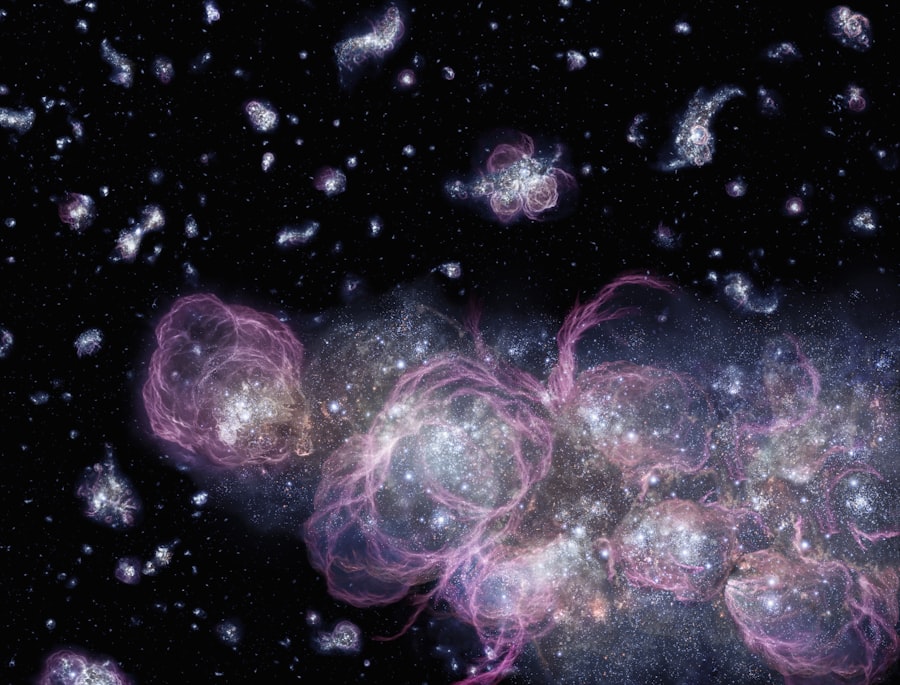
The evolution of cosmic structures is driven by the interactions between these simulated particles. The primary force governing these interactions is gravity, but for baryonic matter, hydrodynamics also plays a crucial role.
Gravitational Interactions: The Cosmic Glue
Gravity is the architect of the large-scale structure of the universe. Particles, regardless of whether they represent dark matter or baryonic matter, exert gravitational pulls on each other.
Newton’s Law of Universal Gravitation
The fundamental equation governing gravitational interactions in simulations is Newton’s law of universal gravitation. For each pair of particles, the force is calculated as:
$F = G \frac{m_1 m_2}{r^2}$
where:
- $F$ is the magnitude of the gravitational force
- $G$ is the gravitational constant
- $m_1$ and $m_2$ are the masses of the two particles
- $r$ is the distance between their centers
Numerical Integration of Orbits
The simulation software uses numerical integration techniques (e.g., leapfrog, Runge-Kutta) to update the positions and velocities of particles over small time steps. This process simulates the continuous orbit of particles under the influence of gravity.
Time Steps
The choice of time step is critical for the accuracy and stability of the simulation. Too large a time step can lead to particles flying out of their orbits or inaccurate momentum conservation, while too small a time step can make the simulation prohibitively slow. The time step often needs to be adaptive, becoming smaller in dense regions where gravitational forces are stronger and dynamics are faster.
Force Calculation Methods
As mentioned earlier, efficient methods for calculating billions of pairwise gravitational forces are essential.
- Direct Summation (for N-body): This is the most accurate but computationally expensive method, calculating the force between every single pair of particles.
- Tree Methods (Barnes-Hut): These methods approximate the force from distant clusters of particles, significantly speeding up calculations.
- Particle-Mesh (PM): Forces are calculated on a grid, interpolating particle positions to grid points and then using Fast Fourier Transforms (FFTs).
Hydrodynamic Interactions: The Behavior of Gas
Baryonic matter is not just subject to gravity; it’s also a fluid. Hydrodynamic simulations extend beyond pure gravity to model the complex behavior of gas.
Fluid Dynamics and Gas Particles
When baryonic particles represent gas, their behavior is governed by the equations of fluid dynamics, including:
- Conservation of Mass: The total mass of gas in a region should be conserved.
- Conservation of Momentum: The motion of gas is governed by forces acting upon it.
- Conservation of Energy: Energy transfer through pressure, heating, and cooling processes is accounted for.
Processes Modeled by Hydrodynamics
- Pressure Support: Gas pressure resists gravitational collapse, preventing all gas from immediately falling into dark matter halos.
- Shock Waves: As gas flows at high speeds, shock waves can form, heating the gas and slowing it down. This is important in galaxy clusters and during mergers.
- Cooling and Heating: Gas in the universe is continuously cooled by radiating energy away at various wavelengths and heated by various sources, such as supernovae and cosmic rays. These processes are crucial for determining if gas will collapse to form stars.
- Turbulence: Large-scale astrophysical flows are often turbulent, leading to complex mixing and filamentary structures within gas clouds. Modeling turbulence accurately is a significant challenge.
Smoothed Particle Hydrodynamics (SPH)
A common method for simulating hydrodynamics in astrophysical contexts is Smoothed Particle Hydrodynamics (SPH). In SPH, properties like density and pressure are not defined on a grid but are calculated by summing contributions from neighboring particles within a smoothing kernel. Each SPH particle carries information about the gas it represents.
Grid-Based Hydrodynamics AMRs
Alternatively, grid-based methods with Adaptive Mesh Refinement can also incorporate hydrodynamic solvers. These methods offer excellent accuracy for capturing shock fronts and high-gradient phenomena.
The Formation of Structures: Galaxies, Clusters, and Beyond
The collective motion and interaction of these particles are what sculpt the universe we observe, leading to the formation of galaxies, galaxy clusters, and the cosmic web.
Dark Matter Halos: The Gravitational Scaffolding
In the early universe, small density fluctuations in the dark matter distribution grew under gravity. Over billions of years, these dense regions attracted more dark matter, forming massive, roughly spherical structures called dark matter halos.
Hierarchical Formation
The prevailing model of structure formation is hierarchical: smaller dark matter halos merge to form larger ones. This process is fundamental to understanding the distribution of galaxies.
The Cosmic Web
As dark matter halos grow and merge, they arrange themselves into a vast, interconnected network known as the cosmic web. This web consists of filaments, nodes (where clusters of galaxies form), and voids (large empty regions). Dark matter simulations are remarkably successful at reproducing the observed large-scale structure of the universe.
Baryonic Matter Accretion and Galaxy Formation
Baryonic matter, attracted by the gravitational pull of dark matter halos, begins to fall into these potential wells.
Gas Cooling and Collapse
As baryonic gas falls into halos, it can cool by radiating energy. This cooling allows the gas to condense, lose its pressure support, and collapse further.
Star Formation
When the gas becomes sufficiently dense and cold within dark matter halos, it can fragment and collapse under its own gravity to form stars. The simulation must model the complex physics of star formation, including the conditions for collapse and the feedback processes that regulate it.
Feedback Mechanisms
Crucially, simulations must also account for feedback from stars and active galactic nuclei (AGN).
- Supernova Feedback: Exploding stars (supernovae) inject enormous amounts of energy and heavy elements into the surrounding gas, which can heat it up and push it out of galaxies, regulating further star formation.
- AGN Feedback: Supermassive black holes at the centers of galaxies can also release vast amounts of energy, expelling gas and shaping their host galaxies and the intergalactic medium.
Galaxy Mergers
Galaxies themselves evolve through mergers and interactions with other galaxies. These mergers can trigger bursts of star formation, fuel active galactic nuclei, and dramatically alter the morphology and properties of the galaxies involved. Simulations track these mergers by observing the interacting particles.
Large-Scale Structures: Clusters and Filaments
On the largest scales, simulations reproduce the cosmic web, with massive galaxy clusters forming at the nodes where multiple filaments intersect.
The Intergalactic Medium (IGM)
The gas that exists between galaxies is known as the intergalactic medium. Simulations track the distribution and properties of this gas, which is crucial for understanding the chemical enrichment of the universe and the reionization epoch.
The Cosmic Microwave Background (CMB)
While not directly simulated with particles, the statistical properties of the early universe, imprinted on the cosmic microwave background radiation, provide a crucial benchmark for validating cosmological simulations. The initial conditions of a simulation are often derived from CMB observations.
Recent advancements in cosmic simulation particles have opened new avenues for understanding the fundamental forces of the universe. Researchers are now able to create highly detailed models that mimic the behavior of dark matter and other celestial phenomena. For those interested in exploring this topic further, a fascinating article can be found at My Cosmic Ventures, which delves into the implications of these simulations on our understanding of cosmic evolution. This research not only enhances our knowledge of the universe but also challenges existing theories, paving the way for future discoveries.
Challenges and Limitations: The Imperfect Mirrors
| Metric | Description | Typical Value | Unit |
|---|---|---|---|
| Number of Particles | Total particles used in the simulation | 109 – 1012 | Count |
| Particle Mass | Mass assigned to each simulation particle | 106 – 109 | Solar Masses |
| Box Size | Physical size of the simulation volume | 100 – 1000 | Megaparsecs (Mpc) |
| Force Resolution | Smallest scale at which gravitational forces are resolved | 1 – 10 | Kiloparsecs (kpc) |
| Time Steps | Number of discrete time intervals in the simulation | 1000 – 10000 | Count |
| Initial Redshift | Starting redshift of the simulation | 50 – 200 | Dimensionless |
| Final Redshift | Ending redshift of the simulation | 0 | Dimensionless |
Despite their immense power, cosmic simulations are not perfect replicas of the universe. They are approximations, and several challenges and limitations exist.
Computational Constraints: The Limits of Our Machines
The sheer scale of the universe and the complexity of its physics pose significant computational challenges.
Resolution Limits
As discussed, the number of particles dictates the resolution. Simulating the entire observable universe with the same resolution as a single galaxy is computationally impossible with current technology. This means simulations often focus on specific volumes or specific epochs.
The ‘Zoom-In’ Technique
A common technique is to run a large, low-resolution simulation of a large cosmological volume to identify regions of interest (e.g., a particularly massive galaxy cluster). Then, a smaller region around that object is re-simulated at much higher resolution, with particles in the high-resolution region being “fragmented” into smaller particles. This allows for detailed study of individual objects while still respecting the large-scale cosmological context.
Physics Parameterization (Sub-grid Physics)
Many important physical processes occur at scales far smaller than what can be directly resolved by most cosmological simulations. These include the formation of individual stars (stellar populations), the details of supernova explosions, and the generation of cosmic rays.
Modeling Stellar Populations
Instead of simulating individual stars, their collective effects (like feedback and heavy element production) are often represented by parameterized sub-grid models. These models use observable quantities in the simulation to estimate the impact of these smaller-scale processes.
Black Hole Growth and Feedback
Similarly, the growth of supermassive black holes and their feedback mechanisms are often handled by sub-grid prescriptions, as resolving the accretion disks and jets of black holes is beyond the scope of typical cosmological simulations.
Model Dependencies: Assumptions and Uncertainties
Simulations are built upon theoretical models of the universe, such as the standard Lambda-CDM model. Any uncertainties or inaccuracies in these underlying models will be reflected in the simulation results.
Dark Matter Properties
The exact nature of dark matter remains unknown. While simulations treat it as cold and collisionless, if dark matter has different properties (e.g., warm dark matter, self-interacting dark matter), the structure formation history could be altered.
Cosmological Parameters
The values of fundamental cosmological parameters, such as the Hubble Constant ($H_0$), the density of dark matter ($\Omega_m$), and the density of dark energy ($\Omega_\Lambda$), are not known with perfect precision. These parameters are inputs to the simulations, and variations in their values can lead to different outcomes.
The Baryon Cycle
The complex cycle of gas within galaxies, including accretion from the intergalactic medium, star formation, and expulsion through feedback, is still not fully understood and is a major area of research and development in simulation techniques.
Validation and Comparison: Bridging the Gap
The ultimate test of any cosmological simulation is its ability to match observational data.
Observational Benchmarks
Simulations are compared against a wide range of observations:
- Galaxy Luminosity Functions: The distribution of galaxy brightnesses.
- Galaxy Clustering Statistics: How galaxies are distributed relative to each other on large scales.
- Cosmic Microwave Background (CMB): The pattern of temperature fluctuations in the early universe.
- Large-Scale Structure Surveys: Maps of the distribution of galaxies and quasars across the universe.
- Properties of Galaxy Clusters: The number, mass, and gas content of the largest gravitationally bound structures.
Discrepancies and Refinements
When simulations don’t perfectly match observations, it provides valuable feedback for refining the models and simulation techniques. For example, discrepancies in the abundance of small galaxies in simulations led to a deeper understanding of the role of supernova feedback in quenching star formation in low-mass galaxies.
The Significance of Cosmic Simulation Particles: Unveiling the Universe
Despite their limitations, the particles in cosmic simulations are indispensable tools for understanding the universe. They allow us to perform “virtual cosmology,” testing theoretical models and exploring phenomena that are impossible to observe directly.
Testing Cosmological Models
Simulations are the primary way to test theoretical models of cosmic evolution, such as the Lambda-CDM model. By comparing simulation predictions with observational data, scientists can either support or challenge existing theories.
The Standard Model of Cosmology
The Lambda-CDM model, which posits a universe dominated by cold dark matter and dark energy, has been remarkably successful in explaining many cosmological observations. Simulations adhering to this model have reproduced features like the cosmic web and the distribution of dark matter halos with impressive accuracy.
Exploring Alternative Models
Simulations can also be used to explore alternative cosmological models, such as those with different properties for dark matter or dark energy, or variations in fundamental physics. This helps to constrain the parameter space of these models and identify promising avenues for future research.
Understanding Complex Processes
The universe is a complex laboratory, and many processes are difficult to disentangle observationally. Simulations allow scientists to control variables and isolate specific phenomena.
The Genesis of Galaxies
Simulations provide a detailed evolutionary history of galaxies, from their formation within dark matter halos to their mergers and interactions. They help to explain why galaxies come in different shapes and sizes and how their star formation histories unfold.
The Role of Dark Matter
Particles in simulations are crucial for understanding the unseen influence of dark matter. They demonstrate how dark matter halos provide the gravitational wells for galaxies to form and how their distribution shapes the large-scale structure of the universe.
The Intergalactic Medium and Cosmic Evolution
Simulations allow us to trace the journey of baryonic matter through the universe, from the primordial gas to the formation of stars and galaxies, and its subsequent expulsion and recirculation through the intergalactic medium. This helps us understand cosmic chemical enrichment and the process of reionization.
Predicting Future Observations
Cosmological simulations can generate mock observations that can guide future observational campaigns. By predicting what new telescopes and surveys should be able to see, simulations help astronomers prioritize their targets and design their instruments.
Guiding Observational Surveys
For instance, simulations can predict the expected distribution of galaxies in upcoming large-scale structure surveys, helping to optimize survey strategies and data analysis techniques.
Identifying Key Observational Signatures
Simulations can also predict subtle observational signatures that might be missed with current technology but could be detectable with future instruments, providing clear targets for groundbreaking discoveries.
Bridging the Scale Gap
Cosmic simulations effectively bridge the vast gulf in scales between the fundamental physics governing particle interactions and the grand tapestry of the observable universe. They allow us to understand how the micro-level interactions of matter, governed by gravity and thermodynamics, manifest as the galaxy clusters and cosmic webs we observe on the largest scales. The particles in these simulations are the digital threads that weave together the fabric of our simulated cosmos, allowing us to explore its mysteries and deepen our understanding of our place within it.
FAQs
What are cosmic simulation particles?
Cosmic simulation particles are computational representations of matter used in astrophysical simulations to model the formation and evolution of structures in the universe, such as galaxies, dark matter halos, and cosmic filaments.
How are cosmic simulation particles used in research?
They are used in numerical simulations to study the large-scale structure of the universe by tracking the gravitational interactions and dynamics of particles over time, helping scientists understand cosmic evolution and test cosmological theories.
What types of particles are typically included in cosmic simulations?
Simulations often include dark matter particles, gas particles, and sometimes star particles, each representing different components of the universe to capture the complex interplay between matter and energy.
What is the significance of particle resolution in cosmic simulations?
Particle resolution refers to the number and mass of particles used; higher resolution allows for more detailed and accurate modeling of small-scale structures but requires greater computational resources.
Which software or codes are commonly used for cosmic particle simulations?
Popular simulation codes include GADGET, RAMSES, and Enzo, which are designed to handle large numbers of particles and incorporate physical processes like gravity, hydrodynamics, and radiative cooling.