The universe, often envisioned as a tapestry woven with the shimmering threads of galaxies and stars, has periods shrouded in profound mystery. Foremost among these is the epoch known as the Dark Ages of the Universe, a crucial yet enigmatic chapter in cosmic history. This era, spanning hundreds of millions of years following the Big Bang, represents a time of transition, a silent stage before the grand illumination of stars and galaxies brought light to the cosmos. Understanding this period is not merely an academic exercise; it is akin to piecing together the blueprint of a magnificent edifice, where the foundational elements dictate the very architecture of what is to come.
The universe’s story begins with the Big Bang, a moment of singular intensity that marked the birth of space, time, and all matter and energy. For the first few hundred thousand years, the universe was a hot, dense plasma, a cosmic soup of fundamental particles and radiation. This state persisted until the universe cooled sufficiently for electrons and protons to combine, forming neutral hydrogen and helium atoms. This event, known as recombination, released the universe from its opaque embrace, allowing photons to travel freely. This era, known as the Cosmic Microwave Background (CMB) epoch, imprinted the faint afterglow that we can still observe today.
Recombination: The Great Uncoupling
The Plasma State
Immediately after the Big Bang, the universe was a chaotic inferno. Temperatures were so extreme that matter existed only as a plasma – a state where electrons were stripped from atomic nuclei. Photons, the carriers of light, were constantly scattering off these free electrons, making the universe opaque, like a thick fog. Imagine trying to see through a dense cloud; that was the early universe.
The Cooling Frontier
As the universe expanded, it cooled. This expansion was not a gentle breeze but an unrelenting process of stretching the very fabric of space. As the universe cooled below a critical temperature, approximately 3000 Kelvin, a profound transformation occurred.
The Dawn of Neutrality
At this temperature threshold, the electrostatic attraction between positively charged atomic nuclei and negatively charged electrons became strong enough to overcome the thermal motion keeping them apart. Electrons were captured by atomic nuclei, forming stable, neutral atoms of hydrogen and helium. This process, recombination, essentially cleared the fog. Photons, no longer constantly interacting with free electrons, could now travel unimpeded across the vast expanse of space.
The CMB: A Cosmic Echo
The Last Scattering Surface
The moment of recombination marks the “last scattering surface” for photons. Before this point, photons were entangled with matter. After, they began their long, solitary journey through the expanding universe. The light we detect as the CMB originated from this very moment, a snapshot of the universe when it was just about 380,000 years old.
Imprints of Early Fluctuations
While the CMB appears remarkably uniform across the sky, it possesses tiny temperature fluctuations. These variations, as subtle as ripples on a still pond, are profoundly important. They represent the seeds of cosmic structure – slight overdensities and underdensities in the distribution of matter that would, over eons, grow into the galaxies and clusters of galaxies we see today.
The Dark Ages: An Interlude of Silence
Following recombination, the universe entered a period that lacked significant sources of light. The dominant constituents were neutral hydrogen and helium, sparsely distributed, and the only radiation present was the fading afterglow of the CMB. This introspective phase, devoid of stellar luminescence, is what scientists refer to as the Dark Ages of the Universe. It was a period of immense scale but with seemingly little to observe, a cosmic slumber before the grand awakening.
The concept of the dark ages of the universe, a period following the Big Bang when the cosmos was devoid of stars and galaxies, has intrigued astronomers and cosmologists alike. For those interested in exploring this fascinating era further, a related article can be found at My Cosmic Ventures, which delves into the implications of this epoch on the formation of the first celestial bodies and the evolution of the universe as we know it today.
The Unseen Tapestry: What Characterized the Dark Ages?
The Dark Ages were a period defined by its absence of visible light sources. The universe was populated by a vast expanse of neutral hydrogen and helium, slowly clumping together under the influence of gravity, without the illuminating presence of stars or galaxies.
Predominance of Neutral Hydrogen
The Dominant Element
Hydrogen, the simplest element, formed the bulk of the universe’s baryonic matter. After recombination, it existed primarily in its neutral atomic form, H I. This meant that each hydrogen atom consisted of a single proton and a single electron, bound together.
Gravitational Assembly
These neutral atoms were not uniformly distributed. The tiny density fluctuations imprinted on the CMB acted as gravitational attractors. Regions with slightly more matter began to pull in matter from their surroundings, a slow but inexorable process of cosmic accretion. This was the universe’s initial sculpting, a gradual gathering of material without any fiery furnaces to witness its progress.
The Absence of Stellar Light
No Stars, No Galaxies
The defining characteristic of the Dark Ages is the lack of stars and galaxies. These luminous structures, powered by nuclear fusion, had not yet formed. The universe was a vast, dark canvas, waiting for the brushstrokes of stellar creation.
The Faint Hum of the CMB
The only pervasive radiation present was the CMB, which was continuously redshifting (losing energy due to the expansion of the universe). Its temperature dropped from around 3000 Kelvin at the time of recombination to a few Kelvin by the end of the Dark Ages. While still a “whisper” of the Big Bang, it provided no visible light.
The First Structures Emerge
The Seeds of Future Galaxies
Although stars had not yet formed, the gravitational clumping of matter was already underway. The slight overdensities in the early universe began to grow, forming large clouds of gas. These were the precursors to the first galaxies, not yet lit by stars, but accumulating the raw material for their eventual construction.
Dark Matter’s Subtle Hand
It is crucial to acknowledge the role of dark matter during this period. While invisible and non-interacting with light, dark matter provided the dominant gravitational scaffolding for the formation of cosmic structures. Its gravitational pull was essential in drawing ordinary matter together, accelerating the process of collapse that would eventually lead to the birth of the first stars.
The Cosmic Dawn: The First Glimmers of Light
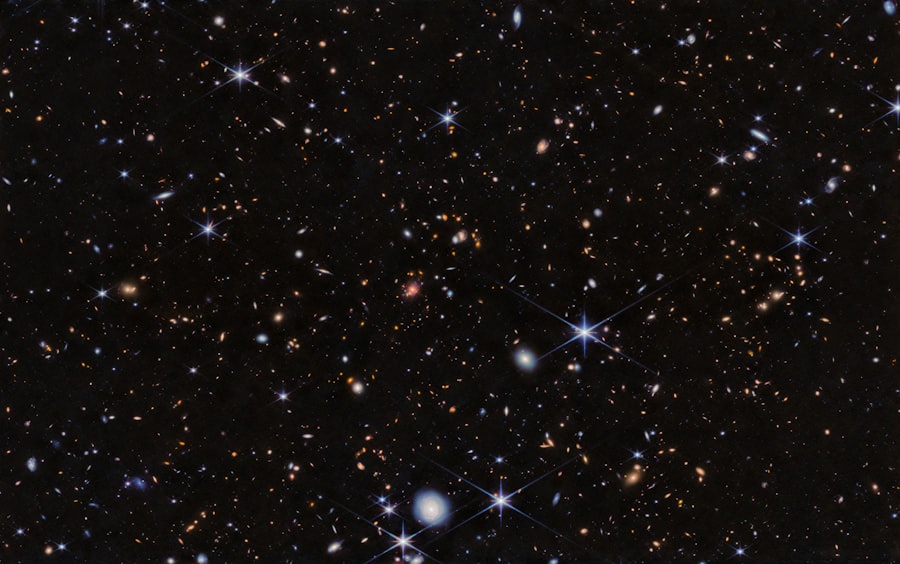
The end of the Dark Ages is marked by the emergence of the first luminous objects, a period often referred to as the Cosmic Dawn. This era witnessed the formation of the very first stars and galaxies, powerful enough to reionize the surrounding neutral hydrogen and bring an end to the cosmic twilight.
The Genesis of the First Stars
Primordial Gas Clouds
The gravitational collapse of dense primordial gas clouds, primarily composed of hydrogen and helium, was the genesis of the first stars. These clouds, seeded by the imperfections of the early universe, contracted under their own gravity.
The Trigger of Fusion
As these gas clouds contracted, their central regions became denser and hotter. Eventually, the temperature and pressure reached a critical point where nuclear fusion could ignite. Protons (hydrogen nuclei) began fusing to form helium nuclei, releasing an immense amount of energy. This marked the birth of the first stars, objects of immense mass and brilliant luminosity, often referred to as Population III stars.
Reionization: The Universe Awakens
The Role of Ultraviolet Radiation
The intense ultraviolet radiation emitted by these first stars and early galaxies played a pivotal role in ending the Dark Ages. This high-energy radiation had enough power to strip electrons from the neutral hydrogen atoms, a process known as reionization.
A Cosmic Metamorphosis
Imagine the universe as a vast, darkened room gradually being illuminated by a multitude of candles. The first stars were these initial candles, their light piercing the surrounding darkness. As more stars and galaxies formed, the illumination intensified, progressively transforming the universe from an opaque, neutral state to the ionized, transparent state that characterizes the universe we observe today. This process was not instantaneous but occurred over hundreds of millions of years, a cosmic metamorphosis from darkness to light.
The End of the “Dark” Era
Reionization essentially cleared the neutral fog that had dominated the universe since recombination. The universe became transparent to ultraviolet radiation, a fundamental change in its physical state and a crucial prerequisite for the formation of more complex structures and, ultimately, life.
Early Galaxies Ignite
Protogalactic Structures
The first stars did not form in isolation. They coalesced within increasingly massive concentrations of matter, the nascent seeds of galaxies. These early galaxies, though likely much smaller and fainter than their modern counterparts, were actively forming stars and contributing to the overall reionization of the universe.
A Chaotic Beginning
The formation of these early galaxies was likely a chaotic process. Mergers and interactions between these protogalactic structures were common, a celestial dance where smaller units combined to form larger ones. This violent epoch laid the groundwork for the hierarchical structure formation we observe today.
The Observational Challenge: Peering into the Darkness
The Dark Ages represent one of the most challenging frontiers in observational cosmology. The faintness of the expected signals and the presence of foreground cosmic noise make it incredibly difficult to directly detect the remnants of this epoch.
The Quest for the First Light
Challenges of Detection
The primary challenge lies in detecting the faint signals from the first stars and galaxies. These objects were incredibly distant and likely much less luminous than present-day galaxies. Furthermore, their light has been redshifted immensely by the expansion of the universe, shifting it into the radio or submillimeter wavelengths.
Foreground Contamination
Another significant hurdle is foreground contamination. Radio signals from our own Milky Way galaxy, as well as from extragalactic sources, can obscure the faint signals from the early universe. Imagine trying to hear a whisper in a crowded stadium; the ambient noise can drown out the subtle sound you are trying to detect.
Radio Astronomy: The Key to Unlocking the Past
Low-Frequency Observations
Radio telescopes are the primary instruments capable of observing the universe during and immediately after the Dark Ages. Specifically, low-frequency radio telescopes are designed to detect the emissions from neutral hydrogen, such as the 21-centimeter line.
The 21-centimeter Line of Hydrogen
The 21-centimeter line is a spectral line emitted by neutral hydrogen atoms when their electron’s spin flips. The frequency of this emission depends on the temperature of the surrounding universe. By observing the 21-cm signal at different redshifts, astronomers can map the distribution of neutral hydrogen and infer properties of the early universe, including the progress of reionization.
Upcoming Telescopes and Future Prospects
The Square Kilometre Array (SKA)
The Square Kilometre Array (SKA) is an ambitious, next-generation radio telescope that will possess unprecedented sensitivity and resolution. Its design is specifically geared towards detecting and studying the faint signals from the Dark Ages and the Epoch of Reionization, promising to revolutionize our understanding of this elusive period.
Radio Experiment for the Observation of the Cosmic Hydrogen (LOFAR)
LOFAR, the Low-Frequency Array, is another significant instrument currently contributing to our exploration of the early universe. It uses a vast network of antennas spread across Europe to observe the sky at low radio frequencies, providing valuable data on the pre-reionization epoch.
The concept of the dark ages of the universe is a fascinating topic that explores the period after the Big Bang when the cosmos was devoid of stars and galaxies. For those interested in delving deeper into this intriguing era, you can find more information in a related article on cosmic evolution. This piece discusses the significance of the dark ages and how they set the stage for the formation of the first luminous objects in the universe. To read more about this captivating subject, visit this article and expand your understanding of the universe’s early history.
Theoretical Frameworks and Unanswered Questions
| Metric | Description | Estimated Value / Range |
|---|---|---|
| Time Period | Duration of the Dark Ages in the universe | ~370,000 to 150 million years after the Big Bang |
| Redshift Range | Corresponding redshift values during the Dark Ages | z ≈ 1100 to z ≈ 30 |
| Temperature | Average temperature of the cosmic gas | ~3000 K at start, cooling to ~10 K by end |
| Ionization State | State of hydrogen in the universe | Neutral hydrogen (mostly un-ionized) |
| Cosmic Microwave Background (CMB) | Radiation left over from the Big Bang | Present but redshifted and cooling |
| Star Formation | Onset of first stars and galaxies | Begins near end of Dark Ages (~150 million years) |
| 21 cm Line Signal | Hydrogen hyperfine transition used to study Dark Ages | Redshifted to ~10-200 MHz frequency range |
Despite the observational challenges, theoretical models have provided crucial frameworks for understanding the expected properties and evolution of the universe during the Dark Ages and the subsequent Cosmic Dawn. However, many fundamental questions remain unanswered.
Models of Structure Formation
Hierarchical Assembly
Current cosmological models, based on the Lambda-CDM (Lambda Cold Dark Matter) paradigm, describe the formation of cosmic structures through a process of hierarchical assembly. This theory posits that small structures form first and then merge to create larger ones over time. This framework is instrumental in predicting where and when the first stars and galaxies should have formed.
The Role of Dark Energy
While dark matter plays a dominant role in structure formation during the early universe, dark energy’s influence becomes more significant later in cosmic history, driving the accelerated expansion of the universe. Understanding the interplay between these cosmic constituents is crucial for accurate simulations of cosmic evolution.
The Nature of the First Stars
Massive and Short-Lived
Theoretical models suggest that the first stars (Population III stars) were likely very massive, perhaps hundreds of times the mass of our Sun. Their immense mass would have led to rapid nuclear burning, resulting in short lifespans. They would have exploded as supernovae, seeding the interstellar medium with heavier elements.
Metallicity and Star Formation
The chemical composition of the early universe, or its “metallicity” (the abundance of elements heavier than hydrogen and helium), is a critical factor influencing subsequent star formation. The first stars were almost entirely devoid of these heavier elements; their formation and evolution would have differed significantly from stars formed later.
The Mystery of the Early Galaxy Distribution
Size and Abundance
While theoretical models predict the existence of early galaxies, their precise size, number, and luminosity distribution remain areas of active research. Direct observational evidence is still scarce, leaving a significant gap in our understanding of how galaxies transitioned from nascent structures to the grand spirals and ellipticals we see today.
The Timing of Reionization
One of the most significant unanswered questions pertains to the exact timing and duration of the Epoch of Reionization. While we know it occurred, pinpointing the precise cosmic epoch when the universe transitioned from neutral to ionized remains a challenge, with different observational constraints suggesting slightly different timelines.
The Dark Ages of the Universe, though devoid of visible light, represent a period of immense cosmic importance. It was a crucible where the fundamental building blocks of the cosmos were assembled, setting the stage for the grand spectacle of starlight and galaxy formation that followed. The ongoing quest to understand this enigmatic epoch, driven by increasingly sophisticated observational tools and theoretical models, promises to illuminate some of the most profound questions about our cosmic origins. As we push the boundaries of our observational capabilities, we inch closer to unveiling the silent universe and understanding precisely how the first lights flickered to life, dispelling the darkness and heralding the dawn of the cosmos.
FAQs
What are the Dark Ages of the Universe?
The Dark Ages of the Universe refer to the period after the Big Bang when the universe had cooled enough for neutral hydrogen to form but before the first stars and galaxies had ignited. During this time, the universe was dark because there were no sources of visible light.
When did the Dark Ages occur?
The Dark Ages began roughly 370,000 years after the Big Bang, following the recombination epoch, and lasted until about 150 million to 1 billion years after the Big Bang, when the first stars and galaxies formed and reionized the universe.
Why is this period called the “Dark Ages”?
It is called the Dark Ages because there were no luminous objects like stars or galaxies to emit light, making the universe opaque to visible light and effectively dark.
What ended the Dark Ages of the Universe?
The Dark Ages ended with the formation of the first stars and galaxies, whose light reionized the neutral hydrogen in the universe, making it transparent to ultraviolet light and marking the beginning of the Epoch of Reionization.
How do scientists study the Dark Ages if there was no light?
Scientists study the Dark Ages by observing the cosmic microwave background radiation and using radio telescopes to detect the 21-centimeter hydrogen line signal, which provides information about the state of neutral hydrogen during this period.