
You’ve stared up at the night sky, a breathtaking tapestry of distant suns and swirling nebulae. Perhaps you’ve even imagined what lies beyond the familiar glow of our solar system. But have you ever considered the most enigmatic, the most powerful objects in the universe? You’re about to embark on a journey to unravel the physics of black holes, cosmic entities so profound they warp space and time itself. Prepare to have your understanding of reality stretched and bent, much like the fabric of spacetime around these gravitational titans.
You might wonder how something with such an immense gravitational pull comes into being. Black holes, at least the stellar-mass variety, are born from the dramatic finales of massive stars. When a star significantly larger than our Sun exhausts its nuclear fuel, it can no longer sustain the outward pressure from nuclear fusion to counteract the relentless inward pull of its own gravity.
The Delicate Balance: Fusion vs. Gravity
Imagine a cosmic tug-of-war. For billions of years, the immense heat and pressure generated by nuclear fusion in the star’s core push outwards. This outward force is locked in a perpetual battle with the star’s own gravity, which constantly tries to pull everything inwards. As long as the star has fuel to burn, fusion wins. But what happens when that fuel runs out?
The Inevitable Collapse: A Stellar Demise
When the nuclear furnace sputters and dies, the outward pressure vanishes. Suddenly, gravity has nothing to hold it back. The star’s core collapses inwards at an astonishing speed. This isn’t a gentle sigh; it’s an implosion of unimaginable force. The outer layers of the star are violently thrown outward in a spectacular event known as a supernova – a cosmic explosion that briefly outshines entire galaxies.
The Genesis of a Singularity: Beyond the Event Horizon
What remains of the core is compressed to an infinitesimal point of infinite density: a singularity. This is where our current understanding of physics begins to fray. The sheer concentration of mass within this point means that the gravitational pull becomes infinitely strong. It’s here, at the heart of what will become a black hole, that the laws of physics as you know them break down. The mass doesn’t just disappear; it’s crushed into an unbelievably small volume.
For those interested in delving deeper into the fascinating world of black holes, a related article that provides an insightful explanation of their physics can be found at this link: Understanding the Physics of Black Holes. This article explores the fundamental concepts surrounding black holes, including their formation, the effects of gravity, and the mysteries of event horizons, making it an excellent resource for both beginners and seasoned enthusiasts in the field of astrophysics.
Defining the Beast: Event Horizons and Singularities
Now that you know how these cosmic monsters are born, let’s define their key features. Black holes aren’t just empty voids; they possess specific structural components that make them so unique and terrifying.
The Point of No Return: The Event Horizon
The most famous characteristic of a black hole is its event horizon. You can think of this as the ultimate cosmic boundary line. It’s not a physical surface you can touch, but rather a spherical region in spacetime. Once you cross the event horizon, there is no turning back. The escape velocity – the speed needed to break free from an object’s gravitational pull – exceeds the speed of light. Since nothing can travel faster than light, anything that crosses this threshold is irrevocably trapped.
The Speed of Light: The Cosmic Speed Limit
You’ve learned in school that the speed of light, approximately 299,792 kilometers per second, is the fastest anything in the universe can travel. This fundamental constant of nature is key to understanding why the event horizon is so absolute. The gravitational pull within the event horizon is so intense that it requires more than the speed of light to escape.
Spaghettification: A Gruesome Fate
Imagine approaching a black hole. As you get closer, you’d feel the gravitational pull increasing. But it wouldn’t be uniform. The gravitational force on your feet, closer to the black hole, would be significantly stronger than the force on your head. This differential in pull would stretch you out, like a piece of spaghetti, a process chillingly known as spaghettification. This astronomical stretching would continue until you were torn apart atom by atom.
The Unknowable Core: The Singularity
At the very center of a black hole lies the singularity. As mentioned before, this is the point where all the mass of the collapsed star is compressed into a region of zero volume and infinite density. Here, spacetime curvature becomes infinite, and our current physical theories, including Einstein’s theory of general relativity, cease to provide a coherent description. It’s a cosmic question mark at the heart of these gravitational giants.
Infinity and Beyond: The Limits of Our Understanding
The concept of infinity is mind-boggling even in everyday life. In the context of a singularity, it represents a breakdown of our mathematical and physical models. Scientists are actively working on theories, such as quantum gravity, that might offer a glimpse into what actually happens at the singularity, but for now, it remains one of the universe’s greatest mysteries.
Beyond Stellar: Supermassive Black Holes

While stellar-mass black holes are formed from collapsing stars, the universe harbors an even more colossal breed: supermassive black holes. These behemoths reside at the centers of most, if not all, large galaxies, including our own Milky Way. Their sheer size and influence are astounding.
Galactic Architects: The Centers of Galaxies
You’ve likely seen images of swirling galaxies, each a cosmic metropolis of stars, gas, and dust. At the heart of these grand structures, often hidden from direct view, lurks a supermassive black hole. These objects can have masses ranging from millions to billions of times the mass of our Sun. Their gravitational influence is so profound that they play a crucial role in the formation and evolution of their host galaxies.
Accretion Disks: Feeding the Beast
Supermassive black holes aren’t just passively existing. They are often actively feeding on surrounding matter. Gas and dust are pulled in by their immense gravity, forming a swirling disk around the black hole known as an accretion disk. As this matter spirals inwards, it heats up to incredibly high temperatures, emitting vast amounts of radiation across the electromagnetic spectrum, including X-rays and gamma rays. This makes them observable, even if the black hole itself is invisible.
The Enigma of Their Origins: How Do They Get So Big?
The existence of supermassive black holes poses a significant puzzle: how did they grow to be so massive so early in the universe’s history? Stellar-mass black holes are the product of individual star deaths, a process that takes time. Supermassive black holes, however, seem to have formed and grown at an astonishing rate.
Seed Black Holes: The Starting Point
One leading theory suggests that supermassive black holes begin as smaller “seed” black holes, perhaps formed from the collapse of the very first, massive stars in the early universe. These seeds then grow by accreting matter and by merging with other black holes.
Mergers and Growth: A Cosmic Feast
As galaxies collide and merge – a common occurrence in the universe – their central black holes also merge. Each merger can add a significant chunk of mass to the growing supermassive black hole. This process, combined with continuous accretion of gas and dust, could explain their colossal sizes.
Unveiling the Invisible: Detecting Black Holes
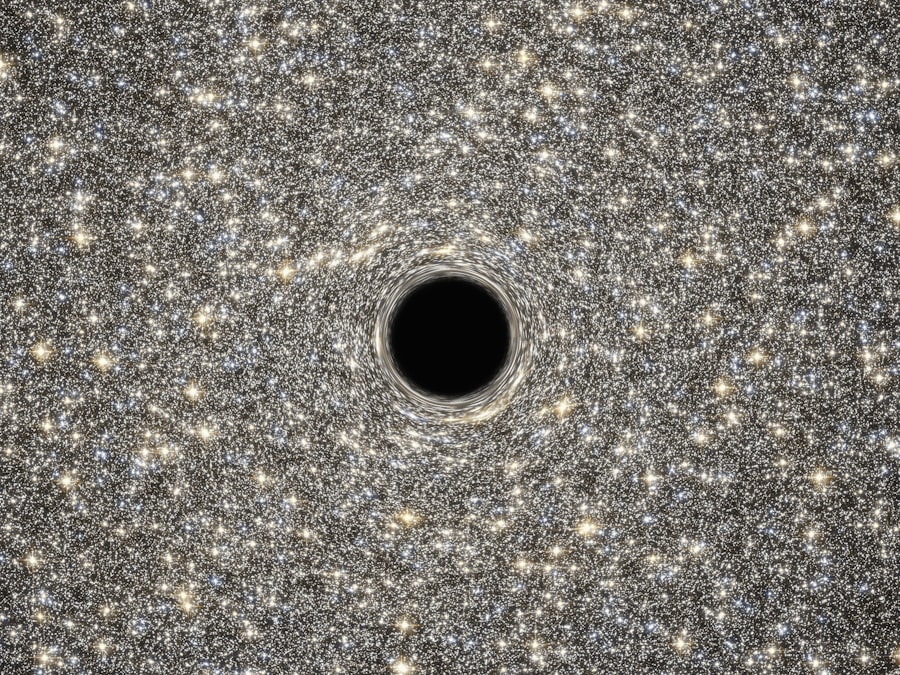
Given that black holes don’t emit light themselves, how do astronomers know they exist? The answer lies in observing their profound effects on their surroundings. You can’t see a black hole directly, but you can see what it does.
Gravitational Lensing: Warping Light’s Path
One of the most compelling pieces of evidence for black holes comes from their ability to bend light. As mentioned earlier, black holes warp spacetime. This warping affects the path of light passing by. If light from a distant star or galaxy passes near a black hole, its path will be bent, much like looking through a distorted lens.
Einstein’s Prediction: A Confirmed Phenomenon
Einstein’s theory of general relativity predicted that massive objects would bend light. This phenomenon, called gravitational lensing, has been observed on numerous occasions. The way light is distorted around a massive object can reveal the presence and even the mass of an unseen object, such as a black hole.
X-ray Astronomy: The Signature of Accretion
As you learned about accretion disks, you discovered they are incredibly hot and emit powerful X-rays. Telescopes designed to detect X-rays have been instrumental in identifying black holes. When gas and dust fall towards a black hole, they are heated to extreme temperatures, producing X-ray emissions that can be detected by orbiting observatories.
The Strongest X-ray Sources: A Clue to the Invisible
Certain X-ray sources in the sky are so intense and their behavior so erratic that they strongly suggest the presence of a black hole. These emissions are often variable, with brightness fluctuating as the accretion disk churns and feeds the black hole.
Gravitational Waves: Ripples in Spacetime
A groundbreaking development in black hole detection came with the direct observation of gravitational waves. These are tiny distortions in spacetime caused by the most violent cosmic events, such as the collision of two black holes.
LIGO and Virgo: Listening to the Cosmos
The Laser Interferometer Gravitational-Wave Observatory (LIGO) and its European counterpart, Virgo, have made history by detecting these faint ripples. When two black holes spiral into each other and merge, they send out gravitational waves that propagate through the universe. These waves are incredibly subtle, but sophisticated instruments can detect them, providing definitive proof of black hole collisions and their properties.
The fascinating world of black holes continues to intrigue scientists and enthusiasts alike, as they challenge our understanding of the universe. For a deeper exploration of the physics behind these enigmatic entities, you can read a related article that delves into the complexities of their formation and behavior. This insightful piece provides a comprehensive overview of the theories and discoveries surrounding black holes, making it a must-read for anyone interested in astrophysics. To learn more, visit this article and expand your knowledge on this captivating topic.
The Future of Black Hole Research: Unanswered Questions
| Aspect | Explanation |
|---|---|
| Event Horizon | The boundary around a black hole beyond which nothing can escape its gravitational pull. |
| Singularity | The infinitely dense and small point at the center of a black hole where the laws of physics break down. |
| Spacetime Curvature | Black holes warp the fabric of spacetime, causing it to curve around the black hole. |
| Hawking Radiation | Theoretical radiation that is predicted to be emitted by black holes due to quantum effects near the event horizon. |
Despite centuries of study and recent breakthroughs, black holes remain a frontier of scientific exploration. There are still profound questions that researchers are striving to answer, pushing the boundaries of our understanding.
The Information Paradox: Where Does Information Go?
One of the most persistent theoretical puzzles is the information paradox. According to quantum mechanics, information can never be truly lost. However, if something falls into a black hole, it seems to disappear beyond the event horizon, and according to classical general relativity, the information it carries is destroyed. This apparent contradiction between quantum mechanics and general relativity is a major area of research.
Hawking Radiation: A Glimmer of Hope?
Stephen Hawking theorized that black holes are not entirely black. He proposed that black holes slowly lose mass over time through a process called Hawking radiation, where quantum fluctuations near the event horizon can create particle-antiparticle pairs, with one falling in and the other escaping. This radiation carries away a minuscule amount of the black hole’s mass, and crucially, it might carry away information.
The Nature of Dark Matter and Dark Energy: Are Black Holes Involved?
While black holes are fascinating in their own right, their immense gravitational influence has led some scientists to consider their potential role in some of the universe’s biggest mysteries, such as dark matter and dark energy. Could some of the unseen gravitational pull attributed to dark matter be explained by a population of unseen, unluminous black holes? And could the expansion of the universe, driven by dark energy, have some unforeseen connection to the dynamics of black holes?
Testing Theories: New Observations and Experiments
The ongoing quest to understand black holes is driving the development of new and more powerful telescopes, both ground-based and in space. Future observatories will be able to probe the extreme environments around black holes with unprecedented detail, testing the predictions of general relativity and searching for evidence of quantum gravity.
You’ve just taken a significant step in unraveling the physics of black holes. You’ve learned about their creation, their defining characteristics, the different types that populate our universe, and how we detect these invisible giants. The journey into the heart of these cosmic enigmas is far from over, and your continued curiosity is the fuel that propels scientific discovery forward. The universe, with its black holes and countless other wonders, awaits your continued exploration.

Physicists Think Reality Might Be 2D
FAQs
What is a black hole?
A black hole is a region in space where the gravitational pull is so strong that nothing, not even light, can escape from it. This occurs when a massive star collapses under its own gravity.
How are black holes formed?
Black holes are formed when massive stars run out of fuel and collapse under their own gravity. This collapse causes the star to shrink to a very small size, creating a region of space with extremely strong gravitational pull.
What is the event horizon of a black hole?
The event horizon of a black hole is the boundary surrounding the black hole beyond which nothing can escape. Once an object crosses the event horizon, it is pulled into the black hole and cannot return.
What happens inside a black hole?
Inside a black hole, the gravitational pull becomes infinitely strong, leading to a singularity, a point of infinite density and zero volume. The laws of physics as we know them break down at this point.
Can anything escape from a black hole?
According to current understanding of physics, nothing can escape from a black hole once it has crossed the event horizon. This includes light, matter, and even information.