You stand at the precipice of understanding, gazing out into the vast, star-dusted canvas that stretches beyond your terrestrial home. For millennia, humanity has looked up, baffled and awestruck by the celestial ballet, and in doing so, you’ve embarked on a grand quest: to unravel the mysteries of space-time. It’s a concept so fundamental, so interwoven with your very existence, yet so utterly alien to your everyday experience. Prepare yourself, for you are about to embark on a journey that bends perception, challenges intuition, and reveals the profound elegance of the universe.
Imagine, if you will, that the universe isn’t just an empty void where things happen. Instead, picture it as a dynamic, interwoven fabric, a four-dimensional tapestry where the dimensions of space – length, width, and height – are inextricably linked with the dimension of time. This, in essence, is space-time. It’s the fundamental arena in which all events unfold, from the birth of a star to the fleeting thought flitting through your mind.
Beyond Three Dimensions: Visualizing the Unseen
Your everyday life is comfortably confined to three spatial dimensions. You can move forward and backward, left and right, up and down. The concept of a fourth dimension, time, is something you experience but struggle to truly visualize in the same way. Think of it this way: a 3D object, like a cube, exists throughout space. Now, imagine that cube existing not just at one point in time, but across a duration. That extended existence, through time, is what space-time represents. It’s the totality of an object’s history, its journey through time, that, when combined with its spatial extent, defines its presence in the four-dimensional manifold.
The Pioneers of Space-Time: From Newton to Einstein
For centuries, you operated under the Newtonian paradigm. Isaac Newton, a titan of science, envisioned space as an absolute, unchanging stage and time as a universal, relentless clock, ticking uniformly for everyone, everywhere. This was a beautifully simple, intuitive model that worked remarkably well for describing the motion of everyday objects and celestial bodies. However, as your observations became more precise and you probed the extremes of the universe – the very fast and the very massive – cracks began to appear in this seemingly solid foundation.
Then came Albert Einstein. His revolutionary theories of special and general relativity shattered the Newtonian absolutes. Einstein revealed that space and time are not independent entities but are instead fused into a single, dynamic continuum: space-time. His insights fundamentally reshaped your understanding of gravity, motion, and the very structure of the cosmos.
For a deeper understanding of the complex concepts surrounding space-time, you may find the article “Understanding Space-Time: A Comprehensive Guide” particularly enlightening. This resource delves into the intricacies of how space and time are interwoven, providing insights that complement the explanations found in the original article. To explore this further, visit the article here: Understanding Space-Time: A Comprehensive Guide.
Time Dilation: The Elasticity of Time
One of the most mind-bending consequences of Einstein’s theories is the concept of time dilation. It’s the idea that time is not absolute, but rather, its passage can be affected by your speed and the gravitational forces you experience. This is where your intuitive grasp of time begins to fray, but the evidence is undeniable.
Speed and the Slowing of Time: Special Relativity in Action
Einstein’s special theory of relativity, published in 1905, laid the groundwork for understanding time dilation due to velocity. It states that the faster you move through space, the slower time passes for you relative to a stationary observer. This isn’t a trick of perception or a faulty clock; it’s a genuine difference in the rate at which time flows.
The Twin Paradox: A Thought Experiment Made Real
The famous twin paradox illustrates this phenomenon. Imagine two identical twins. One remains on Earth, while the other embarks on a journey in a spaceship traveling at speeds approaching the speed of light. When the traveling twin returns, they will have aged less than their Earth-bound sibling. This isn’t science fiction; it’s a direct consequence of the fact that time is relative and depends on your reference frame. The faster you move, the more your temporal experience is stretched.
Practical Proof: GPS Satellites and Atomic Clocks
While the effects of time dilation are negligible at everyday speeds, they are crucial for technologies you rely on. Your Global Positioning System (GPS) satellites, for instance, are constantly moving at high speeds and are also in a weaker gravitational field than you are on Earth’s surface. To ensure accurate location data, engineers must account for both special relativistic time dilation (due to speed) and general relativistic time dilation (due to gravity). Atomic clocks flown on airplanes also demonstrate this effect, showing a measurable difference in elapsed time compared to identical clocks that remained on the ground.
Gravity’s Embrace: Time Dilation in Strong Gravitational Fields
General relativity, published in 1915, expanded on this idea, revealing that gravity also warps space-time, and this warping affects the passage of time. The stronger the gravitational field, the slower time flows. This means time passes slightly slower for you on Earth’s surface than it does for an astronaut in orbit, where gravity is weaker.
Black Holes: The Ultimate Time Dilators
Black holes, regions of space-time where gravity is so intense that nothing, not even light, can escape, are the ultimate laboratories for testing time dilation. As you approach the event horizon of a black hole, time would slow dramatically for you relative to an observer far away. For someone falling into a black hole, time would seem to pass normally for them, while an outsider would see them appear to freeze at the event horizon, their image red-shifted and distorted into eternity.
Gravitational Waves: Ripples in the Fabric of Time
The detection of gravitational waves, ripples in the fabric of space-time caused by cataclysmic cosmic events like the collision of black holes, further validates the concept of a malleable space-time. These waves are not just disturbances in space; they are literally the stretching and compressing of space and time itself as they propagate.
Gravity as Geometry: Einstein’s Masterpiece
Prior to Einstein, gravity was understood as a mysterious force, a pull exerted between objects with mass. Einstein, however, provided a radically different, geometric interpretation of gravity. He proposed that gravity isn’t a force in the traditional sense, but rather a manifestation of the curvature of space-time itself.
Mass and Energy: The Architects of Curvature
According to general relativity, the presence of mass and energy warps the fabric of space-time around them. Think of placing a heavy bowling ball on a stretched rubber sheet. The bowling ball creates a dip, a curvature in the sheet. Now, if you roll a marble across the sheet, it will curve towards the bowling ball, not because of a direct pull, but because it’s following the path dictated by the curvature. Similarly, planets orbit stars not because of a direct force, but because they are following the geodesics – the straightest possible paths – in the curved space-time created by the star’s mass.
The Equivalence Principle: Gravity and Acceleration are One
A cornerstone of general relativity is the equivalence principle. It states that the effects of gravity are indistinguishable from the effects of acceleration. Imagine you are in a closed elevator. If the elevator is accelerating upwards, you would feel pressed against the floor, just as you would if you were standing on the surface of a planet experiencing gravity. This principle was crucial in Einstein’s leap to understanding gravity as a geometric phenomenon.
Testing the Theory: Bending Light and Precessing Orbits
Einstein’s theory made specific predictions that were remarkably different from Newtonian physics, and these predictions have been rigorously tested and confirmed.
The Eddington Expedition: Proving Light Bends
One of the most famous early confirmations came during a solar eclipse in 1919, led by Sir Arthur Eddington. Light from distant stars, passing close to the Sun, was observed to bend. According to Newtonian physics, this bending should have been half as much as what Einstein predicted. The observations precisely matched Einstein’s calculations, providing strong evidence for his theory. This bending of light is a direct consequence of stars warping the space-time around them.
Mercury’s Wobbling Orbit: A Subtle Anomaly Resolved
Another successful prediction related to the orbit of Mercury. Astronomers had long observed a slight, inexplicable anomaly in Mercury’s orbit – its perihelion (the point closest to the Sun) advanced a small amount each orbit more than predicted by Newtonian mechanics. General relativity perfectly accounted for this minuscule but significant discrepancy, attributing it to the curvature of space-time caused by the Sun’s mass.
Wormholes and Warped Realities: Theoretical Possibilities
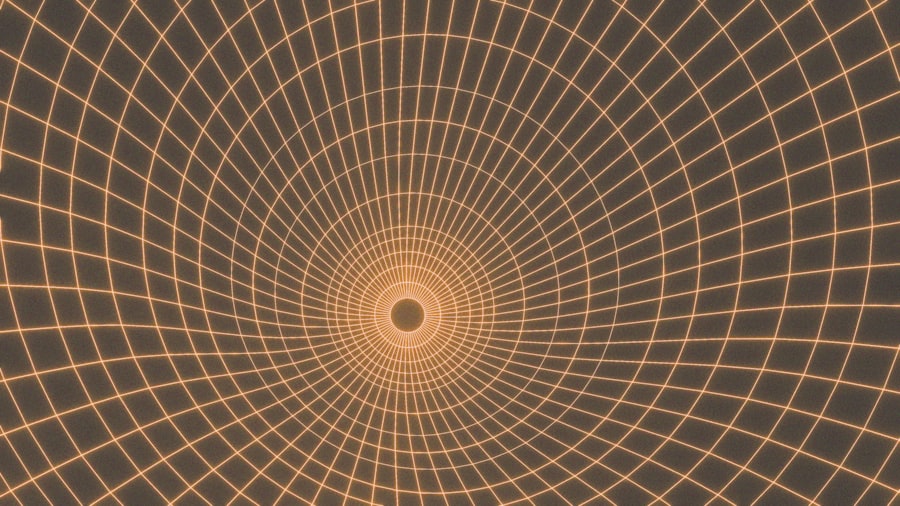
The beauty of space-time, according to Einstein’s equations, is that it allows for some truly astonishing theoretical possibilities, even if they remain firmly in the realm of speculation and science fiction for now.
The Cosmic Bridge: Traversable Wormholes
Wormholes, often depicted as tunnels through space-time, are hypothetical shortcuts that could connect distant points in the universe, or even different universes. Mathematically, solutions to Einstein’s field equations do allow for the existence of wormholes. However, creating and stabilizing a traversable wormhole would likely require exotic matter with negative mass-energy density – something we have not yet observed or are capable of manipulating.
The Challenge of Stability: Keeping the Wormhole Open
Even if wormholes exist, they are predicted to be extraordinarily unstable. Without some form of exotic matter to prop them open, they would likely pinch off and collapse faster than any object could traverse them. This remains one of the biggest hurdles to the practical consideration of wormhole travel.
Warped Space-Time: Faster-Than-Light Travel?
The concept of warping space-time also opens up theoretical avenues for faster-than-light travel, not by exceeding the speed of light directly (which special relativity forbids), but by manipulating space-time itself.
The Alcubierre Drive: A Speculative Warp Bubble
Miguel Alcubierre proposed a theoretical solution known as the Alcubierre drive. This concept involves creating a “warp bubble” that contracts space-time in front of a spacecraft and expands it behind. The spacecraft itself remains stationary within the bubble, but the bubble, and thus the spacecraft, could effectively travel at superluminal speeds by compressing the distance it needs to cover. Again, this requires vast amounts of exotic matter and is currently far beyond our technological capabilities.
Beyond the Realm of Known Physics: Exotic Matter and Negative Energy
The recurring need for exotic matter and negative energy in these speculative faster-than-light travel scenarios highlights the current limitations of our understanding. While mathematically permitted, their physical existence is unproven, and their manipulation is purely theoretical.
If you’re intrigued by the concept of space-time and want to delve deeper into its complexities, you might find the article on the nature of black holes particularly enlightening. This piece explores how black holes warp space-time and the implications this has for our understanding of the universe. To read more about this fascinating topic, check out the article here.
Quantum Space-Time: The Unfinished Symphony
| Concept | Definition |
|---|---|
| Space-time | The four-dimensional continuum in which all events occur, including the three dimensions of space and the one dimension of time. |
| General Relativity | The theory of gravitation developed by Albert Einstein, which describes the gravitational force as a curvature of space-time caused by mass and energy. |
| Time Dilation | The phenomenon in which time passes at different rates for observers in different gravitational fields or relative motion. |
| Black Holes | Regions of space-time where the gravitational pull is so strong that nothing, not even light, can escape. |
While Einstein’s theories excel at describing the universe at large scales – the realm of planets, stars, and galaxies – they falter when confronted with the incredibly small scales of quantum mechanics. Here, the smooth, continuous fabric of space-time envisioned by Einstein may break down, giving way to a more granular, probabilistic reality.
The Problem of Quantum Gravity: Uniting the Ununifiable
The greatest challenge in modern physics is the quest for a theory of quantum gravity – a framework that successfully unifies general relativity with quantum mechanics. These two pillars of modern physics describe different aspects of reality with incredible accuracy, but they are fundamentally incompatible in their current forms.
String Theory: Vibrating Strings in Higher Dimensions
One of the leading contenders for a theory of quantum gravity is string theory. Proponents suggest that the fundamental constituents of the universe are not point-like particles but rather tiny, vibrating strings. The different modes of vibration of these strings give rise to the different particles we observe. Crucially, string theory requires extra spatial dimensions beyond the familiar three – typically ten or eleven in total – and naturally incorporates gravity.
Branes and the Multiverse: Expanding the Cosmic Horizon
Within string theory, the concept of “branes” (short for membranes) emerges. These are higher-dimensional objects on which our three spatial dimensions might be “stuck.” Our universe could be a 3-brane existing within a higher-dimensional space, potentially implying the existence of a multiverse, a vast collection of other universes with their own distinct properties.
Loop Quantum Gravity: Quantizing Space-Time Itself
Another approach, loop quantum gravity, takes a different path. Instead of starting with strings, it attempts to quantize space-time itself. In this framework, space-time is not a smooth continuum but is made up of discrete, indivisible units, like tiny loops. These loops, when woven together, form the fabric of space-time.
The Planck Scale: The Granularity of Reality
Both string theory and loop quantum gravity suggest that at the Planck scale – an incredibly tiny length of about 10⁻³⁵ meters – space-time might not be continuous but rather granular, with a minimum possible size for any spatial extent. This suggests that the smooth, seamless fabric you imagine is an approximation that holds true at macroscopic scales but breaks down at the most fundamental level.
The Search Continues: Mysteries Yet to Unravel
The exploration of space-time is an ongoing saga, a testament to your insatiable curiosity and your relentless pursuit of knowledge. We have journeyed from the intuitive but incomplete Newtonian view to the revolutionary insights of Einstein, and now we stand at the threshold of even deeper mysteries.
The Nature of Dark Matter and Dark Energy: The Invisible Architects
What, for instance, are dark matter and dark energy? These enigmatic substances make up the vast majority of the universe’s mass-energy content, yet their true nature remains elusive. They exert gravitational influence, shaping the cosmos, but they do not interact with light, making them invisible to our telescopes. Their existence strongly suggests that our current understanding of space-time and gravity may be incomplete. Do they represent new particles, modifications to gravity, or something even more profound?
The Beginning and End of the Universe: Cosmic Origins and Fates
The very beginning and potential end of the universe are intimately linked to the behavior of space-time. The Big Bang, the prevailing cosmological model, describes the universe expanding from an incredibly hot, dense state. Understanding precisely what happened at the singularity of the Big Bang requires a complete theory of quantum gravity. Similarly, what lies in store for the universe – whether it will expand forever, collapse in a Big Crunch, or meet some other fate – depends on the interplay of space-time, matter, and energy over cosmic timescales.
Your journey into the mysteries of space-time is far from over. Each discovery opens up a new vista, a new set of questions. You are an explorer on a cosmic frontier, armed with your intellect, your ingenuity, and a profound sense of wonder. The universe, in its intricate dance of space and time, continues to beckon, inviting you to unravel its most profound secrets.

The Universe Never Truly Forgets. Physics Can’t Explain Why.
FAQs
What is space-time?
Space-time is the four-dimensional framework in which all physical events occur. It combines the three dimensions of space with the fourth dimension of time into a single continuum.
How was the concept of space-time developed?
The concept of space-time was developed by Albert Einstein in his theory of general relativity, which he published in 1915. Einstein proposed that space and time are interconnected and that the curvature of space-time is influenced by the presence of mass and energy.
What is the significance of space-time in physics?
Space-time is a fundamental concept in physics, as it provides the framework for understanding the behavior of objects and the propagation of light and other forms of energy. It also plays a crucial role in the formulation of theories such as general relativity and quantum mechanics.
How does space-time affect the motion of objects?
According to the theory of general relativity, the curvature of space-time caused by the presence of mass and energy influences the motion of objects. This curvature results in the phenomenon of gravity, which causes objects to follow curved paths in space-time.
Can space-time be visualized or experienced directly?
While space-time itself cannot be directly visualized or experienced, its effects can be observed and measured through experiments and astronomical observations. For example, the bending of light around massive objects, known as gravitational lensing, is a direct consequence of the curvature of space-time.