
The universe, a vast canvas of stars, galaxies, and unseen forces, harbors some of its most enigmatic phenomena within the swirling darkness of black holes. These celestial bodies, born from the catastrophic collapse of massive stars, possess a gravitational pull so immense that nothing, not even light, can escape their clutches. For centuries, black holes remained theoretical curiosities, figments of mathematical equations. Today, however, observational evidence and theoretical advancements are slowly beginning to lift the veil, unraveling the profound mysteries that shroud these cosmic enigmas.
The birth of a black hole is a dramatic and violent event, a testament to the brutal forces at play in the cosmos. It is a story that begins with the grand, luminous lives of stars, particularly those at the upper end of the stellar mass spectrum.
Stellar Evolution’s Final Act: The Collapse of Massive Stars
Stars, like all things in the universe, have a lifespan. Their existence is a delicate balancing act between the outward pressure generated by nuclear fusion in their core and the inward pull of their own gravity. For most stars, this balance is maintained for billions of years, gradually consuming their hydrogen fuel and progressing through various stages of fusion. However, for stars significantly more massive than our Sun – typically exceeding 20 solar masses – their demise is far more spectacular.
As these supermassive stars exhaust their nuclear fuel, the outward pressure wanes. Without this counteracting force, gravity takes over with unyielding ferocity. The star’s core implodes catastrophically. This implosion triggers a shockwave that tears through the star’s outer layers, resulting in a supernova – an explosion of unimaginable brilliance that can outshine an entire galaxy for a brief period.
Neutron Stars vs. Black Holes: The Critical Mass Threshold
The fate of the stellar core after the supernova depends on its mass. If the core’s mass is within a certain range, the implosion will compress its matter to an incredibly dense state, forming a neutron star. Here, protons and electrons are squeezed together to form neutrons, creating an object supported by neutron degeneracy pressure.
However, if the remnant core exceeds a critical mass, known as the Tolman-Oppenheimer-Volkoff limit (approximately 2 to 3 solar masses), even neutron degeneracy pressure is insufficient to resist the overwhelming force of gravity. The core continues to collapse indefinitely, crushing all matter into an infinitely dense point – the singularity. This is where a stellar-mass black hole is born.
Supermassive Black Holes: The Architects of Galactic Centers
While stellar-mass black holes are the remnants of individual stars, supermassive black holes are a different breed entirely, residing at the hearts of most galaxies. Their origins are still a subject of intense research, but the leading theories suggest a few potential pathways.
Accretion and Mergers: The Growth of Giants
One prevalent theory posits that supermassive black holes grew from smaller “seed” black holes that existed in the early universe. These seeds could have been the remnants of the first massive stars or formed from the direct collapse of gas clouds. Once formed, they would have aggressively consumed surrounding gas, dust, and stars. Through a process called accretion, the black hole’s mass would grow over cosmic time, like a cosmic snowball rolling downhill.
Another significant factor in their growth is galactic mergers. When galaxies collide and merge, their central supermassive black holes also spiral towards each other. Eventually, they coalesce, forming an even larger black hole, fueling further growth through accretion. This process is thought to be responsible for the immense sizes of black holes found at the centers of the largest galaxies.
Intermediate-Mass Black Holes: The Missing Link?
Beyond stellar-mass and supermassive black holes, there’s a tantalizing possibility of intermediate-mass black holes (IMBHs). These hypothetical objects would have masses ranging from a few hundred to tens of thousands of solar masses. Their existence is strongly suspected but direct observational evidence has been elusive.
Searching for the Unseen: Evidence for IMBHs
Scientists are pursuing various avenues to detect IMBHs. One approach involves observing the peculiar motions of stars within globular clusters, dense collections of old stars. Gravitational interactions with a central IMBH could cause stars to orbit in specific, observable patterns. Another method looks for the unique X-ray emissions produced when matter falls into an IMBH, a process known as X-ray binaries. The identification of more IMBHs would fill a crucial gap in our understanding of black hole evolution and their role in galaxy formation.
For those interested in a deeper understanding of black holes, you might find the article “The Mysteries of Black Holes Explained” particularly enlightening. It delves into the formation, characteristics, and the latest research surrounding these enigmatic cosmic phenomena. To explore this fascinating topic further, visit the article here: The Mysteries of Black Holes Explained.
The Anatomy of a Cosmic Drain: Key Features of a Black Hole
Despite their seemingly simple definition – an object from which nothing can escape – black holes possess a complex and fascinating structure, governed by the extreme curvature of spacetime.
The Singularity: A Point of Infinite Density
At the very heart of a black hole lies the singularity, a point where our current understanding of physics breaks down. According to general relativity, all the mass of the black hole is compressed into a region of zero volume and infinite density. What truly exists at the singularity remains one of the most profound mysteries in physics, with theories ranging from quantum gravity effects to entirely new dimensions.
The Event Horizon: The Point of No Return
Surrounding the singularity is the event horizon, a spherical boundary in spacetime. This is the critical feature that defines a black hole. The escape velocity at the event horizon is equal to the speed of light. This means that anything crossing this invisible boundary – whether it’s a star, a planet, or a beam of light – is irrevocably pulled towards the singularity and cannot ever return.
The Schwarzschild Radius: The Size of Oblivion
The size of the event horizon is determined by the black hole’s mass. For a non-rotating black hole, this radius is known as the Schwarzschild radius. For a black hole with the mass of our Sun, the Schwarzschild radius would be about 3 kilometers. For a supermassive black hole like Sagittarius A*, which has a mass of about 4 million Suns, the Schwarzschild radius is roughly 12 million kilometers.
Accretion Disks: The Feast of Cosmic Matter
When matter is drawn towards a black hole, it rarely falls in directly. Instead, it often forms a swirling disk around the black hole known as an accretion disk. As gas, dust, and debris spiral inwards, they are heated to incredibly high temperatures due to friction and gravitational forces. This superheated matter emits intense radiation across the electromagnetic spectrum, particularly in X-rays, which is one of the primary ways astronomers detect black holes.
Relativistic Jets: Beams of Cosmic Energy
In many cases, especially with actively accreting supermassive black holes, a portion of the infalling matter is not consumed. Instead, it is channeled by the black hole’s magnetic fields and ejected outwards in powerful, high-speed jets of plasma. These relativistic jets can extend for hundreds of thousands, even millions, of light-years into intergalactic space, carrying enormous amounts of energy and playing a significant role in shaping their host galaxies.
Observing the Invisible: How We Detect Black Holes

Given their name and nature, directly seeing a black hole is impossible. However, astronomers have developed ingenious methods to infer their presence by observing their profound influence on their surroundings.
Gravitational Effects: The Dance of Stars
One of the primary ways astronomers detect black holes is by observing their gravitational pull on nearby objects.
Stellar Orbits Around Galactic Centers
At the center of our own Milky Way galaxy lies Sagittarius A*, a supermassive black hole. Astronomers have meticulously tracked the orbits of stars very close to our galactic center. These stars are observed to be moving at incredibly high speeds in tight, elliptical orbits, indicating the presence of a massive, invisible object. The mass and size of this object, calculated from these orbits, are consistent with a supermassive black hole.
Stellar Disruption Events: Spaghettification in Action
When a star ventures too close to a black hole, the extreme tidal forces can tear it apart. This process, humorously termed “spaghettification,” stretches the star into a long, thin strand before it is ultimately consumed. The sudden release of energy and the distinct spectral signature from the shredded star provide strong evidence for the presence of a black hole.
Radiation Signatures: The Glow of Accretion
As mentioned earlier, the superheated gas in accretion disks around black holes emits powerful radiation.
X-ray Binaries: Companion Stars and Invisible Partners
Many black holes are found in binary systems, where a visible star orbits an unseen companion. If the unseen companion is massive enough and the stars are close enough, gas can be stripped from the visible star and flow towards the invisible object. This gas forms an accretion disk, which, when heated to extreme temperatures, emits intense X-rays. The detection of these X-ray emissions, coupled with the calculated mass of the unseen object, points to the presence of a stellar-mass black hole.
Active Galactic Nuclei (AGN): Luminous Galactic Hearts
Active Galactic Nuclei are extremely luminous regions at the centers of some galaxies. The prevailing theory is that AGNs are powered by supermassive black holes actively accreting matter. The intense radiation, including radio waves, visible light, and X-rays, observed from AGNs is a direct consequence of this process. The powerful jets often associated with AGNs are also a hallmark of active supermassive black holes.
Gravitational Waves: Echoes of Cosmic Collisions
In 2015, a groundbreaking discovery revolutionized our understanding of black holes: the direct detection of gravitational waves.
LIGO and Virgo: Listening to the Universe’s Ripples
The Laser Interferometer Gravitational-Wave Observatory (LIGO) and the Virgo interferometer are highly sensitive instruments designed to detect ripples in spacetime caused by cataclysmic events. The first detected gravitational wave signal originated from the merger of two stellar-mass black holes. This detection provided the first direct proof of black hole mergers and opened a new window into observing the universe.
Chirps of Colliding Black Holes: Understanding Merger Dynamics
The characteristic “chirp” signal detected by gravitational wave observatories is the sound of two black holes spiraling towards each other and eventually merging. By analyzing these signals, scientists can determine the masses of the colliding black holes, their distances, and the nature of their merger. This has led to the discovery of black hole binaries with masses that were previously unexpected.
The Spacetime Warp: Black Holes and Einstein’s General Relativity
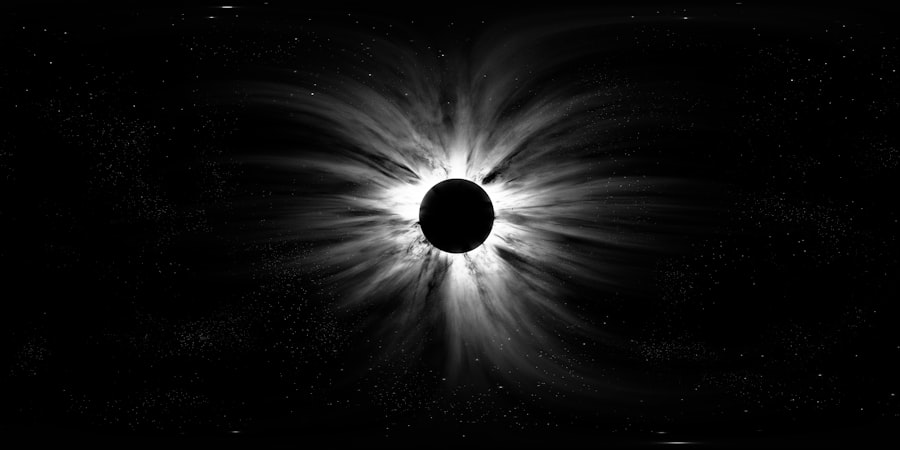
The existence and behavior of black holes are intricately linked to Albert Einstein’s theory of general relativity, which describes gravity not as a force, but as a curvature of spacetime caused by mass and energy.
Warped Fabric of Spacetime: Gravity as Geometry
General relativity posits that massive objects warp the fabric of spacetime around them, much like placing a heavy ball on a stretched rubber sheet. This curvature dictates the paths of objects moving through spacetime, which we perceive as gravity. A black hole, with its immense concentration of mass, causes an extreme warping of spacetime, creating a bottomless pit from which escape is impossible.
Time Dilation: The Slowing of Time Near a Black Hole
One of the counterintuitive consequences of general relativity is time dilation. The stronger the gravitational field, the slower time passes relative to an observer in a weaker field. Near the event horizon of a black hole, this effect becomes extreme. An observer falling into a black hole would experience time as passing normally for themselves, but an external observer would see their time slow down to a crawl as they approach the event horizon, effectively freezing at the boundary.
Frame Dragging: The Spinning Effect of Rotating Black Holes
Many black holes are expected to be rotating, a relic of the rotating stars from which they formed. Rotating black holes create an additional effect known as frame-dragging, or the Lense-Thirring effect. This phenomenon causes spacetime itself to be dragged or twisted around the rotating black hole, like a vortex.
The Ergosphere: A Region of Forced Rotation
For a rotating black hole, there exists a region outside the event horizon called the ergosphere. Within the ergosphere, spacetime is dragged so powerfully that it is impossible for an object to remain stationary relative to a distant observer; it must rotate with the black hole. Energy can even be extracted from a rotating black hole through processes occurring in the ergosphere, such as the Penrose process.
Black holes are one of the most fascinating and mysterious phenomena in the universe, and understanding their nature can be quite complex. For those looking to delve deeper into the subject, an insightful article can be found at My Cosmic Ventures, which explains the formation, characteristics, and implications of black holes in a way that is accessible to both enthusiasts and newcomers alike. This resource provides a comprehensive overview that complements the ongoing discussions in astrophysics and helps to demystify these cosmic giants.
Unanswered Questions and Future Horizons
| Aspect | Explanation |
|---|---|
| Definition | A region in space where the gravitational pull is so strong that nothing, not even light, can escape from it. |
| Formation | Occurs when a massive star collapses under its own gravity at the end of its life cycle. |
| Types | Primordial, stellar, and supermassive are the three main types of black holes. |
| Characteristics | Have a boundary called the event horizon, and are often surrounded by an accretion disk of swirling gas and dust. |
| Study | Scientists use telescopes and other instruments to study black holes and their effects on surrounding matter. |
Despite the remarkable progress in black hole research, numerous mysteries persist, driving ongoing scientific inquiry and technological innovation.
The Information Paradox: What Happens to Information?
One of the most perplexing theoretical challenges is the black hole information paradox. According to quantum mechanics, information cannot be destroyed. However, if matter falls into a black hole, and the black hole eventually evaporates through Hawking radiation, what happens to the information contained within that matter? Does it vanish, violating a fundamental principle of quantum physics?
Hawking Radiation: The Slow Evaporation of Black Holes
Stephen Hawking proposed that black holes are not entirely black but emit a faint thermal radiation, known as Hawking radiation, due to quantum effects near the event horizon. This radiation causes black holes to slowly lose mass and eventually evaporate over incredibly long timescales. Reconciling Hawking radiation with the information paradox is a major goal for theoretical physicists, potentially requiring a complete theory of quantum gravity.
The Nature of the Singularity: Beyond General Relativity
As previously discussed, the singularity represents a point where general relativity breaks down. Understanding the true nature of the singularity likely requires a theory that unifies general relativity with quantum mechanics – a theory of quantum gravity.
Quantum Gravity: The Holy Grail of Physics
Developing a consistent theory of quantum gravity is one of the ultimate goals of modern physics. Such a theory is needed to describe phenomena at extremely small scales and high energies, such as those found within black holes. String theory and loop quantum gravity are two leading candidates for a theory of quantum gravity, but definitive experimental verification remains elusive.
The Quest for Direct Imaging: Capturing the Shadow
While we can observe the effects of black holes, directly imaging their event horizon has been a monumental challenge.
The Event Horizon Telescope: A Global Network of Telescopes
The Event Horizon Telescope (EHT) is a groundbreaking international collaboration that uses a network of radio telescopes around the world to create a virtual telescope the size of Earth. This remarkable instrument has the power to resolve features at the event horizon scale of supermassive black holes.
First Images of Black Hole Shadows: Sagittarius A and M87
In 2019, the EHT collaboration released the first-ever image of a black hole’s shadow – the silhouette of the black hole against the bright background of its accretion disk – around the supermassive black hole M87. In 2022, they released a similar image of Sagittarius A, our own galaxy’s central black hole. These images provide unprecedented visual confirmation of theoretical predictions and offer a wealth of data for further study.
The ongoing exploration of black holes is a testament to humanity’s insatiable curiosity about the cosmos. Each new discovery pushes the boundaries of our knowledge, revealing a universe far more wondrous and complex than we could have ever imagined. As technology advances and our theoretical frameworks evolve, the unraveling of black hole mysteries promises to continue to reshape our understanding of gravity, spacetime, and the fundamental nature of reality itself.

Physics Can’t Explain Gravity (And That’s a Problem)
FAQs
What is a black hole?
A black hole is a region in space where the gravitational pull is so strong that nothing, not even light, can escape from it. This occurs when a massive star collapses under its own gravity.
How are black holes formed?
Black holes are formed when massive stars run out of fuel and collapse under their own gravity. This collapse causes the star to become extremely dense, creating a gravitational pull so strong that it forms a black hole.
What are the different types of black holes?
There are three main types of black holes: stellar black holes, which are formed from the collapse of massive stars; intermediate black holes, which are larger than stellar black holes but smaller than supermassive black holes; and supermassive black holes, which are found at the center of most galaxies, including our own Milky Way.
Can anything escape from a black hole?
Once something crosses the event horizon of a black hole, it cannot escape. This includes light, which is why black holes appear black and are invisible to the naked eye.
What is the significance of black holes in the universe?
Black holes play a crucial role in the universe’s evolution and are important for understanding the laws of physics. They also have a significant impact on the formation and behavior of galaxies.