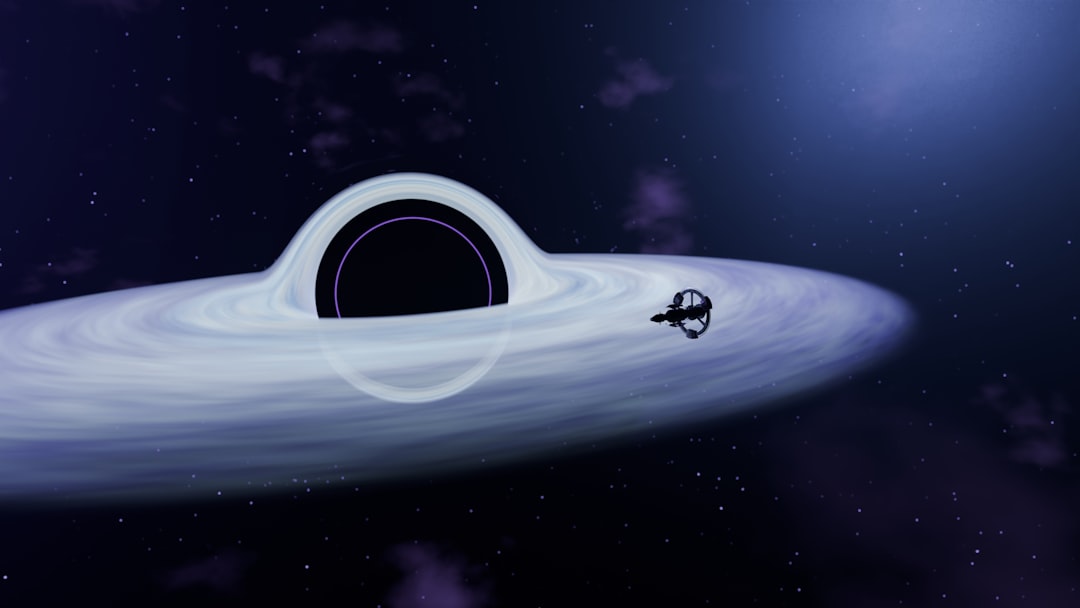
The Black Hole Information Paradox is one of the most profound and vexing puzzles in modern physics, a stubborn knot that ties together the seemingly incompatible pillars of quantum mechanics and general relativity. It asks a fundamental question: what happens to the information that falls into a black hole? To truly grasp this paradox, one must first understand the nature of black holes and the bedrock principles of quantum theory.
Black holes are regions of spacetime where gravity is so strong that nothing, not even light, can escape. They are the ultimate gravitational prisons, formed from the collapsed remnants of massive stars. Their existence is predicted by Albert Einstein’s theory of general relativity, which describes gravity not as a force, but as a curvature in spacetime caused by mass and energy.
The Event Horizon: The Point of No Return
The defining feature of a black hole is its event horizon. Imagine a waterfall so powerful that once you go over the edge, there is no swimming back upstream, no matter how strong you are. The event horizon is that edge. Anything that crosses this boundary is irrevocably pulled towards the singularity at the center. From the perspective of an outside observer, objects falling into a black hole appear to slow down and become redder due to gravitational time dilation, eventually freezing at the event horizon. However, for the infalling object, time would continue to pass normally, and it would cross the horizon without immediate sensation, only to be stretched and compressed by tidal forces as it approaches the singularity.
The Singularity: A Point of Infinite Density
At the heart of a black hole lies the singularity, a theoretical point of infinite density and zero volume. Here, the laws of physics as we understand them break down. General relativity cannot adequately describe what happens at this point. Physicists believe that a quantum theory of gravity is needed to fully comprehend the singularity, but such a theory remains elusive.
The intriguing relationship between black holes and the information paradox has captivated physicists for decades, raising fundamental questions about the nature of information and the fabric of reality itself. For those interested in exploring this topic further, a related article can be found at My Cosmic Ventures, where the complexities of black hole thermodynamics and the implications for quantum mechanics are discussed in detail. This resource provides valuable insights into the ongoing debates and research surrounding these enigmatic cosmic phenomena.
Quantum Mechanics: The Realm of the Infinitesimal
Quantum mechanics governs the behavior of matter and energy at the atomic and subatomic levels. It is a realm of probabilities, uncertainties, and bizarre phenomena that defy classical intuition.
The Principle of Unitarity: Information is Never Lost
A cornerstone of quantum mechanics is the principle of unitarity. This principle states that the evolution of a quantum system is always reversible. In simpler terms, if you know the state of a quantum system at one point in time, you can, in principle, determine its state at any other point in time, past or future. This implies that information about a quantum system is never truly destroyed; it can only be rearranged or transformed. Think of it like shuffling a deck of cards. Even after extensive shuffling, each original card is still in the deck, just in a different order. Quantum mechanics asserts that this is true for all quantum information.
Quantum Entanglement: Spooky Action at a Distance
Quantum entanglement is another peculiar phenomenon that plays a crucial role in the information paradox. When two or more quantum particles become entangled, their fates are intertwined, regardless of the distance separating them. Measuring a property of one entangled particle instantaneously influences the corresponding property of the others, a phenomenon Einstein famously described as “spooky action at a distance.” This interconnectedness is fundamental to understanding how information might behave in extreme gravitational environments.
Hawking Radiation: Black Holes Aren’t Entirely Black

In the 1970s, Stephen Hawking made a groundbreaking discovery that introduced a new layer of complexity to black holes: Hawking radiation. He proposed that black holes are not entirely black but emit faint thermal radiation due to quantum effects near the event horizon.
Virtual Particle Pairs: The Birth of Radiation
Hawking radiation arises from the creation and annihilation of virtual particle-antiparticle pairs in the vacuum of spacetime near the event horizon. In quantum field theory, the vacuum is not empty but is a seething cauldron of constantly fluctuating energy, where pairs of particles and antiparticles spontaneously appear and then annihilate each other. When this occurs at the event horizon, it is possible for one particle to fall into the black hole while the other escapes.
Information Loss? The Crux of the Paradox
The escaping particle carries away energy, causing the black hole to lose mass and gradually evaporate over an incredibly long timescale. The problem arises from the nature of this radiation. Hawking’s calculations suggested that the emitted Hawking radiation is purely thermal, meaning it carries no information about the specific quantum states of the matter that formed the black hole or fell into it. If a black hole eventually evaporates completely, and the radiation it emits is truly thermal and devoid of information, then the unique information about the initial state of the matter would be permanently lost. This directly contradicts the principle of unitarity in quantum mechanics, which states that information cannot be destroyed. It’s like burning a book and expecting to be able to reconstruct the exact words, sentence structure, and unique story from the ashes alone, if the ashes are indistinguishable regardless of which book you burned.
The Information Paradox Unraveled: Proposed Solutions
The contradiction between Hawking radiation and the unitarity of quantum mechanics forms the heart of the black hole information paradox. Physicists have proposed various theories and mechanisms to resolve this apparent conflict. These solutions often probe the very boundaries of our understanding of gravity and quantum mechanics.
The Syngman Effect: Information Encoded in Hawking Radiation
One prominent idea is that the Hawking radiation is not entirely thermal and actually carries subtle quantum correlations that encode the information about what fell into the black hole. This would mean that as the black hole evaporates, the information is not lost but is slowly imprinted on the outgoing radiation. This would require a much more intricate understanding of quantum gravity than currently exists. Imagine the escaped particle is like a faint whisper carrying a detailed message, but we haven’t yet learned to decipher its language.
The Firewall Paradox: A New Obstacle
However, the idea of information being encoded in Hawking radiation has led to further complications, most notably the “firewall paradox.” This paradox suggests that if information is somehow retrieved from a black hole, it would require the existence of a high-energy “firewall” at the event horizon. This firewall would destroy any infalling matter or observer, contradicting the principle that crossing the event horizon should be a relatively smooth experience according to general relativity. This creates a tension: either information is lost, or crossing the event horizon is a violent, destructive event.
The ER=EPR Conjecture: Spacetime as Entanglement
A more radical proposal, known as the ER=EPR conjecture, suggests a deep connection between entanglement and spacetime geometry. It posits that entangled quantum particles are connected by microscopic wormholes (Einstein-Rosen bridges, or ER bridges). This conjecture proposes that the entanglement between Hawking radiation and the matter inside the black hole might be responsible for maintaining a connected spacetime, allowing information to be transferred. In this view, the interior of the black hole and the escaping radiation are not separate entities but are intrinsically linked through entanglement, forming a sort of unified quantum system. This is akin to saying that two hands, even when far apart, are connected by an invisible, unbreakable thread that allows them to influence each other instantaneously.
Planck-Scale Remnants: A Tiny Trace Left Behind
Another avenue of thought explores the possibility that black holes do not fully evaporate but leave behind incredibly small, stable remnants at the Planck scale (the smallest possible unit of length and time). These remnants, while minuscule, could potentially store all the information that fell into the black hole. However, this scenario also faces challenges, as it’s unclear how such remnants would form or preserve such vast amounts of information within their tiny structures.
The intriguing relationship between black holes and the information paradox has captivated physicists for decades, leading to numerous theories and debates. A recent article explores the implications of this paradox and its potential resolutions, shedding light on the fundamental nature of information in our universe. For a deeper understanding of these concepts, you can read more in this insightful piece on cosmic ventures. This exploration not only delves into the mysteries surrounding black holes but also challenges our perceptions of reality and the laws of physics.
The Quest for Quantum Gravity: The Ultimate Resolution
| Metric | Description | Value / Estimate |
|---|---|---|
| Black Hole Mass | Mass of a typical stellar black hole | 5 – 30 Solar Masses |
| Event Horizon Radius | Radius of the event horizon (Schwarzschild radius) for a 10 solar mass black hole | ~30 km |
| Hawking Temperature | Temperature of black hole radiation for a 10 solar mass black hole | ~6 x 10^-9 K |
| Black Hole Entropy (Bekenstein-Hawking) | Entropy proportional to the area of the event horizon | S = k * A / (4 * l_p^2), where A is horizon area, l_p is Planck length |
| Information Paradox | Conflict between quantum mechanics and general relativity regarding information loss | Unresolved; various proposed resolutions include holographic principle, firewall hypothesis |
| Black Hole Evaporation Time | Time for a black hole to evaporate via Hawking radiation (for 10 solar masses) | ~10^67 years |
| Planck Length | Fundamental length scale relevant to quantum gravity | ~1.616 x 10^-35 meters |
| Planck Time | Fundamental time scale relevant to quantum gravity | ~5.39 x 10^-44 seconds |
Ultimately, the resolution to the black hole information paradox likely lies in a complete theory of quantum gravity. Such a theory would unify the principles of general relativity and quantum mechanics, providing a consistent description of gravity at all scales, including the extreme conditions found within black holes.
String Theory and Loop Quantum Gravity: Competing Frameworks
Leading candidates for a theory of quantum gravity include string theory and loop quantum gravity. String theory proposes that the fundamental constituents of the universe are not point-like particles but tiny, vibrating strings. Different vibration modes of these strings correspond to different fundamental particles and forces. Loop quantum gravity, on the other hand, quantizes spacetime itself, suggesting that it is made up of discrete loops. Both theories offer potential frameworks for understanding black holes and resolving the information paradox, but neither has yet been experimentally verified.
Holographic Principle: Information on the Surface
The holographic principle, inspired by black hole thermodynamics, suggests that the information contained within a volume of spacetime can be represented by information on its boundary. In the context of black holes, this would mean that all the information about the matter that falls into a black hole is encoded on its event horizon, acting like a hologram. This idea has profound implications for our understanding of spacetime and quantum gravity, suggesting that our three-dimensional universe could be a projection from a two-dimensional surface.
The Ongoing Dialogue: A Frontier of Physics
The black hole information paradox is not just an abstract theoretical puzzle; it is a profound question that touches upon the very nature of reality. Its resolution will undoubtedly lead to a revolution in our understanding of the universe, potentially unifying our descriptions of the cosmic and the quantum.
Experimental Clues: Searching for Evidence
While direct experimental verification of black hole evaporation and information retrieval is currently beyond our technological capabilities, indirect clues might emerge from observations of astrophysical phenomena, such as gravitational waves from merging black holes or subtle deviations in the cosmic microwave background radiation. The quest for a definitive answer continues, fueled by the intellectual curiosity that drives scientific inquiry.
The black hole information paradox remains an active and vibrant area of research in theoretical physics. It serves as a powerful reminder that our current understanding of the universe is incomplete and that there are still fundamental mysteries waiting to be unraveled. The journey to resolve this paradox is a testament to human ingenuity and our persistent desire to comprehend the deepest secrets of the cosmos.
FAQs
What is a black hole?
A black hole is a region in space where gravity is so strong that nothing, not even light, can escape from it. It forms when a massive star collapses under its own gravity at the end of its life cycle.
What is the information paradox related to black holes?
The information paradox arises from the question of what happens to information about matter that falls into a black hole. According to quantum mechanics, information cannot be destroyed, but classical black hole theory suggests that information is lost when matter crosses the event horizon, leading to a paradox.
Why is the information paradox important in physics?
The information paradox challenges the compatibility of general relativity and quantum mechanics. Resolving it is crucial for developing a unified theory of quantum gravity and understanding the fundamental laws governing the universe.
What are some proposed solutions to the information paradox?
Several solutions have been proposed, including the idea that information is preserved in Hawking radiation emitted by black holes, the holographic principle suggesting information is stored on the event horizon, and the concept of black hole complementarity, which reconciles different perspectives of observers.
Can information escape from a black hole?
According to current theories, information does not escape in the traditional sense but may be encoded in the radiation emitted by black holes, known as Hawking radiation. This process is still under active research and debate in theoretical physics.