The universe, a vast expanse of stars, galaxies, and inexplicable phenomena, has long been a subject of intense scientific inquiry. For decades, researchers have grappled with fundamental questions about its composition, evolution, and underlying physical laws. Among the most persistent enigmas is the nature of dark matter and dark energy, components that, by current understanding, constitute the overwhelming majority of the universe’s mass-energy content. This article delves into the concept of the “75% Rule” in cosmic physics, a framework that seeks to address the dominant yet elusive nature of these cosmic constituents. It explores the observational evidence that necessitates their existence, the theoretical challenges they present, and the ongoing scientific endeavors to unravel their secrets.
The notion of a universe dominated by unseen components did not arise from theoretical speculation alone. Instead, it emerged from a persistent discrepancy between theoretical predictions based on visible matter and the observable dynamics and structure of the cosmos. Early cosmological models, focused primarily on baryonic matter (the stuff of stars, planets, and us), failed to adequately explain a range of observations, leading to the gradual acceptance of more encompassing explanations.
Galactic Rotation Curves and the Missing Mass
One of the earliest and most compelling pieces of evidence for unseen mass emerged from the study of galactic rotation curves. Galaxies, such as our own Milky Way, are not static structures. They are dynamic entities where stars and gas orbit the galactic center. Based on Kepler’s laws of planetary motion, which describe how objects orbit a central mass, astronomers expected stars farther from the galactic center to move slower than those closer in. This is because the gravitational pull, which dictates orbital speed, diminishes with distance from the dominant mass.
However, observations in the late 1960s and 1970s, pioneered by Vera Rubin, revealed a starkly different reality. Stars in the outer regions of spiral galaxies were observed to orbit at speeds far exceeding what could be accounted for by the visible matter (stars, gas, and dust) within those galaxies. This discrepancy implied the presence of a significant amount of invisible mass distributed throughout the galaxies, extending far beyond the visible stellar disk. This “missing mass” acted as an additional gravitational anchor, keeping the outer stars from flying off into intergalactic space. The amount of this inferred dark matter was found to be several times greater than the total mass of visible matter, laying a crucial foundation for what would become the “75% Rule.”
The Anomalous Velocity Dispersions
The velocity dispersion of stars within galaxies, a measure of the random motion of these stars, also provides evidence for dark matter. In elliptical galaxies, where visible matter distribution is more spherically symmetric, stars exhibit a dispersion of velocities that cannot be explained by the gravitational influence of the visible components alone. The higher velocities observed suggest a more pervasive gravitational potential well, consistent with the presence of a dominant dark matter halo.
Galaxy Clusters and Gravitational Lensing
Galaxies are not isolated entities; they often congregate in vast structures called galaxy clusters. The dynamics of these clusters, including the velocities of individual galaxies within them and the hot gas that permeates the space between them, also point to a significant mass deficit. In the 1930s, Fritz Zwicky observed that galaxies within the Coma Cluster were moving too fast to remain bound by the gravitational pull of the visible matter. He estimated that there must be at least 400 times more mass than was visible.
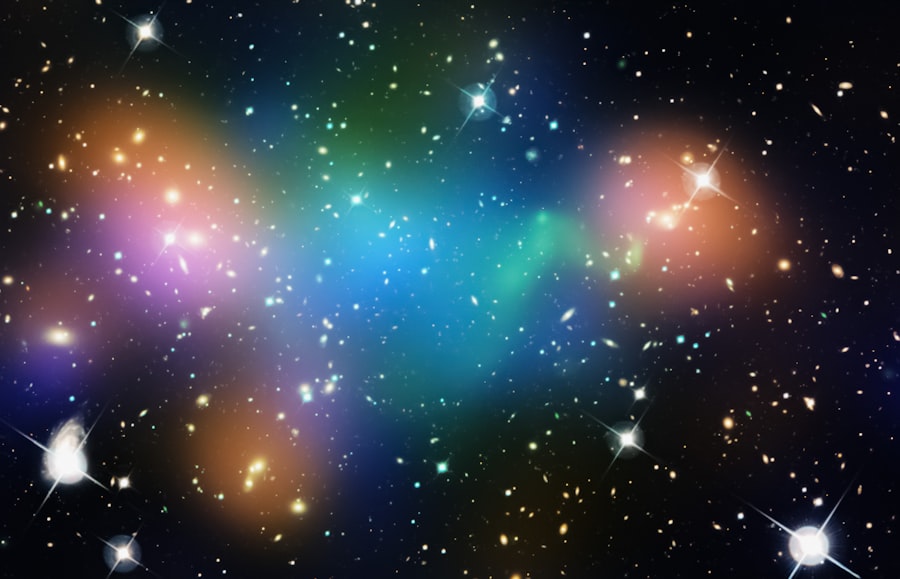
Furthermore, the phenomenon of gravitational lensing offers a direct probe of the total mass distribution, regardless of its luminous or non-luminous nature. Massive objects, according to Einstein’s theory of general relativity, warp the fabric of spacetime. Light passing through this warped region is bent, much like light passing through a lens. Galaxy clusters, with their immense collective mass, act as powerful gravitational lenses, distorting the images of more distant galaxies behind them. The degree of this distortion directly correlates with the total mass of the lensing cluster. Observations of gravitational lensing around galaxy clusters consistently reveal a mass far greater than that accounted for by the visible galaxies and the intergalactic gas, reinforcing the need for dark matter.
The Hot Intergalactic Medium
Galaxy clusters are also filled with vast quantities of extremely hot, diffuse gas, detectable through X-ray emissions. The temperature and distribution of this gas are determined by the gravitational potential of the cluster. Measurements of this gas indicate that it is hotter and more extensive than could be retained by the gravitational field of the visible matter alone, requiring a substantial additional source of gravity to keep it bound.
The Cosmic Microwave Background Radiation
Perhaps the most profound evidence for the dominance of dark energy and dark matter comes from the study of the Cosmic Microwave Background (CMB) radiation. This faint afterglow of the Big Bang fills the entire universe and carries a snapshot of the cosmos when it was approximately 380,000 years old. The CMB is not perfectly uniform; it exhibits minuscule temperature fluctuations, or anisotropies, across the sky.
These fluctuations are the seeds from which all large-scale structures in the universe—galaxies, clusters, and superclusters—eventually grew. The precise pattern and amplitude of these fluctuations are exquisitely sensitive to the composition of the early universe. For decades, cosmological models based solely on baryonic matter struggled to reproduce the observed CMB power spectrum. The inclusion of dark matter and dark energy, in specific proportions, provided a remarkable fit to the data, thereby solidifying their crucial role in the cosmic tapestry.
Baryon Acoustic Oscillations
Within the CMB, there are characteristic patterns known as baryon acoustic oscillations (BAOs). These are relic sound waves that propagated through the primordial plasma before it cooled and matter decoupled from radiation. The scale of these oscillations acts as a standard ruler in cosmology. By measuring the apparent size of this standard ruler at different cosmic epochs, cosmologists can infer the expansion history of the universe. BAO measurements, when combined with CMB data, provide powerful constraints on the relative proportions of dark matter, dark energy, and baryonic matter.
The seventy-five percent rule in cosmic physics highlights the significant role of dark matter and dark energy in the universe, suggesting that these components make up a substantial portion of the cosmos. For a deeper understanding of this concept and its implications for our understanding of the universe, you can explore a related article on cosmic phenomena and their mysteries at My Cosmic Ventures. This resource provides valuable insights into the ongoing research and discoveries in the field of astrophysics.
Theoretical Hurdles and the Nature of the Unknown
While observational evidence strongly suggests the existence of dark matter and dark energy, their fundamental nature remains one of the most significant challenges in modern physics. The “75% Rule” highlights the fact that our current understanding of fundamental particles and forces is woefully incomplete.
The Dark Matter Enigma: Beyond the Standard Model
Dark matter, by definition, does not interact electromagnetically; it does not emit, absorb, or reflect light. This makes it invisible to conventional telescopes. Its gravitational interaction is the primary means by which its existence is inferred. The Standard Model of particle physics, which successfully describes all known fundamental particles and their interactions (except gravity), does not contain any particles with the required properties to be dark matter. Consequently, the search for dark matter has spurred extensive searches for new particles beyond the Standard Model.
Weakly Interacting Massive Particles (WIMPs)
One leading class of candidates for dark matter particles is Weakly Interacting Massive Particles, or WIMPs. These hypothetical particles would interact very weakly with ordinary matter, primarily through the weak nuclear force and gravity. Their hypothesized masses would be in the range of a few GeV to several TeV. Numerous direct detection experiments are underway, aiming to observe the rare instances where a WIMP might collide with the nucleus of an atom in a detector, producing a detectable recoil.
Axions and Sterile Neutrinos
Other theoretical candidates include axions, very light, hypothetical particles that were originally proposed to solve a problem in quantum chromodynamics. Axions are expected to interact extremely weakly with ordinary matter and could potentially form a diffuse condensate that permeates galactic halos. Sterile neutrinos, a hypothetical type of neutrino that does not interact via the weak force, are also considered as potential dark matter candidates. These particles would only interact gravitationally.
The seventy-five percent rule in cosmic physics suggests that a significant portion of the universe is composed of dark matter and dark energy, which remain largely mysterious to scientists. For those interested in exploring this concept further, a related article delves into the implications of this rule on our understanding of the cosmos and the fundamental forces at play. You can read more about it in this insightful piece on cosmic phenomena available at my cosmic ventures. This exploration not only highlights the challenges faced by physicists but also opens up new avenues for research in the field.
The Dark Energy Conundrum: The Accelerating Universe
Dark energy is a more enigmatic entity. Its existence is inferred from the observation that the expansion of the universe is not slowing down, as would be expected from the gravitational pull of all matter, but is, in fact, accelerating. This acceleration implies the presence of a repulsive force, acting over cosmic distances, that counteracts gravity.
The Cosmological Constant (Lambda)
The simplest explanation for dark energy is the cosmological constant, denoted by the Greek letter Lambda ($\Lambda$). This concept was first introduced by Albert Einstein in his equations of general relativity to allow for a static universe, though he later abandoned it. In modern cosmology, $\Lambda$ represents a constant energy density inherent to the vacuum of spacetime itself. If this vacuum energy exists, it would exert a negative pressure, leading to accelerated expansion. However, theoretical calculations of the vacuum energy based on quantum field theory yield a value that is many orders of magnitude larger than the observed cosmological constant, a profound discrepancy known as the cosmological constant problem.
Quintessence and Other Dynamic Models
Alternative models for dark energy propose that it is not a constant but rather a dynamic field that changes over time and space, often referred to as “quintessence.” These models introduce new scalar fields with specific properties that could drive the accelerated expansion. However, these models also come with their own theoretical complexities and require fine-tuning to match observational data. The lack of a definitive observational signature for a dynamic dark energy field makes it difficult to distinguish from the cosmological constant.
The 75% Rule: A Roadmap for Discovery
The “75% Rule” is not a physical law but rather a descriptive shorthand for the current cosmological paradigm, which posits that approximately 75% of the universe’s mass-energy is dark energy, about 25% is dark matter, and a mere 5% is ordinary baryonic matter. This understanding, derived from multiple lines of observational evidence including the CMB, supernovae, and large-scale structure surveys, highlights the vastness of our ignorance and the pressing need for new physics.
The Interplay of Dark Matter and Dark Energy in Cosmic Structure Formation
The relative abundance of dark matter and dark energy plays a critical role in the formation and evolution of cosmic structures. Dark matter, with its gravitational attraction, acts as the scaffolding upon which galaxies and galaxy clusters form. Baryonic matter then falls into these dark matter halos, eventually igniting star formation. Dark energy, on the other hand, acts as a driver of cosmic acceleration, counteracting the gravitational pull of matter and influencing the rate at which structures can grow.
The Epoch of Deceleration and Acceleration
In the early universe, matter density was much higher, and gravity dominated, leading to a period of decelerated expansion. As the universe expanded and matter became more diluted, the influence of dark energy began to increase. At a certain point, dark energy’s repulsive effect overcame the gravitational attraction of matter, leading to the observed epoch of accelerated expansion. The precise timing of this transition is a key parameter constrained by cosmological observations.
Future Observational Frontiers
The quest to “unlock the secrets of cosmic physics” through the lens of the “75% Rule” hinges on the development and deployment of next-generation observational instruments and sophisticated analysis techniques. These endeavors aim to refine our measurements of the universe’s composition and to probe the fundamental nature of dark matter and dark energy with unprecedented precision.
Large Synoptic Survey Telescope (LSST) and its Successors
Projects like the Vera C. Rubin Observatory (formerly LSST) will conduct panoramic surveys of the night sky, gathering vast amounts of data on the positions and movements of millions of galaxies. This data will be used to map the distribution of dark matter through gravitational lensing and to study the growth of large-scale structures over cosmic time. Future telescopes, both ground-based and space-based, are envisioned to probe even deeper into the universe and to provide higher-resolution measurements of cosmic phenomena.
Next-Generation Particle Detectors
Advancements in particle physics detection technology are crucial for the direct or indirect detection of dark matter candidates. Experiments are being designed with increased sensitivity and lower background noise, aiming to capture the elusive signals of WIMPs or other exotic particles interacting with terrestrial detectors. Similarly, experiments designed to search for axions or sterile neutrinos are pushing the boundaries of experimental physics.
The Philosophical Implications of the 75% Rule

The “75% Rule” has profound philosophical implications, challenging our anthropocentric view of the universe and prompting a re-evaluation of our place within it. The realization that the matter which constitutes our immediate surroundings and ourselves is a minor component of the cosmos is a humbling, yet intellectually stimulating, proposition.
Redefining Our Cosmic Neighborhood
The dominance of dark matter and dark energy suggests that the universe is fundamentally stranger and more complex than previously imagined. It implies that the familiar laws of physics, as we understand them through the study of baryonic matter, may only represent a partial description of reality. The vast majority of the universe’s content remains stubbornly beyond our direct perception and current theoretical grasp.
The Search for a Unified Theory
The ongoing investigation into the “75% Rule” is intrinsically linked to the pursuit of a unified theory of physics, one that can seamlessly incorporate gravity with the other fundamental forces and explain the existence and properties of dark matter and dark energy. Such a theory would represent a monumental leap in our understanding of the universe, potentially revealing a deeper, more elegant reality than currently perceived.
The Evolution of Scientific Understanding
The trajectory of scientific discovery has consistently involved confronting phenomena that defy existing paradigms. From the heliocentric model challenging an Earth-centered universe to quantum mechanics revolutionizing our understanding of the subatomic realm, science progresses by questioning assumptions and exploring the unknown. The “75% Rule” represents the latest frontier in this ongoing process of intellectual exploration. It compels scientists to embrace uncertainty and to devise innovative strategies for probing the invisible and the intangible. This relentless pursuit of knowledge, driven by curiosity and scientific rigor, continues to shape our understanding of the cosmos, pushing humanity towards a more complete and nuanced cosmic perspective.
FAQs
What is the seventy five percent rule in cosmic physics?
The seventy five percent rule in cosmic physics refers to the theory that approximately 75% of the universe is made up of dark energy, 20% is dark matter, and only 5% is ordinary matter.
How was the seventy five percent rule in cosmic physics discovered?
The seventy five percent rule in cosmic physics was discovered through observations of the cosmic microwave background radiation, the large-scale structure of the universe, and the measurements of the expansion rate of the universe.
What is dark energy in the context of the seventy five percent rule in cosmic physics?
Dark energy is a mysterious force that is causing the expansion of the universe to accelerate. It is thought to make up approximately 75% of the total energy density of the universe.
What is dark matter in the context of the seventy five percent rule in cosmic physics?
Dark matter is a form of matter that does not emit, absorb, or reflect light, making it invisible and detectable only through its gravitational effects. It is thought to make up approximately 20% of the total energy density of the universe.
What are the implications of the seventy five percent rule in cosmic physics?
The seventy five percent rule in cosmic physics has significant implications for our understanding of the universe, including the nature of dark energy and dark matter, the ultimate fate of the universe, and the fundamental laws of physics.