
The question of origins has haunted humanity since the dawn of consciousness. Where did it all come from? The vast, intricate tapestry of existence, stretching from the subatomic dance of particles to the cosmic ballet of galaxies, begs for an explanation. The proposition of a universe arising from absolute nothingness, a concept once confined to philosophers’ study rooms and theoretical physicists’ blackboards, is now at the forefront of scientific inquiry. This is not merely a speculative thought experiment; it is an ambitious endeavor to construct “The Ultimate Explanation” for the universe’s genesis, a journey into the void before everything.
The very notion of “nothingness” is fraught with conceptual difficulties. In everyday language, nothingness often implies an empty space, a void devoid of matter and energy. However, from a scientific perspective, particularly within quantum mechanics, the concept becomes far more complex and, paradoxically, less empty.
Defining the Void: Beyond an Empty Box
Philosophically, the idea of absolute nothingness – the absence of space, time, matter, energy, laws, and even potential – is exceptionally hard to grasp. If there is truly nothing, then there is no “there” for anything to not be in. This leads to a logical quagmire. Science, while operating within the framework of observable reality and mathematical models, grapples with this from a different angle. The “nothing” of classical physics, an empty vacuum, is demonstrably not truly empty.
The Quantum Vacuum: A Seething Sea of Potential
Quantum field theory paints a radically different picture. The vacuum, in this context, is not a passive stage but a dynamic, energetic entity. It is a sea of fluctuating quantum fields, where virtual particles blink in and out of existence at an astonishing rate. These are not particles that can be directly observed or measured in the traditional sense, but their collective behavior has measurable effects, such as the Casimir effect.
Virtual Particles and Quantum Fluctuations
Quantum fluctuations are the inherent uncertainty in the energy of a quantum system. Even in its lowest energy state, the vacuum, there are constant fluctuations as energy is borrowed and repaid on incredibly short timescales. This means that even in the deepest, coldest, and most empty regions of space, there is a inherent ‘buzz’ of activity. These are the virtual particles, fleeting manifestations of quantum fields that continuously pop into existence and annihilate each other.
Implications for Origins: A Seed of Existence
This quantum vacuum, teeming with potential, is where the idea of a universe from nothing truly takes flight. It suggests that the “nothing” from which the universe might have arisen was not absolute void but a state of quantum possibility, a pre-geometric, pre-energetic substrate from which physical laws and particles could emerge.
The concept of the universe emerging from nothing has fascinated scientists and philosophers alike, prompting extensive exploration into the nature of existence. For a deeper understanding of this intriguing topic, you can read a related article that delves into the theories and implications surrounding the origins of the universe. To learn more, visit My Cosmic Ventures, where you will find insightful discussions and analyses on this profound subject.
Inflationary Cosmology: The Cosmic Big Bang’s Progenitor
The prevailing cosmological model, the Big Bang theory, describes the universe’s evolution from an extremely hot, dense state. However, it doesn’t fully explain why that initial state existed or what preceded it. Inflationary cosmology offers a compelling candidate for the mechanism that rapidly expanded the nascent universe, potentially originating from a quantum vacuum.
The Horizon and Flatness Problems of the Standard Big Bang
The standard Big Bang model, without inflation, faced significant challenges in explaining two key observations about the universe: the horizon problem and the flatness problem. The horizon problem refers to why distant regions of the cosmic microwave background radiation, which appear to be causally disconnected, are so remarkably uniform in temperature. The flatness problem asks why the universe’s geometry appears so close to flat, a state that requires extreme fine-tuning in its initial conditions.
The Inflationary Epoch: A Moment of Exponential Expansion
Inflationary theory proposes a period of extremely rapid, exponential expansion in the universe’s earliest moments, occurring fractions of a second after the Big Bang. This period of inflation, driven by a hypothetical “inflaton field,” stretches a minuscule quantum fluctuation to an enormous scale.
The Inflaton Field: A Theoretical Driver of Expansion
The inflaton field is a speculative scalar field that permeates space and possesses a high potential energy. During inflation, this potential energy dominates, causing space to expand at an accelerated rate. As inflation ends, the inflaton field decays, releasing its energy and “reheating” the universe, creating the hot, dense plasma that the standard Big Bang model describes.
Solving Cosmological Puzzles: From Quantum to Macroscopic
Inflation elegantly addresses the horizon and flatness problems. The immense expansion during inflation smooths out any initial irregularities, explaining the uniformity of the cosmic microwave background. Similarly, the stretching of space flattens out any initial curvature, leading to the observed flatness of the universe.
Quantum Gravity and the Birth of Spacetime
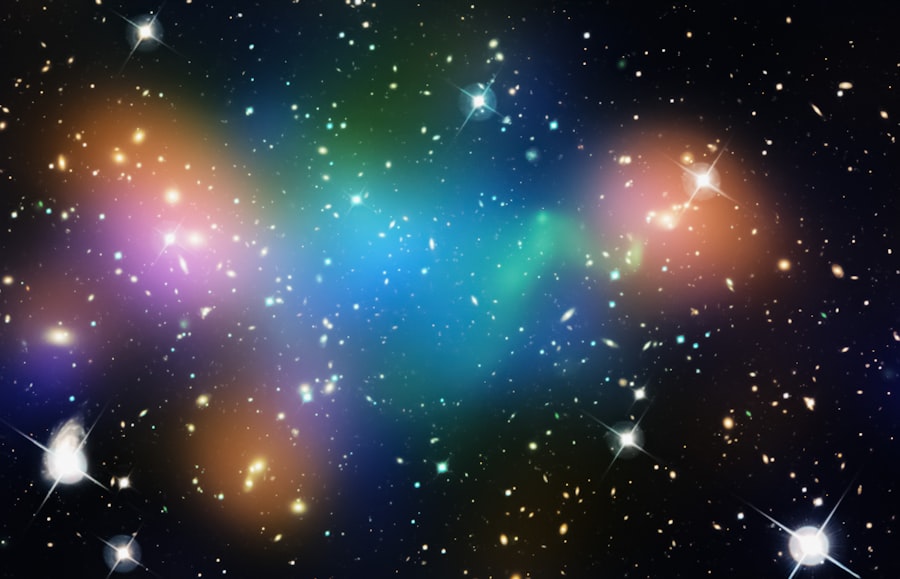
One of the most profound challenges in understanding the universe’s origin lies in reconciling general relativity, which describes gravity and large-scale structures, with quantum mechanics, which governs the microscopic world. A complete theory of quantum gravity is essential to describe the universe at its earliest, most extreme moments.
Unifying the Forces: The Quest for Quantum Gravity
General relativity breaks down at the singularity predicted by the Big Bang, a point of infinite density and temperature. Quantum mechanics, on the other hand, doesn’t adequately incorporate gravity. Physicists are actively seeking a theory that can unify these two pillars of modern physics.
String Theory and Loop Quantum Gravity: Leading Candidates
Two prominent contenders for a quantum theory of gravity are string theory and loop quantum gravity. String theory posits that fundamental particles are not point-like but rather tiny vibrating strings, whose different vibration modes correspond to different particles. Loop quantum gravity, conversely, suggests that spacetime itself is quantized, composed of discrete loops.
Emergence of Spacetime: A Quantum Phenomenon
These theories hint at a radical idea: that spacetime itself, the very fabric of our universe, is not fundamental but an emergent property. In the context of a universe from nothing, this means that before the Big Bang, there might have been no spacetime as we understand it.
Pre-Geometric States: Beyond Space and Time
In some quantum gravity frameworks, the universe might have existed in a “pre-geometric” state, where concepts like distance and causality are not meaningful. The familiar spacetime we experience could have “crystallized” or emerged from this more fundamental, non-spatiotemporal reality during the inflationary epoch.
The Role of Quantum Fluctuations in Spacetime Formation
Quantum fluctuations, which are essential to the dynamic quantum vacuum, could also play a crucial role in the formation of spacetime. Imagine these fluctuations not just creating particles but also influencing the very structure of reality, gradually weaving the tapestry of space and time.
Eternal Inflation and Multiverses: A Cosmological Landscape
The implications of inflation extend beyond a single universe. Some models predict that inflation might not have ended everywhere, leading to the concept of an eternally inflating multiverse.
The Multiverse Hypothesis: Inflation’s Progeny
If inflation is a natural process that occurs under certain conditions, it’s plausible that it might not cease uniformly. Instead, regions of inflating space could continue to expand indefinitely, while other regions might end inflation and form “bubble universes.”
Bubble Universes: Islands in an Expanding Sea
These bubble universes, each potentially with its own unique set of physical laws and constants, would be born from the eternally inflating background. Our universe would then be just one such bubble among an infinite or near-infinite number.
Anthropic Principle and Fine-Tuning: Why Our Universe?
The multiverse offers a potential explanation for the seemingly fine-tuned constants of our universe that appear perfectly suited for life. If there are countless universes with different physical parameters, it’s not surprising that we find ourselves in one where life is possible. This is the essence of the anthropic principle.
The Weak vs. Strong Anthropic Principle
The weak anthropic principle states that we observe the universe to be the way it is because only in such a universe could observers exist. The strong anthropic principle goes further, suggesting that the universe must have properties that allow life to develop within it. The multiverse provides a framework where the weak anthropic principle becomes a powerful explanatory tool.
The concept of the universe emerging from nothing has fascinated scientists and philosophers alike, prompting numerous discussions and theories. A related article that delves deeper into this intriguing topic can be found at My Cosmic Ventures, where various perspectives on the origins of the universe are explored. This exploration not only challenges our understanding of existence but also invites us to ponder the fundamental nature of reality itself.
From Quantum Fluctuations to Cosmic Structures: The Universe’s Grand Design
| Topic | Explanation |
|---|---|
| Big Bang Theory | The theory that the universe originated from a singularity and has been expanding ever since. |
| Quantum Fluctuations | Small fluctuations in the quantum field that could have led to the creation of the universe. |
| Energy Conservation | The idea that the total energy of the universe is constant, even if it changes forms over time. |
| Quantum Gravity | Theoretical framework that aims to unify quantum mechanics and general relativity to explain the universe’s origin. |
Even if a universe arises from a quantum vacuum and undergoes inflationary expansion, the journey from a quantum state to the intricate structures we observe today – galaxies, stars, planets – is a remarkable feat of cosmic evolution.
The Cosmic Microwave Background: Echoes of the Early Universe
The cosmic microwave background (CMB) radiation is a key piece of evidence supporting these theories. It’s a faint afterglow from the Big Bang, containing subtle temperature variations that correspond to tiny density fluctuations in the early universe.
Anisotropies in the CMB: Seeds of Structure
These “anisotropies” in the CMB are the seeds from which all large-scale structures in the universe eventually grew. Gravity acted on these slightly denser regions, pulling in more matter and leading to the formation of galaxies and clusters of galaxies.
Structure Formation: Gravity’s Sculpting Hand
After inflation, the universe began to cool and expand. Matter, initially distributed relatively uniformly (albeit with those slight density fluctuations), began to clump together under the influence of gravity. Dark matter, an invisible substance that interacts gravitationally but not electromagnetically, played a crucial role in this process, providing the gravitational scaffolding around which ordinary matter could coalesce.
The Role of Dark Matter and Dark Energy
Dark matter’s gravitational pull allowed for the formation of the first stars and galaxies. Dark energy, on the other hand, is thought to be responsible for the accelerating expansion of the universe observed today, counteracting gravity’s tendency to pull things together.
The Unanswered Questions: The Edge of Knowledge
While theories of inflation, quantum gravity, and the multiverse offer powerful explanations, they also raise new questions. The precise nature of the inflaton field remains unknown, and the mechanisms by which different bubble universes might form and evolve are still subjects of intense research. The ultimate origin of the quantum laws themselves, which govern the behavior of everything from virtual particles to galaxies, remains one of science’s most profound mysteries. The quest for “The Ultimate Explanation” is not a destination but a continuous exploration, pushing the boundaries of our understanding and revealing the awe-inspiring potential of existence, even from what appears to be nothing.

Physics Can’t Explain Why Reality Exists
FAQs
What is the concept of “universe from nothing”?
The concept of “universe from nothing” refers to the idea that the universe could have originated from a state of nothingness, without the need for a divine creator or external cause. This concept is often discussed in the context of cosmology and theoretical physics.
What are the key theories and explanations for the “universe from nothing” concept?
Several theories and explanations have been proposed to account for the possibility of the universe arising from nothing. These include quantum fluctuations, vacuum energy, and the concept of a “quantum foam” at the smallest scales of spacetime.
What evidence or support exists for the “universe from nothing” concept?
While the concept of the universe arising from nothing is a topic of theoretical speculation and debate, there is currently no direct empirical evidence to support this idea. However, theoretical frameworks such as quantum mechanics and general relativity provide mathematical and conceptual support for the possibility of a universe emerging from a state of nothingness.
What are some criticisms or challenges to the “universe from nothing” concept?
Critics of the “universe from nothing” concept often point to the philosophical and metaphysical implications of such a proposal, as well as the limitations of our current understanding of fundamental physics. Additionally, questions about the nature of “nothing” and the origin of physical laws and constants remain open challenges for this concept.
How does the “universe from nothing” concept relate to current scientific understanding of the origins of the universe?
The “universe from nothing” concept is a speculative idea that challenges traditional notions of cosmic origins and the role of a creator. While it is a topic of ongoing research and debate in the scientific community, it is important to distinguish between theoretical speculation and established empirical evidence when considering the origins of the universe.