The vast expanse of the cosmos, a tapestry woven with stars, galaxies, and unfathomable distances, has captivated humanity for millennia. From ancient stargazers charting celestial movements to modern astrophysicists probing the universe’s deepest secrets, the desire to understand our place within this grand spectacle remains a fundamental human drive. This beginner’s guide aims to demystify the universe, offering a foundational understanding of its observable components, its monumental history, and the mind-boggling forces that shape it. While the universe is infinitely complex, exploring its fundamental principles can be an accessible and awe-inspiring journey for anyone with a curiosity about what lies beyond our planet.
The universe, at its most basic, is a cosmic construction site populated by fundamental celestial bodies. Understanding these primary components is the first step in unraveling the universe’s grand design. Each plays a vital role in the formation and evolution of the cosmos, from the smallest dust particle to the largest galactic supercluster.
Stars: The Luminous Engines
Stars are the most iconic and luminous inhabitants of the universe. They are colossal spheres of hot, ionized gas, primarily hydrogen and helium, that generate light and heat through nuclear fusion in their cores.
The Birth of a Star: From Nebula to Fusion
The stellar life cycle begins within vast, cold clouds of gas and dust known as nebulae. Gravity, the invisible architect of the cosmos, initiates the process. Within these nebulae, denser regions begin to collapse under their own weight. As the cloud collapses, it spins faster and heats up, forming a protostar. If the protostar accumulates enough mass and its core reaches a critical temperature and pressure, nuclear fusion ignites. This is the moment a star is truly born. The outward pressure from the fusion process balances the inward pull of gravity, establishing a stable equilibrium.
Types of Stars: A Diverse Stellar Population
Stars are not all created equal. They come in a wide range of sizes, temperatures, and lifespans, dictating their color and energy output.
Main Sequence Stars: The Long Haul
The vast majority of stars, including our Sun, are currently on the “main sequence.” This is a stable phase where stars fuse hydrogen into helium. The duration of a star’s stay on the main sequence is determined by its mass. More massive stars burn their fuel much faster and have shorter lifespans than less massive stars.
Red Giants and Supergiants: The Aging Phase
As a star exhausts the hydrogen fuel in its core, it begins to expand and cool, becoming a red giant (for Sun-like stars) or a red supergiant (for more massive stars). This is a temporary phase before the star’s ultimate fate.
Stellar Remnants: The End of the Line
What happens after a star’s fusion stops depends on its initial mass.
- White Dwarfs: Lower-mass stars like our Sun eventually shed their outer layers, leaving behind a dense, hot core called a white dwarf. These remnants slowly cool over billions of years.
- Neutron Stars: More massive stars, after going through a supernova explosion, can collapse into incredibly dense objects called neutron stars. These are composed almost entirely of neutrons and are only a few kilometers in diameter but contain more mass than our Sun.
- Black Holes: The most massive stars, after a supernova, can collapse into black holes, objects with gravitational pull so strong that nothing, not even light, can escape.
Planets: The Companions of Stars
Planets are celestial bodies that orbit stars. They are differentiated from stars by their lack of self-generated light through nuclear fusion.
Formation of Planetary Systems: A Cosmic Dance
Planetary systems form from the same disks of gas and dust that birth stars. As a protostar forms, the remaining material flattens into a protoplanetary disk. Within this disk, dust grains collide and stick together, gradually forming larger clumps. These clumps then grow by accreting more material, eventually becoming planetesimals. Through further collisions and gravitational interactions, these planetesimals coalesce into planets.
Types of Planets: Worlds of Variety
Our solar system alone showcases the incredible diversity of planets.
Terrestrial Planets: Rocky Worlds
These are smaller, rocky planets with solid surfaces, such as Mercury, Venus, Earth, and Mars. They are typically found closer to their host star.
Gas Giants and Ice Giants: Jovian Neighbors
Larger planets, like Jupiter and Saturn (gas giants) and Uranus and Neptune (ice giants), are primarily composed of gases and ices. They possess extensive atmospheres and often have ring systems and numerous moons.
Exoplanets: Worlds Beyond Our Solar System
Recent astronomical discoveries have revealed that planets are not unique to our solar system. Thousands of exoplanets – planets orbiting stars other than our Sun – have been detected, suggesting that planetary systems are common throughout the universe. This opens up the tantalizing possibility of finding other worlds that could harbor life.
Galaxies: Islands of Stars
Galaxies are colossal collections of stars, gas, dust, and dark matter, all bound together by gravity. They are the fundamental structural units of the universe on large scales.
Types of Galaxies: Varied Cosmic Cities
Galaxies come in a variety of shapes and sizes, reflecting their evolutionary history and interactions.
Spiral Galaxies: Swirling Disk Structures
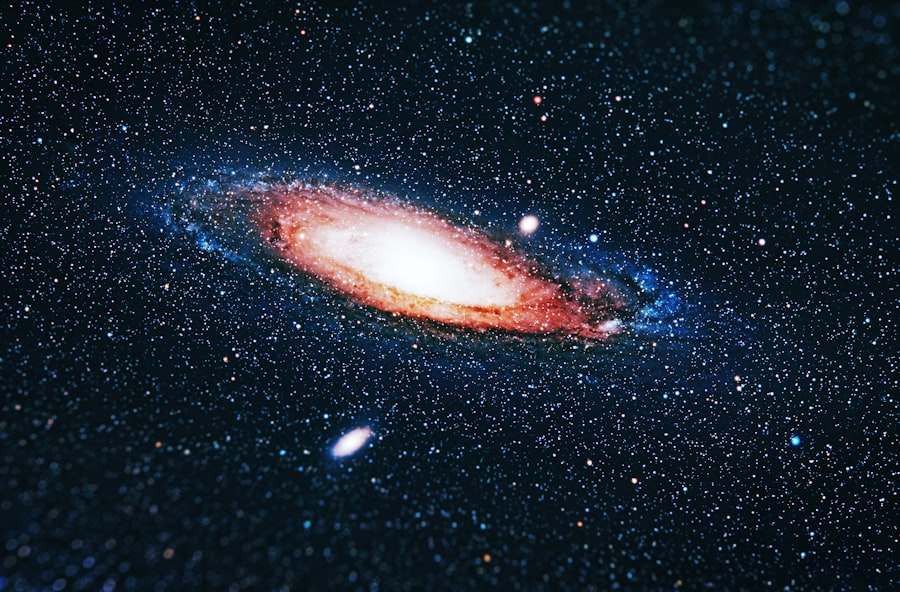
These galaxies, like our own Milky Way, are characterized by a flat, rotating disk containing stars, gas, and dust, with prominent spiral arms extending from a central bulge.
Elliptical Galaxies: Smooth, Oval Forms
Elliptical galaxies are typically older and more spherical or oval-shaped. They contain fewer young stars and less interstellar gas and dust compared to spiral galaxies.
Irregular Galaxies: Chaotic Collections
As their name suggests, irregular galaxies lack a defined shape. They are often the result of gravitational interactions or mergers between other galaxies.
The Milky Way: Our Galactic Home
Our Sun resides in the Milky Way, a spiral galaxy containing an estimated 100 to 400 billion stars. We are located in one of the spiral arms, far from the dense, supermassive black hole at its center.
For those interested in a deeper understanding of the cosmos, you might find the article on “The Expanding Universe” particularly enlightening. This piece delves into the concept of cosmic expansion and how it shapes our understanding of the universe. To explore this fascinating topic further, visit the article here: The Expanding Universe.
The Cosmic Story: A History of the Universe
The universe is not a static entity; it has a dynamic and dramatic history stretching back billions of years. Understanding this cosmic narrative provides context for the formation of stars, galaxies, and ultimately, ourselves.
The Big Bang: The Genesis Event
The prevailing cosmological model for the universe’s origin is the Big Bang theory. This theory posits that the universe began as a singularity, an infinitely hot and dense point, approximately 13.8 billion years ago.
The Early Moments: Inflation and Cooling
In the instants following the Big Bang, the universe underwent a period of rapid expansion called inflation. As it expanded, it cooled, allowing fundamental particles to form.
Quarks and Leptons: The First Particles
Within the first few minutes, protons and neutrons began to form from quarks, and electrons (a type of lepton) also appeared.
Nucleosynthesis: The Creation of Light Elements
The intense heat and pressure of the early universe facilitated Big Bang nucleosynthesis, the formation of the first atomic nuclei, primarily hydrogen and helium, along with trace amounts of lithium.
The Dark Ages: The Universe Before Stars
After nucleosynthesis, the universe entered a period known as the “Dark Ages.” The universe was filled with neutral hydrogen and helium gas, but there were no stars or galaxies to emit light. This period lasted for hundreds of millions of years.
The Dawn of Stars and Galaxies: Reionization
As gravity continued to pull matter together, the first stars and galaxies began to form. The intense ultraviolet radiation emitted by these early stars reionized the neutral hydrogen atoms in the universe, marking the end of the Dark Ages.
Structure Formation: The Cosmic Web
Over billions of years, gravity sculpted the early universe into the large-scale structures we observe today. Galaxies clustered together into groups, clusters, and superclusters, forming a vast, interconnected network known as the cosmic web.
Evolution of Galaxies and Stars: A Continuous Process
Galaxies and stars are not static. They evolve over cosmic timescales, interacting with each other through gravitational forces, mergers, and the ongoing cycle of star birth and death.
The Invisible Forces: Gravity and Dark Matter
While we can observe stars, planets, and galaxies, much of the universe’s behavior is governed by forces and substances that are largely invisible to us.
Gravity: The Universal Architect
Gravity is the fundamental force that governs the attraction between any two objects with mass. It is responsible for holding planets in orbit around stars, stars within galaxies, and galaxies within clusters.
Newton’s Law of Universal Gravitation: A Classical Understanding
Sir Isaac Newton’s law of universal gravitation provided a foundational understanding of how gravity works, describing it as a force proportional to the masses of the objects and inversely proportional to the square of the distance between them.
Einstein’s General Relativity: A More Profound View
Albert Einstein’s theory of general relativity revolutionized our understanding of gravity. It describes gravity not as a force but as a curvature in spacetime caused by mass and energy. Massive objects warp the fabric of spacetime around them, and other objects follow these curves.
Dark Matter: The Mysterious Enabler
Observations of galactic rotation curves and the motion of galaxy clusters revealed that there isn’t enough visible matter to account for the gravitational forces at play. This led to the hypothesis of dark matter.
Evidence for Dark Matter: Beyond Visible Light
- Galactic Rotation Curves: Stars in the outer regions of galaxies orbit much faster than predicted if only visible matter were present.
- Galaxy Clusters: The motion of galaxies within clusters and the gravitational lensing effects observed around them suggest a significant amount of unseen mass.
- Cosmic Microwave Background (CMB): The patterns in the CMB, the afterglow of the Big Bang, also point to the existence of dark matter.
The Nature of Dark Matter: An Ongoing Puzzle
The exact nature of dark matter remains one of the biggest mysteries in physics. It does not appear to interact with light or ordinary matter in any significant way, making it difficult to detect directly. Leading candidates include Weakly Interacting Massive Particles (WIMPs) and axions.
The Expanding Universe and Dark Energy
Perhaps the most astounding revelation about our universe is its continuous expansion, a phenomenon driven by an even more enigmatic force.
The Expanding Universe: A Constant Growth
Observations by Edwin Hubble in the early 20th century revealed that galaxies are moving away from us, and the farther away they are, the faster they recede. This indicates that the universe is not static but is expanding.
Redshift: The Doppler Effect for Light
The light from distant galaxies is stretched as the universe expands, causing its wavelength to shift towards the red end of the spectrum. This phenomenon, known as redshift, is analogous to the change in pitch of a siren as it moves away from an observer.
The Hubble Constant: Measuring Expansion
The rate of this expansion is described by the Hubble constant, which relates the recession velocity of galaxies to their distance.
Dark Energy: The Accelerating Force
Initially, scientists expected the expansion of the universe to be slowing down due to the pull of gravity. However, observations of distant supernovae in the late 1990s revealed the opposite: the expansion is actually accelerating. This acceleration is attributed to a mysterious entity called dark energy.
The Cosmological Constant: Einstein’s Placeholder
One proposed explanation for dark energy is Einstein’s cosmological constant, a term he initially introduced into his equations to allow for a static universe but later called his “greatest blunder.” It suggests an intrinsic energy density of empty space that drives expansion.
Phantom Energy and Quintessence: Alternative Theories
Other theories suggest that dark energy might be a dynamic field that changes over time, such as quintessence or phantom energy, which could lead to an even more rapid acceleration and a potential “Big Rip” in the future.
The Dominance of Dark Energy
Current understanding suggests that dark energy makes up about 68% of the total energy density of the universe, while dark matter accounts for about 27%, and ordinary visible matter constitutes only about 5%. This means that the vast majority of the universe is composed of substances we cannot directly see or fully understand.
For those intrigued by the vast mysteries of the cosmos, an insightful article can be found that delves deeper into the fundamental concepts of the universe. This piece not only expands on the ideas presented in the universe explained but also offers a comprehensive overview of cosmic phenomena and theories. To explore this fascinating topic further, you can read the article here: universe explained.
The Search for Life and Our Place in the Cosmos
| Topic | Explanation |
|---|---|
| Big Bang Theory | The prevailing cosmological model for the observable universe from the earliest known periods through its subsequent large-scale evolution. |
| Dark Matter | A form of matter thought to account for approximately 85% of the matter in the universe and about a quarter of its total energy density. |
| Dark Energy | A hypothetical form of energy that permeates all of space and tends to accelerate the expansion of the universe. |
| Galaxies | Huge collections of stars, gas, and dust that are held together by gravity. |
The grand scale and complexity of the universe naturally lead to the profound question: are we alone? This quest for extraterrestrial life, or astrobiology, is a burgeoning field that intersects with our understanding of the universe.
The Conditions for Life: A Delicate Balance
Scientists hypothesize that life, as we know it, requires a specific set of conditions to arise and thrive.
Habitable Zones: The Goldilocks Principle
These are regions around stars where the temperature is just right for liquid water to exist on a planet’s surface. Too close to the star, and water would boil away; too far, and it would freeze.
Essential Elements: The Building Blocks
Life also relies on the presence of essential elements like carbon, hydrogen, oxygen, nitrogen, phosphorus, and sulfur, which are common throughout the universe.
Stable Environments: Protection from Chaos
A stable planetary environment, with a protective atmosphere and a magnetic field to shield from harmful radiation, is also considered crucial.
The Search Continues: SETI and Exoplanet Exploration
The search for extraterrestrial intelligence (SETI) actively scans the cosmos for radio or optical signals that could indicate intelligent life. Meanwhile, the exploration of exoplanets using telescopes like the James Webb Space Telescope offers the potential to find planets with atmospheres that might contain biosignatures – evidence of biological activity.
Panspermia: The Cosmic Seed
The theory of panspermia suggests that life, or its basic building blocks, could be transported across interstellar space, potentially seeding life on different planets or even in different star systems.
Our Cosmic Perspective: Humility and Wonder
As we continue to explore and understand the universe, we gain a deeper appreciation for our own existence. The sheer scale of the cosmos, the billions of years of cosmic evolution, and the vast number of potentially habitable worlds can evoke a sense of humility, reminding us of our small but significant place within this grand universal tapestry. The ongoing quest to explain the universe is not just an intellectual pursuit; it is a journey of self-discovery, inspiring wonder and fostering a profound connection to the cosmos that surrounds us. Each new discovery, from the farthest quasar to the closest exoplanet, adds another brushstroke to our ever-evolving portrait of the universe, inviting us to continue asking, exploring, and marveling at the boundless mysteries that lie ahead.

Physics Can’t Explain Gravity (And That’s a Problem)
FAQs
What is the universe?
The universe is the entirety of space, time, matter, and energy. It includes all galaxies, stars, planets, and other celestial bodies.
How old is the universe?
The current estimate for the age of the universe is about 13.8 billion years. This age is based on observations of the cosmic microwave background radiation and the expansion of the universe.
What is the size of the universe?
The observable universe is about 93 billion light-years in diameter. However, the entire universe may be much larger, possibly infinite, but our observations are limited to the observable universe.
What is the composition of the universe?
The universe is primarily composed of dark matter and dark energy, which make up about 95% of its total mass-energy. The remaining 5% is ordinary matter, including atoms, molecules, and other known particles.
How did the universe begin?
The prevailing scientific theory for the origin of the universe is the Big Bang theory. According to this theory, the universe began as a hot, dense state and has been expanding and cooling ever since. This expansion continues to the present day.