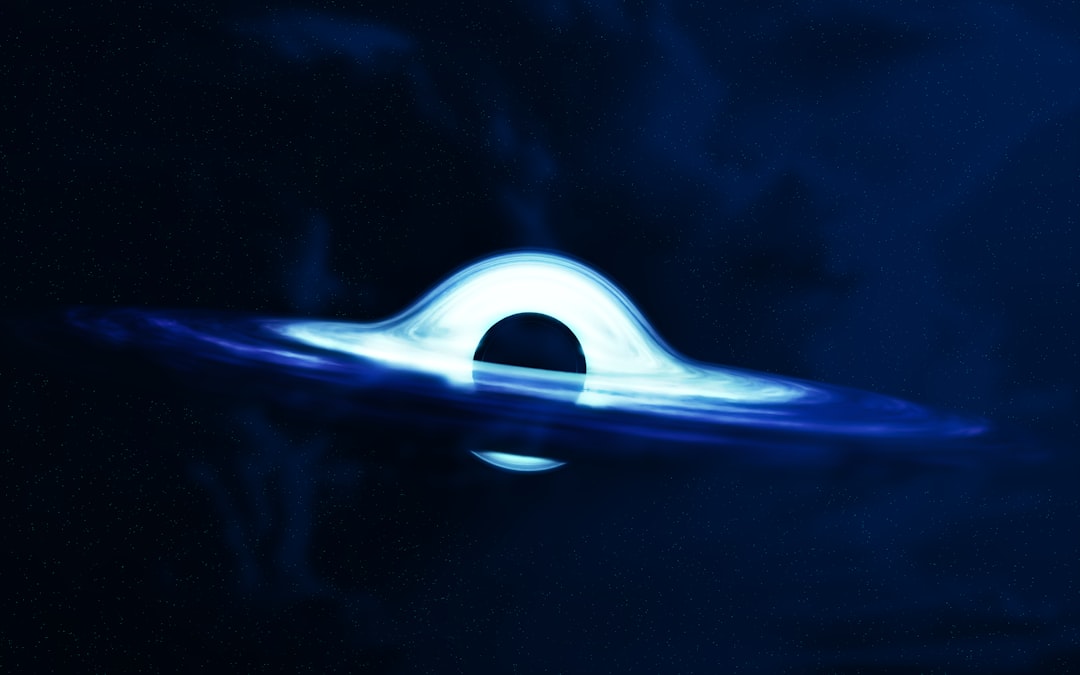
The phenomenon of black holes represents one of the most profound and captivating enigmas in modern astrophysics. These celestial objects, characterized by their immense gravitational pull, possess a unique property: their gravitational field is so powerful that nothing, not even light, can escape once it crosses a certain boundary. Understanding why light cannot escape black holes requires delving into the fundamental principles of gravity, spacetime, and the extreme conditions that define these cosmic entities.
Black holes are not “holes” in the traditional sense but rather regions of spacetime where gravity has become overwhelmingly dominant. Their formation is intrinsically linked to the life cycle of stars, specifically the most massive ones, and the subsequent collapse of their core.
Stellar Evolution and the Birth of Extreme Gravity
The majority of stars, including our Sun, spend the bulk of their existence in a stable phase known as the main sequence. During this period, they are engaged in nuclear fusion in their cores, converting hydrogen into helium and releasing vast amounts of energy. This outward pressure from fusion counteracts the inward pull of gravity, maintaining hydrostatic equilibrium.
Foremost Stages of Stellar Life
Stars embark on their cosmic journey as clouds of gas and dust, primarily hydrogen and helium, that gradually condense under their own gravity. As this mass accumulates and its density increases, the temperature at its core rises. Eventually, temperatures and pressures become sufficient to ignite nuclear fusion, marking the star’s birth. The star then enters the main sequence, its luminosity and temperature determined by its initial mass.
The Inevitable End for Massive Stars
For stars significantly more massive than our Sun, their lifespans are considerably shorter despite their greater luminosity. They burn through their nuclear fuel at a much faster rate. When a massive star exhausts its hydrogen fuel supply, it begins to fuse heavier elements, progressively creating elements up to iron. Iron fusion does not release energy; instead, it consumes it. This halt in energy production leads to an abrupt loss of outward pressure.
Core Collapse and Supernova Explosions
Without the outward push from fusion, the star’s core can no longer support itself against the immense inward force of gravity. This triggers a catastrophic collapse. The core implodes rapidly, reaching incredibly high densities. The outer layers of the star, which are still undergoing some fusion or are still falling inward, rebound off the now ultra-dense core, generating an enormous shockwave that propagates outwards. This shockwave results in a supernova explosion, one of the most energetic events in the universe, scattering heavy elements forged in the star across interstellar space.
The Remnant: Neutron Stars and Black Holes
What remains after a supernova depends on the mass of the star’s core. If the core’s mass is between approximately 1.4 and 3 times the mass of our Sun (the Chandrasekhar limit for white dwarfs and the Tolman-Oppenheimer-Volkoff limit for neutron stars), the collapse is halted by neutron degeneracy pressure. This results in the formation of a neutron star, an incredibly dense object composed primarily of neutrons.
Degeneracy Pressure: A Quantum Shield
Neutron degeneracy pressure is a quantum mechanical effect that arises from the Pauli exclusion principle. This principle states that no two neutrons can occupy the same quantum state simultaneously. In the extreme density of a neutron star’s core, neutrons are forced into the lowest possible energy states, creating an outward pressure that resists further gravitational collapse.
The Threshold for Singularity Formation
However, if the core’s mass exceeds roughly three solar masses, even neutron degeneracy pressure is insufficient to counteract gravity. The collapse continues unchecked, crushing all matter into an infinitely dense point known as a singularity. This is where a black hole is born. The immense mass concentrated into an infinitesimally small volume generates an overwhelming gravitational field.
The concept that nothing escapes a black hole, not even light, is a fascinating topic in astrophysics that has intrigued scientists and enthusiasts alike. A related article that delves deeper into this phenomenon can be found at My Cosmic Ventures. This article explores the nature of black holes, the event horizon, and the implications of their gravitational pull, providing a comprehensive understanding of why these cosmic giants are often referred to as “cosmic vacuum cleaners.”
The Structure of a Black Hole: Beyond the Event Horizon
A black hole is not just a singularity; it is characterized by a complex structure that includes an event horizon, the point of no return, and a singularity at its center. The nature of spacetime within and around a black hole is fundamentally altered.
The Singularity: A Point of Infinite Density
At the heart of every black hole lies a singularity, a theoretical point where the density and gravitational field are infinite. According to classical general relativity, all the mass of the black hole is concentrated here. However, physicists widely believe that the known laws of physics break down at a singularity, and a complete description would likely require a theory of quantum gravity, which is still under development.
The Breakdown of Physical Laws
The concept of infinite density and curvature in spacetime suggests that our current understanding of physics is insufficient to describe the conditions at the singularity. Concepts like distance and time, as we understand them, cease to have meaning in this extreme environment.
Quantum Gravity’s Challenge
A unified theory that reconciles general relativity with quantum mechanics is essential to truly comprehend the nature of the singularity. Such a theory would hopefully provide a framework for understanding what happens to matter and spacetime at these extreme scales.
The Event Horizon: The Boundary of No Return
The most defining characteristic of a black hole, in terms of its observational properties, is the event horizon. This is not a physical surface but rather a boundary in spacetime. Once an object or light crosses the event horizon, it is irrevocably pulled towards the singularity and cannot escape.
Defining the Point of No Return
The event horizon is determined by the Schwarzschild radius, which is the radius of the sphere around the singularity from which the escape velocity equals the speed of light. For a non-rotating, uncharged black hole (a Schwarzschild black hole), the Schwarzschild radius is directly proportional to its mass. A more massive black hole has a larger event horizon.
The Escape Velocity Conundrum
Escape velocity is the minimum speed an object needs to overcome the gravitational pull of a celestial body and escape into space. For Earth, the escape velocity is about 11.2 kilometers per second. As gravity intensifies, so does the escape velocity. At the event horizon of a black hole, the escape velocity reaches the speed of light. Since nothing can travel faster than light, anything that crosses this boundary is trapped.
Spacetime Distortion Around a Black Hole
The immense gravity of a black hole warps the fabric of spacetime in its vicinity. This distortion affects the paths of objects and light, leading to observable phenomena.
Gravitational Lensing Magnified
The warping of spacetime causes light rays passing near a black hole to bend, a phenomenon known as gravitational lensing. This can distort or magnify the images of distant objects behind the black hole, acting like a cosmic lens. In extreme cases, it can create multiple images of the same object or even an Einstein ring.
Time Dilation as Predicted by Relativity
Einstein’s theory of general relativity predicts that time passes more slowly in stronger gravitational fields. Near a black hole, this time dilation effect becomes extreme. An observer far away from the black hole would see time for someone approaching the event horizon slow down, seemingly to a standstill as they reach the horizon itself.
The Fundamental Reason: The Speed of Light Limit
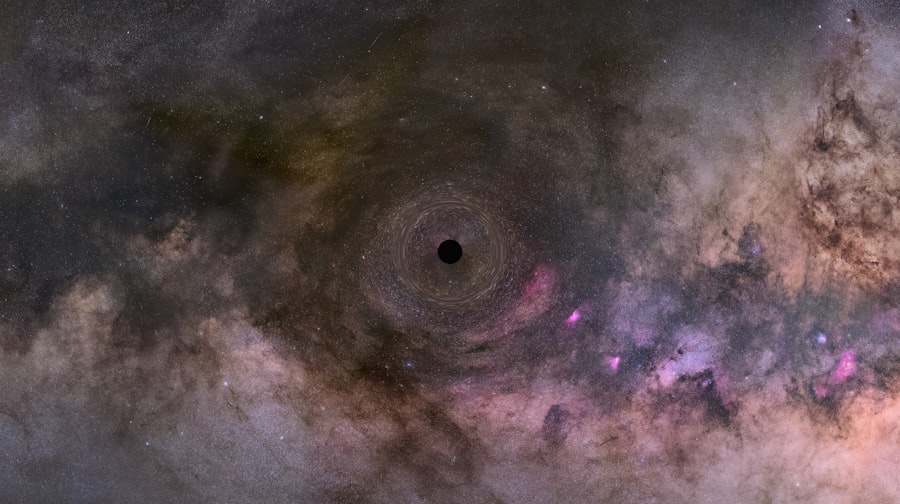
The inability of light to escape a black hole is a direct consequence of the fundamental speed limit imposed by the universe: the speed of light. This limit is deeply ingrained in the laws of physics as described by Einstein’s theory of special relativity.
Special Relativity and the Cosmic Speed Limit
Special relativity, formulated by Albert Einstein in 1905, revolutionized our understanding of space and time. One of its most profound implications is that the speed of light in a vacuum (denoted by the symbol c) is constant for all observers, regardless of their relative motion. This speed is approximately 299,792,458 meters per second.
Inertial Frames of Reference
Special relativity deals with inertial frames of reference, which are non-accelerating environments. In these frames, the laws of physics are the same. The constancy of the speed of light is a cornerstone postulate from which many of its other predictions, such as time dilation and length contraction, are derived.
The Ultimate Velocity Barrier
The speed of light is not merely a characteristic of light itself but rather a universal speed limit for the transmission of information and any physical influence. No object with mass can reach the speed of light, and even massless particles like photons are confined to this speed.
Gravity’s Influence on Spacetime and Motion
General relativity extends special relativity to include gravity. It describes gravity not as a force but as a curvature of spacetime caused by the presence of mass and energy. This curvature dictates how objects move.
Curvature Dictates Trajectories
Massive objects like stars and planets warp the fabric of spacetime around them. Objects moving through this warped spacetime follow curved paths, which we perceive as gravitational attraction. A black hole, with its enormous mass concentrated in a tiny region, warps spacetime to an extreme degree.
The Geometry of Escape
The escape velocity concept highlighted earlier is a direct result of this spacetime curvature. To escape a gravitational well, an object must move fast enough to traverse a path that effectively “straightens out” in the infinitely warped spacetime near a black hole. At the event horizon, this path requires a velocity exceeding the speed of light.
The Unescapable Nature of the Gravitational Well

The extreme gravity of a black hole creates a gravitational well so deep that the spatial geometry itself becomes inverted relative to an escaping observer.
The Inverted Geometry of the Event Horizon
Within the event horizon, spacetime is so severely distorted that the direction towards the singularity becomes the “future” direction, not just spatially, but temporally for any object inside.
Future is Towards the Singularity
Imagine a spacetime diagram. Normally, time progresses upwards, and space sideways. Away from a black hole, these directions are distinct. However, as one approaches and crosses the event horizon, the spacetime becomes so warped that the direction pointing towards the singularity becomes unavoidable, like a permanent “forward” in time. No matter which way you try to move spatially, you are also moving inexorably towards the singularity.
The Role of Time as a Direction
This phenomenon is often described as time itself becoming spatial within the event horizon. The direction that was once associated with the passage of time for an outside observer is now the dominant spatial direction pointing inwards.
Photons and the Absolute Nature of the Limit
Photons, the particles of light, travel at the speed of light. While they have no mass, they are still subject to the curvature of spacetime.
No Mass Does Not Mean No Interaction
Although photons are massless, their energy and momentum mean they interact with the gravitational field. They follow the geodesics (the straightest possible lines) in curved spacetime. Near a black hole, these geodesics are so severely bent inwards that even a photon traveling directly away from the singularity will eventually be pulled back.
Forever Trapped
Once a photon crosses the event horizon, its geodesic points irrevocably towards the singularity. Its speed, which is already the maximum possible, is insufficient to overcome the gravitational pull and change its trajectory to escape the warped spacetime. It is effectively trapped, destined to collide with the singularity or contribute to the black hole’s mass.
The intriguing nature of black holes has captivated scientists and enthusiasts alike, particularly the concept that nothing can escape their grasp, not even light. This phenomenon occurs due to the immense gravitational pull that black holes exert, which warps the fabric of spacetime around them. For a deeper understanding of this captivating subject, you can explore a related article that delves into the science behind black holes and their effects on light and matter. Check it out here to learn more about the mysteries of the universe and the forces that govern it.
Observational Evidence and Implications
| Reason | Explanation |
|---|---|
| Gravitational Pull | The immense gravitational pull of a black hole is so strong that it traps everything, including light, within its event horizon. |
| Escape Velocity | The escape velocity near a black hole is greater than the speed of light, making it impossible for anything, including light, to escape. |
| Curvature of Space-Time | The extreme curvature of space-time near a black hole prevents anything from escaping, as all paths lead towards the singularity at the center. |
While black holes themselves are invisible because they emit no light, their presence can be inferred through their gravitational influence on surrounding matter and their effects on spacetime.
Indirect Detection Methods
Astronomers employ several indirect methods to detect and study black holes, providing compelling evidence for their existence.
Accretion Disks and X-ray Emissions
When a black hole is in a binary system with another star, it can pull matter from its companion. This matter forms a swirling disk around the black hole, known as an accretion disk. As the matter in the disk spirals inwards, it heats up to extremely high temperatures due to friction and gravitational forces, emitting intense X-rays and gamma rays. These emissions can be detected by X-ray telescopes, revealing the presence of an unseen, compact object with high mass, consistent with a black hole.
Stellar Orbits and Galactic Centers
By observing the orbits of stars around their galactic centers, astronomers can infer the presence of supermassive black holes. Stars in these regions move at incredibly high velocities, indicating that they are orbiting a massive, unseen object. The rapid acceleration of stars near the center of our own Milky Way galaxy, for instance, provides strong evidence for the existence of Sagittarius A*, a supermassive black hole at its core.
Gravitational Waves from Merging Black Holes
The direct detection of gravitational waves by observatories like LIGO and Virgo has provided further confirmation of black hole existence and their dynamic interactions. When two black holes merge, they release immense quantities of energy in the form of gravitational waves – ripples in spacetime. The patterns of these waves precisely match the predictions of general relativity for black hole mergers, allowing scientists to measure the masses and spins of the colliding black holes.
The Universal Nature of Black Holes
Black holes are not rare anomalies but are believed to exist throughout the universe in various forms, playing significant roles in galactic evolution.
Stellar-Mass Black Holes
These black holes, typically a few to tens of solar masses, are the remnants of collapsed massive stars. They are found scattered throughout galaxies.
Supermassive Black Holes at Galactic Centers
Found at the heart of most galaxies, including our own, supermassive black holes can have masses ranging from millions to billions of solar masses. Their formation is still an area of active research, but they are thought to grow by accreting gas and merging with other black holes. They play a crucial role in regulating star formation within their host galaxies.
Intermediate-Mass Black Holes
A more recently hypothesized class, intermediate-mass black holes are thought to bridge the gap between stellar-mass and supermassive black holes, with masses ranging from hundreds to tens of thousands of solar masses. Evidence for their existence is growing, but their formation mechanisms are not yet fully understood.
The inescapable pull of black holes, stemming from the extreme warping of spacetime and the fundamental limit imposed by the speed of light, continues to be a focal point of astrophysical research, pushing the boundaries of our understanding of gravity, cosmology, and the very nature of reality.
FAQs
1. What is a black hole?
A black hole is a region in space where the gravitational pull is so strong that nothing, not even light, can escape from it.
2. Why can’t light escape from a black hole?
The gravitational pull of a black hole is so intense that it warps space and time, creating a point of no return called the event horizon. Once light crosses the event horizon, it cannot escape the black hole’s gravitational pull.
3. How do black holes form?
Black holes are formed when massive stars collapse under their own gravity at the end of their life cycle. This collapse creates a singularity, a point of infinite density at the center of the black hole, surrounded by the event horizon.
4. Can anything escape from a black hole?
According to current scientific understanding, nothing can escape from a black hole once it has crossed the event horizon, not even light. However, there are theories such as Hawking radiation that suggest tiny amounts of energy can escape over time.
5. How do we know that nothing escapes from a black hole, including light?
Scientists have observed the effects of black holes on nearby objects and light, such as the bending of light around a black hole and the gravitational pull on nearby stars. These observations support the understanding that nothing can escape from a black hole, including light.