The grand narrative of the universe, from its fiery genesis to the vast, intricate tapestry it is today, is a story of relentless growth. The history of cosmic expansion is not merely an observation; it is a fundamental principle that underpins our understanding of reality. This journey, spanning billions of years, has transformed a singularity into a cosmos teeming with galaxies, stars, and the potential for life.
The prevailing cosmological model, the Big Bang theory, posits that the universe began as an incredibly hot and dense point, a singularity of infinite density and temperature. This moment, approximately 13.8 billion years ago, marks the origin of space, time, matter, and energy. It was not an explosion in space, but rather an expansion of space itself.
The Planck Epoch: The Unknowable Beginning
The earliest moments of the universe, the Planck epoch, are shrouded in mystery. Lasting for a minuscule fraction of a second, from 10⁻⁴³ to 10⁻³⁶ seconds after the Big Bang, this era is characterized by energies so extreme that our current understanding of physics, particularly quantum mechanics and general relativity, breaks down. The four fundamental forces – gravity, electromagnetism, the strong nuclear force, and the weak nuclear force – are believed to have been unified during this primordial state. Scientists theorize that during this epoch, the very fabric of spacetime was being formed and quantized. Understanding this period requires a unified theory of quantum gravity, a theoretical framework that remains elusive.
Inflation: The Epoch of Exponential Growth
Following the Planck epoch, a period of incredibly rapid and exponential expansion, known as cosmic inflation, is thought to have occurred. This inflationary phase, lasting from roughly 10⁻³⁶ to 10⁻³² seconds after the Big Bang, is crucial for explaining several key features of our observable universe. It smoothed out initial inhomogeneities, making the universe remarkably uniform on large scales, and also amplified tiny quantum fluctuations into the seeds of the large-scale structures we observe today, such as galaxies and galaxy clusters. Without inflation, the universe would likely be much smaller, more lumpy, and potentially devoid of the complex structures necessary for life.
The Quark-Gluon Plasma: A Primordial Soup
As inflation subsided and the universe began to expand and cool, it entered a phase dominated by a state of matter known as the quark-gluon plasma. For a brief period, from about 10⁻⁶ seconds to 1 second after the Big Bang, the universe was a searingly hot soup of fundamental particles – quarks and gluons – not yet bound together into protons and neutrons. As the universe continued to expand and cool, these quarks and gluons began to coalesce, forming the first protons and neutrons. This transition marked a significant step towards the formation of the atomic nuclei that would later populate the cosmos.
Nucleosynthesis: The Birth of Light Elements
The period between roughly 3 minutes and 20 minutes after the Big Bang witnessed the formation of the first atomic nuclei, a process known as Big Bang nucleosynthesis. In this hot, dense environment, protons and neutrons fused together, primarily forming helium and trace amounts of deuterium, helium-3, and lithium. The abundance of these light elements observed in the universe today provides strong evidence supporting the Big Bang model. The ratios of hydrogen to helium, for instance, are precisely what the theory predicts based on the conditions of the early universe. Heavier elements, such as carbon, oxygen, and iron, would not be forged until much later, within the cores of stars.
The history of cosmic expansion is a fascinating topic that explores how our universe has evolved over billions of years. For a deeper understanding of this subject, you can read a related article that delves into the key discoveries and theories surrounding the expansion of the cosmos. This article provides insights into the work of astronomers like Edwin Hubble and the implications of the Big Bang theory. To learn more, visit this link.
The Cosmic Dark Ages and the Dawn of Light
Following nucleosynthesis, the universe continued to expand and cool. This period, often referred to as the cosmic dark ages, was characterized by a lack of luminous sources. However, this era was not devoid of activity; it was a crucial period of preparation for the structures that would eventually emerge.
Recombination: The Universe Becomes Transparent
Around 380,000 years after the Big Bang, the universe had cooled sufficiently for electrons to combine with atomic nuclei, forming neutral atoms. This event, known as recombination, dramatically changed the universe’s interaction with light. Prior to recombination, the universe was opaque, with photons constantly scattering off free electrons. After recombination, photons could travel freely through space, making the universe transparent for the first time. This event is directly observable through the Cosmic Microwave Background (CMB) radiation, a faint afterglow of the Big Bang that permeates the entire sky. The CMB represents a snapshot of the universe at the moment it became transparent, and its subtle temperature fluctuations provide invaluable information about the early universe’s composition and structure.
The Cosmic Dark Ages: A Universe in Waiting
The period following recombination, extending for several hundred million years, is known as the cosmic dark ages. While the universe was now transparent, there were no stars or galaxies to produce light. The dominant form of matter was still neutral hydrogen and helium, and the only significant radiation was the cooling CMB. This era was a crucial period for the gravitational assembly of matter. Tiny density fluctuations, amplified during inflation, began to grow, drawing in more and more matter. These regions of slightly higher density acted as gravitational wells, attracting the surrounding neutral gas.
The Emergence of Structure: Stars and Galaxies Take Form
The relentless pull of gravity, acting on the primordial matter, gradually sculpted the universe into the complex web of structures we observe today. This was a long and intricate process, stretching over hundreds of millions of years.
The First Stars: Population III Stars
The seeds of structure, sown by quantum fluctuations and amplified by inflation, eventually coalesced into the first stars, known as Population III stars. These stars, born from pristine hydrogen and helium, were colossal and short-lived. They were significantly more massive than stars like our Sun and burned through their nuclear fuel at an astonishing rate, ending their lives in powerful supernova explosions. These supernovae were crucial, not only for their brilliant light that marked the end of the dark ages, but also for their role in synthesizing heavier elements and dispersing them into the interstellar medium, paving the way for the next generation of stars.
The First Galaxies: Islands of Light
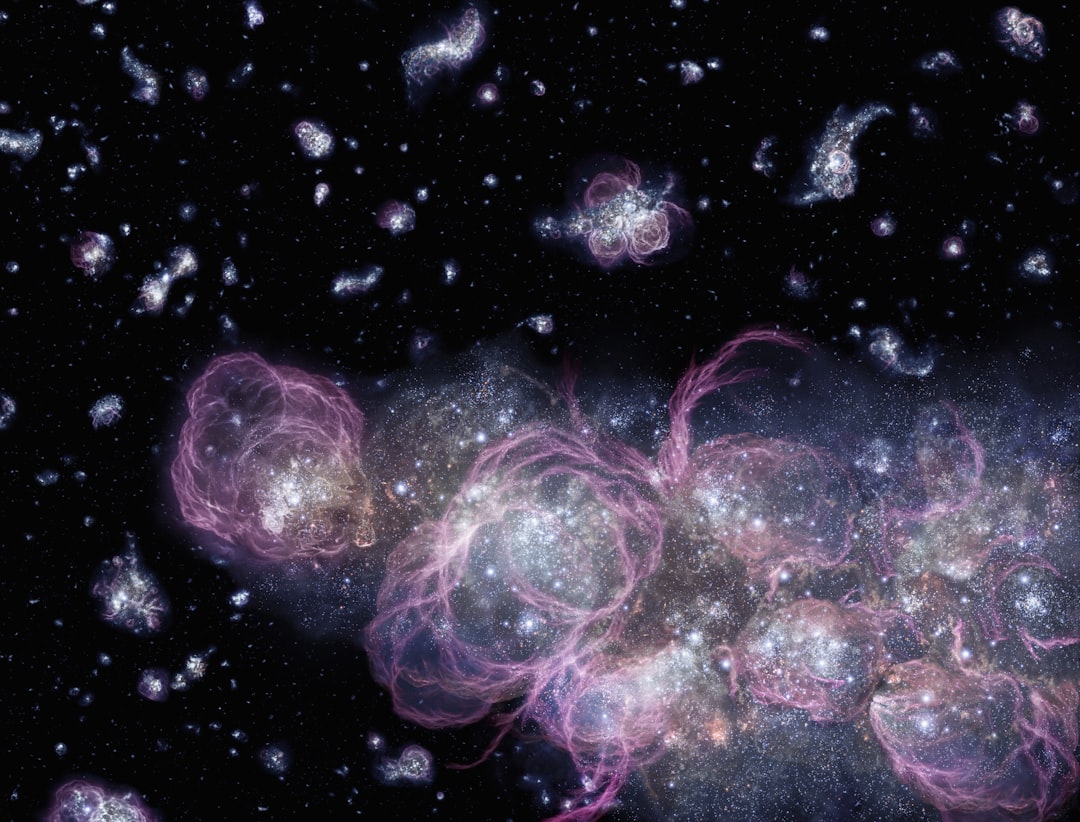
As gravity continued its work, the first stars began to cluster together, forming the earliest protogalaxies. These nascent galaxies were smaller and less organized than the majestic spiral and elliptical galaxies we see today. They were the building blocks, the primordial islands of light in an otherwise vast and dark universe. Through a process of hierarchical merging, these smaller protogalaxies gradually coalesced, accreting more gas and dark matter, growing into larger and more complex galaxies over billions of years. The gravitational dance of these early structures laid the groundwork for the cosmic web.
Reionization: Illuminating the Universe
The intense ultraviolet radiation emitted by the first stars and early galaxies began to ionize the neutral hydrogen gas that filled the intergalactic medium. This process, known as reionization, effectively “cleared” the fog of neutral hydrogen, making the universe transparent to ultraviolet light once again. Reionization is a pivotal event in cosmic history, signaling the transition from the largely neutral universe of the dark ages to the ionized, transparent universe we inhabit today. The timing and extent of reionization are active areas of research, with ongoing efforts to map out this crucial epoch.
The Cosmic Web and its Evolution
The universe is not uniformly distributed; it is organized into a vast, intricate network of filaments, voids, and clusters, known as the cosmic web. This large-scale structure is a direct consequence of the early seeds of density fluctuations and the subsequent gravitational evolution.
Dark Matter: The Invisible Scaffold
A substantial portion of the matter in the universe, approximately 85%, is believed to be dark matter. This enigmatic substance does not interact with light, making it invisible to telescopes. However, its gravitational influence is undeniable. Dark matter provided the gravitational scaffolding around which ordinary matter, such as gas and stars, could gather. Without dark matter, the formation of galaxies and the large-scale structure of the universe would not have proceeded as observed. The precise nature of dark matter remains one of the greatest unsolved mysteries in physics.
Galaxy Clusters and Superclusters: Gravitational Hubs
On the largest scales, galaxies are not randomly distributed but are organized into clusters and superclusters. Galaxy clusters are the most massive gravitationally bound structures in the universe, containing hundreds or even thousands of galaxies. These clusters, in turn, are linked together by vast filaments of gas and dark matter, forming superclusters. These immense structures represent the dominant nodes in the cosmic web, where the gravitational pull is strongest. The study of these structures provides crucial insights into the distribution of matter and the evolution of the universe over cosmic timescales.
The Role of Black Holes: Galactic Engines
Supermassive black holes, lurking at the centers of most large galaxies, play a significant role in galactic evolution and the large-scale structure of the universe. Their immense gravitational pull influences the dynamics of their host galaxies, and their energetic outflows can regulate star formation, impacting the surrounding intergalactic medium. The interplay between supermassive black holes and their host galaxies is a complex feedback loop that shapes the evolution of cosmic structures.
The history of cosmic expansion is a fascinating topic that delves into the evolution of our universe from the Big Bang to the present day. Understanding this expansion helps us grasp the fundamental principles of cosmology and the forces that shape our universe. For a deeper exploration of this subject, you can read a related article that discusses the key milestones in the discovery of cosmic expansion and its implications for our understanding of the universe. Check it out here to learn more about the exciting developments in this field.
The Accelerating Universe: A Surprising Discovery
| Year | Discovery |
|---|---|
| 1929 | Edwin Hubble discovers that galaxies are moving away from us, indicating the expansion of the universe |
| 1998 | Discovery of the accelerating expansion of the universe, leading to the theory of dark energy |
| 2011 | Further evidence for cosmic expansion and dark energy from the Planck satellite |
For much of the 20th century, cosmologists debated the ultimate fate of the universe. Would it expand forever, eventually growing cold and dark, or would gravity eventually halt the expansion and cause it to collapse back on itself? The discovery of dark energy in the late 1990s dramatically altered this picture.
Dark Energy: The Force of Expansion
Observations of distant supernovae revealed that the expansion of the universe is not slowing down, as expected, but is actually accelerating. This unexpected acceleration is attributed to a mysterious force known as dark energy, which is thought to be a property of space itself. Dark energy exerts a repulsive gravitational effect, counteracting the attractive force of gravity and driving the universe apart at an ever-increasing rate. This discovery has profound implications for our understanding of the universe’s future.
The Cosmological Constant and Beyond
The simplest explanation for dark energy is Einstein’s cosmological constant, a term he initially introduced to allow for a static universe but later discarded. However, current observations suggest that dark energy behaves much like a cosmological constant, with its density remaining relatively constant as the universe expands. Nevertheless, alternative theories propose that dark energy might be a dynamic field that changes over time, leading to different possible futures for the universe. The precise nature and origin of dark energy are active areas of research, with ongoing theoretical and observational efforts to unravel this cosmic enigma.
The Fate of the Universe: An Ever-Expanding Future
With the accelerating expansion driven by dark energy, the universe appears destined for a cold, lonely future. Galaxies will continue to recede from each other at an accelerating pace, eventually becoming so distant that their light will no longer be visible. Stars will eventually exhaust their fuel, and black holes will evaporate through Hawking radiation. The universe will become a vast, cold, and dark expanse, a stark contrast to its fiery beginnings. However, our understanding of dark energy is still evolving, and future discoveries could paint a different, albeit speculative, picture.
The history of cosmic expansion is a testament to the fundamental laws of physics and the power of observation. From the singularity of the Big Bang to the accelerating expansion of today, the universe has undergone a remarkable transformation. The ongoing quest to understand the mysteries of dark matter and dark energy, the evolution of structures, and the very origins of existence continues to push the boundaries of human knowledge, reminding us of the vastness and wonder of the cosmos.

Dark Energy May Be Changing—So What Happens to the Universe?
FAQs
What is cosmic expansion?
Cosmic expansion refers to the increase in the distance between galaxies in the universe. This phenomenon was first discovered by Edwin Hubble in the 1920s and is now widely accepted as a fundamental aspect of the universe’s evolution.
When did scientists first discover cosmic expansion?
The concept of cosmic expansion was first discovered by Edwin Hubble in 1929. Hubble observed that galaxies were moving away from each other, leading to the conclusion that the universe is expanding.
What evidence supports the theory of cosmic expansion?
The theory of cosmic expansion is supported by various pieces of evidence, including the redshift of distant galaxies, the cosmic microwave background radiation, and the distribution of galaxies in the universe. These observations all point to the conclusion that the universe is expanding.
How does cosmic expansion relate to the Big Bang theory?
Cosmic expansion is a key component of the Big Bang theory, which posits that the universe began as a hot, dense state and has been expanding ever since. The discovery of cosmic expansion provided crucial evidence for the Big Bang theory and has since become a cornerstone of modern cosmology.
What are the implications of cosmic expansion for the future of the universe?
The implications of cosmic expansion for the future of the universe are still a topic of active research and debate. Depending on the rate of expansion and the amount of dark energy in the universe, the ultimate fate of the universe could be a “Big Freeze,” “Big Rip,” or “Big Crunch.” These scenarios describe possible outcomes based on the continued expansion of the universe.