
The cosmos, a boundless canvas of unfathomable complexity, has long captivated the human intellect. Within this grand tapestry, the concept of computation, the intrinsic processing of information, has emerged as a fundamental lens through which to understand reality. Seth Lloyd, a pioneering figure in quantum computation and information theory, has dedicated his career to exploring the universe as an ultimate computational system. His work posits that the very fabric of existence, from the smallest subatomic particles to the largest galactic structures, can be understood through the lens of information processing. This perspective offers a profound re-evaluation of cosmic operations, suggesting that the universe is not merely evolving, but actively computing.
Lloyd’s foundational premise rests on the idea that the universe, at its core, operates as a quantum computer. This is not a metaphorical comparison but a literal proposition; that the universe performs calculations using quantum mechanical principles.
Information as the Fundamental Constituent
For Lloyd, information is not an emergent property but a fundamental constituent of the universe. Just as energy and matter are conserved, so too is information, though its form may change. This perspective suggests that every interaction, every change of state, is a computational step.
- Bits and Qubits of Reality: In classical computation, the basic unit of information is the bit, representing either a 0 or a 1. In quantum computation, this is extended to the qubit, which can be 0, 1, or a superposition of both simultaneously. Lloyd argues that the universe’s most fundamental particles, such as electrons and photons, behave as qubits, encoding and processing information through their quantum states.
- The Universe’s Program: If the universe is a computer, then it must be running a program. This “program” is not a written code in the human sense, but rather the intrinsic laws of physics themselves. These laws dictate how information is processed and how the quantum components interact, governing everything from particle decay to the formation of stars.
The Dynamics of Quantum Computation
The universe’s computation is not static; it is a dynamic process defined by interactions and evolution. These dynamics are governed by the rules of quantum mechanics, leading to a computational process that is inherently parallel and probabilistic.
- Entanglement as a Computational Resource: One of the most counter-intuitive aspects of quantum mechanics is entanglement, where two or more particles become linked, sharing the same fate regardless of distance. Lloyd views entanglement as a crucial computational resource for the universe. It allows for incredibly complex correlations and parallel processing, enabling the universe to explore a vast number of possibilities simultaneously. Imagine two distant theatrical stages, and the performance on one instantly influences the performance on the other, without any obvious connection; this is entanglement at play in the cosmic剧场.
- Decoherence and Classical Emergence: While the universe may operate fundamentally at the quantum level, we observe a largely classical reality. Lloyd explains this through the process of decoherence, where quantum systems lose their superposition and entanglement due to interactions with their environment. This effectively “collapses” quantum possibilities into definite classical outcomes, much like a quantum computation reaching a classical answer.
Seth Lloyd’s concept of cosmic operations count provides a fascinating framework for understanding the computational capabilities of the universe. For those interested in exploring this topic further, a related article can be found at My Cosmic Ventures, which delves into the implications of Lloyd’s theories and their relevance to quantum computing and information theory. This resource offers valuable insights into how the universe itself may be viewed as a vast computational entity, expanding our understanding of both physics and information science.
The Universe’s Computational Capacity
A key area of Lloyd’s research involves estimating the computational capacity of the universe. How much information can the universe process, and at what rate? These are monumental questions, but Lloyd has proposed frameworks to address them.
Estimating the Universal Bit Rate
Lloyd’s estimates for the universe’s computational capacity are staggering. He has calculated an approximate “bit rate” for the universe, akin to the processing speed of a computer.
- Bits per Second per Joule: Lloyd’s calculations often involve the Planck constant and the total energy density of the universe, leading to an estimated processing power far beyond any human-made supercomputer. He posits that every joule of energy in the universe performs operations at a prodigious rate, converting fundamental interactions into information processing events.
- The Bekenstein Bound and Information Density: The Bekenstein bound, a limit on the maximum entropy (and thus information) that can be contained within a given region of space with a finite amount of energy, plays a crucial role in these calculations. Lloyd extends this principle to the entire universe, suggesting an ultimate limit to the information density and processing power available within its confines.
The Implications for Universal Simulation
If the universe is computing, could we, as conscious beings within it, be part of that computation? This leads to fascinating philosophical and scientific implications.
- The Simulation Hypothesis: While not directly originating from Lloyd’s work, his ideas provide a strong scientific underpinning for the simulation hypothesis, which posits that our reality could be a simulated environment. If the universe is capable of such immense computation, simulating a complex reality like ours is, in principle, within its capabilities.
- Limits to Knowledge and Predictability: Even if the universe is a computer, its sheer scale and complexity mean that predicting its future states with absolute certainty remains an immense challenge. The inherent randomness of quantum mechanics also places fundamental limits on perfect predictability, introducing an element of cosmic “noise” into the grand computation.
Cosmic Evolution and Information Processing
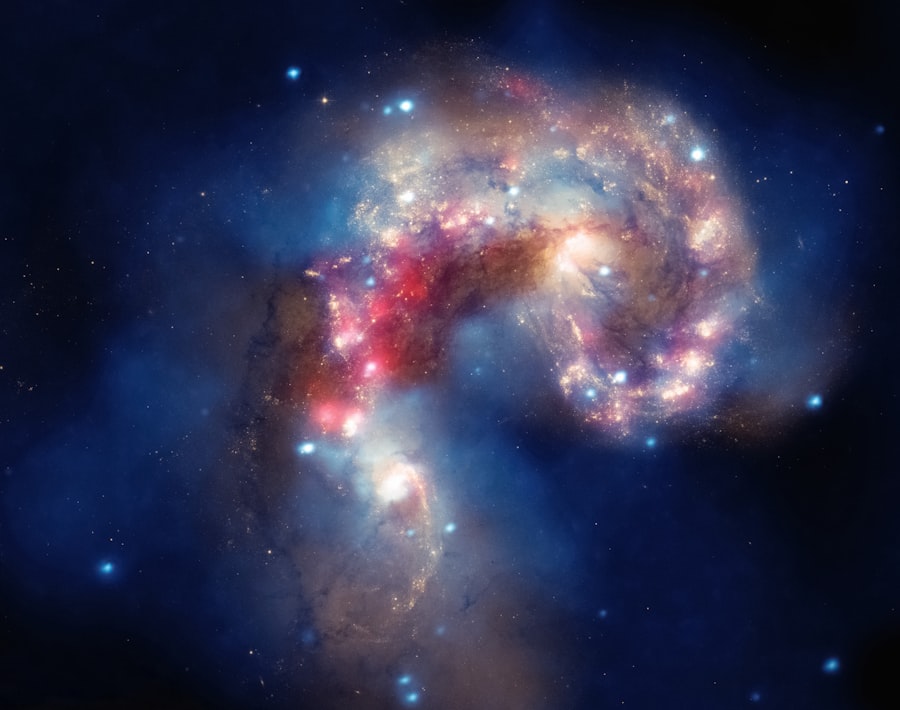
Lloyd’s perspective re-frames cosmic evolution not just as a sequence of physical events but as an ongoing story of information processing and transformation.
From the Big Bang to Complex Structures
The journey from the primordial singularity of the Big Bang to the complex structures we observe today – stars, galaxies, life – can be viewed as an ever-increasing sophistication of information processing.
- Early Universe as a Simple Processor: In the extremely hot and dense early universe, information processing was relatively simple, dominated by fundamental particle interactions. Imagine a powerful but basic calculator, performing simple arithmetic operations at an immense pace.
- Emergence of Complexity: As the universe expanded and cooled, more complex structures began to form. Atoms, molecules, stars, and eventually planets represent increasingly intricate computational modules, performing more sophisticated information processing. The formation of a star, for instance, involves a complex interplay of gravitational forces, nuclear reactions, and energy transport – all interpretable as information being processed and transformed.
- Life as the Ultimate Information Processor: From Lloyd’s perspective, life itself is an extraordinarily advanced form of information processing. DNA, the blueprint of life, is a highly efficient information storage and retrieval system. Biological processes, from cellular metabolism to cognitive functions, are intricate computational algorithms executed within complex biological hardware.
The Arrow of Time and Information Growth
The unidirectional flow of time, often linked to entropy, also finds a complementary explanation in the context of information.
- Increasing Complexity, Not Just Disorder: While the second law of thermodynamics dictates an overall increase in entropy (disorder) in a closed system like the universe, Lloyd suggests that this doesn’t preclude the emergence of localized pockets of increasing order and complexity. These pockets represent the universe “running” more sophisticated computations and generating new information. Imagine a messy room where, through focused effort, a complex LEGO structure is built. Though the room as a whole might still be considered messy, the LEGO structure represents a localized increase in organized information.
- The Universe Learning and Adapting: One could even venture to say that the universe “learns” and “adapts” through its computational processes. As it explores different configurations and possibilities, it effectively refines its “program,” leading to the emergence of highly complex and efficient information processing systems, culminating in conscious observers who can, in turn, analyze and understand the universe’s computations.
The Observer and the Observed
Lloyd’s work also touches upon the profound relationship between the observer and the observed, a cornerstone of quantum mechanics, within the framework of cosmic computation.
The Role of Observation in Cosmic Computation
In quantum mechanics, observation is not a passive act; it actively affects the state of the observed system. This principle has far-reaching implications when applied to the universe as a whole.
- The Universe Observing Itself: If every interaction is a computational step, and observation is an interaction, then the universe is constantly “observing itself.” Particles interact with fields, stars interact with planets, and living organisms interact with their environment – each an act of observation that contributes to the ongoing cosmic computation.
- Consciousness as a Self-Referential Computational Loop: Human consciousness, with its ability to comprehend and interpret the universe, could be seen as a particularly advanced form of self-referential computation. We are not just processing information from the universe; we are also generating new information and feeding it back into the cosmic computational loop through our theories, experiments, and understanding.
The Measurement Problem in a Cosmic Context
The measurement problem – the transition from quantum superposition to definite classical states upon measurement – remains a puzzle. Lloyd’s framework offers a way to contextualize it within the larger cosmic computation.
- Decoherence as Universal Measurement: For Lloyd, decoherence, the interaction of a quantum system with its environment, acts as a continuous, universal measurement process. The vast number of particles and interactions in the universe constantly “measure” each other, driving the collapse of quantum states and the emergence of a classical reality.
- Observer-Independent Reality: While the act of observation is crucial, it does not imply that reality is solely dependent on a conscious observer. Rather, it suggests that reality is a product of ongoing, ubiquitous interactions and computations, where “measurement” is an intrinsic part of the process, occurring whether a conscious entity is present or not.
Seth Lloyd’s concept of cosmic operations count offers a fascinating perspective on the intersection of quantum mechanics and information theory. For those interested in exploring this topic further, a related article can be found at My Cosmic Ventures, which delves into the implications of these ideas in the context of our understanding of the universe. This exploration not only highlights the significance of information in physical processes but also opens up new avenues for research in quantum computing and beyond.
Implications and Future Directions
| Metric | Value | Unit | Description |
|---|---|---|---|
| Estimated Cosmic Operations Count | 10^120 | operations | Maximum number of logical operations the universe can have performed since the Big Bang |
| Estimated Number of Particles in the Universe | 10^90 | particles | Approximate total number of elementary particles in the observable universe |
| Age of the Universe | 13.8 | billion years | Current estimated age of the universe |
| Speed of Light | 3.0 × 10^8 | meters/second | Fundamental constant used in calculations of cosmic operations |
| Planck Time | 5.39 × 10^-44 | seconds | Smallest meaningful unit of time in physics |
| Maximum Information Storage | 10^90 | bits | Estimated maximum number of bits the universe can store |
Seth Lloyd’s work provides a compelling and intellectually stimulating framework for understanding the universe. His “cosmic operations count” offers a unified perspective that bridges physics, information theory, and computation.
A New Lens for Fundamental Questions
This computational view of the universe offers fresh perspectives on some of the most profound questions in science and philosophy.
- The Origin of the Universe: If the universe began as a simple “program,” what initiated it? This pushes the question of creation into the realm of computational genesis.
- The Nature of Reality: Is reality fundamentally digital or analog? Lloyd’s work leans towards a digital, information-based reality, where even continuous variables can be approximated with immense precision.
- The Search for Extraterrestrial Intelligence: If life is a natural outcome of advanced information processing, then the conditions that lead to such processing might be widespread, increasing the probability of other computationally advanced civilizations.
Experimental Verification and Theoretical Refinements
While many of Lloyd’s ideas are theoretical and conceptual, they inspire new avenues for scientific inquiry.
- Quantum Information Experiments: Advances in quantum computing and quantum information science allow for the experimental probing of quantum phenomena at increasingly complex scales. These experiments can provide insights into how information is processed at the most fundamental levels, shedding light on the universe’s own computational mechanics.
- Cosmological Data Analysis: Utilizing cosmological data to look for signatures of universal computation, though challenging, remains a long-term goal. Could there be subtle patterns or correlations in the cosmic microwave background or the distribution of galaxies that hint at an underlying computational process?
- Theoretical Models of Quantum Gravity: Integrating Lloyd’s computational framework with theories of quantum gravity, such as loop quantum gravity or string theory, could lead to a more complete and unified understanding of the universe as a whole. This would involve finding the “quantum code” that governs spacetime itself.
Seth Lloyd’s intellectual journey has taken him from the intricacies of quantum bits to the grand scale of cosmological operations. His vision of the universe as an ultimate quantum computer is not merely a scientific hypothesis but a profound philosophical statement. It invites us to see the cosmos not as a static backdrop for events, but as a dynamic, intelligent system constantly computing its own existence. By considering the universe through the lens of information, we gain a deeper appreciation for the intricate dance of reality, where every particle, every interaction, and every moment contributes to the grand, ongoing computation that is our cosmos. This perspective, while challenging, offers a powerful and elegant framework for understanding the fundamental nature of reality itself.
FAQs
What is the Seth Lloyd cosmic operations count?
The Seth Lloyd cosmic operations count is an estimate of the total number of elementary logical operations that the universe can have performed since the Big Bang. It was proposed by physicist Seth Lloyd as a way to quantify the computational capacity of the cosmos.
How does Seth Lloyd calculate the cosmic operations count?
Lloyd calculates the cosmic operations count by considering the total amount of matter and energy in the universe, the time elapsed since the Big Bang, and the physical limits on computation such as the speed of light and quantum mechanics. He uses these factors to estimate the maximum number of bit operations the universe could have executed.
Why is the cosmic operations count significant?
The cosmic operations count provides insight into the universe as a computational system, helping scientists understand the limits of information processing in physical systems. It bridges concepts from physics, information theory, and computer science, and has implications for fields like quantum computing and cosmology.
What is the approximate value of the cosmic operations count according to Seth Lloyd?
Seth Lloyd estimates that the universe has performed roughly 10^120 elementary logical operations since the Big Bang. This number represents an upper bound on the total computational capacity of the observable universe.
Does the cosmic operations count have practical applications?
While primarily theoretical, the cosmic operations count influences research in quantum computing, information theory, and fundamental physics. It helps frame discussions about the ultimate limits of computation and the nature of physical laws as information processing rules.