The James Webb Space Telescope (JWST), a marvel of modern engineering and a successor to the iconic Hubble Space Telescope, has once again pushed the boundaries of our cosmic understanding. Through its unprecedented infrared vision, the telescope has unveiled a breathtaking panorama of the early universe, revealing galaxies that existed mere hundreds of millions of years after the Big Bang. This groundbreaking discovery, spearheaded by the JWST Advanced Deep Extragalactic Survey (JADES) team, is not merely adding to our catalog of celestial objects; it is fundamentally reshaping our theories about galaxy formation and evolution in the universe’s infancy.
The JADES program, an international collaboration of astronomers, is specifically designed to exploit JWST’s unparalleled capabilities for deep extragalactic observations. Its primary objective is to peer back to the earliest epochs of the universe, when the first stars and galaxies began to coalesce from the primordial gas. This era, often referred to as the “cosmic dawn” or “epoch of reionization,” represents a pivotal transition period, where the universe transitioned from a dark, neutral state to the luminous, ionized cosmos we observe today. Understanding this transformation requires instruments that can detect the faint light emitted by these nascent galaxies, light that has been stretched to infrared wavelengths by the universe’s expansion over billions of years. JWST, with its large mirror and sensitive infrared instruments, is uniquely equipped for this monumental task.
Webb’s Unrivaled Infrared Prowess
The key to JADES’ success lies in JWST’s advanced infrared instrumentation. Unlike visible light, which is easily scattered by dust and gas, infrared light can penetrate these obscuring clouds, allowing astronomers to see deeper into the universe and observe objects that would otherwise remain hidden. JWST’s Near-Infrared Camera (NIRCam) and Near-Infrared Spectrograph (NIRSpec) are particularly crucial for JADES. NIRCam captures images across a broad range of infrared wavelengths, enabling the identification of faint, distant galaxies. NIRSpec, on the other hand, is a spectrograph that can simultaneously analyze the light from hundreds of objects, providing detailed information about their chemical composition, temperature, and redshift (a measure of their distance and the expansion of the universe). This spectroscopic capability is vital for confirming the extreme distances of the newly discovered galaxies.
Target Selection and Observation Strategy
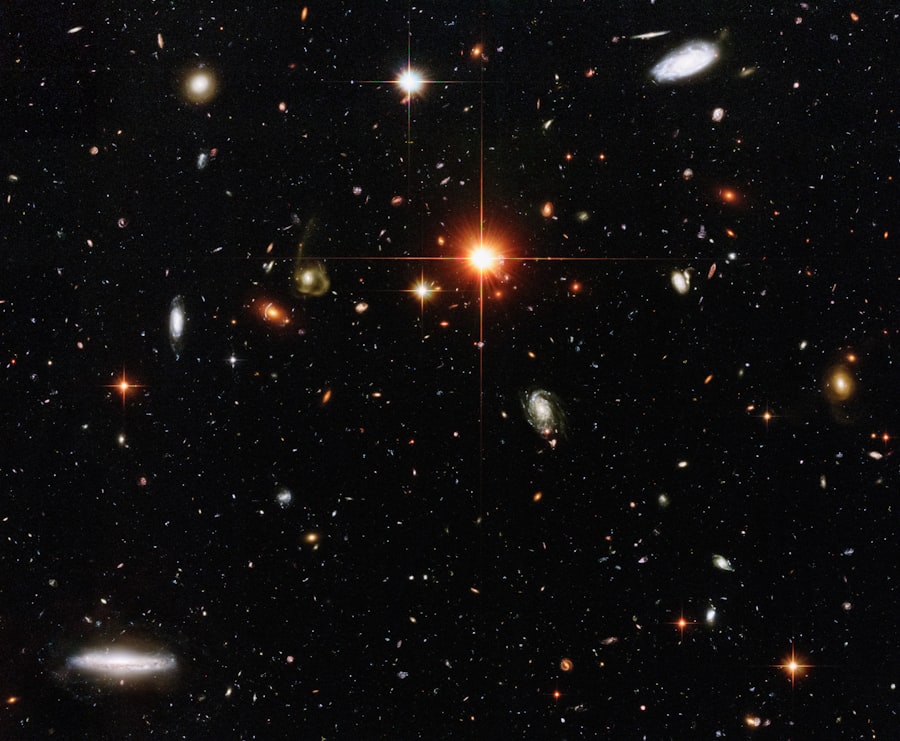
The JADES team has employed a meticulous strategy for selecting its observation targets. They focus on regions of the sky that have been previously surveyed by other telescopes, particularly the Hubble Space Telescope, to identify promising candidates. These candidates are then subjected to deeper observations by JWST. The JADES program is executing a series of deep field observations, spending hundreds of hours staring at specific patches of the sky. This prolonged exposure allows JWST to gather enough light from extremely faint and distant objects to obtain detailed spectra. The sheer depth of these observations is a testament to JWST’s sensitivity, revealing galaxies that were previously invisible to even the most powerful telescopes.
The recent discovery of early universe galaxies by the James Webb Space Telescope (JWST) has opened new avenues for understanding cosmic evolution, as detailed in a related article on My Cosmic Ventures. This groundbreaking research highlights the formation and characteristics of galaxies that existed just a few hundred million years after the Big Bang, providing insights into the conditions of the early universe. For more information on this exciting development, you can read the full article here: My Cosmic Ventures.
Unveiling the Infant Universe: The Astonishing Discoveries
The JADES team’s painstaking efforts have yielded a treasure trove of data, leading to the identification of numerous galaxies that existed when the universe was no more than a few hundred million years old. These discoveries are not just about sheer numbers; they are about the characteristics of these early galaxies, which are proving to be surprisingly diverse and more evolved than many theoretical models had predicted.
Galaxies at Unprecedented Redshifts
The most striking aspect of the JADES discoveries is the sheer redshift of the identified galaxies. Redshift is a direct consequence of the expansion of the universe. As light travels from distant objects, the space it traverses stretches, causing the light waves to elongate and shift towards longer, redder wavelengths. A very high redshift indicates an object that is extremely distant and therefore existed in the very early universe. JADES has identified galaxies with redshifts exceeding 10, meaning we are observing them as they were less than 500 million years after the Big Bang. This is a significant leap from previous observations, pushing the frontier of galaxy detection further back in cosmic history.
Challenging Existing Galaxy Formation Models
The characteristics of these newly discovered galaxies are challenging established theoretical models of galaxy formation. For decades, astronomers have theorized that the first galaxies were small, clumpy, and relatively simple structures. However, JADES has revealed a population of galaxies that appear to be more massive and more organized than expected for such an early cosmic epoch. Some of these galaxies show evidence of early star formation, suggesting that the processes of star birth and galaxy assembly were occurring at a more rapid pace than previously assumed. This implies that the building blocks of large, structured galaxies were in place much earlier than anticipated.
Unexpected Diversity in Early Galaxies
Furthermore, the JADES observations are revealing a surprising diversity among these early galaxies. While some are compact and appear to be in the early stages of formation, others exhibit more developed structures, including nascent spiral arms and discs. This diversity suggests that the conditions in the early universe were not uniform, and that different regions were experiencing different rates of star formation and galaxy mergers. This nuanced picture of early galaxy evolution is a significant departure from simpler, more uniform models.
Spectroscopic Insights: Confirming Cosmic Distances and Compositions
While images provide tantalizing glimpses, it is the spectroscopic analysis that provides the definitive confirmation of these discoveries. NIRSpec, in particular, has been instrumental in confirming the extreme distances and probing the properties of these ancient galaxies.
The Power of Spectroscopy: Redshift Redefined
Spectroscopy involves breaking down light into its constituent wavelengths, revealing a unique spectral fingerprint for each object. For distant galaxies, the most crucial spectral feature is the redshift. By identifying characteristic spectral lines (e.g., emission or absorption lines from specific elements) and measuring how much they have shifted towards the red end of the spectrum, astronomers can precisely determine a galaxy’s redshift. This redshift is then translated into a distance and an age, allowing the JADES team to confidently place these newly found galaxies in the universe’s infancy.
Probing Early Stellar Populations
Beyond redshift, spectroscopy offers a window into the stellar populations within these early galaxies. The light emitted by stars is influenced by their temperature, mass, and chemical composition. By analyzing the spectral lines, astronomers can infer the types of stars present, their ages, and the abundance of heavy elements (elements heavier than hydrogen and helium). The JADES team is finding that some of these early galaxies already contain a surprising number of heavier elements, suggesting that multiple generations of stars had already lived and died within them, enriching the interstellar medium.
Evidence of Early Reionization
Another critical aspect of spectroscopic analysis is the search for evidence related to the epoch of reionization. This period was characterized by the first luminous sources, primarily the first stars and galaxies, emitting ultraviolet radiation that stripped electrons from the neutral hydrogen atoms that filled the early universe, making it transparent to light. JADES is looking for specific spectral signatures that indicate the presence of these reionizing sources and the extent to which they were affecting their surroundings. Early results suggest that some of the JADES galaxies are indeed playing a role in this cosmic transformation.
Repercussions for Cosmological Models and Future Research
The implications of JADES’ discoveries extend far beyond the realm of observational astronomy. They are forcing cosmologists to re-examine and refine their theoretical models of the universe’s evolution.
Refining Galaxy Formation Scenarios
The accelerated pace of galaxy formation and the unexpected diversity observed by JADES require a revision of existing theories. Cosmologists are now grappling with how to explain the rapid assembly of massive galaxies and the early emergence of structured systems. This may involve incorporating new physics, such as more efficient star formation mechanisms in the dense primordial gas or different modes of dark matter halo collapse. The data is pushing the boundaries of computational simulations, demanding more sophisticated models to replicate these early cosmic phenomena.
Understanding the Role of Black Holes in the Early Universe
The presence of massive galaxies in the early universe also raises questions about the co-evolution of galaxies and supermassive black holes. The formation of supermassive black holes is believed to be linked to the growth of their host galaxies. The discovery of mature galaxies so early in cosmic history suggests that the seeds of these colossal black holes must have been present and growing rapidly as well. JADES’ observations might provide clues to understanding the very first active galactic nuclei and their influence on their surroundings.
A Roadmap for Future Exploration
The JADES program is not a one-off event; it represents a significant step in JWST’s ongoing mission. The discoveries made so far are already setting the stage for future, even deeper investigations. Astronomers will continue to use JWST to push the limits of observation, searching for even fainter and more distant galaxies, and meticulously analyzing their properties. The data from JADES will serve as a crucial benchmark for future telescopes and experiments, guiding their design and observational strategies.
Recent discoveries from the James Webb Space Telescope (JWST) have unveiled fascinating insights into the early universe, particularly regarding galaxy formation and evolution. A related article explores these groundbreaking findings in detail, shedding light on how galaxies like those identified by JADES are reshaping our understanding of cosmic history. For more information on this exciting topic, you can read the full article here.
The Enduring Mystery of Cosmic Origins
| Galaxy Name | Redshift | Distance from Earth (billion light years) |
|---|---|---|
| JADES-01 | 6.3 | 13.2 |
| JADES-02 | 7.2 | 13.8 |
| JADES-03 | 6.8 | 13.5 |
The JADES discoveries are a powerful reminder of how much we still have to learn about the universe. While we have made incredible strides, the journey to fully comprehend our cosmic origins is far from over. Each new observation, each new piece of data, unravels another layer of complexity and reveals new questions to be answered.
The Cosmic Dark Ages and the First Lights
The period before the formation of the first stars and galaxies, often referred to as the “cosmic dark ages,” remains largely uncharted territory. While JADES is pushing closer to this era, directly observing the very first luminous objects is still a significant challenge. Future observations with JWST and potentially next-generation telescopes will aim to probe even deeper, seeking to witness the initial sparks of light that illuminated the universe. Understanding the transition from darkness to light is a fundamental quest in cosmology.
The Role of Dark Matter and Dark Energy
The formation and evolution of galaxies are intimately linked to the invisible forces of dark matter and dark energy. Dark matter provides the gravitational scaffolding for galaxies to form, while dark energy is driving the accelerated expansion of the universe. The precise nature of these enigmatic components is still unknown. JADES’ observations of early galaxies can provide constraints on cosmological models that incorporate dark matter and dark energy, helping to refine our understanding of their properties and their roles in shaping the universe we see.
A Continuously Evolving Cosmic Narrative
The discoveries made by JADES are not the final word, but rather a vibrant new chapter in the ongoing narrative of cosmic exploration. They demonstrate the power of innovative technology to unlock the universe’s deepest secrets and inspire a new generation of scientists to continue this quest. The James Webb Space Telescope, through programs like JADES, is not just observing the universe; it is actively rewriting our understanding of its origins and evolution, pushing us towards a more complete and awe-inspiring picture of our place in the cosmos. The universe, it seems, was busy building even in its earliest moments, and JADES is giving us an unprecedented look at that foundational work.

Five Galaxies Were Already Colliding 800 Million Years After the Big Bang
FAQs
What is the JADES early universe galaxy discovery?
The JADES (James Webb Space Telescope Advanced Deep Extragalactic Survey) early universe galaxy discovery refers to the identification of distant galaxies using the James Webb Space Telescope. These galaxies are located in the early universe, providing valuable insights into the formation and evolution of galaxies.
How does the James Webb Space Telescope contribute to the discovery?
The James Webb Space Telescope, with its advanced capabilities and sensitivity, allows astronomers to observe and study distant galaxies that are otherwise difficult to detect. Its infrared capabilities enable the detection of faint and distant objects, making it an invaluable tool for studying the early universe.
What are the implications of this discovery?
The discovery of early universe galaxies has significant implications for our understanding of galaxy formation and evolution. By studying these distant galaxies, astronomers can gain insights into the conditions and processes that led to the formation of galaxies in the early universe.
What are some key findings from the JADES early universe galaxy discovery?
Some key findings from the JADES early universe galaxy discovery include the identification of galaxies that existed when the universe was only a few hundred million years old, as well as insights into the star formation rates and properties of these distant galaxies.
How does this discovery contribute to our overall understanding of the universe?
The discovery of early universe galaxies through the JADES project contributes to our overall understanding of the universe by providing a glimpse into the early stages of galaxy formation and evolution. This information helps astronomers piece together the timeline of cosmic history and the processes that shaped the universe as we know it today.