
The common cosmological model, the Big Bang theory, describes the universe as originating from an extremely hot and dense state approximately 13.8 billion years ago. However, the question of what, if anything, existed before this singularity is a frontier of theoretical physics and cosmology, a realm where established facts give way to speculation grounded in the mathematical frameworks of quantum mechanics and general relativity. While the Big Bang marks the observable beginning of our universe’s expansion and evolution, it doesn’t necessarily preclude the existence of prior states or a more encompassing reality from which our universe emerged.
The Big Bang model, in its standard formulation, presents a boundary to our direct observation and thus our empirical understanding. The singularity itself is a point where the known laws of physics, particularly general relativity, break down.
The Singularity Problem
General relativity describes gravity as the curvature of spacetime. At the Big Bang singularity, spacetime is understood to have been infinitely curved and dense, a situation for which the mathematical tools of classical physics are not equipped to handle. This breakdown suggests that a more fundamental theory, likely one that unifies gravity with quantum mechanics, is needed to describe the universe’s earliest moments. This theory, often referred to as a “theory of quantum gravity,” is currently incomplete, with leading candidates including string theory and loop quantum gravity. Until such a theory is fully developed and experimentally verified, the nature of the singularity and what preceded it remains an open question, a theoretical chasm rather than a factual void.
The Event Horizon of Observation
Our ability to observe the universe is limited by the speed of light and the age of the universe. We can only see as far as light has had time to travel to us since the Big Bang. This cosmic horizon defines the observable universe. Events beyond this horizon are, by definition, unobservable for us, making any speculation about conditions prior to the Big Bang inherently theoretical. This observational limit means that direct evidence for a pre-Big Bang era is, by its very nature, exceedingly difficult, if not impossible, to obtain.
The brane theory, which suggests that our universe exists on a membrane within a higher-dimensional space, raises intriguing questions about the conditions that preceded the Big Bang. For a deeper exploration of this concept and its implications for understanding the origins of our universe, you can read the article on cosmic theories and their connections to the brane model at My Cosmic Ventures. This article delves into various hypotheses about what may have existed before the Big Bang and how brane theory fits into the broader framework of cosmology.
Theoretical Frameworks for Pre-Big Bang Scenarios
Despite the observational limitations, theoretical physicists have developed several models that attempt to address the “before the Big Bang” question. These scenarios are not mutually exclusive in all their implications and often draw upon similar fundamental principles.
Inflationary Cosmology and its Precursors
Inflationary cosmology, a significant extension to the standard Big Bang model, posits a period of rapid exponential expansion of space in the immediate aftermath of the initial hot, dense state. While primarily developed to address certain observed properties of the cosmic microwave background radiation, inflation also has implications for what might have preceded it.
The “Eternal Inflation” Hypothesis
One prominent interpretation of inflation is “eternal inflation.” In this model, inflation, once it begins, never truly stops in all regions of space. Instead, it continues indefinitely, spawning new “bubble universes” that bud off from the inflating spacetime. Our own universe would be one such bubble. In an eternally inflating multiverse, the concept of a single “beginning” becomes problematic. Each bubble universe would have its own Big Bang, but this would be a local event within a larger, ever-expanding inflationary landscape. Therefore, “before” our Big Bang would simply be the perpetually inflating spacetime from which our bubble emerged.
Cyclic Models Resurrected
The concept of a cyclic universe, where the universe undergoes a series of expansions and contractions, has a long history. However, early cyclic models faced theoretical challenges. Modern iterations, often incorporating concepts from quantum gravity or brane cosmology, propose mechanisms for a “bounce” that transitions from a contracting phase to an expanding one, avoiding a true singularity.
The “Big Bounce”
In these “big bounce” scenarios, the universe reaches a point of maximum contraction, where quantum gravity effects become dominant, preventing a collapse into an infinitely dense singularity. Instead, the universe “bounces” back, initiating a new phase of expansion. This suggests a universe that has existed in an endless cycle of contraction and expansion, with our Big Bang being the most recent bounce event. What preceded it would be the previous contracting phase of the same universe.
Brane Cosmology and Collisions
String theory and its extensions, particularly M-theory, introduce the idea of higher dimensions and “branes” – multidimensional objects that can exist within these higher dimensions. In some brane cosmology models, our universe is envisioned as a 3-dimensional brane. The Big Bang could then be interpreted as the result of a collision between two such branes in a higher-dimensional space.
Ekpyrotic and Cyclic Models based on Brane Collisions
The ekpyrotic universe and similar cyclic models propose that the universe undergoes periodic cycles driven by the collision of branes. These collisions would generate the energy and conditions necessary for a new expansion phase. In this framework, “before” our Big Bang would be the prior existence and eventual collision of these branes, a process that could repeat indefinitely.
Quantum Gravity and the Planck Era
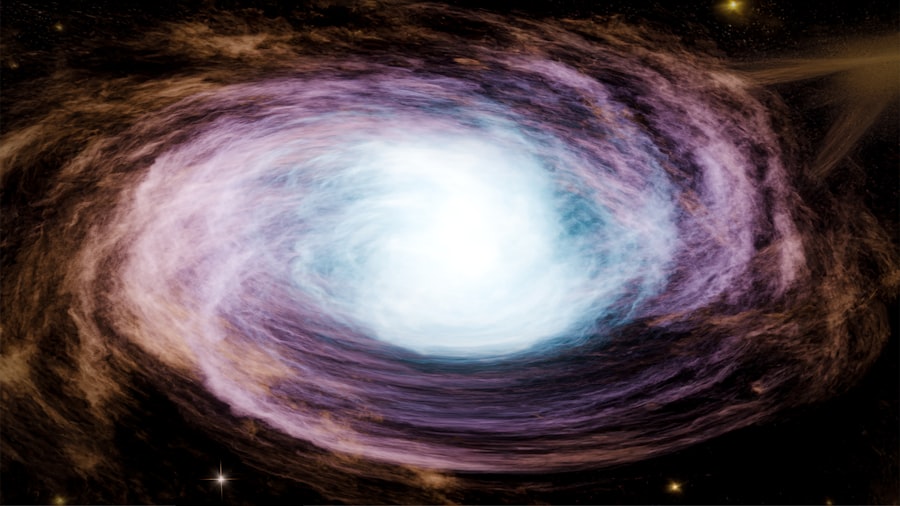
The very earliest moments of the universe, approaching the Big Bang singularity, are theorized to be governed by quantum gravity – the regime where both quantum mechanics and general relativity are crucial. Understanding this Planck epoch is key to exploring what might have preceded it.
The Planck Epoch
The Planck epoch is the earliest imaginable time in the universe’s history, occurring from time zero up to approximately 10⁻⁴³ seconds after the Big Bang. At this incredibly short time, the density and temperature of the universe were so extreme that quantum effects of gravity are expected to have been significant.
String Theory’s Perspective
String theory proposes that fundamental particles are not point-like but rather tiny vibrating strings. In certain string theory models, the universe could be conceptualized as existing on a higher-dimensional manifold, with our familiar four dimensions (three spatial and one time) being just a subset. The Big Bang could be an event occurring within this larger framework, perhaps related to the energy released from string interactions or brane collisions.
Cyclic Universes in String Theory
Some string theory-inspired models explore the possibility of cyclic universes. These models often involve scenarios where the universe undergoes phases of contraction and expansion, with the transition governed by string-theoretic phenomena. The “end” of one universe could be the “beginning” of another, suggesting a continuous existence across these cycles.
Loop Quantum Gravity (LQG)
Loop quantum gravity offers a different approach, seeking to quantize spacetime itself. In LQG, spacetime is viewed as a discrete fabric, composed of fundamental loops. This discreteness inherently avoids the infinities associated with singularities in general relativity.
The Big Bounce in LQG
Loop quantum gravity provides a natural framework for the “big bounce” scenario. Calculations within LQG suggest that the universe, upon reaching a certain point of extreme density, does not collapse into a singularity but rather “bounces” into an expanding phase. This implies a universe that has always existed, transitioning through these bounce events.
Quantum Fluctuations and Vacuum States
Quantum mechanics tells us that even in what we consider empty space (a vacuum), there are constant, tiny fluctuations in energy and fields. Some theories suggest that our universe may have originated from such a quantum fluctuation.
Pre-Existing Vacuum State
In this context, “before” the Big Bang would be a pre-existing vacuum state, possibly a quantum vacuum filled with potential energy. A sufficiently large quantum fluctuation within this vacuum could have triggered the rapid expansion we associate with the Big Bang.
Spontaneous Creation of the Universe
This scenario suggests a spontaneous creation of the universe from a prior, potentially unchanging, quantum vacuum. It removes the need for an external “creator” in the traditional sense, with the universe emerging from the inherent properties of quantum mechanics.
Multiverse Concepts and Analogies

The idea of a multiverse, a collection of multiple universes, is a recurring theme in many pre-Big Bang theories. These universes can have different properties, constants, and even physical laws.
The Infinite Multiverse
Some cosmological models, particularly those involving eternal inflation, predict an infinite number of universes. Each of these universes could have experienced its own Big Bang independently.
Bubble Universes
As mentioned with eternal inflation, our universe is conceived as a “bubble” that nucleated and expanded within a larger, eternally inflating spacetime. The “space” between these bubbles could be considered the realm that “preceded” the formation of our specific bubble universe.
Different Physical Laws in Other Universes
Within these multiverse frameworks, it’s possible that other universes have fundamentally different physical laws, constants, and even dimensions. This raises questions about the uniqueness of our own universe and the nature of physical reality itself.
The Landscape in String Theory
String theory, particularly in its current understanding, suggests a vast “landscape” of possible vacuum states, each corresponding to a different set of physical laws and constants.
Our Universe as One Possibility
Our universe, with its specific set of laws and constants, would represent just one point within this enormous landscape. The Big Bang would then be the event that led to the realization of our particular vacuum state within this landscape.
The Existence of other Universes Before Ours
The landscape implies that many other universes could have formed and evolved, possibly before our own, each corresponding to a different minimum in the string theory potential energy.
The brane theory offers intriguing insights into the conditions that may have existed before the Big Bang, suggesting that our universe could be just one of many within a higher-dimensional space. For those interested in exploring this concept further, a related article discusses the implications of string theory on our understanding of the cosmos. You can read more about it here. This perspective not only challenges traditional views of the universe’s origins but also opens up new avenues for research in theoretical physics.
Challenges and Observational Prospects
| Event | Description |
|---|---|
| Quantum Fluctuations | Small random fluctuations in the energy density of the early universe. |
| Inflationary Epoch | Rapid expansion of the universe, smoothing out irregularities and creating the conditions for the Big Bang. |
| Big Bang Nucleosynthesis | The formation of light atomic nuclei in the early universe. |
| Formation of Atoms | Electrons combine with nuclei to form neutral atoms, allowing light to travel freely. |
| Formation of Galaxies | Gravity causes matter to clump together, forming galaxies and large-scale structures. |
While theoretical models abound, the prospect of experimentally verifying or falsifying hypotheses about the pre-Big Bang era remains a significant challenge. The very nature of these theories places them beyond direct observation.
The Imprint on the Cosmic Microwave Background
The cosmic microwave background (CMB) radiation provides a snapshot of the universe when it was about 380,000 years old. While it offers extremely valuable information about the early universe, looking before this era pushes the boundaries of what the CMB can reveal.
Anomalies and Future Experiments
Scientists are constantly searching for subtle anomalies or patterns in the CMB that might hint at events that occurred before or during the inflationary period. Future, more sensitive CMB experiments, such as those planned with polarization measurements, might provide stronger constraints on inflationary models and, by extension, on pre-inflationary conditions.
Gravitational Waves as a Window
Gravitational waves, ripples in spacetime predicted by general relativity, are also considered a potential messenger from the very early universe. Primordial gravitational waves, generated during inflation, could carry information about the energy scales and physics of that era. Detecting these waves would be a monumental achievement, offering a glimpse into a period far earlier than what is accessible through electromagnetic radiation.
Theoretical Falsification and Progress
The scientific method relies on falsifiability. Theories about the pre-Big Bang era are difficult to falsify because the relevant phenomena are either inaccessible or occurred at scales far beyond our current technological capabilities.
Developing Testable Predictions
The ongoing work by theoretical physicists is focused on developing models that, even if indirectly, offer testable predictions. This could involve predicting specific properties of gravitational waves, suggesting subtle signatures in cosmological observations, or guiding the development of new theoretical frameworks.
The Role of Mathematical Consistency
The primary arbiter of progress in this field, at present, is mathematical consistency and the ability of different theoretical approaches to converge on similar fundamental principles. The pursuit of a unified theory of quantum gravity remains a central goal, and its eventual realization is likely to shed significant light on the question of what, if anything, preceded the Big Bang. The exploration of the universe before the Big Bang remains a testament to humanity’s enduring curiosity and the power of theoretical inquiry to probe the deepest mysteries of existence, even when direct empirical evidence is elusive.
FAQs
What is the brane theory?
The brane theory, also known as the membrane theory, is a concept in theoretical physics that suggests our universe is a 3-dimensional “brane” floating in a higher-dimensional space.
What happened before the big bang according to brane theory?
According to brane theory, before the big bang, there was a collision between two branes in a higher-dimensional space, which resulted in the creation of our universe.
How does brane theory differ from other theories about the origin of the universe?
Brane theory differs from other theories, such as the Big Bang theory, in that it proposes the existence of extra dimensions beyond the familiar three spatial dimensions and one time dimension.
What evidence supports brane theory?
Currently, there is no direct experimental evidence to support brane theory. It is a theoretical framework that is still being explored and tested through mathematical models and simulations.
What are the implications of brane theory for our understanding of the universe?
Brane theory has the potential to provide new insights into the nature of the universe, including the possibility of parallel universes and extra dimensions beyond the ones we currently observe. However, it is still a speculative theory and requires further research and evidence to be fully validated.