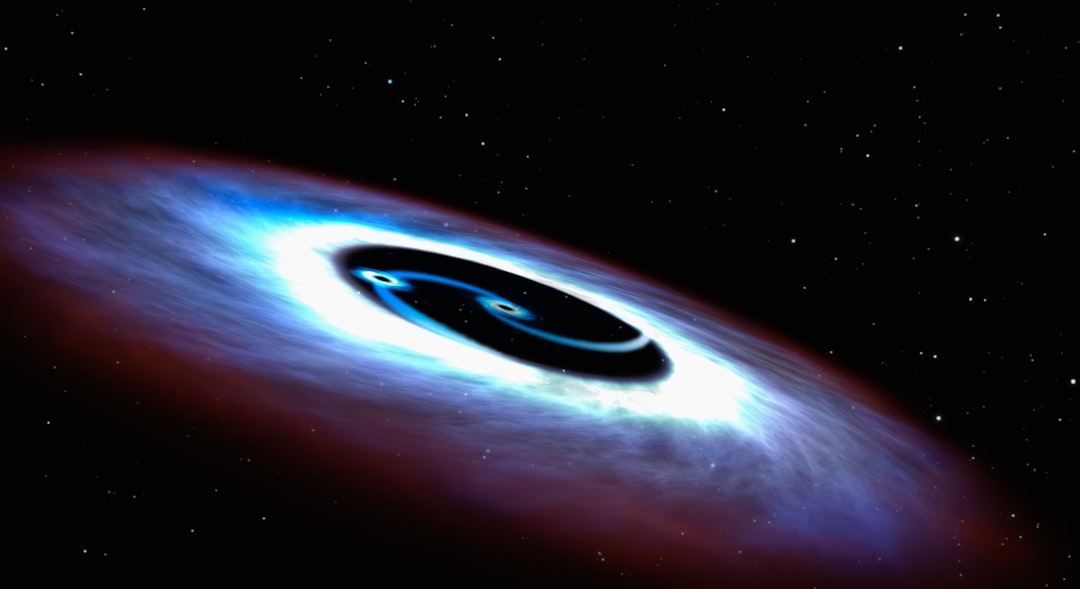
The notion that our universe might reside within the event horizon of a colossal black hole is a fascinating and mind-bending concept that has captured the imagination of physicists and cosmologists. While it remains a speculative hypothesis, it is grounded in our current understanding of gravity, spacetime, and the enigmatic nature of black holes. To explore this possibility requires delving into the intricacies of general relativity, the properties of black holes, and the potential cosmological implications of such an arrangement.
The Foundation: General Relativity and Black Holes
Albert Einstein’s theory of general relativity provides the theoretical framework for understanding gravity not as a force, but as the curvature of spacetime caused by mass and energy. Massive objects warp the fabric of spacetime around them, and this warping dictates the paths of other objects, including light. In this context, black holes represent extreme manifestations of this spacetime curvature.
What is a Black Hole?
A black hole is a region of spacetime where gravity is so strong that nothing, not even light, can escape its pull. This boundary of no return is known as the event horizon. The formation of black holes is typically associated with the gravitational collapse of massive stars at the end of their life cycle. When a star exhausts its nuclear fuel, it can no longer withstand the inward pull of its own gravity, leading to a catastrophic collapse. If the star’s core is sufficiently massive, it collapses into an infinitely dense point called a singularity.
The Event Horizon: A Cosmic Membrane
The event horizon is a peculiar feature of black holes, acting as a one-way membrane. Anything that crosses this boundary is irrevocably drawn towards the singularity. From the perspective of an external observer, time appears to freeze for an object approaching the event horizon, and its light is redshifted into oblivion. However, for an object falling into the black hole, the crossing of the event horizon would not be marked by any immediate spatial anomaly; it would simply be an irreversible journey inward.
Inside the Event Horizon: A Realm of Uncertainty
What lies beyond the event horizon is where our current physics begins to falter. The singularity at the center is a point of infinite density and zero volume, where the known laws of physics break down. General relativity predicts a breakdown of predictability at the singularity, and a complete understanding would likely require a successful quantum theory of gravity, which remains elusive.
The Black Hole Universe Hypothesis: A Conceptual Bridge
The proposition that our universe might exist within a black hole stems from certain similarities between the observed properties of our cosmos and the theoretical description of the interior of a black hole. This hypothesis, though not widely accepted as the leading cosmological model, has been explored by theoretical physicists as a way to reconcile certain cosmological puzzles and to consider the implications of extreme gravitational environments.
Cosmological Similarities
One of the key arguments for this hypothesis draws parallels between the expansion of our universe and the inward motion within a black hole. In the standard cosmological model (Lambda-CDM), the universe is observed to be expanding, with galaxies moving away from each other. Some theoretical models suggest that the interior of a black hole, particularly a rotating one (Kerr black hole), might exhibit a “bounce” or an outward movement from a singularity, which could, in some abstract way, be interpreted as an expansion.
The “Big Bounce” Analogy
The “Big Bounce” is a cosmological model that proposes the universe undergoes a series of expansions and contractions, with the Big Bang being a transition from a previous contracting phase rather than the absolute beginning of existence. Some interpretations of black hole interiors, under specific theoretical conditions, have suggested a similar cyclical behavior, albeit in a vastly different context. Imagine a crumpled piece of paper representing spacetime; a black hole could be thought of as a deep crease. If the universe is within that crease, its outward blossoming could mimic the expansion we observe.
Potential Explanations for Cosmic Phenomena
If our universe were indeed inside a black hole, it could potentially offer explanations for certain puzzling aspects of cosmology. These include the fine-tuning of fundamental constants and the apparent uniformity of the cosmic microwave background radiation.
The Fine-Tuning Problem
The fine-tuning problem refers to the observation that the fundamental constants of the universe, such as the strength of gravity or the mass of elementary particles, appear to be precisely calibrated to allow for the existence of stars, galaxies, and life. If these constants were even slightly different, the universe as we know it could not exist.
Anthropic Principle as a Potential Solution
One widely discussed explanation for fine-tuning is the anthropic principle, which suggests that we observe the universe to be the way it is because if it were different, we would not be here to observe it. This principle, however, can feel somewhat unsatisfactory, as it doesn’t explain why the constants are set the way they are.
The Black Hole Interior as a Filter
The black hole universe hypothesis offers a more tangible, albeit speculative, mechanism. It is proposed that if our universe emerged from such an environment, the conditions within the black hole’s interior might naturally favor the selection of specific physical parameters that are conducive to complexity and evolution. This is akin to a specific type of seed only germinating in a very particular soil; our universe could be the “germinated” outcome of the conditions within the black hole.
The Cosmic Microwave Background (CMB) and Horizon Problem
The cosmic microwave background radiation is a faint afterglow of the Big Bang, providing a snapshot of the universe when it was about 380,000 years old. The CMB is remarkably uniform in temperature across the entire sky, a phenomenon that poses a challenge for standard Big Bang cosmology known as the “horizon problem.” Regions of the universe that are currently too far apart to have ever been in causal contact appear to have the same temperature.
Inflationary Cosmology as a Solution
The prevailing explanation for the horizon problem is cosmic inflation, a hypothetical period of extremely rapid expansion in the very early universe. Inflation is thought to have stretched microscopic quantum fluctuations to macroscopic scales, smoothing out initial irregularities and explaining the observed uniformity.
Black Hole Interior Dynamics and Uniformity
Some proponents of the black hole universe hypothesis suggest that the dynamics within a black hole’s interior, under certain theoretical models, might also lead to a naturally smoothed-out state, thus providing an alternative or complementary explanation for the CMB uniformity without necessarily invoking inflation. The immense gravitational forces and the chaotic nature of the black hole’s interior could, in theory, homogenize the nascent universe before its apparent “birth” within the event horizon.
Theoretical Frameworks and Challenges
While the black hole universe hypothesis is intriguing, it faces significant theoretical and observational challenges. It requires extending our understanding of physics beyond established theories and often involves speculative mathematical models.
Beyond Standard Cosmology
The standard cosmological model, Lambda-CDM, is built upon general relativity and has been exceptionally successful in explaining a vast array of cosmological observations, including the expansion of the universe, the formation of large-scale structures, and the CMB. Any alternative hypothesis, like the black hole universe, must be able to account for these successes while also offering explanations for phenomena that remain problematic for the standard model.
Introducing Extra Dimensions or Modified Gravity
Some theoretical explorations of the black hole universe idea involve scenarios that go beyond standard physics. This might include the existence of extra spatial dimensions, or modifications to the theory of general relativity itself at extreme scales. These additions, while potentially offering new insights, also increase the speculative nature of the hypothesis.
The Singularity Problem Revisited
The singularity at the heart of a black hole remains a significant hurdle. If our universe is inside a black hole, then the singularity is a fundamental part of our cosmic origin. Understanding how a universe can emerge from or exist within such a point of infinite curvature is a profound challenge that currently lacks a definitive answer. It is akin to asking how a river can originate from a single point of infinitely compressed water. The very concept defies our intuitive understanding of origins.
Observational Verification: The Ultimate Test
Perhaps the greatest challenge for the black hole universe hypothesis is the difficulty of finding direct observational evidence to support it. The event horizon of a black hole is, by definition, a boundary from which no information can escape to the outside. If our universe is contained within such a boundary, we would be inherently trapped within it, unable to directly observe its exterior.
Indirect Evidence and Future Telescopes
The search for indirect evidence would rely on identifying anomalies in cosmological observations that cannot be explained by standard models but are predicted by the black hole universe hypothesis. This might involve subtle variations in the CMB, unexpected patterns in the distribution of galaxies, or deviations from predicted gravitational effects at large scales. Future generations of telescopes with enhanced sensitivity and resolution, such as the Square Kilometre Array or next-generation space telescopes, might be able to probe these subtle signatures. It would be like trying to deduce the shape of the entire ocean by observing only the patterns on a single wave.
The Multiverse Connection: Black Holes as Seeds?
The concept of our universe being inside a black hole often finds itself intertwined with the broader idea of a multiverse, a collection of multiple universes. In some theoretical frameworks, black holes could be seen as potential “seeds” or portals to new universes.
Black Holes as “Baby Universes”
Some speculative theories propose that a black hole might not simply lead to a singularity but could instead be the origin of a new, separate universe. The singularity is often viewed as a barrier, but in some models, it could act as a bridge. This new universe would then exist independently of its “parent” universe, with its own set of physical laws and constants, potentially leading to a vast cosmic landscape of diverse universes.
Hawking Radiation and the End of Black Holes
It is important to note that black holes are not eternal. They are predicted to slowly lose mass over time through a process called Hawking radiation. If our universe were a “baby universe” born from a black hole, the demise of its progenitor black hole would not directly affect our universe’s existence within its event horizon. It’s like the umbilical cord being severed; the new life continues independently.
Implications for the Origin of Our Universe
If this scenario were true, the Big Bang would not be the absolute beginning of everything, but rather the “birth” of our universe within a pre-existing structure. The conditions that led to the formation of our universe would then be dictated by the properties of the black hole from which it emerged. This elegantly connects the enigmatic origin of our cosmos to the well-established astrophysical phenomenon of black hole formation.
Conclusion: A Speculative Journey into the Unknown
The hypothesis that our universe might exist inside a black hole remains a deeply speculative but intellectually stimulating avenue of research. It pushes the boundaries of our current understanding of physics and cosmology, forcing us to confront the limitations of our knowledge and to imagine possibilities that defy everyday intuition. While it offers potential explanations for some of the universe’s deepest mysteries, it faces formidable theoretical and observational challenges.
The Ongoing Quest for Understanding
The scientific endeavor is characterized by its relentless pursuit of knowledge, constantly probing the unknown. The black hole universe hypothesis, much like other ambitious cosmological models, serves as a testament to this ongoing quest. Whether it ultimately proves to be a valid description of reality or a fascinating but incorrect detour, its exploration contributes to our deeper understanding of gravity, spacetime, and the profound questions surrounding the origin and nature of our existence. It is a reminder that the cosmos may hold secrets far stranger and more profound than we can currently comprehend, hidden behind cosmic veils we have yet to fully pierce. The journey to unravel these secrets continues, fueled by curiosity and the unwavering spirit of scientific inquiry.
FAQs
1. What does it mean to say our universe is inside a black hole?
This hypothesis suggests that the entire universe exists within the interior of a black hole that formed in a higher-dimensional space. It implies that the Big Bang could be the result of matter collapsing into a black hole in another universe, creating a new, expanding universe inside it.
2. Is there scientific evidence supporting the idea that our universe is inside a black hole?
Currently, the idea is largely theoretical and speculative. While some models in theoretical physics and cosmology explore this concept, there is no direct observational evidence confirming that our universe resides inside a black hole.
3. How does the black hole universe theory relate to the Big Bang?
The theory proposes that the Big Bang might be the “white hole” or the expanding interior of a black hole formed in a parent universe. This could explain the initial conditions of our universe as a result of gravitational collapse in another universe.
4. What are the main challenges in proving or disproving this theory?
One major challenge is the lack of observable data from beyond our universe or from inside black holes. Additionally, the theory requires a framework that unifies general relativity and quantum mechanics, which is still an open problem in physics.
5. Are there alternative explanations for the origin of our universe?
Yes, there are several competing theories about the universe’s origin, including the standard Big Bang model, cosmic inflation, multiverse theories, and cyclic models. Each has different implications and varying degrees of observational support.