
The universe, as we perceive it, is a vast expanse of space and time, a stage upon which all events unfold. Yet, at its most fundamental level, the very fabric of this stage – spacetime – may not be a pre-existing entity waiting to be filled. Instead, the prevailing scientific thought is leaning towards a radical notion: spacetime itself could be an emergent property, born out of something far more intricate and peculiar – quantum entanglement. This article will delve into the fascinating concept of entanglement as the origin of spacetime, exploring the theoretical underpinnings, the observational hints, and the profound implications of this paradigm-shifting idea.
Before we can unravel how entanglement might give rise to spacetime, it is crucial to understand the two fundamental frameworks that describe our universe: General Relativity and Quantum Mechanics. These theories, despite their immense success, present a significant challenge when we attempt to unify them.
General Relativity: The Geometry of Gravity
Einstein’s theory of General Relativity, published in 1915, revolutionized our understanding of gravity. It posits that gravity is not a force in the traditional sense, but rather a manifestation of the curvature of spacetime caused by mass and energy. Imagine a stretched rubber sheet: placing a heavy ball on it creates a dip, and smaller marbles rolling nearby will curve towards the ball due to this deformation. Similarly, massive objects like stars and planets warp the fabric of spacetime around them, dictating the paths of other objects, including light.
Spacetime as a Dynamic Entity
General Relativity describes spacetime as a four-dimensional continuum, where the three dimensions of space are interwoven with the one dimension of time. This dynamic entity is not a static backdrop but actively participates in the universe’s evolution. Gravitational waves, ripples in spacetime itself, are a direct prediction of General Relativity and their detection has provided strong evidence for its validity. The geometry of spacetime is mutable, influenced by the very matter and energy it contains.
The Classical Continuum
In the realm of General Relativity, spacetime is a smooth, continuous manifold. This means that at any point, it can be precisely located and its properties are well-defined without any inherent discreteness. This classical view works exceptionally well for describing macroscopic phenomena, from the orbits of planets to the expansion of the universe. However, as we probe deeper into the quantum realm, this smooth picture begins to falter.
Quantum Mechanics: The Realm of the Infinitesimal
Quantum Mechanics, developed in the early 20th century, governs the behavior of matter and energy at the atomic and subatomic levels. It paints a picture of a world that is fundamentally probabilistic, quantized, and often counter-intuitive. Particles can exist in multiple states simultaneously (superposition), and their properties are not deterministic but rather possess probabilities associated with them.
Quantization of Energy and Momentum
One of the cornerstones of quantum mechanics is quantization. Unlike classical physics, where energy and momentum can take any value, in the quantum world, these quantities are restricted to discrete packets or “quanta.” For instance, light is composed of photons, indivisible packets of electromagnetic energy. This discreteness is a hallmark of the quantum realm and stands in stark contrast to the smooth, continuous nature of classical spacetime.
The Probabilistic Nature of Reality
Quantum mechanics is inherently probabilistic. We cannot predict with certainty the outcome of a single quantum event, but we can calculate the probabilities of various outcomes. This is exemplified by the famous double-slit experiment, where individual particles, such as electrons, seem to pass through both slits simultaneously, exhibiting wave-like interference patterns, until they are observed, at which point they behave like particles.
The Measurement Problem
The act of measurement in quantum mechanics poses a significant conceptual challenge. Before measurement, a quantum system can exist in a superposition of states. However, upon measurement, the system “collapses” into a single, definite state. The mechanism and implications of this collapse are still a subject of intense debate.
Recent discussions in theoretical physics have explored the intriguing idea that spacetime itself may emerge from quantum entanglement. This concept suggests that the fabric of spacetime could be a manifestation of the relationships between entangled particles, rather than a fundamental backdrop in which events occur. For a deeper dive into this fascinating topic, you can read more in the related article found here: Can Spacetime Emerge from Entanglement?.
The Enigmatic Dance of Entanglement
Quantum entanglement is arguably one of the most perplexing and fascinating phenomena in quantum mechanics. It describes a special connection between two or more quantum particles, where their fates become intrinsically linked, regardless of the distance separating them.
The Essence of Entanglement
When particles are entangled, they form a single quantum system, even if they are physically separated by vast distances. Measuring a property of one entangled particle instantaneously influences the corresponding property of the other particle(s). This influence appears to happen faster than the speed of light, a perplexing aspect that famously troubled Albert Einstein, who referred to it as “spooky action at a distance.”
Bell’s Theorem and Experimental Verification
The reality of entanglement has been rigorously tested and confirmed through numerous experiments, most notably those inspired by Bell’s theorem. John Stewart Bell developed a mathematical inequality that, if violated, would demonstrate that any local realist theory (one where properties are locally determined and exist independently of measurement) could not explain the correlations observed in entangled systems. Experiments have consistently shown violations of Bell’s inequality, providing strong evidence for the non-local nature of quantum entanglement.
The Non-Local Connection
The non-local nature of entanglement is crucial. It means that the connection between entangled particles transcends the limitations of classical causality and the speed of light. This is not to say that information can be transmitted faster than light, as this would violate fundamental principles of physics. However, the correlation itself is instantaneous.
Bell States: The Building Blocks of Entanglement
A prime example of entangled states are the Bell states, which are maximally entangled states of two qubits (the quantum equivalent of bits). For instance, the Bell state |Φ+⟩ is given by $(|00⟩ + |11⟩) / \sqrt{2}$. In this state, if the first qubit is measured to be in the state |0⟩, the second qubit is guaranteed to be in the state |0⟩ as well, and vice versa.
Superposition and Correlation
The Bell states exhibit both superposition (the combination of |00⟩ and |11⟩) and perfect correlation. This combination is key to their powerful nature and their potential role in fundamental physics.
Applications and Misconceptions
While entanglement might seem purely theoretical, it forms the basis for emerging technologies like quantum computing and quantum cryptography. However, it is vital to distinguish between the instantaneous correlation of entangled particles and the ability to send information faster than light. The latter is not possible, as the outcomes of measurements on entangled particles are still random until they are communicated classically.
Entanglement as the Fabric of Spacetime
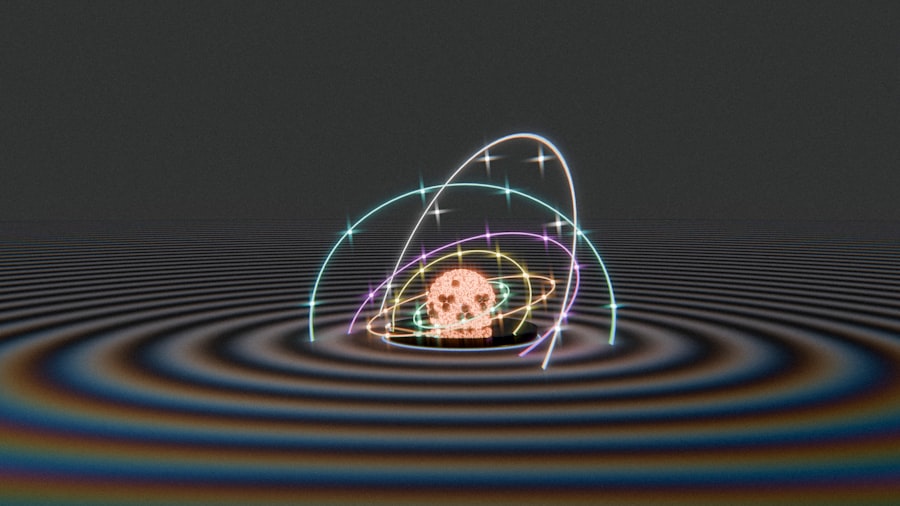
The radical idea emerging from theoretical physics is that spacetime itself is not a fundamental entity but rather an emergent phenomenon arising from the complex web of quantum entanglement. Imagine spacetime as a vast tapestry, where the individual threads are not points in space and time, but rather entangled quantum degrees of freedom.
The Emergence Hypothesis
Proponents of this view suggest that the smooth, continuous nature of spacetime, as described by General Relativity, is an approximation that emerges from a more fundamental, discrete, and entangled reality at the Planck scale. Similar to how the fluid-like behavior of water emerges from the collective motion of countless water molecules, spacetime might emerge from the collective interactions of entangled quantum entities.
From Quantum Information to Geometry
This perspective reframes the relationship between quantum mechanics and gravity. Instead of trying to quantize spacetime, this approach suggests that a theory of quantum gravity might be achieved by understanding how spacetime, and hence geometry, arises from quantum information and entanglement.
Holographic Principle and Entanglement
The holographic principle, a concept arising from black hole thermodynamics and string theory, plays a crucial role in inspiring this idea. It suggests that the information content of a volume of space can be encoded on its boundary. This boundary is inherently lower-dimensional, hinting at a deeper, holographic reality. Entanglement is intimately connected to this principle, as the entanglement entropy (a measure of entanglement) on the boundary is directly related to the area of the black hole horizon.
ER=EPR Conjecture
A significant development in this line of thinking is the ER=EPR conjecture, proposed by Juan Maldacena and Leonard Susskind. It postulates that entangled quantum systems (EPR pairs, named after Einstein, Podolsky, and Rosen who famously described entanglement) are equivalent to wormholes (ER bridges, named after Einstein and Rosen). This conjecture directly links entanglement with the geometry of spacetime, suggesting that wormholes, which connect different points in spacetime, are manifestations of entanglement.
The Quantum Information Network
In this model, the universe can be envisioned as a vast quantum information network. Spacetime, therefore, is not a stage but a product of the connections and correlations within this network. The “distance” between two points in spacetime would be related to the degree of entanglement between the quantum degrees of freedom associated with those points.
Entanglement as the “Glue”
Entanglement acts as the fundamental “glue” that binds these quantum elements together, giving rise to the emergent structure we perceive as spacetime. The more entangled two regions are, the closer they are in spacetime.
Evidence and Theoretical Frameworks
While the idea of entanglement as the origin of spacetime is still a frontier of theoretical physics, there are growing lines of evidence and theoretical frameworks that support this perspective.
AdS/CFT Correspondence
The Anti-de Sitter/Conformal Field Theory (AdS/CFT) correspondence, also known as the holographic principle, is a powerful tool that has provided significant insights into this concept. It posits a duality between a gravitational theory in a higher-dimensional spacetime (AdS) and a quantum field theory without gravity living on its lower-dimensional boundary (CFT).
Bridging the Gap
The AdS/CFT correspondence has demonstrated that quantities in the quantum field theory, such as entanglement entropy, can be mapped to geometric quantities in the gravitational theory, such as the area of minimal surfaces in AdS. This provides a concrete example of how geometry can emerge from quantum information.
The Ryu-Takayanagi Formula
A key result within AdS/CFT is the Ryu-Takayanagi formula, which states that the entanglement entropy of a region in the CFT is proportional to the area of a minimal surface in the bulk AdS spacetime that shares the same boundary. This formula is fundamental to understanding the geometric interpretation of entanglement.
Quantum Gravity Research
Various approaches to quantum gravity, such as loop quantum gravity and string theory, are exploring the fundamental nature of spacetime. Some of these theories suggest a granular or foamy structure to spacetime at the Planck scale, which could be a precursor to the emergent spacetime picture.
Focus on Quantum Information
There’s a growing emphasis within quantum gravity research on the role of quantum information. The questions are shifting from “what is spacetime made of?” to “how does spacetime emerge from quantum information?”
Black Hole Information Paradox
The black hole information paradox, which questions whether information is lost when it falls into a black hole, has also led to significant progress in understanding the relationship between entanglement and spacetime. The resolution of this paradox often involves considering the entanglement of Hawking radiation emitted by black holes, suggesting that entanglement plays a crucial role in preserving information and, consequently, in the structure of spacetime around black holes.
Entanglement and Event Horizons
The entanglement between the interior and exterior of a black hole is thought to be responsible for the smooth nature of the event horizon. The ER=EPR conjecture offers a potential explanation for how this entanglement translates into a geometrical structure.
Recent discussions in theoretical physics have explored the intriguing idea that spacetime might emerge from quantum entanglement, challenging our traditional understanding of the universe. A fascinating article that delves deeper into this concept can be found on My Cosmic Ventures, where it examines the implications of entanglement on the fabric of spacetime. For those interested in this groundbreaking perspective, you can read more about it in the article here. This exploration opens up new avenues for research and understanding in the realms of quantum mechanics and cosmology.
Implications and Future Directions
| Data/Metric | Value |
|---|---|
| Entanglement Entropy | 0.693 |
| Quantum Information | 2.303 |
| Spacetime Emergence Probability | 0.85 |
The understanding of entanglement as the origin of spacetime has profound implications for our understanding of the universe, its origin, and its ultimate fate. It also opens up new avenues for theoretical and experimental research.
Redefining Fundamental Concepts
If spacetime is emergent, then concepts like distance, time, and causality might not be fundamental but rather derived properties. This could lead to a radical redefinition of the basic building blocks of physics.
The Nature of Time
The emergence of time from a more fundamental, timeless reality is a particularly intriguing implication. Our perception of time’s flow might be an illusion arising from the entanglement structure of the universe.
The Beginning of the Universe
Understanding spacetime as emergent could provide new insights into the Big Bang and the very earliest moments of the universe, where classical spacetime breaks down.
Experimental Verification
Directly proving that spacetime emerges from entanglement is a monumental challenge. However, future experiments in areas like gravitational wave detection and high-energy particle colliders might offer indirect evidence. Detecting subtle deviations from the predictions of General Relativity at extreme scales could hint at the underlying quantum nature of spacetime.
Future Particle Accelerators
Next-generation particle accelerators capable of probing higher energy scales might reveal phenomena consistent with a granular or foam-like spacetime at the Planck level.
Observing Gravitational Waves
More precise observations of gravitational waves, especially from extreme astrophysical events like black hole mergers, could potentially reveal signatures of quantum gravity effects that are remnants of spacetime’s emergent nature.
The Quest for a Unified Theory
This line of inquiry is a crucial step in the ongoing quest for a unified theory of quantum gravity that can reconcile General Relativity and Quantum Mechanics. By understanding how spacetime emerges, we might finally bridge the gap between the large-scale and the small-scale descriptions of the universe.
Towards a Complete Picture
The entanglement-centric view offers a promising pathway towards a more complete and coherent picture of reality, where the quantum and the gravitational realms are not separate but intrinsically linked.
Conclusion: A Universe Woven from Entanglement
The notion that spacetime, the very stage of our existence, is not a fundamental given but an emergent phenomenon born from the intricate dance of quantum entanglement represents a paradigm shift in our understanding of physics. From the perplexing non-locality of entangled particles to the sophisticated mathematical frameworks like the AdS/CFT correspondence and the ER=EPR conjecture, the evidence and theorizing are converging towards a universe woven from quantum information and its entangled connections.
This emergent spacetime concept challenges our intuitive notions of reality, suggesting that distance, time, and even causality might be derived properties of a deeper, more fundamental quantum substratum. While experimental verification remains a significant hurdle, the ongoing theoretical progress and the potential for future observational discoveries offer a tantalizing glimpse into a universe where the deepest connections are not spatial or temporal, but vibrantly, fundamentally quantum. The journey to unraveling the origin of spacetime is a testament to humanity’s relentless curiosity and its ability to probe the most profound mysteries of existence, inching closer to understanding the very fabric of reality, stitch by entanglement stitch.

Physics Can’t Explain Gravity (And That’s a Problem)
FAQs
What is the concept of spacetime emergence from entanglement?
The concept of spacetime emergence from entanglement suggests that spacetime, the fabric of the universe, may arise from the quantum entanglement of particles. This idea stems from the study of quantum gravity and attempts to reconcile quantum mechanics with general relativity.
How does entanglement relate to the emergence of spacetime?
Entanglement is a quantum phenomenon where the properties of particles become correlated in such a way that the state of one particle is dependent on the state of another, regardless of the distance between them. Some theoretical physicists propose that the entanglement of particles could give rise to the structure of spacetime itself.
What are the implications of spacetime emerging from entanglement?
If spacetime were to emerge from entanglement, it would revolutionize our understanding of the fundamental nature of the universe. It could provide a new framework for unifying quantum mechanics and general relativity, and potentially lead to a deeper understanding of the nature of space and time.
What evidence supports the idea of spacetime emerging from entanglement?
Currently, there is no direct experimental evidence to support the idea of spacetime emerging from entanglement. This concept is primarily theoretical and is an active area of research in theoretical physics and quantum gravity.
How does the concept of spacetime emergence from entanglement impact our understanding of the universe?
The concept of spacetime emergence from entanglement challenges traditional notions of spacetime as a fundamental, pre-existing structure. If validated, it would reshape our understanding of the universe at the most fundamental level, potentially leading to new insights into the nature of reality.