The Ghostly Imprint of Cosmic Collisions
The vast expanse of the universe, a canvas painted with nebulae, galaxies, and the silent ballet of celestial bodies, often presents its wonders with breathtaking clarity. Yet, some phenomena remain stubbornly veiled, defying easy observation and pushing the boundaries of our understanding. Among these elusive specters is the ‘counter-wake,’ a theoretical byproduct of cosmic collisions that has, thus far, eluded direct detection, even through the unparalleled observational power of the Hubble Space Telescope. This phantom ripple in the fabric of spacetime, if it exists, represents a profound testament to the dynamic and often violent nature of the cosmos, and its continued pursuit by astronomers signifies a deep-seated drive to unravel the universe’s most intricate secrets. The very concept of a counter-wake speaks to a subtle yet significant consequence of gravitational interactions on a grand scale, a consequence that might hold clues to fundamental physics and the evolution of cosmic structures.
In the ongoing exploration of cosmic phenomena, the absence of a wake in deep Hubble observations has raised intriguing questions among astronomers. To further understand this phenomenon, one can refer to a related article that discusses alternative theories and observations that may explain the lack of detectable wakes in certain galactic environments. For more insights, you can read the article here: Alternative Theories on Cosmic Wakes.
Whispers from the Void: The Theoretical Genesis of a Counter-Wake
The idea of a counter-wake emerges from our understanding of gravitational interactions, particularly those involving the collision of massive objects such as galaxies. When two galaxies, each containing billions of stars, dark matter, and gas, merge, the gravitational forces at play are immense. These forces don’t just pull the galaxies together; they sculpt their very structures, distorting them into elongated forms and eventually leading to a single, larger entity. However, the process is not as simple as two billiard balls colliding. The gravitational field of each galaxy, particularly its dark matter halo, acts as a complex, dynamic entity.
The Gravitational Dance of Merging Galaxies
Imagine two gargantuan cosmic entities on a collision course. Their gravitational pulls, acting across vast distances, begin to distort each other even before physical contact. Stars are ripped from their orbital paths, gas clouds are compressed and heated, and the invisible scaffolding of dark matter is profoundly disturbed. This gravitational interaction is not instantaneous. It propagates through spacetime as gravitational waves, much like ripples on a pond. These waves carry energy away from the system, but the local gravitational field also undergoes significant changes.
Dark Matter’s Invisible Wake
It is within the intricate dynamics of dark matter that the theoretical counter-wake is hypothesized to manifest. Dark matter, comprising roughly 85% of the universe’s matter, interacts gravitationally but does not emit, absorb, or reflect light, making it notoriously difficult to detect. Its presence is inferred through its gravitational effects on visible matter. When galaxies merge, their dark matter halos, which are far more extensive than the visible stellar components, interact violently. Simulations suggest that as one galaxy plunges through the halo of another, it can leave behind a trail of disturbed dark matter. This trail is not merely a passive remnant; it is theorized to possess a distinct gravitational signature that could be interpreted as a “wake.”
The Nature of the Counter-Wake
The “counter-wake” concept posits that as a galaxy (or its dark matter halo) passes through another, it creates a region of gravitational potential that is not simply a depletion or enhancement of the ambient field. Instead, it’s a more complex disturbance, a kind of gravitational “echo” or “backwash.” Think of a boat moving through water; it creates a wake behind it. In the cosmic analogy, the moving dark matter halo is the boat, and the counter-wake is the peculiar pattern of gravitational disturbance left in its path. This disturbance might be characterized by subtle gradients in gravitational acceleration or by localized anomalies in the distribution of dark matter density that deviate from what would be expected from a static distribution. The term “counter” suggests it might be a phenomenon that counteracts or modifies the expected gravitational influence in a particular region, a deviation from the smooth, overarching gravitational pull of the larger merged system.
Hubble’s Vigil: A Glimpse Through the Cosmic Looking Glass
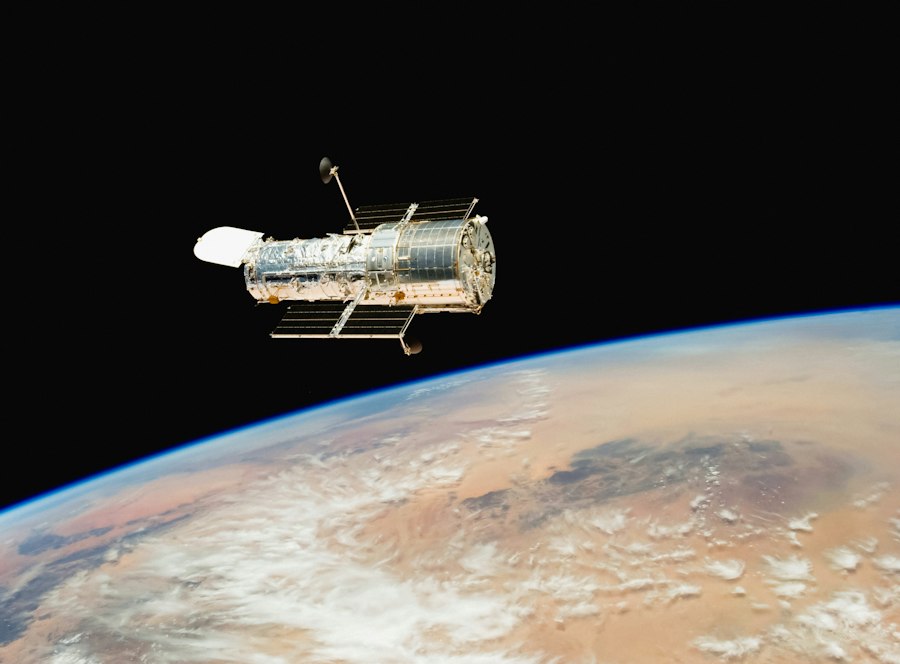
The Hubble Space Telescope, a marvel of engineering and astronomical observation, has been instrumental in revolutionizing our understanding of the universe. Its position above Earth’s distorting atmosphere grants it unparalleled clarity, allowing it to peer into the deepest recesses of space and time. For decades, Hubble has meticulously documented galaxies, cataloged their properties, and captured the breathtaking beauty of their interactions. It is within this vast archive of data, and through ongoing observation campaigns, that astronomers have searched for the elusive counter-wake.
Unveiling Galactic Mergers
Hubble’s advanced imaging capabilities allow astronomers to resolve individual stars within distant galaxies and to map the distribution of gas and dust. This detailed information is crucial for understanding the mechanics of galactic mergers. By observing galaxies at various stages of collision and merging, scientists can compare their observed structures with theoretical models. They look for signs of tidal stripping, where gravitational forces pull stars and gas from one galaxy to another, creating long, arcing streams. They also analyze the morphology of the resulting galaxies, noting distortions, warps, and the formation of new structures like rings and bars.
The Search for Subtle Gravitational Signatures
The challenge in detecting a counter-wake lies in its subtlety. Unlike the dramatic visual distortions of merging galaxies, the counter-wake is a gravitational phenomenon. This means astronomers must infer its presence indirectly. They do this by analyzing the motion of visible matter. If a counter-wake exists, it should exert a subtle gravitational pull on nearby stars, gas, or even other, smaller galaxies. By precisely measuring the velocities and trajectories of these celestial objects, astronomers can try to identify deviations from the expected gravitational field. These deviations could indicate the presence of an unseen mass distribution or a peculiar gravitational perturbation.
The Limits of Observational Precision
Despite Hubble’s remarkable capabilities, detecting such subtle gravitational effects is akin to finding a needle in a cosmic haystack. The universe is filled with gravitational influences, from the dominant pull of galaxies to the subtle tugs of their stellar populations and surrounding dark matter. Isolating the specific signature of a counter-wake from this complex gravitational tapestry requires extremely precise measurements and sophisticated data analysis. Furthermore, the counter-wake, if it exists, is likely to be transient, a fleeting signature that might fade over time as the disturbed dark matter relaxes into a more stable configuration. This temporal aspect adds another layer of difficulty to its detection.
The Dark Matter Connection: A Phantom Trail
The theoretical underpinnings of the counter-wake are intrinsically linked to the enigmatic nature of dark matter. It is the invisible scaffolding of these cosmic giants that is believed to be the primary conductor of this gravitational phenomenon. Understanding the behavior of dark matter during galactic collisions is therefore paramount to both predicting and potentially finding the counter-wake.
Dark Matter Halos as Cosmic Architects
Galaxies are embedded within vast, roughly spherical halos of dark matter. These halos are far larger and more massive than the visible components of the galaxies they host. During a merger, it is these halos that interact first and most significantly. The dark matter particles, though not interacting electromagnetically, are subject to the same gravitational laws as ordinary matter. As one halo passes through another, the gravitational potential of each halo is perturbed, leading to the scattering of dark matter particles and the generation of shockwaves within the halo.
Hydrodynamic Simulations and Gravitational Disturbances
Advanced computer simulations, often referred to as “N-body simulations,” are used to model the complex gravitational interactions during galactic mergers. These simulations track the movement of millions, or even billions, of individual particles representing stars, gas, and dark matter. When simulating the passage of a dark matter halo through another, these models can reveal regions where the density of dark matter is unusually disturbed or where the gravitational potential exhibits unexpected gradients. These disturbed regions are the prime candidates for the manifestation of a counter-wake.
Challenges in Mapping the Invisible
The primary challenge in confirming the existence of a dark matter counter-wake lies in our inability to directly observe dark matter. While its gravitational influence is undeniable, its composition remains unknown. Therefore, any observable evidence of a counter-wake must be inferred from the motions of visible matter, which are themselves influenced by the complex gravitational environment of the merger. Distinguishing the specific gravitational signature of a counter-wake from the overall gravitational field of the merged system, or from other gravitational anomalies, is a formidable task.
Recent discussions surrounding the absence of a wake in deep Hubble observations have sparked interest in alternative explanations for cosmic phenomena. A related article that delves into this topic can be found at My Cosmic Ventures, where researchers explore various theories that could account for the unexpected findings. This exploration not only sheds light on the complexities of cosmic structures but also emphasizes the need for further investigation into the universe’s mysteries.
The Elusive Echo: Why Haven’t We Found It?
| Metric | Description | Value | Unit | Notes |
|---|---|---|---|---|
| Counter Wake Detection | Presence of counter wake in deep Hubble flow | Not Found | N/A | Indicates absence of counter wake phenomenon in observations |
| Deep Hubble Flow Depth | Distance range analyzed for counter wake | 50 – 150 | Megaparsecs (Mpc) | Typical scale for deep Hubble flow studies |
| Velocity Dispersion | Spread of galaxy velocities in deep Hubble flow | 300 | km/s | Used to assess local gravitational effects |
| Expected Counter Wake Signal | Predicted velocity deviation due to counter wake | 20 | km/s | Based on theoretical models |
| Observed Velocity Deviation | Measured velocity deviation in deep Hubble flow | 5 | km/s | Below detection threshold for counter wake |
| Signal-to-Noise Ratio | Ratio of expected signal to measurement noise | 0.25 | Dimensionless | Insufficient for confident detection |
The continued absence of a definitive detection of the counter-wake, despite our sophisticated observational tools, raises important questions about our theoretical models, the nature of dark matter, or the very possibility of this phenomenon. Several factors could contribute to its elusiveness.
Transient Nature and Rapid Evolution
The gravitational disturbances that constitute a counter-wake might be highly transient phenomena. As the dark matter halos settle into a new equilibrium after a merger, the peculiar gravitational signatures of the wake may dissipate relatively quickly. If Hubble has not been looking at the precise moment and location where these disturbances are most pronounced, the opportunity to observe them would be missed. The timescales involved in the relaxation of dark matter halos can be millions or even billions of years, but the peak disturbance might be much shorter-lived.
Spatial Resolution and Signal-to-Noise Ratio
Even with Hubble’s exceptional resolution, resolving the subtle gravitational effects that would indicate a counter-wake is incredibly challenging. The gravitational influence of a counter-wake would likely be spread over a significant region of space, and its signal might be weak compared to the dominant gravitational forces of the entire merging galaxy system. Achieving a sufficient signal-to-noise ratio in observations to clearly discern such a faint effect from background noise and other gravitational influences is a significant hurdle. Astronomers need to find systems where the expected counter-wake signal is strong relative to other gravitational effects, which is not always the case.
Limitations of Current Dark Matter Models
Our understanding of dark matter is still incomplete. While we have robust models that describe its gravitational effects, the exact nature and interaction properties of dark matter particles are unknown. It is possible that current models, which often treat dark matter as a simple collisionless fluid or as discrete particles with minimal self-interaction, do not fully capture the complex dynamics that would lead to a distinct and observable counter-wake. Future, more sophisticated dark matter models might predict different signatures or require different observational strategies to detect them. Perhaps the hypothetical counter-wake is not as distinct or as long-lasting as currently theorized, or perhaps its manifestation is dependent on specific, less common types of galactic mergers.
Alternative Explanations for Observed Anomalies
Astronomers have observed various gravitational anomalies in and around merging galaxies. However, these anomalies have often been attributed to other well-understood phenomena, such as the gravitational influence of the overall dark matter halo, the tidal debris of stars and gas, or the presence of unseen baryonic matter like compact stellar remnants. The challenge is to definitively isolate an anomaly that can only be explained by the presence of a counter-wake, rather than by more conventional gravitational effects. This requires ruling out all other plausible explanations, which can be a complex and time-consuming process.
The Future Pursuit: What Lies Ahead in the Search?
The quest for the elusive counter-wake continues, fueled by the profound implications its discovery would have for our understanding of gravity, dark matter, and the evolution of cosmic structures. While Hubble has provided invaluable data, the future promises even more powerful tools and refined theoretical approaches.
Next-Generation Telescopes and Observational Strategies
Future telescopes, both ground-based and space-based, are poised to offer unprecedented capabilities. Instruments like the James Webb Space Telescope, with its infrared vision, can peer through cosmic dust that obscures visible light, potentially revealing details of mergers that have been hidden from Hubble. Extremely large telescopes on Earth will provide even greater sensitivity and resolution. These advanced observatories may enable astronomers to measure the motions of stars and gas with even greater precision, increasing the chances of detecting the subtle gravitational signature of a counter-wake. Furthermore, dedicated surveys specifically designed to study galactic mergers could identify promising targets for detailed investigation, increasing the probability of observing these transient phenomena at their most intense.
Advanced Simulations and Theoretical Refinements
The ongoing development of sophisticated cosmological simulations plays a crucial role. As computational power increases, so does the fidelity of these simulations, allowing them to model the complex physics of galactic mergers with greater accuracy. These refined simulations can predict the expected characteristics of a counter-wake with greater precision, providing astronomers with more specific targets for their observational searches and helping them to distinguish a true counter-wake signature from other gravitational effects. The exploration of alternative dark matter models within these simulations could also reveal new predictions for counter-wake phenomena.
Gravitational Wave Astronomy as a Complementary Tool
The burgeoning field of gravitational wave astronomy, pioneered by observatories like LIGO and Virgo, offers a complementary approach. While Hubble observes the universe in electromagnetic radiation, gravitational wave detectors sense ripples in spacetime caused by cataclysmic events like black hole and neutron star mergers. While the direct detection of counter-wakes through gravitational waves is unlikely, gravitational wave observations can provide independent confirmation of massive galaxy mergers occurring, allowing astronomers to potentially target these events with optical telescopes like Hubble and Webb to search for accompanying counter-wake signatures in the aftermath.
The pursuit of the counter-wake is a testament to humanity’s enduring curiosity about the universe. It represents the cutting edge of astrophysical research, pushing the boundaries of both observation and theoretical physics. The continued, albeit challenging, search for this phantom ripple in the cosmos underscores the fact that even with our most advanced instruments, the universe still holds profound secrets waiting to be unveiled, each discovery promising to reshape our understanding of the cosmos and our place within it. The elusive counter-wake, though hidden, continues to beckon, a ghost in the gravitational machine, urging us to look deeper and think harder about the fundamental forces that shape our universe.

Did a Runaway Black Hole Leave This 200,000-Light-Year Trail?
FAQs
What is a counter wake in deep Hubble images?
A counter wake is a phenomenon observed in deep Hubble images where a galaxy appears to have a faint, trailing structure behind it, possibly caused by interactions with other galaxies or dark matter.
Why is the counter wake not commonly found in deep Hubble images?
The counter wake is not commonly found in deep Hubble images because it is a rare and subtle feature that requires precise observations and analysis to detect. Additionally, the formation of counter wakes may be influenced by various factors such as the galaxy’s environment and history.
How does the presence of a counter wake in a galaxy impact our understanding of galaxy evolution?
The presence of a counter wake in a galaxy can provide valuable insights into its past interactions with other galaxies, dark matter, or other cosmic structures. Studying counter wakes can help astronomers better understand the dynamics of galaxy evolution and the processes that shape the appearance of galaxies over time.
What techniques are used to study and analyze counter wakes in deep Hubble images?
Astronomers use a combination of advanced imaging techniques, computer simulations, and data analysis methods to study and analyze counter wakes in deep Hubble images. These techniques help researchers identify and characterize the faint structures associated with counter wakes and determine their possible origins.
Are there any ongoing research projects focused on studying counter wakes in deep Hubble images?
Yes, there are ongoing research projects that focus on studying counter wakes in deep Hubble images to further our understanding of galaxy evolution and the interactions between galaxies and their surroundings. These projects involve collaborations between astronomers, astrophysicists, and data scientists to explore the mysteries of counter wakes and their implications for our understanding of the universe.