
The human mind grapples with time, imagining it as a river flowing inexorably forward. Events are etched in the past, immutable and fixed. Yet, the peculiar realm of quantum mechanics, where probabilities dance and certainty is a fragile illusion, throws this comforting linearity into question. At the heart of this bewilderment lies the phenomenon of observation and its seemingly profound, and often paradoxical, influence on the quantum world. Specifically, the question arises: does observing a photon, the fundamental particle of light, possess the power to alter events that have already transpired? This is not a question of simple recall or recording; it delves into the very fabric of causality and the nature of reality at its most fundamental level.
The Quantum Enigma of Observation
The concept that observation can influence reality is not an intuitive one. In our macroscopic world, observing a ball rolling down a hill does not alter its trajectory. We are passive witnesses to events. However, in the quantum universe, the act of measurement is inextricably linked to the state of the system being measured. This is a cornerstone of quantum theory, often referred to as the “observer effect” or, more accurately, the “measurement problem.”
The Wave-Particle Duality: A Paradoxical Nature
At the heart of the photon’s enigma lies its dual nature. It behaves, at times, as a discrete packet of energy – a particle. At other times, it exhibits characteristics of a wave, spreading out and interfering with itself. This wave-particle duality is not a matter of a photon being one or the other at any given moment, but rather possessing both potentialities simultaneously until an interaction forces it into a definite state.
The Double-Slit Experiment: A Quantum Canvas
The iconic double-slit experiment serves as the most compelling demonstration of this duality and the role of observation. When photons are sent one by one towards a screen with two slits, an interference pattern emerges on a detector screen behind it, as if each photon had passed through both slits simultaneously and interfered with itself, a characteristic of waves. This suggests the photon was in a superposition of states, exploring both paths.
The Collapse of the Wave Function: The Observer’s Role
However, when detectors are placed at the slits to ascertain which slit each photon passes through, the interference pattern vanishes, and instead, two distinct bands appear, as if the photons behaved purely as particles. The act of observation, of “knowing” which path the photon took, appears to force the photon out of its wave-like superposition and into a definite, particle-like state. This abrupt transition from a probabilistic wave to a definite outcome is often described as the “collapse of the wave function.”
Superposition: A State of Many Possibilities
Before observation, a quantum system like a photon can exist in a superposition of multiple possible states simultaneously. This means it is not definitively here or there, or spinning clockwise or counter-clockwise. It embodies all these possibilities until a measurement forces it to “choose” one.
Schrödinger’s Cat: An Analogous Thought Experiment
While not directly about photons, Schrödinger’s famous cat paradox illustrates the implications of superposition on a larger scale. A cat in a box, linked to a quantum event that has a 50% chance of releasing poison, is considered both alive and dead simultaneously until the box is opened and the cat’s state is observed. This highlights the counter-intuitive nature of quantum superposition.
The Uncertainty Principle: Limits on Knowledge
Heisenberg’s Uncertainty Principle further emphasizes the constraints on our knowledge of quantum systems. It states that certain pairs of physical properties, such as position and momentum, cannot be simultaneously known with perfect accuracy. The more precisely one is known, the less precisely the other can be determined. This implies that any act of measurement inherently introduces some degree of disturbance to the system.
The intriguing question of whether observing a photon can alter the past delves into the realms of quantum mechanics and the nature of reality itself. For those interested in exploring this concept further, a related article can be found at My Cosmic Ventures, which discusses the implications of observation on quantum states and the philosophical ramifications of such phenomena. This exploration not only challenges our understanding of time and causality but also invites readers to ponder the very fabric of the universe.
The Arrow of Time: A Quantum Perspective
The classical understanding of time is deeply rooted in the concept of causality: cause precedes effect. The past is a fixed sequence of events that led to the present. The quantum realm, however, introduces complexities that challenge this unidirectional flow.
Retrocausality: The Idea of Backwards Causation
Retrocausality, the concept that an effect can precede its cause, is a highly speculative but theoretically explored idea within quantum mechanics. It suggests that future events might, in some way, influence past events. However, mainstream interpretations of quantum mechanics largely adhere to causality in the forward direction.
Delayed Choice Experiments: A Crucial Distinction
Experiments like the delayed-choice experiment, pioneered by John Archibald Wheeler, are often cited in discussions about observing photons and time. In these experiments, the choice of whether to measure the photon’s wave-like or particle-like nature is made after the photon has already passed through the slits. The results show that the photon behaves as if the choice was made at the time it passed through the slits, even though the decision was made later.
The Illusion of Retrocausality: A Matter of Interpretation
While these experiments are mind-bending, they are generally interpreted not as the photon changing its past trajectory, but rather as the “measurement” defining which past reality is accessed or revealed. The wave function, representing all possibilities, evolves and collapses based on future choices, but it doesn’t rewrite history in a causal sense. The photon never was definitively in a wave state or a particle state until the measurement determined it.
The Nature of Quantum Information: Not History Books
Quantum information is probabilistic and deals with possibilities, not with a fixed historical record. When we observe a photon, we are essentially collapsing its wave function into a definite state. This act doesn’t alter a pre-existing definite past; rather, it defines the present outcome from a range of potential pasts.
Information is Acquired, Not Created or Destroyed
The information about the photon’s state is acquired through the measurement. This information was not present in a definite form before the measurement, and the measurement process itself doesn’t erase or change a concrete past event. It’s more akin to developing a photograph that was in a latent state; the act of development reveals what was captured, it doesn’t alter the light that hit the film.
The Past as a Probability Landscape
One way to conceptualize this is to imagine the past not as a single, solid path, but as a landscape of probabilities. The act of observation, or measurement, is like walking into this landscape and choosing a particular path to follow. You are not altering the entire landscape; you are simply defining the specific route your consciousness experiences.
The Measurement Problem: An Unresolved Paradox
The “measurement problem” remains one of the most significant unsolved puzzles in quantum mechanics. It grapples with how and why the act of measurement leads to the collapse of the wave function, and what constitutes a “measurement” in the first place.
Decoherence: The Interaction with the Environment
One leading explanation for the apparent collapse is decoherence. This theory suggests that a quantum system, like a photon, interacts with its environment (air molecules, stray photons, detectors). These interactions rapidly entangle the system with its surroundings, effectively destroying its quantum coherence and making it behave classically, appearing to have a definite state.
Is the Observer Essential?
Decoherence suggests that a conscious observer is not necessarily required for the wave function to “collapse.” Any interaction with a macroscopic system can achieve the same effect. This shifts the focus from the subjective experience of an observer to the objective process of interaction.
The Role of Macroscopic Systems
Macroscopic systems, being composed of a vast number of particles, are far more robust to quantum superposition. When a quantum system interacts with a macroscopic system, its delicate quantum state is overwhelmed by the sheer number of interactions, leading to a classical outcome.
Different Interpretations of Quantum Mechanics
The measurement problem has led to various interpretations of quantum mechanics, each offering a different perspective on the role of observation and the nature of reality.
The Copenhagen Interpretation: The Standard View
The Copenhagen interpretation, championed by Niels Bohr and Werner Heisenberg, is the most widely taught and accepted. It posits that a quantum system does not have definite properties until they are measured. The act of measurement forces the system into a definite state.
The Many-Worlds Interpretation: Parallel Universes
The Many-Worlds Interpretation, proposed by Hugh Everett III, suggests that every quantum measurement causes the universe to split into multiple parallel universes, each representing a different possible outcome. In this view, the wave function never truly collapses; all possibilities are realized in different universes.
The Problem of “Consciousness”: A Philosophical Minefield
Some early interpretations of quantum mechanics suggested that consciousness itself played a role in collapsing the wave function. However, this view is largely dismissed by most physicists today, as it lacks empirical support and introduces unnecessary philosophical complexities.
The Physicality of Measurement
The prevailing view is that measurement is a physical interaction, not a mental one. The interaction between the quantum system and a measuring device, which is itself a macroscopic object, is what leads to the observed outcome.
Avoiding Anthropomorphism
It is crucial to avoid anthropomorphizing quantum phenomena. The “observer” in quantum mechanics does not necessarily imply a human being with subjective awareness. It refers to any interaction that extracts definite information from a quantum system.
The Photon’s Journey: A Snapshot in Time
When we observe a photon, we are essentially taking a snapshot of its state at a particular moment. This snapshot is a definite outcome from a range of possibilities that existed before the observation. The question then becomes whether this act of “snapshotting” retroactively alters the path the photon took to arrive at that moment.
The Principle of Indeterminacy: No Fixed Past for a Photon
Quantum mechanics, particularly through the Uncertainty Principle, suggests that a photon, before measurement, doesn’t possess a definite trajectory in the same way a macroscopic object does. Its path is a probabilistic wave. The act of observation forces it to manifest a specific trajectory.
The Wave Packet’s Evolution
A photon, as a wave packet, evolves through space and time according to the laws of quantum mechanics. This evolution is probabilistic. When a measurement is made, this wave packet is localized, and we observe a particle at a specific point.
The “Choice” of Path
In experiments like the delayed-choice experiment, the photon’s “choice” of behavior (wave-like or particle-like) is determined by the measurement setup, even if that setup is decided upon after the photon has already begun its journey. This suggests that the nature of the future interaction influences how the past is experienced or revealed.
Causality as Information Extraction
Perhaps the most robust way to understand this is to view causality in the quantum realm not as a rigid chain of events, but as the extraction of information. The photon’s journey is a probabilistic unfolding. Our observation is the act of acquiring specific information about that unfolding.
The Non-Local Correlations
Quantum entanglement, where two or more particles become linked in such a way that they share the same fate, regardless of distance, introduces non-locality. Measuring one entangled particle instantaneously influences the state of the other. This has led to deep philosophical questions about causality and the nature of reality.
Bell’s Theorem and its Implications
Bell’s theorem and subsequent experiments have shown that quantum mechanics violates local realism, meaning that either locality (influences cannot travel faster than light) or realism (objects have definite properties independent of observation) must be abandoned. Most physicists favor abandoning locality in the strict sense, but not in a way that allows for faster-than-light communication or direct manipulation of the past.
The Unobserved Past: A Realm of Potentiality
The “unobserved past” of a photon, in a quantum mechanical sense, is not a fixed historical record of definite events. It’s a landscape of potentialities, a probability distribution governed by quantum rules.
The Quantum Foam of Possibilities
Imagine the past as a quantum foam, a sea of possibilities where events have not yet been solidified into definite occurrences. The act of observation, through interaction and measurement, causes a particular ripple in this foam to become a tangible event.
The Butterfly Effect, Magnified
While the butterfly effect in chaos theory describes how small changes in initial conditions can lead to large differences in future outcomes, the quantum realm operates on a far more fundamental level. The “butterfly flap” of an observation can influence the “weather” of the past, not by changing what happened, but by defining what is observed to have happened.
The intriguing question of whether observing a photon can alter the past has sparked much debate in the realm of quantum mechanics. This concept challenges our understanding of time and reality, suggesting that the act of observation might influence events that have already occurred. For those interested in exploring this topic further, a related article discusses the implications of quantum observation and its potential effects on our perception of time. You can read more about it in this fascinating article.
The Photon’s Trace: A Retrospective Revelation
The crucial distinction lies between changing the past and revealing it in a particular way. When we observe a photon, we are not erasing an event that definitively occurred. Instead, we are forcing a probabilistic event into a definite manifestation.
The Act of Measurement Defines Reality
The act of measurement is not a passive observation of a pre-existing reality. It is an active process that participates in defining that reality. For a photon, its properties are not fixed until they are measured.
The Delayed Choice Nuance
In delayed-choice experiments, the decision about how to measure the photon is made after it has passed the point where its path could have been determined. The photon then behaves as if that decision had been made earlier. This is not because it “knew” the future choice, but because the nature of the final measurement influences the entire probabilistic evolution of its wave function.
The Past as a Statistical Ensemble
The past, from a quantum perspective, can be thought of as a statistical ensemble of possibilities. The measurement selects one specific outcome from this ensemble. The act of selecting doesn’t change the ensemble itself, but it collapses the probabilities to a single realized event.
No Teleological Manipulation of History
It is important to emphasize that this does not imply teleological manipulation of history. We cannot, by observing a photon today, retroactively change a historical event that had definite macroscopic consequences. The interactions involved in macroscopic events are far too robust and numerous to be influenced by the subtle quantum effects of a single photon measurement.
The Scale of Quantum Effects
Quantum effects are most pronounced at the microscopic level. While they underpin all of reality, their influence on macroscopic systems is generally averaged out. The act of observing a single photon does not have the power to rewrite the outcome of a battle or change the trajectory of a planet.
The Limits of Influence
The influence of observation is confined to the quantum system being observed. It defines the state of that system at the time of measurement. It does not reach back and alter a completed, macroscopic causal chain.
The Photon as a Propagating Wave Packet
The photon can be visualized as a propagating wave packet. This wave packet carries probabilities. When we observe the photon, we are essentially localizing this wave packet, forcing it to reveal its particle-like nature at a specific location.
The Quantum Eraser Experiment: A Further Twist
The quantum eraser experiment takes this a step further. In this experiment, information about which path a photon took is intentionally erased after the photon has passed the slits. When this information is erased, the interference pattern reappears, as if the photon had behaved like a wave after all. This suggests that the “decision” about its past behavior can be influenced by the removal of information.
Information, Not Physical Alteration
Even in the quantum eraser, it’s not about physically altering the photon’s past trajectory. It’s about the interplay of information and the probabilistic nature of quantum systems. When the path information is available, the photon is forced into a particle-like state. When that information is erased, its wave-like potential is restored, and the interference pattern emerges.
Conclusion: A Tapestry of Possibility, Not a Fixed Narrative
The question of whether observing a photon changes the past leads us to a profound re-evaluation of our understanding of time, causality, and reality itself. While the quantum world presents phenomena that challenge our classical intuitions, the current understanding of physics suggests that observing a photon does not alter a fixed, historical past. Instead, it defines a present reality from a landscape of quantum possibilities.
The Nature of Quantum Reality
Quantum reality is not a static, predetermined narrative. It is a dynamic interplay of probabilities, where the act of observation plays a crucial role in solidifying potential into actuality. The photon’s journey is not a single, unwavering line, but a probabilistic dance that unfolds and is revealed through interaction.
The Ongoing Quest for Understanding
The measurement problem and the interpretation of quantum mechanics remain active areas of research. As our understanding evolves, our perception of the relationship between observation, time, and the fundamental nature of the universe will undoubtedly continue to be refined.
The Limits of Our Current Framework
It is important to acknowledge that our current framework of physics, while remarkably successful, may still hold limitations in fully explaining these counter-intuitive phenomena. Future discoveries could potentially offer new perspectives.
A Universe of Unfolding Potential
The idea that observing a photon doesn’t rewrite the past, but rather reveals a specific aspect of a probabilistic unfolding, offers a more nuanced and perhaps even more wondrous view of the universe. It suggests a reality where potentiality is as fundamental as actuality, and where our interaction with the cosmos is not merely passive observation, but an active participant in its manifestation. The past, in this context, is not a finished book, but an intricate tapestry of possibilities, and our observations are the threads that bring specific patterns into focus.
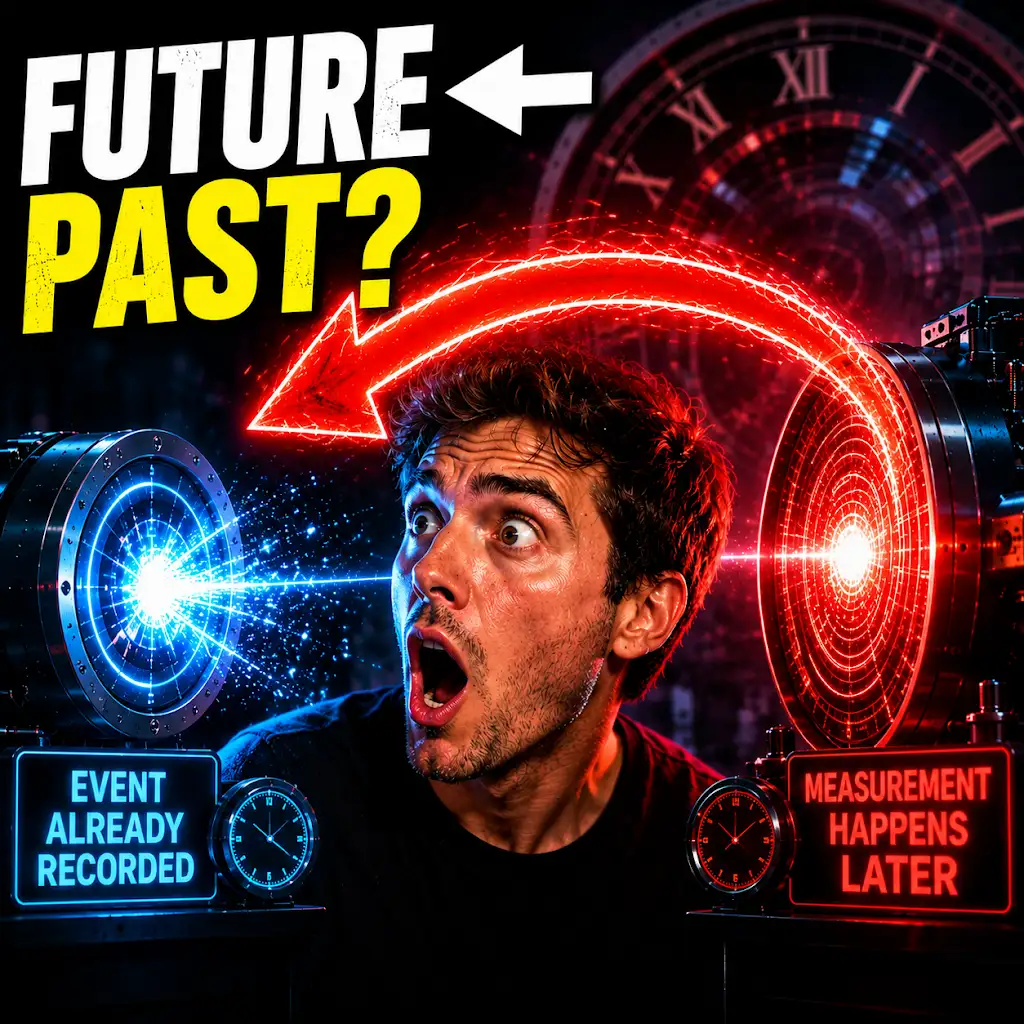
The Quantum Experiment That Looks Like It Changed the Past
FAQs

What is the concept of observing a photon changing the past?
Observing a photon changing the past refers to the idea that the act of observing a photon’s behavior can potentially affect events that have already occurred in the past.
What is the significance of this concept in the field of quantum physics?
This concept is significant in the field of quantum physics as it challenges our traditional understanding of cause and effect, and raises questions about the nature of time and the role of consciousness in shaping reality.
Is there scientific evidence to support the idea that observing a photon can change the past?
There is currently no scientific evidence to support the idea that observing a photon can change the past. This concept is largely theoretical and is the subject of ongoing debate and speculation within the scientific community.
What are some of the proposed explanations for this concept?
Some proposed explanations for the concept of observing a photon changing the past include the idea that observation collapses the wave function, retrocausality, and the role of consciousness in shaping reality.
What are the implications of this concept for our understanding of time and causality?
The implications of this concept for our understanding of time and causality are profound, as it challenges our conventional understanding of these concepts and raises fundamental questions about the nature of reality and the role of consciousness in shaping it.