The enigmatic nature of black holes, entities of such extreme gravitational pull that not even light can escape their clutches, has long captivated the scientific imagination. However, these cosmic leviathans present a profound conundrum, a puzzle that has occupied physicists for decades: the black hole information paradox. This article aims to demystify this complex theoretical problem by dissecting its origins, its implications, and the various avenues being explored to resolve it, making the concept accessible to anyone with a curiosity about the universe’s deepest mysteries.
To understand the information paradox, one must first appreciate the foundational pillars of modern physics: Einstein’s General Relativity and Quantum Mechanics. These two theories, extraordinarily successful in their respective domains, present a fundamental conflict when applied to the extreme conditions of a black hole.
General Relativity: The Cosmic Loom
General Relativity, Einstein’s masterpiece, describes gravity not as a force, but as a curvature of spacetime caused by mass and energy. Imagine spacetime as a vast, invisible rubber sheet. Placing a heavy object, like a star, onto this sheet causes it to bend and warp. This warping dictates how other objects, including light, move through the region, which we perceive as gravity.
Black Holes: The Ultimate Dent
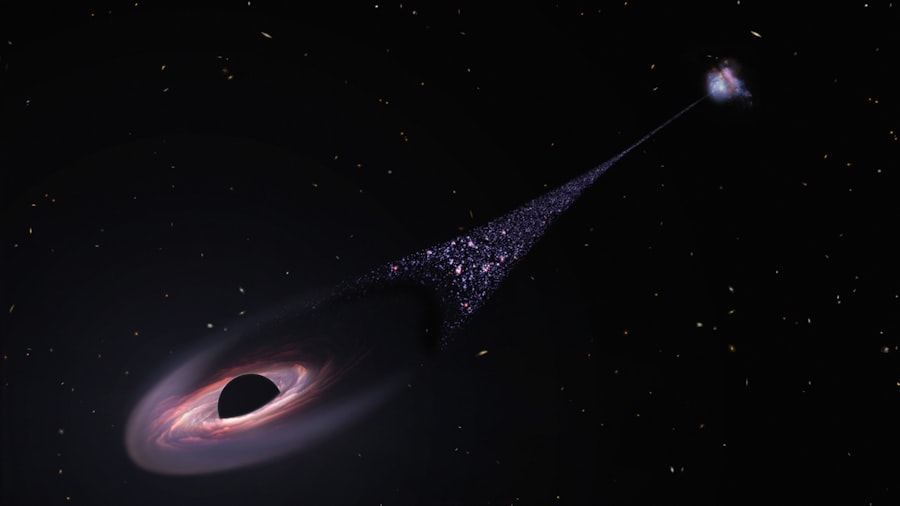
Black holes are the ultimate manifestation of this curvature. They form when a massive star collapses under its own gravity, compressing an enormous amount of mass into an infinitesimally small point called a singularity. This creates a region of spacetime so distorted that it forms an event horizon – a one-way boundary. Anything crossing this boundary, including light, is inexorably pulled towards the singularity and lost from the observable universe. From the perspective of General Relativity, once information crosses the event horizon, it is effectively gone forever, trapped within the black hole’s inscrutable depths.
Quantum Mechanics: The Universe of Probabilities
Quantum Mechanics, in stark contrast, governs the behavior of matter and energy at the smallest scales. One of its most fundamental principles is the conservation of information. In quantum mechanics, the state of a system at any given time can, in principle, determine its state at any other time. This is like having a perfectly preserved book; you can always reconstruct its original content by examining its pages. This principle implies that no information is ever truly lost from the universe; it might change form, become incredibly dispersed, or be encoded in a complex way, but it always remains.
The Crucial Principle of Unitarity
At the heart of quantum mechanics lies a concept called unitarity. Unitarity ensures that the evolution of a quantum system is reversible. If you know the final state of a closed system, you can, in principle, trace its history backward to determine its initial state. This reversibility is inextricably linked to the conservation of information.
The black hole information paradox is a fascinating topic that challenges our understanding of physics and the nature of information itself. For those looking to grasp the basics of this complex issue, a great resource is the article available at My Cosmic Ventures, which explains the paradox in an accessible way for beginners. This article delves into the implications of black holes on information theory and discusses various perspectives from leading physicists, making it an excellent starting point for anyone curious about this intriguing subject.
Hawking Radiation: A Glimmer of Hope, a Ray of Doubt
The paradox truly begins to take shape with the groundbreaking work of Stephen Hawking in the 1970s. Hawking, applying quantum mechanics to the vicinity of a black hole’s event horizon, discovered a remarkable phenomenon: black holes are not entirely black.
The Quantum Realm Near the Horizon
Hawking’s insight revolved around the concept of quantum fluctuations in the vacuum. In quantum field theory, even empty space is not truly empty. It is a roiling sea of virtual particle-antiparticle pairs that constantly pop into existence and annihilate each other. Near the event horizon, these pairs can be separated by the extreme gravitational gradient.
Particle-Antiparticle Dance
Imagine a virtual electron and positron pair appearing right at the edge of the event horizon. If the positron falls into the black hole, the electron can escape. For an external observer, this escaping electron appears as radiation emitted by the black hole. This is known as Hawking radiation.
A Black Hole’s Slow Demise
Hawking radiation has a crucial implication: it carries energy away from the black hole. Since energy and mass are equivalent (E=mc²), the black hole loses mass. Over immense periods, this slow drip of Hawking radiation causes the black hole to shrink and eventually evaporate completely. This is akin to a colossal entity slowly dissolving into microscopic whispers.
The Information Predicament
Here lies the crux of the information paradox. Hawking’s initial calculations suggested that Hawking radiation is purely thermal. A thermal radiation is characterized only by its temperature and contains no information about the specific details of what fell into the black hole. If a black hole forms from a book, and then evaporates into purely thermal radiation, where did the information about the book’s words, its author, its very existence go? It seems to have vanished, violating the fundamental principle of unitarity in quantum mechanics. The book is gone, and its story has been erased.
The Paradox Crystallizes: A Clash of Titans
The conflict between General Relativity’s seemingly absolute information loss and Quantum Mechanics’ ironclad conservation of information creates a profound theoretical impasse. This is not a minor glitch; it’s a deep philosophical and physical chasm.
The Loss of Determinism
If information can be irretrievably lost, it implies a fundamental breakdown in our understanding of causality and determinism. If we cannot, in principle, reconstruct the past from the present state of the universe, then our ability to predict the future, or even understand how we arrived at the present, is compromised. The universe, in this scenario, would not be a cosmic clockwork mechanism, but something far more unpredictable and perhaps even chaotic at its deepest level.
The Enigma of the Singularity
At the heart of a black hole lies the singularity, a point of infinite density where the laws of physics as we currently understand them break down. General Relativity provides no clear picture of what happens at the singularity. Quantum mechanics, on the other hand, suggests that information should be preserved. Reconciling these two perspectives is crucial to solving the paradox.
What Happens at the ‘End of the Line’?
The singularity is the ultimate cosmic drain, and understanding what happens to information at this point of infinite curvature is key to deciphering its fate. Does it truly cease to exist, or is it transformed in a way we cannot yet comprehend?
The Complementarity Principle: A Proposed Bridge
One of the early proposals to bridge this gap came from Gerard ‘t Hooft and Leonard Susskind, who proposed the principle of complementarity. This idea suggests that two seemingly contradictory descriptions of a physical system can both be correct, depending on the observer’s perspective.
Inside vs. Outside the Event Horizon
According to complementarity, an observer falling into a black hole would experience crossing the event horizon and eventually reaching the singularity. However, an observer outside the black hole would see the falling object become increasingly redshifted and seem to “freeze” at the event horizon, never actually crossing it, before being radiated away. The information, in this view, is not lost; it is simply encoded differently for different observers. It’s like knowing the same melody can be played on a piano or sung by a choir; the information (the melody) is the same, but the way it is expressed is different.
Probing the Depths: Proposed Solutions and Ongoing Research

The information paradox has spurred a vast amount of theoretical research, with physicists exploring various avenues to resolve the apparent contradiction. These investigations often venture into the realm of quantum gravity, a theoretical framework that seeks to unify General Relativity and Quantum Mechanics.
The Holographic Principle: A Universe on a Surface
A significant development in this quest has been the holographic principle, which suggests that the information content of a region of spacetime can be fully described by a theory living on its boundary. Applied to black holes, this implies that all the information that falls into a black hole might be encoded on its event horizon.
The Black Hole as a Hologram
Imagine a 3D image being projected from a 2D surface. The holographic principle suggests that our three-dimensional universe, or at least certain aspects of it, might be fundamentally described by a theory living on a lower-dimensional boundary. In the context of black holes, the event horizon acts as this boundary, holding all the information.
String Theory and Branes: Multidimensional Explanations
String theory, a leading candidate for a theory of quantum gravity, offers another potential pathway to resolution. In string theory, fundamental particles are not point-like but rather tiny vibrating strings. This framework allows for extra spatial dimensions beyond the three we experience.
The Role of Branes
Within string theory, “branes” (short for membranes) are higher-dimensional objects. Some theories propose that black holes might be related to these branes, and that information entering a black hole could be transferred to a parallel brane or encoded in the vibrational modes of these branes.
Firewalls: A Potential New Paradox
More recently, the idea of “firewalls” has emerged, suggesting that the event horizon of a black hole might be a region of high energy that would incinerate anything attempting to cross it. This concept, while attempting to preserve unitarity, introduces its own set of paradoxes by challenging the smooth fabric of spacetime predicted by General Relativity at the event horizon.
Rethinking the Smooth Horizon
The firewall hypothesis is a radical departure, suggesting that the smooth, gentle crossing of a black hole’s event horizon, as described by General Relativity, might be an illusion, and instead, a fiery barrier awaits.
Quantum Entanglement and Information Scrambling
Another active area of research focuses on the role of quantum entanglement in black hole evaporation. Entanglement is a phenomenon where two or more particles become linked in such a way that they share the same fate, regardless of the distance separating them.
The Scrambled Message
Physicists like Joseph Polchinski and Daniel Harlow have proposed that as matter falls into a black hole, its quantum information becomes rapidly and complexly entangled with the degrees of freedom on the event horizon and the emitted Hawking radiation. This scrambling process, they argue, is key to preserving unitarity, although the information becomes incredibly difficult to decode. It’s like taking a perfectly clear message, shredding it into tiny pieces, and then scattering those pieces across the universe; the original message still exists, but it’s incredibly challenging to reassemble.
The black hole information paradox is a fascinating topic that challenges our understanding of physics and the nature of reality. For those looking to delve deeper into this intriguing concept, a great resource can be found in an article that breaks down the complexities of the paradox for beginners. You can explore this informative piece at My Cosmic Ventures, where the author explains how the paradox arises from the conflict between quantum mechanics and general relativity, making it accessible for anyone curious about the mysteries of the universe.
The Implied Structure of Spacetime: Deeper Questions
| Concept | Description | Importance for Beginners |
|---|---|---|
| Black Hole | A region in space with gravity so strong that nothing, not even light, can escape from it. | Basic understanding of what a black hole is. |
| Event Horizon | The boundary around a black hole beyond which nothing can return. | Helps visualize the “point of no return”. |
| Information Paradox | The puzzle about whether information that falls into a black hole is lost forever. | Central problem that challenges physics laws. |
| Quantum Mechanics | The branch of physics that deals with the behavior of very small particles. | Explains why information should not be lost. |
| Hawking Radiation | Radiation predicted to be emitted by black holes, causing them to slowly evaporate. | Shows black holes can lose mass and energy. |
| Information Loss Problem | If black holes evaporate completely, what happens to the information inside? | Raises questions about the laws of physics. |
| Current Theories | Ideas like holographic principle and black hole complementarity attempt to resolve the paradox. | Introduces ongoing research and possible solutions. |
The black hole information paradox is not just a theoretical puzzle for astrophysicists; it touches upon the very nature of space, time, and reality itself. Resolving it could unlock profound insights into the fundamental workings of the universe.
The Nature of Quantum Gravity
Ultimately, solving the information paradox requires a complete theory of quantum gravity, a unified description of gravity and quantum mechanics. The paradox serves as a crucial testing ground for proposed quantum gravity theories, as any valid theory must be able to explain what happens to information in the extreme environment of a black hole.
The Missing Piece of the Universe’s Puzzle
A fully developed theory of quantum gravity would be the Rosetta Stone for understanding phenomena like the Big Bang, the interior of black holes, and the ultimate fate of the universe. The information paradox is a critical clue in the hunt for this elusive theory.
The Meaning of Information in Physics
The paradox also prompts a re-evaluation of what “information” truly means in a physical context. Is it something that exists independently, or is it an emergent property of physical interactions? If information can be lost, does that imply a fundamental limit to our ability to know and predict the universe?
Redefining Our Understanding of Reality
The questions raised by the information paradox push us to consider whether our current frameworks are sufficiently robust to describe the universe at its most fundamental levels.
The Enduring Mystery of the Universe
The black hole information paradox, while daunting, represents the cutting edge of our scientific inquiry. It highlights the power of the scientific method to probe the most profound mysteries and the relentless human drive to understand our place in the cosmos. The journey to demystify the black hole information paradox is an ongoing one, a testament to the enduring allure of the unknown and the ever-expanding horizons of human knowledge. As we continue to explore these cosmic enigmas, we inch closer to a more complete and profound understanding of the universe we inhabit.
FAQs
What is the black hole information paradox?
The black hole information paradox is a puzzle resulting from the conflict between quantum mechanics and general relativity. It questions whether information that falls into a black hole is lost forever, which would violate the principles of quantum theory that state information must be conserved.
Why is information loss in black holes a problem for physics?
Information loss contradicts the fundamental law of quantum mechanics that information about a physical system’s initial state cannot be destroyed. If black holes erase information, it challenges our understanding of how the universe operates at a fundamental level.
How do black holes form?
Black holes form when massive stars collapse under their own gravity at the end of their life cycle. This collapse creates a region in space with gravity so strong that nothing, not even light, can escape from it.
What is Hawking radiation and how does it relate to the paradox?
Hawking radiation is theoretical radiation predicted by physicist Stephen Hawking, which suggests black holes can emit particles and slowly lose mass over time. This radiation appears to be random and does not carry information about what fell into the black hole, contributing to the information paradox.
Are there any proposed solutions to the black hole information paradox?
Several theories have been proposed, including the idea that information is encoded in Hawking radiation, that it is preserved on the black hole’s event horizon (the holographic principle), or that information escapes through quantum effects. However, a definitive solution remains an active area of research in theoretical physics.