The vast expanse of the cosmos, a tapestry of stars, galaxies, and unfathomable voids, has always been a source of profound wonder and persistent questions. Among the most captivating of these inquiries is the fate of the universe. While current cosmological models suggest a continued expansion, the possibility of a cosmic collapse, a reversal of the Big Bang’s outward surge, remains a compelling thought experiment, igniting debates among scientists and philosophers alike. Could the universe, after billions of years of outward momentum, one day falter and implode?
The prevailing scientific narrative of the universe’s origin is the Big Bang theory. Approximately 13.8 billion years ago, all the matter and energy in the observable universe was compressed into an infinitesimally small, incredibly hot, and dense point. This point then underwent a rapid expansion, and continues to do so today. This expansion is not merely an explosion into pre-existing space, but rather an expansion of space itself. Galaxies are not flying away from a central point, but rather the very fabric of spacetime between them is stretching, carrying them further apart.
Evidence for Expansion: The Redshift of Light
The most compelling evidence for the universe’s expansion comes from the observation of redshift. When light from distant galaxies is analyzed, it is found to be shifted towards the red end of the electromagnetic spectrum. This phenomenon, analogous to the Doppler effect in sound where the pitch of a siren lowers as it moves away, indicates that these galaxies are receding from us. The further away a galaxy is, the greater its redshift, a direct consequence of the expansion of space. Edwin Hubble’s groundbreaking observations in the late 1920s laid the foundation for this understanding, revealing a universe far larger and more dynamic than previously imagined.
The Cosmic Microwave Background Radiation: Echoes of the Beginning
Further supporting the Big Bang and subsequent expansion is the detection of the Cosmic Microwave Background (CMB) radiation. This faint glow of microwave radiation permeates the entire universe, a relic from a time when the universe was hot, dense, and opaque. As the universe expanded and cooled, this radiation stretched to microwave wavelengths, providing a snapshot of the early cosmos. The remarkable uniformity of the CMB, with tiny fluctuations that seeded the formation of galaxies, is precisely what is predicted by the Big Bang model and the subsequent expansion.
The intriguing question of whether the universe could collapse again has been a topic of extensive research and debate among cosmologists. For those interested in exploring this concept further, an insightful article can be found on My Cosmic Ventures, which delves into the theories surrounding the fate of the universe and the potential for a future collapse. To read more about this fascinating subject, visit My Cosmic Ventures.
The Cosmic Tug-of-War: Gravity vs. Expansion
The universe’s ultimate fate hinges on a fundamental cosmic tug-of-war: the outward push of expansion versus the inward pull of gravity. Gravity, the force that binds stars, planets, and galaxies, acts as a brake on the universe’s expansion. If gravity were strong enough, it could eventually overcome the initial impetus of the Big Bang, causing the expansion to slow down, halt, and then reverse.
The Role of Matter and Energy: The Density Parameter
The key factor determining the balance between expansion and gravity is the total density of matter and energy within the universe. Cosmologists use a parameter known as Omega ($\Omega$) to represent this density. Omega is defined as the ratio of the actual density of the universe to the critical density required to just halt the expansion.
$\Omega > 1$: The Closed Universe and the Big Crunch
If the density of the universe is greater than the critical density ($\Omega > 1$), then gravity would eventually win. In this scenario, the universe is said to be “closed,” with a positive curvature, much like the surface of a sphere. The expansion would slow down, eventually reach a maximum size, and then begin to contract. Galaxies would rush towards each other, the temperature would rise, and the universe would ultimately collapse back into a singularity, a reversal of the Big Bang, often referred to as the “Big Crunch.”
$\Omega = 1$: The Flat Universe and Eternal Expansion (or a slow halt)
If the density of the universe is exactly equal to the critical density ($\Omega = 1$), the universe is considered “flat.” In a flat universe, the expansion would continue indefinitely, but at an ever-decreasing rate. For a long time, this was considered a strong possibility. While it wouldn’t collapse, the universe would approach a state of infinite emptiness and near-absolute zero temperature, a scenario known as the “Big Freeze” or “Heat Death.”
$\Omega < 1$: The Open Universe and Endless Expansion
If the density of the universe is less than the critical density ($\Omega < 1$), then the universe is "open," with negative curvature, resembling a saddle. In this case, the expansion would continue forever, never slowing down significantly. This scenario also leads to a "Big Freeze," but the universe would continue to expand at a more vigorous pace.
The Dominance of Dark Energy: A Surprising Twist
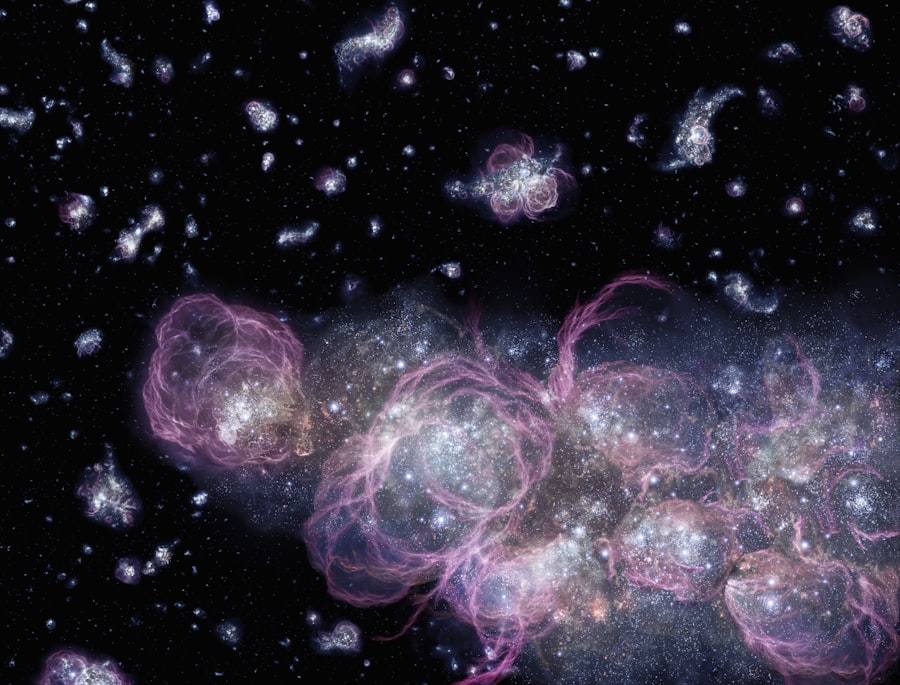
For decades, the question of the universe’s ultimate fate revolved around the density of ordinary matter and dark matter. However, in the late 1990s, observations of distant supernovae revealed a startling discovery: the expansion of the universe is not slowing down; it is accelerating. This acceleration implies the existence of a mysterious force, dubbed “dark energy,” that counteracts gravity and drives the universe apart at an increasing rate.
Supernovae as Cosmic Yardsticks: Unveiling the Acceleration
The discovery of the accelerating expansion was made possible by studying Type Ia supernovae. These are exploding white dwarf stars that have a remarkably consistent peak luminosity, making them reliable “standard candles” for measuring cosmic distances. By observing the redshift and apparent brightness of these supernovae at various distances, astronomers could infer the rate of expansion at different points in cosmic history. The results were unambiguous: more distant supernovae appeared fainter than expected, indicating that the expansion had been slower in the past and has been speeding up over time.
The Nature of Dark Energy: A Cosmic Enigma
The exact nature of dark energy remains one of the biggest mysteries in modern physics. It is thought to constitute about 70% of the total energy density of the universe, far outweighing both ordinary matter and dark matter. Several theoretical models attempt to explain dark energy:
The Cosmological Constant ($\Lambda$): Einstein’s Resurrected Idea
One leading candidate is the cosmological constant, a term that Albert Einstein famously introduced and later retracted. This constant represents a form of energy inherent to space itself, a vacuum energy that exerts a negative pressure, causing expansion. If dark energy is indeed the cosmological constant, then the universe will continue to expand and accelerate indefinitely, leading to a “Big Rip” where even the fabric of spacetime is torn apart, or more likely, a perpetual expansion into extreme cold and emptiness.
Quintessence: A Dynamic and Evolving Force
Another possibility is “quintessence,” a hypothetical dynamic field that permeates spacetime. Unlike the cosmological constant, quintessence could vary in strength and density over time. Depending on its properties, quintessence could lead to different cosmic fates, including an eventual collapse if its influence wanes sufficiently.
Modified Gravity: Rethinking the Fundamental Force
Some theories propose that the observed acceleration is not due to a new form of energy but rather a modification of Einstein’s theory of general relativity on cosmic scales. If gravity behaves differently over vast distances, it could explain the accelerated expansion without invoking dark energy.
The Big Crunch: A Reversal of Fortune?

Given the current evidence for an accelerating expansion driven by dark energy, the prospect of a Big Crunch appears increasingly unlikely. However, the universe’s behavior in the distant future is far from certain, and several theoretical scenarios, while speculative, keep the possibility of a collapse alive.
The Oscillating Universe Hypothesis: A Cyclical Existence
One of the more enduring hypotheses is the “oscillating universe” model. This idea posits that the universe undergoes a continuous cycle of expansion and contraction. The Big Bang is followed by a period of expansion, which eventually slows down and reverses into a Big Crunch. This collapse would then trigger another Big Bang, initiating a new cycle. This model was more popular before the discovery of dark energy, as it required a universe with $\Omega > 1$. However, if dark energy were to decay or change its properties in the far future, a future contraction could, in principle, still be possible.
The Possibility of Dark Energy Decay or Change: A Future Uncertainty
The stability of dark energy over cosmic timescales is a critical question. If dark energy is not a constant but rather a dynamic field (like quintessence), its strength might decrease or even reverse its effect over eons. If dark energy were to weaken significantly or even become attractive, it could allow gravity to reassert its dominance, leading to a slowdown and eventual reversal of the cosmic expansion. The implications of such a decay are profound and could fundamentally alter the universe’s ultimate destiny.
The Role of Vacuum Decay: A Catastrophic Phase Transition
A more speculative but potentially devastating scenario involves “vacuum decay.” The vacuum of space is not truly empty but is filled with quantum fields. If our current vacuum is in a metastable state, it could, at some point, transition to a lower energy state. This transition would propagate outwards at the speed of light, fundamentally altering the laws of physics and potentially leading to the destruction of all structures within the universe, including a rapid collapse.
The concept of the universe potentially collapsing again has intrigued scientists and cosmologists for years, sparking numerous theories about the fate of our cosmos. A related article explores the various scenarios that could lead to such an event, delving into the intricate balance of dark energy and gravity. For those interested in a deeper understanding of this topic, you can read more in this insightful piece on cosmic phenomena at My Cosmic Ventures. This exploration not only highlights the current scientific perspectives but also raises thought-provoking questions about the ultimate destiny of the universe.
Beyond the Crunch: Alternative Fates of the Cosmos
| Question | Answer |
|---|---|
| Could the universe collapse again? | There are theories suggesting that the universe could collapse again in the future, but it is still a topic of debate among scientists. |
Even if a Big Crunch were to occur, it would not necessarily be the absolute end. As mentioned, the oscillating universe model suggests a perpetual cycle of creation and destruction. However, other scenarios also paint a picture of the universe’s ultimate fate, independent of a collapse.
The Big Freeze (Heat Death): An Ever-Expanding Emptiness
The most widely accepted scenario, given the current understanding of dark energy, is the “Big Freeze” or “Heat Death.” In this scenario, the universe continues to expand and accelerate indefinitely. Galaxies will drift so far apart that they will become invisible to each other. Stars will eventually exhaust their fuel, and black holes will evaporate through Hawking radiation. The universe will become an incredibly cold, dilute, and featureless expanse, with matter and energy spread so thinly that no further processes can occur.
The Big Rip: A Violent Dissolution
If dark energy is a form of phantom energy, its repulsive force could grow stronger over time. This would lead to a “Big Rip,” where the expansion becomes so violent that it tears apart galaxies, stars, planets, and eventually even atoms and subatomic particles. This is a more extreme and less likely outcome than the Big Freeze but remains a theoretical possibility.
The Final State of Matter: A Universe of Particles and Radiation
Regardless of the ultimate fate – collapse, freeze, or rip – the universe’s journey is one of transformation. If a Big Crunch were to occur, it would be a violent compression. If it leads to an oscillating universe, the cycle would begin anew. In scenarios of endless expansion, the universe would fade into a cold, dark, and empty void. The question of whether the universe could collapse again, while seemingly improbable given current data, serves as a crucial reminder of the vast uncertainties that still shroud our understanding of the cosmos and its ultimate destiny. The ongoing quest to unravel the mysteries of dark energy and the fundamental nature of spacetime will undoubtedly shape our future perspectives on the grand cosmic narrative.

Dark Energy May Be Changing—So What Happens to the Universe?
FAQs
1. What is the theory of the universe collapsing again?
The theory suggests that the universe, which is currently expanding, could eventually stop expanding and start collapsing in on itself due to the force of gravity.
2. What evidence supports the possibility of the universe collapsing again?
Some scientists point to the idea that dark energy, the mysterious force driving the universe’s expansion, could weaken over time, allowing gravity to eventually overcome it and cause the universe to collapse.
3. Has the universe collapsed before?
There is no direct evidence that the universe has collapsed before, but some theories suggest that the universe may have gone through cycles of expansion and contraction in the past.
4. What would happen if the universe were to collapse again?
If the universe were to collapse, it would likely result in a “Big Crunch,” where all matter and energy in the universe would be compressed into a hot, dense state.
5. Is the collapse of the universe a widely accepted theory among scientists?
The idea of the universe collapsing again is still a topic of debate among scientists, and there is no consensus on whether it will actually happen. It remains a speculative possibility based on current understanding of the universe’s dynamics.