The human desire to revisit and alter past events is a persistent theme in literature, philosophy, and even our everyday musings. From regretting a missed opportunity to wishing away a painful memory, the notion of a malleable past holds a potent allure. However, from a scientific standpoint, the question of whether the past can be changed is not one of sentimentality, but of fundamental physical laws and the very fabric of reality. This article delves into the scientific perspective, exploring the concepts of time, causality, and the theoretical possibilities and insurmountable barriers that govern our perception of a fixed and unalterable past.
The intriguing question of whether the past can be changed scientifically has captivated both scientists and philosophers alike. A related article that delves into the complexities of time travel and its implications on altering historical events can be found at My Cosmic Ventures. This article explores various theories in physics, such as quantum mechanics and relativity, that challenge our understanding of time and causality, offering insights into the potential for changing past events.
Understanding the Nature of Time
At the heart of any discussion about changing the past lies our understanding of time itself. For much of history, time was perceived as a linear, absolute entity, flowing uniformly forward like a river. However, modern physics has revolutionized this view, presenting a far more complex and nuanced picture.
The Newtonian Clockwork Universe
Absolute Time: A Universal Rhythm
In classical physics, as formulated by Isaac Newton, time was considered absolute and universal. This meant that every observer, regardless of their motion or location, would measure the passage of time in the same way. A second was a second for everyone, everywhere. This “Newtonian clockwork” envisioned a deterministic universe where every event was predetermined by initial conditions. In such a universe, the past would be as fixed as the gears of a celestial clockwork. The idea of altering past events would be nonsensical within this framework, as it would imply a break in the unbroken chain of cause and effect that defined the universe’s progression. The universe would be a perfectly recorded film, with no possibility of editing or reshooting scenes.
The Illusion of a Universal Present
While Newton’s view dominated for centuries, it has been largely superseded by Einstein’s theories of relativity, which paint a starkly different picture of time.
Einstein’s Relativity: Time as a Dynamic Dimension
Special Relativity: Time Dilation and Length Contraction
Albert Einstein’s Special Theory of Relativity, published in 1905, shattered the notion of absolute time. It posited that time is not absolute but relative, dependent on the observer’s frame of reference. A key consequence of Special Relativity is time dilation, where time passes slower for an object moving at a significant fraction of the speed of light compared to a stationary observer. Similarly, length contraction occurs, where the length of an object appears shorter in its direction of motion. This means that if one were to travel at near-light speeds, upon returning to Earth, they would have aged less than those who remained behind. This isn’t a change to the past, but rather a difference in the passage of time for different observers. The events that transpired on Earth during their journey still occurred in their historical sequence, unaffected by the traveler’s altered temporal experience. The “past” of the traveler is still the past for Earth, it’s just that their journey through it was subjectively different.
General Relativity: Spacetime and Gravity’s Influence
General Relativity, published in 1915, further expanded this understanding by incorporating gravity into the fabric of spacetime. It describes gravity not as a force, but as a curvature of spacetime caused by mass and energy. This curvature affects the passage of time. Time passes slower in stronger gravitational fields. For instance, time passes slightly slower at sea level than it does at the top of a mountain, although the difference is imperceptible in everyday life. These relativistic effects, while real and experimentally verified, do not offer a mechanism for altering past events. They describe how time behaves within the existing framework of spacetime, but not how to rewind or rewrite it. The past remains a fixed record within this curved spacetime, and our journey through it is dictated by the laws of physics.
The Block Universe Model: A Four-Dimensional Reality
The implications of relativity, particularly the concept of spacetime, have led some physicists to consider the “block universe” model.
The Enduring Present Moment
A Static, Unchangeable Reality
In the block universe model, all of spacetime – past, present, and future – exists simultaneously as a static, four-dimensional block. Our perception of a flowing present is considered an illusion, an emergent property of consciousness navigating this pre-existing reality. If the block universe is indeed the accurate representation of reality, then the past, present, and future are all equally real and fixed. Changing the past would be akin to trying to alter a segment of a finished sculpture – the form is already set. This model inherently denies the possibility of changing the past, as it suggests that the past, like the future, has already happened and is a permanent feature of the spacetime continuum.
Causality: The Unbreakable Chain of Events

The concept of causality, the principle that every event has a cause, is fundamental to our understanding of how the universe operates. The idea of changing the past directly challenges this principle, leading to paradoxes that highlight the inherent difficulty, if not impossibility, of such an endeavor.
The Law of Cause and Effect
Temporal Order and Predictability
Causality dictates a temporal order: causes precede their effects. This sequential relationship is what allows us to understand and predict phenomena. If the past could be altered, this fundamental order would be broken. An event that caused another event could be erased or changed, leading to a cascade of inconsistencies. For example, if one were to prevent their own birth by traveling back in time and altering their parents’ meeting, it would create a paradox: if they were never born, they could not have traveled back in time to prevent their birth. This self-negating loop is known as a causal loop or grandfather paradox, and it highlights a major theoretical hurdle for any scenario involving changing the past.
Paradoxes of Time Travel
The Grandfather Paradox: A Logical Impossibility
The grandfather paradox is the most famous illustration of the logical inconsistencies that arise from the possibility of changing the past. It posits that if someone were to travel back in time and prevent their grandfather from meeting their grandmother, their own existence would be impossible. If they never existed, they could not have traveled back in time, thus their grandfather would have met their grandmother, and they would have been born – a clear contradiction. Scientists grapple with this paradox by suggesting that such paradoxes might be inherently impossible, implying that the laws of physics would prevent any action that leads to a logical contradiction.
The Polchinski Paradox: A Quantum Twist
A more nuanced paradox, the Polchinski paradox, arises when considering quantum mechanics. It involves a billiard ball sent into a wormhole that emerges in the past to collide with its earlier self, knocking it off course and preventing it from entering the wormhole in the first place. While this might seem like a variation of the grandfather paradox, it highlights how even at the quantum level, the deterministic nature of causality might be preserved, preventing such self-contradictory events from occurring.
Theoretical Pathways and Their Limitations

While the scientific consensus leans heavily towards the unchangeable nature of the past, theoretical physics does explore exotic concepts that, at least in principle, might offer glimpses into manipulating the fabric of spacetime. However, these remain highly speculative and face immense practical and theoretical obstacles.
Wormholes: Tunnels Through Spacetime
Einstein-Rosen Bridges and Exotic Matter
Wormholes, also known as Einstein-Rosen bridges, are hypothetical topological features of spacetime that could theoretically connect two distant points in space or time. The concept arises from solutions to Einstein’s field equations in General Relativity. However, to remain traversable and stable, wormholes would likely require “exotic matter” with negative mass or energy density, which has never been observed and may not exist. Even if traversable wormholes could be created, the physics of how they would behave in terms of time travel is far from settled. It’s conceivable that if one end of a wormhole were accelerated to near-light speeds and then brought back, it could create a time difference between the two mouths, potentially allowing for travel into the past. However, the energy requirements and the stability issues make this scenario purely theoretical.
Closed Timelike Curves (CTCs)
Traveling Back to One’s Own Past
Closed Timelike Curves (CTCs) are paths through spacetime that allow an object to return to its starting point in both space and time. Certain solutions to Einstein’s field equations, such as those involving rotating black holes or cosmic strings, theoretically allow for the existence of CTCs. Traveling along a CTC would, by definition, allow one to revisit and potentially alter events in their past. However, the existence of CTCs is highly debated. Many physicists believe that quantum effects or other physical principles would prevent their formation or render them unstable, thus preventing any practical application for time travel into the past.
The intriguing question of whether the past can be changed scientifically has captivated both scientists and philosophers alike. Many theories suggest that while we cannot alter past events, our understanding of time and space might allow for different interpretations of historical occurrences. For those interested in exploring this concept further, a related article can be found at this link, which delves into the implications of time travel and its potential effects on our perception of history.
Quantum Mechanics: A Realm of Possibility or Further Constraint?
| Question | Answer |
|---|---|
| Can the past be changed scientifically? | According to current scientific understanding, the past cannot be changed. Time is considered to be a one-way dimension, and events that have occurred in the past are considered to be fixed and unchangeable. |
Quantum mechanics, the theory describing the behavior of matter and energy at the atomic and subatomic levels, introduces a layer of probabilistic uncertainty that some have speculated might offer avenues for influencing the past. However, the prevailing interpretations of quantum mechanics generally reinforce the idea of a fixed past.
Superposition and Quantum Uncertainty
The Many Worlds Interpretation
One interpretation of quantum mechanics, the Many Worlds Interpretation (MWI), suggests that every quantum measurement causes the universe to split into multiple parallel universes, each representing a different possible outcome. If this were true, then any attempt to change the past might simply result in the traveler entering a different parallel universe where the desired alteration occurs, leaving their original timeline unchanged. This doesn’t technically change their past, but rather creates a new, divergent history.
The Arrow of Time at the Quantum Level
Entropy and Irreversibility
The “arrow of time” – the apparent unidirectional flow from past to future – is deeply connected to the second law of thermodynamics, which states that entropy (a measure of disorder) in a closed system always increases over time. This law suggests a fundamental irreversibility in physical processes. While individual quantum events can be time-symmetric (meaning they can proceed forwards or backwards in time), the macroscopic world, governed by the collective behavior of many particles, exhibits a clear temporal directionality due to the relentless increase in entropy. Reversing this process on a macroscopic scale, which would be necessary to “change” the past, would require a decrease in entropy, a violation of this fundamental law.
The Present Perspective: An Unchanging History
From the established laws of physics, the overwhelming scientific perspective is that the past cannot be changed.
The Unyielding Nature of Spacetime
A Record of What Was
The universe, as described by relativity, is a four-dimensional spacetime continuum. Events, once they have occurred, are recorded within this continuum. Our journey through spacetime is a progression through this existing landscape. The past is not a malleable clay to be reshaped, but rather a fixed monument. Any attempt to alter it would be akin to trying to erase a page from a book that has already been printed and bound. The physical laws that govern our universe appear to be designed to preserve the integrity of causality and prevent logical contradictions.
The Role of Observation and Measurement
Quantum Indeterminacy vs. Historical Reality
While quantum mechanics introduces probabilities and observer effects at the microscopic level, these phenomena do not translate into the ability to retroactively alter macroscopic historical events. The quantum realm’s indeterminacy does not grant us the power to rewrite the past. Instead, it describes the probabilistic nature of events as they unfold in the present, not as a means to undo what has already transpired.
The Philosophical Implications
Free Will and Determinism
The question of changing the past also has profound philosophical implications, particularly concerning free will and determinism. If the past is unchangeable, does this imply a deterministic universe where our actions are predetermined? Conversely, if the past could be changed, it might suggest a greater degree of free will, but at the cost of logical consistency. While science focuses on the physical possibility, these philosophical debates continue to explore the implications of our perception of time and agency.
In conclusion, while the allure of altering past events remains a powerful human desire, the scientific perspective, grounded in the principles of relativity, causality, and thermodynamics, strongly suggests that the past is immutable. The theoretical avenues explored, such as wormholes and CTCs, remain highly speculative and face significant theoretical and practical hurdles that make them unlikely to ever offer a means of truly changing what has already occurred. The arrow of time, at least from our current scientific understanding, points resolutely forward, and the tapestry of history, once woven, appears to be permanently fixed.
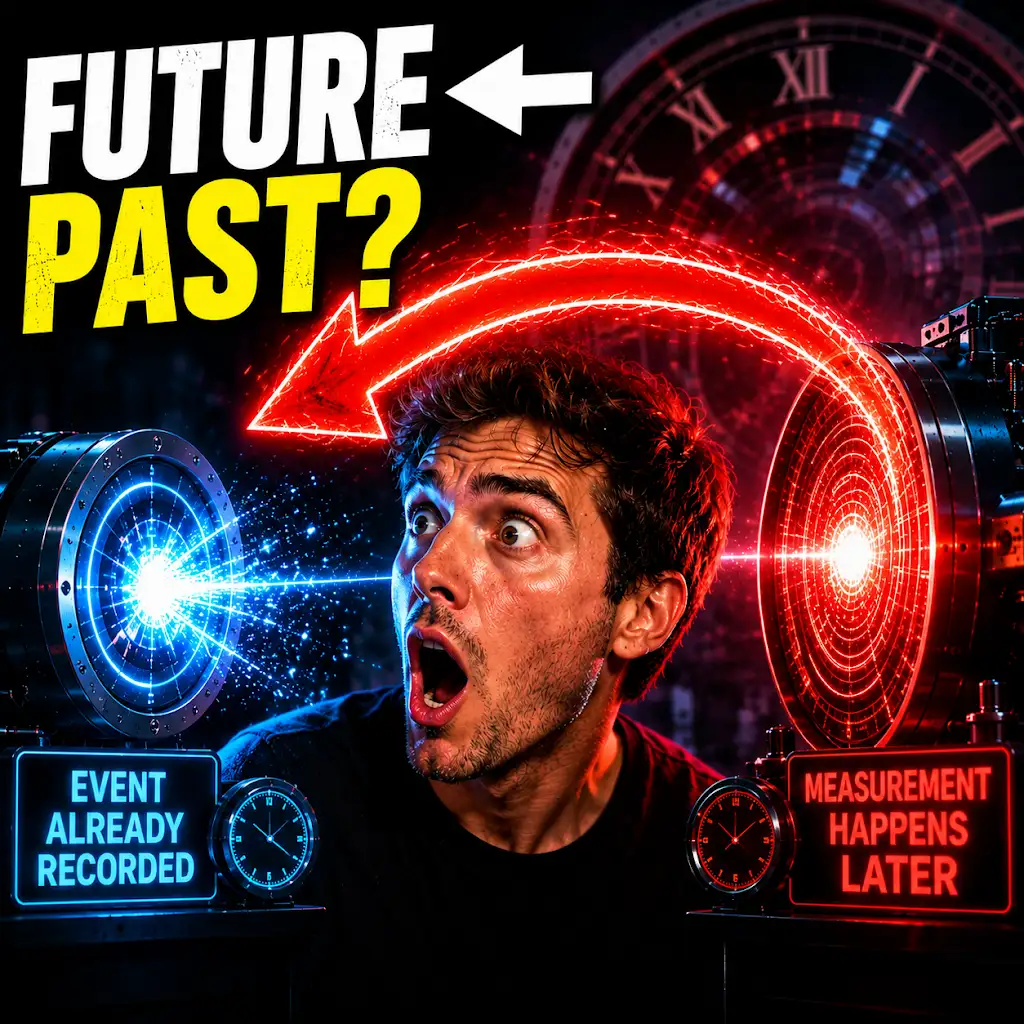
The Quantum Experiment That Looks Like It Changed the Past
FAQs
1. Can the past be changed scientifically?
No, according to the laws of physics and our current understanding of time, the past cannot be changed scientifically. Time is considered to be a one-way street, and events that have occurred in the past are considered to be fixed.
2. Is time travel possible to change the past?
As of now, time travel to change the past is purely theoretical and has not been proven to be possible. The concept of time travel raises many paradoxes and challenges, and there is no scientific evidence to support the idea of altering the past through time travel.
3. Are there any scientific theories that suggest the past can be changed?
While there are various scientific theories and thought experiments related to time travel and alternate timelines, none of these theories have been proven or demonstrated to allow for the actual changing of the past.
4. Can technology or advancements in science change the past?
As of now, there is no technology or scientific advancement that has been shown to change the past. Our understanding of causality and the laws of physics suggest that altering the past is not feasible with current technology or scientific knowledge.
5. What are some ways in which the past can be influenced or perceived differently?
While the past cannot be changed scientifically, our perception and understanding of historical events can evolve over time. New evidence, reinterpretation of existing evidence, and advancements in technology can lead to different perspectives on the past, but these do not constitute actual changes to the past.