The human fascination with altering history is as old as storytelling itself. From ancient myths to modern cinematic blockbusters, the idea of undoing a mistake, preventing a tragedy, or experiencing a bygone era has captivated our imaginations. But beyond the realm of fiction, a question lingers: can scientists, with their ever-expanding knowledge and technological prowess, ever truly change the past? This exploration delves into the theoretical underpinnings and speculative possibilities that scientists ponder when contemplating the malleability of time.
At the heart of any discussion about changing the past lies our understanding of spacetime. Einstein’s theory of relativity fundamentally reshaped our perception of the universe, unifying space and time into a single, four-dimensional continuum. This framework provides the theoretical foundation for many speculative ideas about time travel, both forward and backward.
General Relativity and the Geometry of Time
General relativity describes gravity not as a force, but as a curvature in spacetime caused by mass and energy. Massive objects, like stars and black holes, warp the fabric of spacetime around them. This warping has profound implications for how time is experienced. For instance, time passes more slowly in stronger gravitational fields – a phenomenon known as gravitational time dilation, which has been experimentally verified. While this allows for a form of “travel” into the future (by spending time in a stronger gravitational field relative to someone else), it doesn’t offer a direct mechanism for reversing or altering past events.
Wormholes: Cosmic Shortcuts Through Spacetime
The theoretical concept of wormholes, also known as Einstein-Rosen bridges, has emerged as a popular candidate for facilitating time travel. These hypothetical tunnels could connect two distant points in spacetime, acting as shortcuts through the universe. If a wormhole could be manipulated in specific ways, it might theoretically allow for travel between different points in time, not just space.
The Grandfather Paradox and Causality Violations
The most significant hurdle for any theory involving backward time travel is the potential for paradoxes. The most famous of these is the grandfather paradox: if someone travels back in time and prevents their grandfather from meeting their grandmother, they would never be born, thus making it impossible for them to go back in time in the first place. This highlights a fundamental tension between the possibility of altering the past and the principle of causality – the idea that every effect must have a cause, and causes precede their effects.
Stability and Exotic Matter Requirements
Even if wormholes exist, maintaining their stability and keeping them open long enough for passage presents enormous theoretical challenges. Physicists hypothesize that the existence of exotic matter, possessing negative mass-energy density, would be required to prop open a wormhole and prevent it from collapsing. Such matter has not been definitively observed and remains largely within the realm of theoretical speculation.
The intriguing question of whether scientists can change the past has sparked numerous debates and discussions in the field of theoretical physics and philosophy. A related article that delves deeper into the implications of time travel and its potential effects on history can be found at this link: Exploring the Possibilities of Time Travel. This article examines various theories and concepts surrounding time manipulation, providing readers with a comprehensive understanding of the challenges and ethical considerations involved in altering historical events.
Quantum Mechanics: A Different Perspective on Time
While general relativity offers a macroscopic view of spacetime, quantum mechanics delves into the subatomic realm, where the rules of reality are often counterintuitive. The probabilistic nature of quantum phenomena has led some physicists to explore whether the past might be less rigidly defined at the quantum level.
Quantum Superposition and the Measurement Problem
In quantum mechanics, particles can exist in multiple states simultaneously, a phenomenon known as superposition. However, upon measurement, the superposition “collapses” into a single, definite state. This has led to various interpretations of quantum mechanics, some of which hint at the possibility of influencing past events, albeit in highly indirect and subtle ways.
The Many-Worlds Interpretation and Parallel Universes
The Many-Worlds Interpretation (MWI) of quantum mechanics proposes that every quantum measurement causes the universe to split into multiple parallel universes, each representing a different possible outcome. In this framework, traveling back in time and altering an event wouldn’t change “your” past; instead, it would create a new timeline or branch off into a pre-existing one where that alteration occurred. This elegantly sidesteps the grandfather paradox by positing that the traveler’s actions would simply lead them to a different reality, leaving their original timeline untouched.
Retrocausality in Quantum Experiments
Some quantum experiments have yielded results that suggest a form of “retrocausality,” where later events appear to influence earlier ones. For example, experiments involving delayed-choice quantum erasers have been interpreted by some as demonstrating that the act of measuring a particle’s path at a later time can influence its behavior at an earlier stage. However, these interpretations are highly debated, and most physicists argue that these phenomena can be explained within the standard framework of quantum mechanics without invoking actual backward causation.
Entanglement and Non-Locality
Quantum entanglement is another perplexing quantum phenomenon where two or more particles become linked in such a way that they share the same fate, regardless of the distance separating them. Measuring the state of one entangled particle instantaneously influences the state of the other. While this “spooky action at a distance,” as Einstein famously called it, demonstrates a form of non-locality, it does not provide a mechanism for transmitting information or altering past events.
Information Paradoxes and the Nature of Reality

The very concept of altering the past raises profound questions about the nature of information and the conservation laws that govern our universe. If an event is changed, what happens to the information associated with the original event?
The Black Hole Information Paradox
The black hole information paradox is a prime example of how fundamental physics principles clash when considering drastic events. According to classical general relativity, anything falling into a black hole is lost forever. However, quantum mechanics suggests that information cannot be destroyed. Stephen Hawking’s work on Hawking radiation indicated that black holes slowly evaporate, but the nature of the radiation emitted does not appear to carry the information of what fell in. Resolving this paradox might offer insights into how information behaves under extreme conditions, potentially influencing our understanding of time.
Holographic Principle and the Universe as a Projection
The holographic principle, a theoretical concept suggesting that the information content of a volume of space can be encoded on its boundary, has been proposed as a way to resolve the black hole information paradox. If this principle holds true for the entire universe, it might imply that our reality is a kind of cosmic hologram, with past, present, and future existing in a complex, interconnected way. This could mean that “changing” the past is not about rewriting a physical record but rather about altering how information is accessed or interpreted.
Determinism vs. Indeterminism: A Philosophical Divide
The debate about whether the universe is deterministic or indeterministic has significant implications for the possibility of changing the past. If the universe is entirely deterministic, then every event is predetermined, and free will is an illusion. In such a universe, changing the past would be impossible because the future, and indeed all of history, is already fixed.
The Block Universe Model
The “block universe” model, a philosophical interpretation often supported by the block universe view of spacetime in physics, suggests that all of time – past, present, and future – exists simultaneously and is equally real. In this view, the universe is a static, four-dimensional block, and our perception of flow and change is merely an illusion. If this is the case, then “changing” the past would be akin to trying to alter a pre-existing, immutable sculpture.
Quantum Indeterminacy and the Open Future
Conversely, if the universe is fundamentally indeterminate, as suggested by quantum mechanics, then the future is not fixed. This opens up possibilities for genuine novelty and choice. However, even with indeterminacy, it is a significant leap to suggest that past events themselves can be rewritten. The indeterminacy typically applies to future outcomes rather than the fixed history of events that have already transpired.
Theoretical Frameworks and Hypothetical Technologies

While the fundamental laws of physics currently present formidable barriers, scientists continue to explore theoretical frameworks that might, in the far future, offer pathways to influencing the past. These remain highly speculative.
Closed Timelike Curves (CTCs)
Within the equations of general relativity, certain exotic spacetime geometries can theoretically contain “closed timelike curves” (CTCs). Traveling along a CTC would, in principle, allow an object to return to its own past. However, the conditions required for the formation of CTCs are extreme and likely involve phenomena like rapidly rotating black holes or cosmic strings, which are not known to exist or are highly unstable.
The Chronology Protection Conjecture
Physicist Stephen Hawking proposed the Chronology Protection Conjecture, which suggests that the laws of physics themselves conspire to prevent time travel into the past on macroscopic scales. This conjecture, if proven true, would imply that any theoretical loophole for time travel would be inherently unstable or impossible to exploit.
The Nature of Time Itself: A Fluid or Fixed Entity?
Our current understanding of time is largely based on empirical observation and theoretical models. However, the very nature of time remains a subject of profound philosophical and scientific inquiry. Is time a fundamental aspect of reality, or an emergent property of something else?
Time as an Emergent Property
Some theories propose that time is not a fundamental entity but rather an emergent property that arises from more basic, timeless interactions. If this is the case, then understanding the underlying processes could reveal new ways of interacting with or even influencing what we perceive as temporal progression.
The Arrow of Time and Entropy
The “arrow of time,” the unidirectional flow from past to future, is closely linked to the second law of thermodynamics, which states that entropy (disorder) in a closed system tends to increase over time. Reversing or altering past events would seemingly require a reversal of entropy, which is considered highly improbable on a macroscopic scale. However, at the quantum level, entropy’s behavior is more nuanced, leading to ongoing research.
The intriguing question of whether scientists can change the past has sparked numerous debates and discussions in the realm of theoretical physics and philosophy. A related article explores the implications of time travel and its potential consequences on our understanding of history and causality. For those interested in delving deeper into this fascinating topic, you can read more about it in this insightful piece found here.
Ethical and Philosophical Implications
| Question | Answer |
|---|---|
| Can scientists change the past? | No, scientists cannot change the past as it has already occurred and cannot be altered. |
Even if the scientific possibility of changing the past were to emerge, the ethical and philosophical implications would be staggering.
The Morality of Intervention
If one could alter past events, what would be the criteria for deciding which events to change? Who would wield such power, and what would prevent its misuse? The potential for unintended consequences and the ethical dilemmas surrounding the alteration of history are immense.
The Butterfly Effect and Unforeseen Consequences
The concept of the “butterfly effect,” popularized by chaos theory, illustrates how tiny changes in initial conditions can lead to drastically different outcomes over time. Any intervention in the past, no matter how small, could have unforeseen and potentially catastrophic consequences for the present and future.
Identity and Memory
If the past is altered, how would this affect individual identity and collective memory? Would people remember the original timeline or the altered one? The very foundations of our sense of self, rooted in our personal histories, would be called into question.
Conclusion: A Frontier of Imagination and Scientific Inquiry
Currently, the ability for scientists to change the past remains firmly within the realm of theoretical speculation and science fiction. While our understanding of spacetime and quantum mechanics offers glimpses into intriguing possibilities, the fundamental laws of physics, particularly causality and the conservation of information, present formidable barriers. The pursuit of answers, however, continues to drive scientific inquiry, pushing the boundaries of our comprehension of the universe and our place within it. Whether the past is an immutable record or a malleable tapestry, the exploration of these questions enriches our understanding of reality and sparks the imagination, reminding us of the vast mysteries that still lie at the frontier of human knowledge. The journey to understand time, and perhaps one day even influence it, is an ongoing testament to humanity’s relentless curiosity.
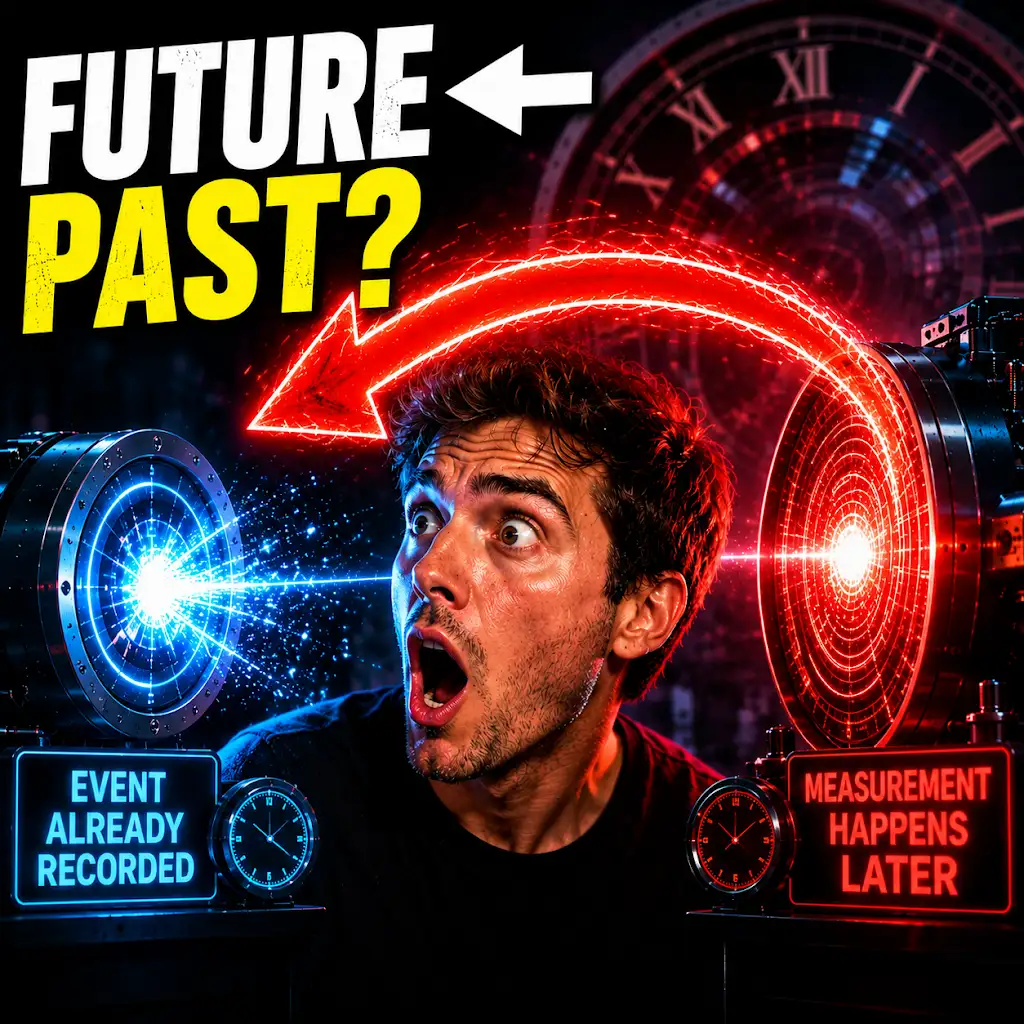
The Quantum Experiment That Looks Like It Changed the Past
FAQs
1. Can scientists change the past?
No, scientists cannot change the past. The past is a fixed sequence of events that have already occurred and cannot be altered.
2. Is time travel possible for scientists to change the past?
According to current scientific understanding, time travel to the past is not possible. The laws of physics, as currently understood, do not allow for backward time travel.
3. Are there any scientific theories that suggest changing the past is possible?
There are some theoretical concepts in physics, such as the idea of closed timelike curves, that suggest the theoretical possibility of time travel to the past. However, these concepts are purely speculative and have not been proven to exist in the real world.
4. Can scientists influence events that have already occurred in the past?
No, scientists cannot influence events that have already occurred in the past. Once an event has taken place, it is fixed and cannot be changed by any future actions.
5. What are some ways scientists study and understand the past?
Scientists study and understand the past through disciplines such as archaeology, paleontology, geology, and historical research. These fields use evidence from the natural world and historical records to reconstruct and understand past events.