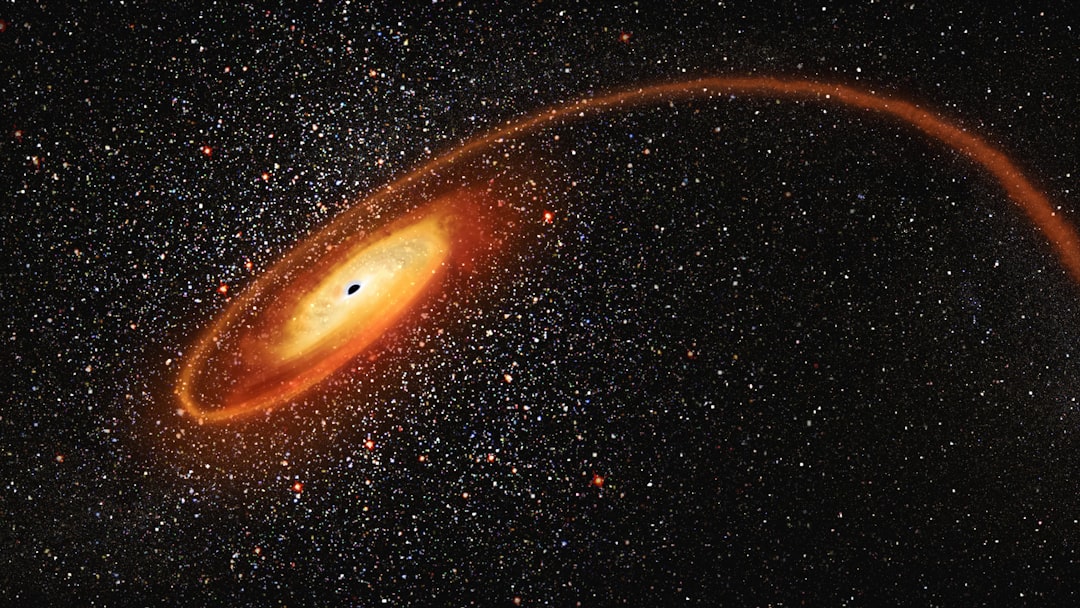
The enigmatic nature of black holes has captivated scientists and the public imagination for decades. These cosmic abysses, regions of spacetime exhibiting such strong gravitational effects that nothing—not even particles and electromagnetic radiation such as light—can escape from inside them, present a formidable challenge to our understanding of the universe. One of the most profound and persistent mysteries surrounding black holes is the fate of information that falls into them. Can information truly escape a black hole, or is it lost forever? This question, often referred to as the “black hole information paradox,” lies at the heart of the theoretical conflict between general relativity and quantum mechanics.
The genesis of the information paradox can be traced back to the fundamental principles of two pillars of modern physics: Albert Einstein’s general theory of relativity and quantum mechanics. General relativity, which describes gravity as a curvature of spacetime, predicts that black holes are essentially featureless objects, characterized only by their mass, charge, and angular momentum—a concept famously described by John Wheeler as “black holes have no hair.” This implies that any information about the matter that formed the black hole, beyond these three properties, is irrevocably lost once it crosses the event horizon.
The Problem with No Hair
The “no-hair” theorem suggests that a black hole formed from a pile of old books, for instance, would be indistinguishable from a black hole formed from a collapsing star of the same mass, charge, and angular momentum. The intricate details of the books’ molecular structure, the words printed on their pages—all would seemingly vanish without a trace. This deterministic loss of information presents a stark philosophical challenge, as it fundamentally contradicts the principles of quantum mechanics.
Quantum Mechanics and Unitary Evolution
Quantum mechanics, the theory that describes the universe at its smallest scales, asserts that information is always conserved. This principle is encapsulated in the concept of “unitary evolution,” which dictates that the state of a quantum system can always be traced back to its initial state. In simpler terms, if you know the initial conditions of a quantum system, you can theoretically predict its future state and, crucially, retrodict its past state. The idea that information could be destroyed within a black hole violates this cornerstone of quantum mechanics, leading to a profound theoretical impasse.
The intriguing question of whether information can escape a black hole has captivated scientists and enthusiasts alike, leading to numerous discussions and theories in the field of astrophysics. For a deeper exploration of this topic, you can read a related article that delves into the complexities of black holes and the nature of information within them. Check it out here: My Cosmic Ventures.
Hawking Radiation and the Evaporating Black Hole
The plot thickened significantly in the 1970s with Stephen Hawking’s groundbreaking prediction of “Hawking radiation.” Using quantum field theory in curved spacetime, Hawking demonstrated that black holes are not entirely black; they emit a faint thermal radiation due to quantum effects near the event horizon. This seemingly innocuous discovery had profound implications for the information paradox.
The Mechanics of Hawking Radiation
Hawking radiation arises from virtual particle-antiparticle pairs that constantly pop in and out of existence in the vacuum of space. Near the event horizon, where spacetime is highly curved, it’s possible for one particle of a pair to fall into the black hole while its partner escapes to infinity. The escaping particle carries away positive energy, while the infalling particle carries negative energy, effectively reducing the black hole’s mass. This process, over cosmic timescales, leads to the gradual evaporation of the black hole, a slow dissipation resembling a cosmic ice cube melting over eons.
The Information Problem of Evaporation
The dilemmatic aspect of Hawking radiation is that it appears to be purely thermal, meaning it carries no information about the matter that formed the black hole. Imagine tossing a detailed, uniquely patterned piece of tapestry into a roaring fireplace. The smoke rising from the fire, much like Hawking radiation, would carry no discernible information about the tapestry’s original intricate design. If a black hole eventually evaporates completely, leaving behind only this information-poor radiation, then all the information that fell into it—from the details of its constituent particles to the very history of its formation—would truly be lost to the universe. This stark conclusion directly clashes with the quantum mechanical principle of information conservation.
Proposed Solutions and Theoretical Landscape

The black hole information paradox has spurred decades of intense theoretical research, with physicists proposing various ingenious solutions to reconcile general relativity and quantum mechanics. These proposals often involve radical revisions to our understanding of spacetime, quantum gravity, or both.
Holographic Principle and AdS/CFT Correspondence
One of the most promising avenues of research is the holographic principle, which suggests that all the information contained within a region of spacetime can be encoded on its boundary. This principle finds a concrete realization in the Anti-de Sitter/Conformal Field Theory (AdS/CFT) correspondence, a conjectured duality between a theory of quantum gravity in an Anti-de Sitter (AdS) spacetime and a conformal field theory (CFT) living on its boundary. If this correspondence holds true, it implies that the information about what falls into a black hole might be encoded on the event horizon itself, or in some other holographic boundary. The black hole, in this view, would act as a kind of cosmic hard drive, storing information on its surface rather than destroying it.
Firewalls and Fuzzballs
Other proposals challenge the smooth, featureless nature of the event horizon. The “firewall paradox” suggests that quantum entanglement between infalling and outgoing Hawking radiation could lead to a violently hot curtain of energetic particles—a “firewall”—at the event horizon, incinerating anything that attempts to cross it. This challenges Einstein’s equivalence principle, which states that an observer falling into a black hole should not experience anything unusual until they reach the singularity.
Alternatively, the “fuzzball” hypothesis posits that black holes are not singular points but rather complex, quantum-gravitational objects, a “fuzzball” of strings or other fundamental constituents, that are extended throughout the region where the event horizon is expected to be. In this model, there is no true event horizon to cross, and information would be encoded within the intricate structure of the fuzzball itself, allowing it to eventually escape as the fuzzball dissipates.
The Role of Quantum Entanglement

Quantum entanglement, a peculiar phenomenon where two or more particles become linked in such a way that they share the same fate regardless of the distance separating them, plays a crucial role in the information paradox. The formation of Hawking radiation implicitly relies on entanglement.
Entanglement Across the Horizon
When a virtual particle-antiparticle pair is created near the event horizon, the particles are entangled. One particle falls into the black hole, while its entangled partner escapes as Hawking radiation. If the infalling particle carries information, then its entangled partner, escaping to infinity, should somehow also carry a semblance of that information, even if encoded in a highly subtle way. The conundrum arises because if the black hole eventually evaporates completely, the entanglement between the escaping particles and the now non-existent interior of the black hole is broken, leading to a violation of quantum mechanics.
The Entanglement Swapping Problem
Imagine a scenario where particle A falls into a black hole, entangled with particle B. Particle C is emitted as Hawking radiation, entangled with particle D, which also falls into the black hole. If a large number of such entangled pairs are produced and absorbed, and the black hole eventually evaporates, the entanglement between past, present, and future Hawking radiation, as well as with particles that fell into the black hole, becomes incredibly complex. This leads to what’s sometimes called the “monogamy of entanglement,” where a particle can only be maximally entangled with one other particle. If a Hawking photon is entangled with its partner inside the black hole, it cannot also be entangled with early Hawking radiation without violating this principle, leading to the firewall paradox.
The intriguing question of whether information can escape a black hole has captivated scientists and enthusiasts alike, leading to numerous theories and debates in the field of astrophysics. A related article explores the complexities of this topic and delves into the implications of black hole thermodynamics. For those interested in a deeper understanding, you can read more about it in this insightful piece on black hole information paradox. This exploration not only sheds light on the fundamental nature of black holes but also challenges our understanding of physics as we know it.
Implications for Fundamental Physics
| Metric | Description | Value/Status |
|---|---|---|
| Event Horizon | The boundary beyond which nothing can escape a black hole | Defined by Schwarzschild radius |
| Hawking Radiation | Quantum radiation predicted to be emitted by black holes | Exists, allows theoretical information leakage |
| Information Paradox | Debate on whether information is lost or preserved in black holes | Unresolved, active research area |
| Black Hole Complementarity | Theory suggesting information is both reflected and passes through horizon | Proposed resolution to paradox |
| Firewall Hypothesis | Proposed energetic barrier at event horizon that destroys information | Controversial, not widely accepted |
| AdS/CFT Correspondence | Mathematical framework suggesting information is preserved in black holes | Supports information conservation |
The black hole information paradox is not merely an academic exercise; its resolution has profound implications for our understanding of the universe at its most fundamental level. It represents a critical battleground where our theories of gravity and quantum mechanics clash, demanding a more complete and unified description of reality.
The Search for a Theory of Quantum Gravity
The paradox highlights the need for a comprehensive theory of quantum gravity—a theoretical framework that successfully merges general relativity with quantum mechanics. Current frameworks, like string theory and loop quantum gravity, offer potential pathways towards such a unification, and their ability to address the information paradox is a key test of their validity. A successful resolution would provide critical insights into the microscopic structure of spacetime and the very nature of reality at the Planck scale.
Redefining Causality and the Nature of Time
If information is truly lost in black holes, it would challenge our fundamental understanding of causality and the deterministic nature of physics. If, however, information is preserved and eventually escapes, it suggests a more intricate interplay between spacetime and quantum fields than previously imagined. This might even imply a subtle “memory” within spacetime itself, allowing information to persist even through the most extreme gravitational environments.
The Future of Black Hole Research
Ongoing and future astrophysical observations of black holes, particularly with advanced gravitational wave detectors and event horizon telescopes, could provide crucial empirical data to constrain theoretical models. While directly “seeing” information escape a black hole remains beyond our current technological capabilities, observing phenomena like gravitational echoes or subtle deviations from predicted Hawking radiation could offer tantalizing clues. For you, the reader, contemplating these deep mysteries illuminates the sheer ingenuity and persistent curiosity that drives scientific discovery, pushing the boundaries of what is known and revealing the awe-inspiring complexity of the cosmos. The black hole information paradox remains one of the most profound unresolved puzzles in modern physics, a cosmic Gordian knot waiting to be untangled, promising to unlock secrets that will redefine our place in the universe.
FAQs
1. What does it mean for information to escape a black hole?
Information escaping a black hole refers to the idea that data about the physical state of matter falling into a black hole might be preserved or transmitted out, rather than being lost forever inside the black hole.
2. Why is the question of information escaping a black hole important in physics?
This question is crucial because it relates to the “black hole information paradox,” which challenges the principles of quantum mechanics and general relativity. Resolving it helps scientists understand how these fundamental theories can coexist.
3. Can anything physically escape from inside a black hole’s event horizon?
According to classical physics, nothing, not even light, can escape from inside the event horizon of a black hole. This boundary marks the point of no return.
4. What is Hawking radiation and how does it relate to information escape?
Hawking radiation is theoretical radiation predicted to be emitted by black holes due to quantum effects near the event horizon. It suggests black holes can slowly lose mass and energy, raising questions about whether information can be encoded in this radiation.
5. Have scientists resolved whether information can escape a black hole?
While there is no definitive experimental proof yet, many physicists believe that information is not lost but rather encoded in subtle ways, such as in Hawking radiation or on the event horizon, preserving the laws of quantum mechanics.