The dance between light and matter is a fundamental spectacle of the universe, a constant interplay that underpins everything from the way we perceive the world to the operation of cutting-edge technologies. At the heart of this interaction lies the atom, the basic building block of matter, and the photon, the quantum of light. Understanding how photons interact with atoms is not merely an academic pursuit; it unlocks profound insights into the nature of energy, matter, and the very fabric of reality. This exploration delves into the atomic response to light, dissecting the intricate mechanisms of photon-atom interactions and their far-reaching implications.
The Quantum Nature of Light and Matter
Before delving into the specifics of photon-atom interactions, it is essential to grasp the quantum underpinnings of both light and matter. The classical view of light as a continuous electromagnetic wave and matter as a collection of discrete particles has been superseded by quantum mechanics, which paints a more nuanced picture. This paradigm shift is crucial for comprehending the quantized nature of energy exchange between photons and atoms.
Photons: Packets of Energy
Light, as described by quantum electrodynamics, is composed of discrete, indivisible packets of energy called photons. Each photon carries a specific amount of energy, directly proportional to its frequency. This relationship is elegantly captured by Planck’s equation, $E = hf$, where $E$ represents the energy of the photon, $h$ is Planck’s constant, and $f$ is the frequency of the light. This means that different colors of light, corresponding to different frequencies, carry different amounts of energy. A blue photon, with its higher frequency, carries more energy than a red photon, with its lower frequency. This quantization of light energy is a cornerstone of understanding how it interacts with atoms.
Atoms: The Discrete Energy Levels
Atoms, on the other hand, are not simply collections of electrons orbiting a nucleus. Instead, their electrons occupy specific, quantized energy levels. These energy levels are analogous to rungs on a ladder; an electron can exist on one rung or another, but not in between. The lowest energy level is known as the ground state, and higher energy levels are called excited states. An atom can only absorb or emit energy in discrete amounts that correspond precisely to the energy difference between these allowed energy levels. This principle, known as Bohr’s model of the atom and later refined by quantum mechanics, is fundamental to understanding how atoms respond to incoming photons. The transitions between these energy levels are probabilistic, meaning that while an atom can absorb or emit a photon of a specific energy, there is no certainty it will do so instantaneously.
The Resonance Condition
The interaction between a photon and an atom is governed by a crucial condition: resonance. For an atom to absorb a photon, the photon’s energy must precisely match the energy difference between one of its occupied energy levels and a higher, unoccupied energy level. Similarly, for an atom to emit a photon, the energy of the emitted photon must exactly equal the energy difference between an excited state and a lower energy state. If a photon’s energy does not match such an energy difference, it will typically pass through the atom largely unaffected, or it might scatter in a different direction without causing a transition. This precise energy matching is the key to selective absorption and emission processes.
In exploring the fascinating phenomenon of atomic response to light, one can gain deeper insights by referring to a related article that delves into the principles of quantum mechanics and its implications for light-matter interactions. This article provides a comprehensive overview of how atoms absorb and emit light, shedding light on the underlying processes that govern these interactions. For more information, you can read the article here: Atomic Response to Light.
Absorption: The Atom Takes a Photon

Absorption is the process by which an atom gains energy by capturing a photon. This phenomenon is central to many optical phenomena and technological applications. The atom essentially “catches” the photon, and in doing so, the photon ceases to exist as a free entity, its energy having been transferred to the atom.
Electronic Transitions
The most common form of absorption in atomic systems involves electronic transitions. When a photon with the correct energy strikes an atom, it can be absorbed by an electron. This absorption “kicks” the electron from its current, lower energy level to a higher, excited energy level. The atom is now in an excited state, possessing more internal energy than it did in its ground state. The energy of the absorbed photon dictates which specific electronic transition occurs. For instance, a photon with energy corresponding to the difference between the ground state and the first excited state will cause an electron to jump to that first excited level. Higher energy photons can cause electrons to jump to even higher energy levels, or even to ionize the atom by completely removing an electron.
Vibrational and Rotational Excitation
While electronic transitions are often the most discussed, atoms and molecules can also absorb photons that lead to changes in their vibrational and rotational energy states. These processes typically involve lower energy photons, often in the infrared and microwave regions of the electromagnetic spectrum. Vibrational excitation involves the stretching and bending of bonds within molecules, while rotational excitation involves the overall rotation of the atom or molecule. These types of absorptions are crucial in spectroscopy, allowing scientists to identify and study molecules based on their unique vibrational and rotational fingerprints.
The Role of Selection Rules
Not all theoretically possible transitions between energy levels are actually observed. Quantum mechanics dictates “selection rules” that govern the probability of a particular transition occurring. These rules are based on the conservation of angular momentum and parity. For example, in many atomic systems, a transition where the change in the orbital angular momentum is zero or ±1 is allowed, while larger changes are forbidden. These selection rules explain why certain wavelengths of light are absorbed by an atom and others are not, even if the energy difference seems plausible.
Emission: The Atom Releases a Photon
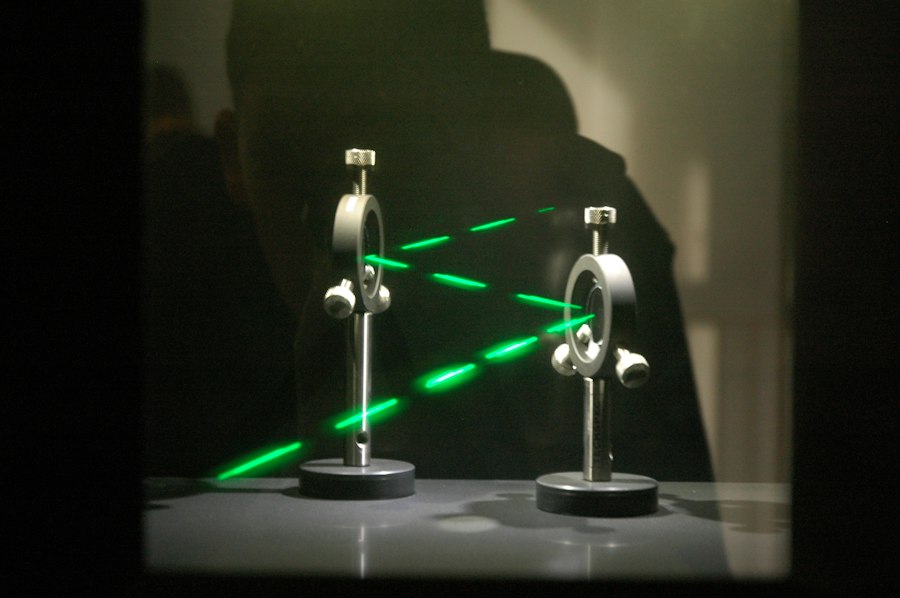
Emission is the inverse process of absorption, where an atom releases energy in the form of a photon. This process is responsible for the light emitted by stars, lamps, and many other luminous sources. It is a testament to the dynamic equilibrium within atoms.
Spontaneous Emission
Spontaneous emission occurs when an atom is in an excited state. After a certain average lifetime, characteristic of the particular excited state, the electron will naturally transition back to a lower energy level, releasing the excess energy as a photon. The energy of this emitted photon is equal to the energy difference between the initial excited state and the final lower energy state. The direction and polarization of the spontaneously emitted photon are random. This is the most common form of light emission from excited atoms.
Stimulated Emission
Stimulated emission, a concept central to the operation of lasers, occurs when an atom is already in an excited state, and an incoming photon with energy precisely matching the energy difference between the excited state and a lower state encounters it. Instead of just waiting for spontaneous emission, the incoming photon “stimulates” the excited atom to emit an identical photon. This emitted photon has the same energy, direction, polarization, and phase as the stimulating photon. This coherence is what makes lasers so powerful and useful. For stimulated emission to dominate over absorption, the material must be in a state of “population inversion,” where there are more atoms in an excited state than in the lower state, a condition that requires external energy input.
Fluorescence and Phosphorescence
Fluorescence and phosphorescence are related phenomena involving the emission of light after absorption of higher-energy radiation, typically ultraviolet light. In fluorescence, the emitted light is of lower energy (longer wavelength) than the absorbed light and occurs very rapidly, usually within nanoseconds. The excited state involved in fluorescence is typically a short-lived singlet state. Phosphorescence, on the other hand, involves emission from a longer-lived triplet state, resulting in a much slower decay of light, which can persist for seconds, minutes, or even hours. This delayed emission is often referred to as “afterglow.”
Scattering: Light Interacts and Changes Direction
Scattering is a process where photons interact with atoms or molecules and change their direction. Unlike absorption and emission, which involve the complete transfer of photon energy, scattering often involves the photon retaining most of its energy, albeit with a change in its momentum.
Rayleigh Scattering
Rayleigh scattering occurs when light interacts with particles that are much smaller than the wavelength of the light, such as individual atoms and molecules in the atmosphere. In this type of scattering, the incident photon causes a temporary, oscillating dipole moment in the atom or molecule. This oscillating dipole then re-radiates photons in various directions. Rayleigh scattering is strongly dependent on wavelength, with shorter wavelengths (like blue light) being scattered much more effectively than longer wavelengths (like red light). This is why the sky appears blue; sunlight, composed of all colors, is scattered by atmospheric molecules, and the blue component is scattered more widely, reaching our eyes from all directions.
Raman Scattering
Raman scattering is an inelastic scattering process, meaning that the scattered photon has a different energy (and therefore a different frequency/wavelength) than the incident photon. This energy change arises from the interaction of the photon with the vibrational or rotational energy levels of the molecule. If the scattered photon has lower energy, it is called Stokes scattering, and the molecule gains energy. If the scattered photon has higher energy, it is called anti-Stokes scattering, and the molecule loses energy. Raman scattering is a powerful tool in analytical chemistry and materials science for identifying molecular structures and studying chemical bonds.
Compton Scattering
Compton scattering is a process observed when high-energy photons, such as X-rays or gamma rays, interact with free electrons or loosely bound electrons in atoms. In this interaction, the photon transfers some of its energy and momentum to the electron, resulting in the emission of a scattered photon with a lower energy and a change in direction. The amount of energy lost by the photon depends on the scattering angle. Compton scattering provides strong evidence for the particle nature of light and is an important consideration in fields like medical imaging and radiation shielding.
Recent advancements in the field of photonics have shed light on the intricate mechanisms of atomic response to light, revealing fascinating insights into how atoms interact with electromagnetic radiation. For a deeper understanding of this topic, you can explore a related article that delves into the principles of light-matter interaction and its implications for various technologies. This article can be found at My Cosmic Ventures, where you will discover more about the exciting developments in this area of research.
Applications and Significance of Photon-Atom Interactions
| Metric | Description | Typical Value | Unit |
|---|---|---|---|
| Absorption Cross Section | Effective area that quantifies the likelihood of an atom absorbing a photon | 10-18 to 10-16 | cm² |
| Spontaneous Emission Lifetime | Average time an excited atom remains in the excited state before emitting a photon | 1 to 100 | nanoseconds (ns) |
| Rabi Frequency | Frequency of coherent oscillations between atomic energy levels under resonant light | 1 to 100 | MHz |
| Transition Dipole Moment | Measure of the strength of interaction between an atom and the electromagnetic field | 1 to 10 | Debye |
| Linewidth (Natural) | Intrinsic spectral width of an atomic transition due to spontaneous emission | 1 to 10 | MHz |
| Quantum Efficiency | Ratio of emitted photons to absorbed photons in an atomic transition | ~1 (near unity) | Dimensionless |
The fundamental principles governing photon-atom interactions are not just abstract scientific concepts; they are the bedrock upon which numerous technologies and scientific disciplines are built. From the displays we look at daily to the instruments that probe the universe, the understanding of these interactions is indispensable.
Spectroscopy and Analytical Chemistry
Spectroscopy, in its various forms (absorption, emission, Raman, etc.), is one of the most powerful analytical techniques in science. By studying the specific wavelengths of light that atoms and molecules absorb or emit, scientists can identify unknown substances, determine their concentrations, and probe their electronic, vibrational, and rotational structures. This is vital in fields ranging from environmental monitoring and medical diagnostics to forensic science and astronomical observations. The unique spectral fingerprints of elements and molecules act like bar codes, allowing for precise identification.
Lasers and Optical Technologies
The phenomenon of stimulated emission, a direct consequence of photon-atom interactions, is the fundamental principle behind the operation of lasers. Lasers produce highly monochromatic, coherent, and directional beams of light, which have revolutionized industries from telecommunications and manufacturing to medicine and entertainment. Fiber optics, used for high-speed internet and data transmission, relies on light traveling through optical fibers, with the initial generation of that light often stemming from laser technology.
Quantum Computing and Information Science
The interaction of photons with atoms, particularly with trapped ions or superconducting qubits, is a key area of research in the development of quantum computers. Quantum computers leverage quantum phenomena, such as superposition and entanglement, to perform calculations that are intractable for classical computers. The precise control of individual photons and their interactions with quantum bits (qubits) is essential for building and operating these futuristic machines. Furthermore, quantum communication protocols, designed for secure data transfer, often employ photons as information carriers.
Astrophysics and Cosmology
The light we observe from distant stars and galaxies is a direct result of photon-atom interactions occurring in those celestial bodies. By analyzing the absorption and emission lines in the spectra of stars, astronomers can determine their chemical composition, temperature, and velocity. The cosmic microwave background radiation, a faint afterglow from the Big Bang, provides crucial information about the early universe, and its properties are understood through the lens of photon-matter interactions in the primordial plasma. Studying these interactions allows us to unravel the history and evolution of the universe.
Everyday Technologies
Even seemingly simple technologies rely on our understanding of photon-atom interactions. The fluorescent lights that illuminate our homes work by exciting mercury atoms with electricity, causing them to emit ultraviolet photons, which then strike a phosphor coating on the inside of the tube, causing it to glow with visible light. Digital cameras and solar panels convert light energy into electrical signals through processes involving the absorption of photons by semiconductor materials, leading to the excitation of electrons. The very act of seeing relies on photons from light sources interacting with the atoms in our eyes, ultimately leading to the perception of images.
In conclusion, the atomic response to light, the intricate dance of photons and atoms, is a captivating and profoundly important area of physics. From the fundamental principles of quantum mechanics governing energy quantization to the diverse phenomena of absorption, emission, and scattering, this interaction shapes our understanding of the universe and drives technological innovation. The continued exploration of photon-atom interactions promises even deeper insights and revolutionary advancements in the future.
Physicists Just Measured a Negative Second.
FAQs
What is the atomic response to light?
The atomic response to light refers to the interaction between atoms and light, where atoms absorb or emit photons in response to light stimulation.
How do atoms respond to different wavelengths of light?
Atoms respond differently to various wavelengths of light based on their energy levels. When atoms absorb light, electrons can jump to higher energy levels, and when they emit light, electrons transition back to lower energy levels.
What are some applications of studying atomic response to light?
Studying atomic response to light is crucial in various fields such as spectroscopy, quantum mechanics, and laser technology. It helps in understanding atomic structure, developing new materials, and advancing technologies like lasers and optical devices.
Can atomic response to light be used in quantum computing?
Yes, atomic response to light plays a significant role in quantum computing. By manipulating atoms with light, researchers can control quantum states, which are essential for quantum information processing and building quantum computers.
How does atomic response to light contribute to the field of photonics?
Atomic response to light is fundamental in photonics, the science of generating, detecting, and manipulating light. By understanding how atoms interact with light, researchers can design and optimize devices like lasers, optical fibers, and photonic circuits for various applications in communication, sensing, and imaging.