
Virtual particles are a fascinating concept in the realm of quantum mechanics, representing transient fluctuations that occur in the vacuum of space. Unlike ordinary particles, which can be detected and measured, virtual particles exist only for a fleeting moment, existing in a state that defies the conventional laws of physics. They arise from the uncertainty principle, which allows for temporary violations of energy conservation, enabling these particles to pop in and out of existence.
This phenomenon is not merely theoretical; it plays a crucial role in the interactions between particles at the quantum level. The nature of virtual particles is inherently tied to the fabric of quantum field theory, where they serve as intermediaries in particle interactions. For instance, when two electrons repel each other, they do so by exchanging virtual photons, which are the force carriers of electromagnetic interactions.
These virtual particles are not directly observable but can be inferred through their effects on real particles. Their existence challenges traditional notions of reality and invites deeper inquiry into the fundamental workings of the universe.
Key Takeaways
- Virtual particles are fluctuations in quantum fields that appear and disappear in a very short amount of time.
- In quantum field theory, virtual particles play a crucial role in mediating the fundamental forces of nature.
- Virtual particles influence physical phenomena such as the Casimir effect and the Lamb shift, contributing to observable effects in the quantum realm.
- Vacuum fluctuations are closely related to virtual particles, as they arise from the uncertainty principle and contribute to the dynamic nature of empty space.
- The existence of virtual particles is supported by both theoretical predictions and experimental observations, providing strong evidence for their reality.
The Role of Virtual Particles in Quantum Field Theory
In quantum field theory (QFT), virtual particles are integral to understanding how forces operate at the subatomic level. QFT posits that particles are excitations in underlying fields that permeate space and time. When particles interact, they do so through the exchange of virtual particles, which mediate these interactions.
This exchange is often depicted in Feynman diagrams, where virtual particles are represented as internal lines connecting external lines that denote real particles. These diagrams provide a visual representation of complex interactions, simplifying calculations and enhancing comprehension. The role of virtual particles extends beyond mere mediators; they embody the dynamic nature of quantum fields.
In this framework, every particle is associated with a corresponding field, and virtual particles emerge from fluctuations within these fields. This interplay between fields and particles illustrates the interconnectedness of all matter and energy in the universe. As such, virtual particles are not just theoretical constructs but essential components that help physicists describe and predict the behavior of fundamental forces.
How Virtual Particles Influence Physical Phenomena

The influence of virtual particles extends into various physical phenomena, often manifesting in ways that challenge classical intuitions. One notable example is the Casimir effect, which arises from the vacuum fluctuations of virtual particles between two closely spaced conducting plates. The presence of these plates alters the vacuum state, leading to an observable force that pushes them together.
This phenomenon exemplifies how virtual particles can have tangible effects on macroscopic objects, bridging the gap between quantum mechanics and classical physics.
In this scenario, virtual particle pairs are generated at the boundary of a black hole; one particle may fall into the black hole while the other escapes, resulting in a net loss of mass for the black hole over time.
Such processes underscore the profound implications of virtual particles on our understanding of gravity and thermodynamics in extreme environments.
The Connection Between Virtual Particles and Vacuum Fluctuations
| Concept | Description |
|---|---|
| Virtual Particles | Temporary fluctuations in energy that violate the conservation of energy-momentum relation for a short period of time. |
| Vacuum Fluctuations | Quantum fluctuations that occur in a vacuum, leading to the creation and annihilation of particle-antiparticle pairs. |
| Connection | Virtual particles are a manifestation of vacuum fluctuations, where the temporary creation of particle-antiparticle pairs contributes to the energy-momentum fluctuations in the vacuum. |
Vacuum fluctuations are a cornerstone concept in quantum mechanics, closely linked to the existence of virtual particles. The vacuum is not an empty void but rather a seething sea of energy where virtual particles continuously emerge and annihilate. This dynamic state challenges classical notions of emptiness, suggesting that even “empty” space is teeming with activity.
The energy associated with these fluctuations can have significant implications for various physical processes. The connection between virtual particles and vacuum fluctuations is particularly evident in phenomena such as the Lamb shift, where energy levels of electrons in hydrogen atoms are altered due to interactions with virtual photons from vacuum fluctuations. This shift provides experimental evidence for the reality of vacuum fluctuations and their role in shaping atomic structures.
As researchers delve deeper into these concepts, they uncover new layers of complexity that further illuminate the intricate relationship between energy, matter, and the fabric of spacetime.
Theoretical and Experimental Evidence for the Existence of Virtual Particles
The existence of virtual particles, while initially a theoretical construct, has garnered substantial support from both theoretical frameworks and experimental observations. Quantum electrodynamics (QED), a well-established theory describing electromagnetic interactions, predicts various phenomena that can only be explained by considering virtual particles. For instance, the anomalous magnetic moment of the electron is accurately calculated using QED by accounting for contributions from virtual particle loops.
Experimental evidence supporting the existence of virtual particles can be found in high-energy physics experiments conducted at particle accelerators like CERN’s Large Hadron Collider (LHC). These experiments often reveal unexpected results that align with predictions involving virtual particles. Additionally, precision measurements in atomic physics have confirmed effects attributed to vacuum fluctuations and virtual particle interactions, reinforcing their significance in contemporary physics.
The Impact of Virtual Particles on Fundamental Forces
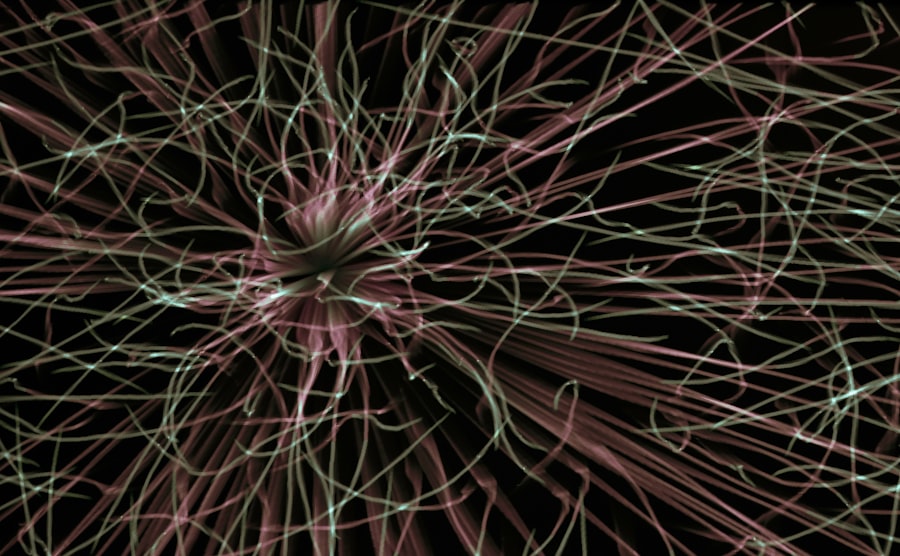
Virtual particles play a pivotal role in mediating fundamental forces within the universe. Each fundamental force—gravitational, electromagnetic, weak nuclear, and strong nuclear—is associated with specific virtual particles that facilitate interactions between matter. For example, photons serve as the exchange particles for electromagnetic forces, while gluons mediate strong nuclear forces between quarks within protons and neutrons.
The impact of virtual particles extends beyond mere mediation; they also contribute to our understanding of force unification theories. In attempts to unify gravity with other fundamental forces, physicists explore how virtual particles might bridge gaps between disparate theories. This quest for unification underscores the importance of understanding virtual particles not only as individual entities but as integral components within a broader framework that seeks to explain the fundamental workings of nature.
Virtual Particles in Astrophysics and Cosmology
In astrophysics and cosmology, virtual particles have profound implications for understanding cosmic phenomena. One area where their influence is particularly notable is in the study of cosmic microwave background radiation (CMB). The CMB represents remnants from the early universe, and fluctuations in this radiation can be attributed to interactions involving virtual particles during cosmic inflation—a rapid expansion phase shortly after the Big Bang.
Furthermore, virtual particles are thought to play a role in dark energy theories that seek to explain the accelerated expansion of the universe. Some models propose that vacuum energy associated with virtual particle fluctuations contributes to this mysterious force driving cosmic acceleration. As researchers continue to explore these connections, they uncover new insights into the nature of dark energy and its relationship with fundamental physics.
Harnessing the Power of Virtual Particles in Technology
The implications of virtual particles extend beyond theoretical physics into practical applications that could revolutionize technology. Quantum computing is one area where harnessing quantum phenomena—including those involving virtual particles—holds immense potential. By leveraging superposition and entanglement, quantum computers could perform calculations at speeds unattainable by classical computers.
Additionally, advancements in materials science may benefit from understanding how virtual particle interactions influence material properties at the quantum level. For instance, researchers are investigating how manipulating vacuum fluctuations could lead to breakthroughs in superconductivity or energy storage technologies. As scientists continue to explore these possibilities, they pave the way for innovations that could reshape industries and enhance everyday life.
The Future of Virtual Particles Research
The future of research on virtual particles promises to be an exciting frontier in theoretical and experimental physics. As technology advances and experimental techniques become more refined, physicists are poised to explore deeper questions surrounding these elusive entities. Ongoing efforts to unify quantum mechanics with general relativity may yield new insights into how virtual particles operate within gravitational fields or during extreme cosmic events.
Moreover, interdisciplinary collaborations between physicists, mathematicians, and computer scientists may lead to novel approaches for simulating complex quantum systems involving virtual particles. Such advancements could enhance our understanding not only of fundamental physics but also of emergent phenomena across various scientific disciplines. The quest to unravel the mysteries surrounding virtual particles will undoubtedly continue to inspire future generations of researchers.
Debates and Controversies Surrounding Virtual Particles
Despite their acceptance within mainstream physics, debates surrounding virtual particles persist among scientists and philosophers alike. Some critics argue that labeling these entities as “particles” may be misleading since they do not possess a well-defined existence like traditional particles do. This raises questions about their ontological status—whether they should be considered real entities or merely mathematical artifacts used for calculations.
Additionally, discussions about the implications of virtual particles on concepts such as causality and determinism have sparked philosophical inquiries into the nature of reality itself. As researchers grapple with these questions, they must navigate a complex landscape where empirical evidence meets abstract theoretical constructs. Such debates enrich our understanding of both physics and philosophy while highlighting the ongoing evolution of scientific thought.
Exploring the Philosophical Implications of Virtual Particles
The existence and behavior of virtual particles invite profound philosophical reflections on the nature of reality and our understanding of existence itself. If vacuum fluctuations give rise to transient entities that challenge classical notions of being, what does this imply about our perception of reality? Philosophers have long pondered questions related to existence, causality, and determinism; virtual particles add another layer to this discourse by blurring boundaries between what is considered “real” and “virtual.” Furthermore, discussions surrounding virtual particles prompt inquiries into the limits of human knowledge and understanding within scientific paradigms.
As physicists strive to comprehend phenomena that defy intuitive explanations—such as those involving non-locality or entanglement—they confront fundamental questions about observation, measurement, and interpretation in science. The philosophical implications surrounding virtual particles thus extend beyond mere academic curiosity; they challenge humanity’s quest for meaning within an ever-evolving universe. In conclusion, virtual particles represent a captivating intersection between quantum mechanics and philosophical inquiry.
Their role in mediating fundamental forces, influencing physical phenomena, and shaping our understanding of reality underscores their significance within contemporary physics. As research continues to unfold around these enigmatic entities, both scientists and philosophers will undoubtedly find themselves engaged in an ongoing dialogue about what it means to exist within a universe rich with complexity and wonder.
Virtual particles are fascinating entities in the realm of quantum physics, often described as transient fluctuations that briefly appear and disappear in a vacuum. These particles play a crucial role in various quantum phenomena, including the Casimir effect and Hawking radiation. For those interested in delving deeper into the intriguing world of virtual particles and their implications in modern physics, a related article can be found on My Cosmic Ventures. This article explores the broader context of quantum mechanics and its impact on our understanding of the universe. You can read more about it by visiting this page.
WATCH THIS! How a Quantum Loophole Sparked Everything: The Universe Born From Nothing, Explained
FAQs
What are virtual particles?
Virtual particles are particles that exist temporarily as a result of the uncertainty principle in quantum mechanics. They are not directly observable, but their effects can be detected through their interactions with other particles.
How do virtual particles differ from real particles?
Virtual particles differ from real particles in that they do not have the same properties as real particles, such as mass and energy. They also do not obey the same conservation laws as real particles.
What is the role of virtual particles in quantum field theory?
In quantum field theory, virtual particles are used to describe the interactions between real particles. They are considered to be the carriers of fundamental forces, such as the electromagnetic force and the strong nuclear force.
Can virtual particles be directly observed?
Virtual particles cannot be directly observed, as they exist only temporarily and do not have the same properties as real particles. However, their effects can be detected through their interactions with real particles.
What are some examples of virtual particles?
Some examples of virtual particles include virtual photons, which are responsible for the electromagnetic force, and virtual gluons, which are responsible for the strong nuclear force. These virtual particles mediate the interactions between real particles.