Black holes have long captivated the imagination of scientists and the general public alike. These enigmatic cosmic entities, formed from the remnants of massive stars, possess gravitational forces so intense that nothing, not even light, can escape their grasp. The very nature of black holes challenges the boundaries of human understanding, raising profound questions about the fabric of space and time.
Their existence was first theorized in the early 20th century, but it wasn’t until the advent of modern astrophysics that researchers began to unravel their complexities. The mystery surrounding black holes lies not only in their formation and characteristics but also in their implications for the universe as a whole. As researchers delve deeper into the nature of black holes, they encounter a paradox that has puzzled physicists for decades: the information paradox.
This conundrum arises from the conflict between quantum mechanics and general relativity, two pillars of modern physics that describe the universe at vastly different scales. While general relativity explains the gravitational behavior of massive objects, quantum mechanics governs the behavior of particles at the smallest scales. The intersection of these two theories within the context of black holes presents a rich tapestry of questions and challenges, prompting scientists to explore new theories and models that could bridge this gap.
Key Takeaways
- Black holes are mysterious cosmic objects with extreme gravitational pull and unique properties like the event horizon and singularity.
- Quantum mechanics and theories like the Quantum Bounce offer new insights into black hole behavior and formation.
- Hawking radiation suggests black holes can emit particles and potentially evaporate over time.
- Quantum entanglement plays a role in understanding information paradoxes related to black holes.
- Advances in quantum gravity and the Quantum Bounce hypothesis could revolutionize future astrophysics research.
The Quantum Bounce Theory
The Quantum Bounce Theory offers a fascinating perspective on the nature of black holes and their potential role in the universe’s lifecycle. This theory posits that instead of collapsing indefinitely into a singularity, a black hole may undergo a “bounce” at its core, leading to a new phase of expansion. This idea challenges traditional views of black holes as ultimate endpoints, suggesting instead that they could serve as gateways to new universes or states of existence.
The implications of this theory are profound, as they suggest that black holes may not be the final destination for matter and energy but rather a transformative process that contributes to the ongoing evolution of the cosmos. At its core, the Quantum Bounce Theory is rooted in the principles of quantum gravity, which seeks to unify general relativity and quantum mechanics. By applying quantum principles to gravitational phenomena, researchers hope to uncover a more comprehensive understanding of black holes and their behavior.
This theory not only provides a potential resolution to the information paradox but also opens up new avenues for exploring the fundamental nature of reality itself. As scientists continue to investigate this theory, they may uncover insights that reshape our understanding of black holes and their significance in the grand tapestry of the universe.
Understanding Quantum Mechanics

To fully appreciate the implications of theories like the Quantum Bounce Theory, one must first grasp the fundamentals of quantum mechanics. This branch of physics describes the behavior of matter and energy at the smallest scales, where classical physics fails to provide accurate predictions. Quantum mechanics introduces concepts such as wave-particle duality, superposition, and entanglement, which challenge our intuitive understanding of reality.
At this microscopic level, particles can exist in multiple states simultaneously and can instantaneously affect one another regardless of distance—a phenomenon known as entanglement. The principles of quantum mechanics have far-reaching implications for our understanding of black holes. For instance, when considering how information behaves in extreme gravitational fields, quantum mechanics suggests that information cannot be destroyed, even if it falls into a black hole.
This idea has led to intense debates among physicists regarding how information is preserved or transformed within these cosmic entities. By exploring these quantum principles, researchers aim to bridge the gap between quantum mechanics and general relativity, ultimately leading to a more unified theory that can explain the behavior of black holes and other cosmic phenomena.
The Birth of a Black Hole
| Metric | Value | Unit | Description |
|---|---|---|---|
| Event Date | 2015-09-14 | UTC | Date when gravitational waves from a black hole merger were first detected |
| Black Hole Mass (Primary) | 36 | Solar Masses | Mass of the larger black hole before merger |
| Black Hole Mass (Secondary) | 29 | Solar Masses | Mass of the smaller black hole before merger |
| Final Black Hole Mass | 62 | Solar Masses | Mass of the newly formed black hole after merger |
| Energy Radiated | 3 | Solar Masses equivalent | Energy emitted as gravitational waves during the merger |
| Distance from Earth | 1.3 | Billion Light Years | Estimated distance to the black hole merger event |
| Signal Duration | 0.2 | Seconds | Duration of the gravitational wave signal detected |
| Frequency Range | 35 – 250 | Hz | Frequency range of the detected gravitational waves |
The birth of a black hole is a dramatic event in the life cycle of a star. When a massive star exhausts its nuclear fuel, it can no longer support itself against gravitational collapse. The core implodes under its own weight, leading to an explosion known as a supernova.
This cataclysmic event can outshine entire galaxies for a brief period, scattering stellar material across space while leaving behind a dense remnant core. If this core’s mass exceeds a certain threshold—known as the Tolman-Oppenheimer-Volkoff limit—it will collapse into a black hole. The formation process is not merely a one-time event; it is part of a larger cosmic cycle.
The material expelled during a supernova can contribute to the formation of new stars and planets, creating a continuous cycle of birth and death in the universe. This interconnectedness highlights the dynamic nature of cosmic evolution and raises questions about the role black holes play in shaping galaxies and star systems. As researchers study these processes, they gain insights into not only how black holes form but also how they influence their surroundings over cosmic timescales.
The Event Horizon
The event horizon is one of the most intriguing features associated with black holes. It represents the boundary beyond which nothing can escape the gravitational pull of the black hole. Once an object crosses this threshold, it is effectively lost to the outside universe, leading to speculation about what happens to matter and information within this region.
The event horizon serves as a point of no return, creating an aura of mystery around what lies beyond it. Understanding the event horizon is crucial for comprehending how black holes interact with their environment. For instance, when matter spirals into a black hole, it forms an accretion disk around the event horizon, emitting intense radiation as it heats up due to friction and gravitational forces.
This process can lead to observable phenomena such as quasars—extremely bright objects powered by supermassive black holes at the centers of galaxies. By studying these interactions, scientists can glean valuable information about black holes and their influence on galactic evolution.
The Singularity
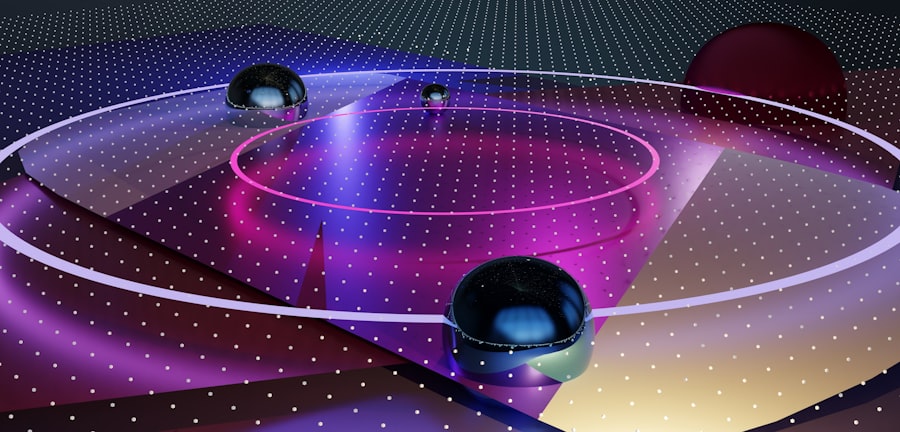
At the heart of every black hole lies a singularity—a point where gravitational forces compress matter to an infinitely small volume and density. In this region, known laws of physics break down, leading to conditions that defy our current understanding. The singularity represents a frontier where our knowledge falters; it is both a theoretical construct and an enigma that challenges physicists to rethink their models of reality.
The implications of singularities extend beyond black holes themselves; they raise fundamental questions about the nature of space and time. If singularities exist within black holes, what does this mean for our understanding of causality and the structure of spacetime? As researchers grapple with these questions, they are compelled to explore new theories that could reconcile general relativity with quantum mechanics—an endeavor that may ultimately lead to groundbreaking discoveries about the universe’s fundamental nature.
Quantum Entanglement and Black Holes
Quantum entanglement is another phenomenon that plays a significant role in understanding black holes. When two particles become entangled, their states become linked in such a way that measuring one particle instantaneously affects the other, regardless of distance. This peculiar behavior raises intriguing questions about how entangled particles behave in extreme environments like those found near black holes.
Some physicists propose that entanglement could provide insights into how information is preserved when matter falls into a black hole. If entangled particles are separated by an event horizon, does their connection persist? This question has led to various hypotheses regarding how information might be encoded on the event horizon itself—a concept known as holography.
Hawking Radiation and Black Holes
Hawking radiation is perhaps one of the most groundbreaking concepts related to black holes, introduced by physicist Stephen Hawking in 1974. According to this theory, black holes are not entirely black; they emit radiation due to quantum effects near their event horizons. This radiation arises from virtual particle pairs that spontaneously form in empty space—one particle may fall into the black hole while its counterpart escapes into space, resulting in a net loss of mass for the black hole over time.
The implications of Hawking radiation are profound; if true, it suggests that black holes can eventually evaporate completely over astronomical timescales. This challenges traditional notions that black holes are eternal entities and raises questions about what happens to information contained within them as they lose mass. Hawking’s work has sparked extensive research into how this radiation interacts with quantum mechanics and what it means for our understanding of gravity and thermodynamics.
Quantum Gravity and Black Holes
Quantum gravity is an area of theoretical physics that seeks to unify general relativity with quantum mechanics—a task that has proven elusive for decades. Black holes serve as natural laboratories for exploring these concepts due to their extreme gravitational fields and unique properties. Researchers are investigating various approaches to quantum gravity, including string theory and loop quantum gravity, each offering different perspectives on how gravity operates at quantum scales.
Understanding quantum gravity is essential for resolving many paradoxes associated with black holes, including the information paradox and singularities. By developing a coherent framework that incorporates both quantum mechanics and general relativity, scientists hope to gain deeper insights into how black holes function and their role in shaping the universe’s structure. This pursuit not only enhances our understanding of black holes but also has broader implications for fundamental physics.
The Quantum Bounce Hypothesis
The Quantum Bounce Hypothesis posits that instead of collapsing into singularities, black holes may undergo a bounce due to quantum effects at extremely high densities. This idea suggests that when matter reaches critical density within a black hole’s core, it could rebound rather than compress indefinitely. Such a bounce could lead to new phases of expansion or even give rise to new universes—a concept reminiscent of cyclic cosmological models.
This hypothesis challenges conventional views about black holes as ultimate endpoints and opens up exciting possibilities for understanding cosmic evolution. If true, it implies that black holes could play an active role in generating new structures within the universe rather than simply consuming matter indefinitely. As researchers explore this hypothesis further, they may uncover novel insights into how black holes contribute to cosmic dynamics.
Implications for the Future of Astrophysics
The exploration of black holes and their associated theories has far-reaching implications for the future of astrophysics. As scientists continue to investigate these enigmatic entities through observational data and theoretical models, they are likely to uncover new phenomena that challenge existing paradigms. The interplay between quantum mechanics and general relativity remains one of the most significant frontiers in modern physics; breakthroughs in this area could revolutionize our understanding of space, time, and gravity.
Moreover, advancements in technology—such as gravitational wave detectors and high-energy particle colliders—are providing unprecedented opportunities for testing theories related to black holes and quantum gravity. As researchers push the boundaries of knowledge in these fields, they may uncover answers to some of humanity’s most profound questions about existence itself: What lies beyond our observable universe? How do fundamental forces shape reality?
The journey into understanding black holes promises not only to illuminate these mysteries but also to inspire future generations of scientists in their quest for knowledge about the cosmos.
Recent research into the concept of a quantum bounce universe has shed light on the potential origins of black holes, suggesting that these cosmic phenomena may arise from the collapse of previous universes. This intriguing idea aligns with the theories presented in a related article, which explores the implications of quantum mechanics on the fabric of spacetime. For more insights on this topic, you can read the article here: Quantum Bounce Universe and Black Hole Origins.
WATCH THIS 🛑 The Impossible Proof: Our Universe Is a Black Hole’s Interior
FAQs
What is a quantum bounce in cosmology?
A quantum bounce is a theoretical concept in quantum cosmology where the universe undergoes a contraction phase followed by a bounce, leading to an expansion phase. This idea replaces the classical Big Bang singularity with a quantum transition, avoiding infinite density and temperature.
How does the quantum bounce relate to the origin of the universe?
The quantum bounce suggests that the universe did not begin from a singular point but instead emerged from a previous contracting universe. This bounce provides a possible explanation for the universe’s origin without requiring a singularity, consistent with principles of quantum gravity.
What role do black holes play in the quantum bounce universe theory?
In some models, black holes are proposed as potential sites where quantum bounce phenomena occur. The intense gravitational collapse inside black holes might trigger a bounce, possibly giving rise to new universes or contributing to the origin of our own universe.
Is the quantum bounce theory widely accepted in the scientific community?
The quantum bounce is a speculative but actively researched idea within theoretical physics and cosmology. While it offers solutions to problems like the Big Bang singularity, it remains a hypothesis requiring further theoretical development and observational evidence.
What theories support the concept of a quantum bounce?
Loop quantum gravity is one of the main theoretical frameworks supporting the quantum bounce concept. It applies quantum principles to spacetime geometry, predicting that quantum effects can cause a bounce instead of a singularity during gravitational collapse.
Can the quantum bounce be observed or tested experimentally?
Direct observation of a quantum bounce is currently beyond our technological capabilities. However, researchers look for indirect evidence through cosmic microwave background radiation patterns, gravitational waves, or other cosmological signatures that might support or refute bounce models.
How does the quantum bounce differ from the traditional Big Bang theory?
The traditional Big Bang theory posits a singular beginning of the universe with infinite density and temperature. The quantum bounce replaces this singularity with a finite, quantum-driven transition from contraction to expansion, avoiding infinities and potentially explaining pre-Big Bang conditions.
What implications does the quantum bounce have for black hole physics?
If black holes can undergo quantum bounces, it could imply that black holes are gateways to new universes or that their singularities are resolved by quantum effects. This challenges classical views of black holes and may provide insights into quantum gravity and information paradoxes.