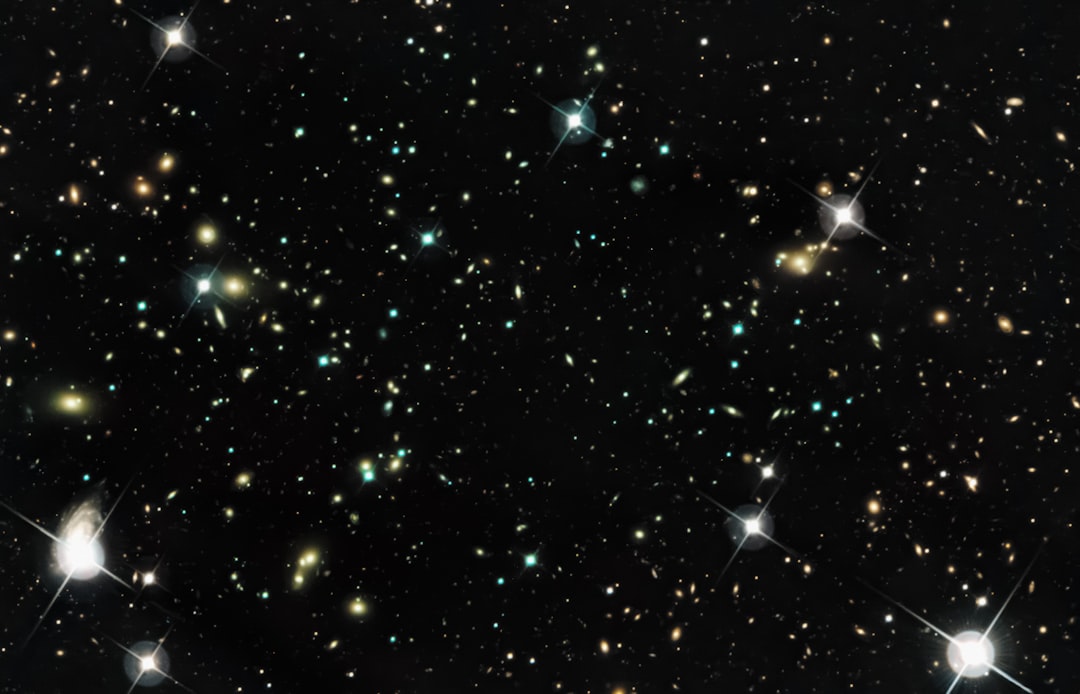
In the vast expanse of the universe, two enigmatic components dominate the cosmic landscape: dark matter and dark energy. These phenomena, while invisible and elusive, play crucial roles in shaping the structure and evolution of the cosmos. Dark matter, which constitutes approximately 27% of the universe’s total mass-energy content, is believed to exert gravitational forces that influence the motion of galaxies and galaxy clusters.
In contrast, dark energy, accounting for about 68% of the universe, is thought to drive its accelerated expansion. Together, they form a significant part of the universe’s composition, yet remain largely mysterious to scientists. The study of dark matter and dark energy challenges our understanding of fundamental physics and cosmology.
As researchers delve deeper into these subjects, they confront questions that probe the very nature of reality. What are these substances made of? How do they interact with ordinary matter?
The quest to unravel these mysteries not only enhances our comprehension of the universe but also pushes the boundaries of scientific inquiry, leading to new theories and technologies.
Key Takeaways
- Dark matter and dark energy are two mysterious components that make up the majority of the universe’s mass and energy.
- The existence of dark matter was first proposed in the 1930s, while dark energy was discovered in the late 1990s.
- Dark matter is believed to be non-luminous and non-interacting, making it difficult to detect, while dark energy is thought to be responsible for the accelerated expansion of the universe.
- Scientists are actively searching for dark matter using a variety of methods, including direct and indirect detection experiments.
- Understanding dark matter and dark energy is crucial for comprehending the structure, evolution, and ultimate fate of the universe.
Historical Background and Discovery
The journey to uncover the existence of dark matter began in the early 20th century when astronomers first noticed discrepancies in the motion of galaxies. In 1933, Swiss astronomer Fritz Zwicky observed that galaxies within the Coma Cluster were moving at speeds that suggested there was far more mass present than could be accounted for by visible matter alone. He proposed the existence of “dark matter,” a term that would later become synonymous with this unseen mass.
Zwicky’s findings laid the groundwork for a new understanding of cosmic dynamics, although his ideas were met with skepticism at the time. The concept of dark energy emerged much later, in the late 1990s, when observations of distant supernovae revealed an unexpected phenomenon: the universe’s expansion was not slowing down as previously thought but accelerating. This groundbreaking discovery led to the hypothesis that a mysterious force, dubbed dark energy, was driving this acceleration.
The realization that dark energy constituted a significant portion of the universe’s total energy content transformed cosmology and prompted a reevaluation of existing theories about the universe’s fate.
The Nature of Dark Matter

Dark matter is fundamentally different from ordinary matter, which makes up stars, planets, and living organisms. While ordinary matter interacts with electromagnetic forces, allowing it to emit, absorb, or reflect light, dark matter does not interact with light in any detectable way. This lack of interaction is what renders it invisible and difficult to study directly.
However, its presence is inferred through gravitational effects on visible matter. For instance, galaxies rotate at such speeds that they should tear themselves apart if only visible matter were present; dark matter provides the additional gravitational pull necessary to hold them together. Various candidates have been proposed for what constitutes dark matter.
One leading theory suggests that it is composed of Weakly Interacting Massive Particles (WIMPs), which would interact through gravity and possibly through weak nuclear forces. Other candidates include axions and sterile neutrinos. Despite extensive research and numerous experiments designed to detect these particles directly or indirectly, no conclusive evidence has yet emerged.
The elusive nature of dark matter continues to challenge physicists and astronomers alike.
The Search for Dark Matter
| Experiment | Location | Year |
|---|---|---|
| LUX | South Dakota, USA | 2013 |
| XENON1T | Gran Sasso, Italy | 2016 |
| DarkSide-50 | Gran Sasso, Italy | 2013 |
The quest to identify dark matter has led to a multitude of experimental efforts across the globe. Underground laboratories, particle accelerators, and astronomical surveys are all part of this extensive search. For instance, experiments like the Large Hadron Collider (LHC) at CERN aim to create conditions that might produce dark matter particles.
Meanwhile, observatories such as the Vera Rubin Observatory are set to map the distribution of dark matter in galaxies by observing gravitational lensing—an effect where light from distant objects is bent around massive bodies. Despite these efforts, direct detection remains elusive. Researchers have developed sophisticated detectors designed to capture potential interactions between dark matter particles and ordinary matter; however, these attempts have yet to yield definitive results.
The ongoing search for dark matter is not just a scientific endeavor but also a testament to human curiosity and perseverance in unraveling one of the universe’s greatest mysteries.
The Role of Dark Matter in the Universe
Dark matter plays a pivotal role in shaping the structure of the universe on both large and small scales. It acts as a scaffolding for galaxies and galaxy clusters, influencing their formation and evolution over billions of years. Without dark matter, the universe as we know it would be vastly different; galaxies would not have formed in the same way, if at all.
The gravitational pull exerted by dark matter helps to bind galaxies together within clusters and affects their interactions with one another. Moreover, dark matter is essential for understanding cosmic phenomena such as gravitational lensing and cosmic microwave background radiation. Gravitational lensing occurs when light from distant objects is bent by massive foreground objects—often rich in dark matter—allowing astronomers to map its distribution across the universe.
Similarly, studies of the cosmic microwave background provide insights into how dark matter influenced the early universe’s structure and evolution. Thus, dark matter is not merely an abstract concept; it is integral to our understanding of cosmic history.
The Concept of Dark Energy
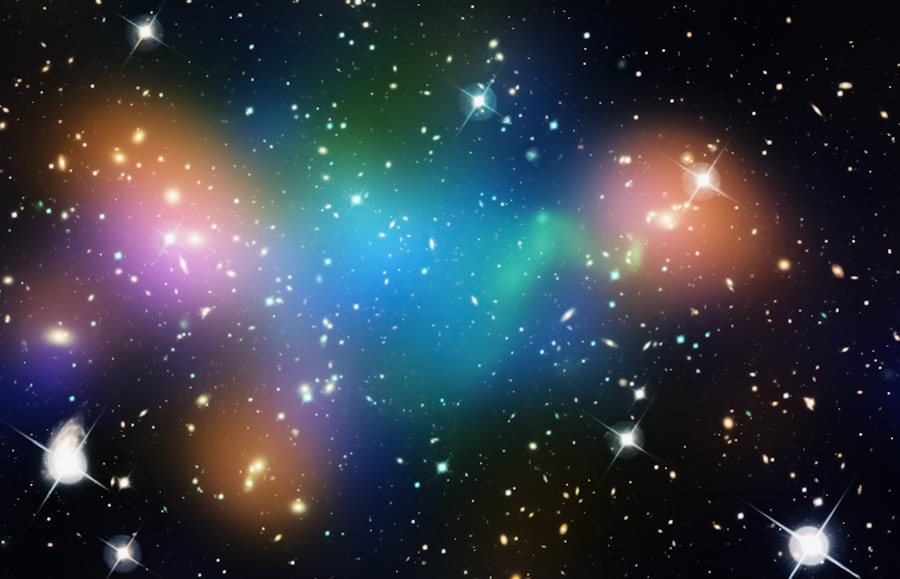
While dark matter serves as a gravitational anchor in the universe, dark energy represents a force that drives its expansion. This mysterious energy is thought to permeate all of space and exert a repulsive effect on galaxies, causing them to move away from each other at an accelerating rate. The concept of dark energy challenges traditional notions of gravity and has profound implications for our understanding of the universe’s fate.
The nature of dark energy remains one of the most significant unsolved problems in cosmology. Various theories have been proposed to explain its existence, ranging from a cosmological constant—an energy density associated with empty space—to more exotic ideas such as quintessence or modifications to general relativity. Each theory presents unique challenges and predictions that scientists are actively investigating through observational data and theoretical models.
The Expansion of the Universe and Dark Energy
The discovery that the universe is expanding was first made by Edwin Hubble in the 1920s when he observed that distant galaxies were moving away from Earth at speeds proportional to their distances—a phenomenon now known as Hubble’s Law. This expansion was initially thought to be slowing down due to gravitational attraction; however, observations in the late 1990s revealed that this expansion is actually accelerating due to dark energy. This acceleration has profound implications for cosmology and our understanding of time itself.
If dark energy continues to dominate over gravitational forces, it could lead to scenarios such as the “Big Freeze,” where galaxies drift apart until stars burn out and galaxies become isolated islands in an ever-expanding void. Alternatively, other theories suggest potential outcomes like the “Big Rip,” where dark energy could eventually tear apart galaxies, stars, planets, and even atomic structures.
Theories and Explanations for Dark Energy
Numerous theories have been proposed to explain dark energy’s nature and effects on cosmic expansion. One prominent idea is the cosmological constant introduced by Albert Einstein in his equations of general relativity—a term he later dismissed but which has regained attention in light of recent discoveries. This constant represents a uniform energy density filling space homogeneously.
Another approach involves dynamic fields known as quintessence, which suggest that dark energy could vary over time and space rather than being constant. These models introduce additional complexities but offer intriguing possibilities for understanding cosmic evolution. Other theories explore modifications to general relativity itself or propose entirely new physics beyond our current understanding.
Current Research and Observations
As scientists continue their quest to understand dark matter and dark energy, current research efforts are focused on gathering more observational data and refining theoretical models. Large-scale surveys like the European Space Agency’s Euclid mission aim to map the geometry of the universe with unprecedented precision while investigating how dark energy influences cosmic structures. Additionally, advancements in technology have enabled astronomers to observe distant supernovae with greater accuracy, providing critical insights into cosmic expansion rates over time.
Ground-based observatories are also playing a vital role in studying gravitational lensing effects caused by dark matter distributions across vast cosmic distances.
Implications of Dark Matter and Dark Energy
The implications of dark matter and dark energy extend far beyond academic curiosity; they challenge our fundamental understanding of physics and cosmology. If dark matter exists as theorized, it could lead to new insights into particle physics and potentially reveal new forces or particles yet unknown to science.
Moreover, these concepts have philosophical implications regarding humanity’s place in the universe. As researchers grapple with questions about existence and reality itself—what constitutes “matter” or “energy”—they confront profound existential inquiries that resonate with humanity’s quest for knowledge.
Future Prospects and Challenges
Looking ahead, the future prospects for research into dark matter and dark energy are both exciting and challenging. As technology advances, new observational tools will emerge that could provide clearer insights into these phenomena. Upcoming missions like NASA’s James Webb Space Telescope promise to revolutionize our understanding by observing distant galaxies and cosmic events with unprecedented detail.
Researchers must navigate complex theoretical frameworks while developing innovative experimental techniques capable of detecting or measuring these phenomena directly. In conclusion, while much remains unknown about dark matter and dark energy, ongoing research continues to push boundaries in astrophysics and cosmology.
As scientists strive to unlock these cosmic mysteries, they not only seek answers about the universe but also embark on a journey that reflects humanity’s enduring curiosity about existence itself.
Dark matter and dark energy are two of the most intriguing and mysterious components of our universe, making up about 95% of its total mass-energy content. While dark matter is thought to be responsible for the gravitational effects that cannot be explained by visible matter alone, dark energy is believed to be driving the accelerated expansion of the universe. For those interested in delving deeper into these cosmic phenomena, a related article can be found on My Cosmic Ventures. This article explores the latest theories and discoveries surrounding dark matter and dark energy, providing a comprehensive overview of their roles in the cosmos. You can read more about it by visiting this link.
WATCH THIS! Did JWST DISPROVE The BIG BANG?!?!
FAQs
What is dark matter?
Dark matter is a hypothetical form of matter that is thought to make up about 27% of the universe’s total mass and energy. It does not emit, absorb, or reflect light, making it invisible and undetectable by current astronomical instruments.
What is dark energy?
Dark energy is a mysterious force that is thought to make up about 68% of the universe’s total mass and energy. It is believed to be responsible for the accelerating expansion of the universe and is distinct from both ordinary matter and dark matter.
How do we know dark matter and dark energy exist?
The existence of dark matter and dark energy is inferred from their gravitational effects on visible matter and the expansion of the universe. Observations of the rotation of galaxies, the motion of galaxy clusters, and the large-scale structure of the universe all point to the presence of dark matter and dark energy.
What is the difference between dark matter and dark energy?
Dark matter is a form of matter that exerts gravitational forces and affects the motion of galaxies and galaxy clusters, while dark energy is a force that is causing the expansion of the universe to accelerate. Dark matter is thought to be “clumpy” and interacts with gravity, while dark energy is thought to be “smooth” and acts as a repulsive force.
What are the implications of dark matter and dark energy for our understanding of the universe?
The existence of dark matter and dark energy challenges our current understanding of the fundamental forces and particles that make up the universe. Their presence has significant implications for cosmology, astrophysics, and our understanding of the ultimate fate of the universe.