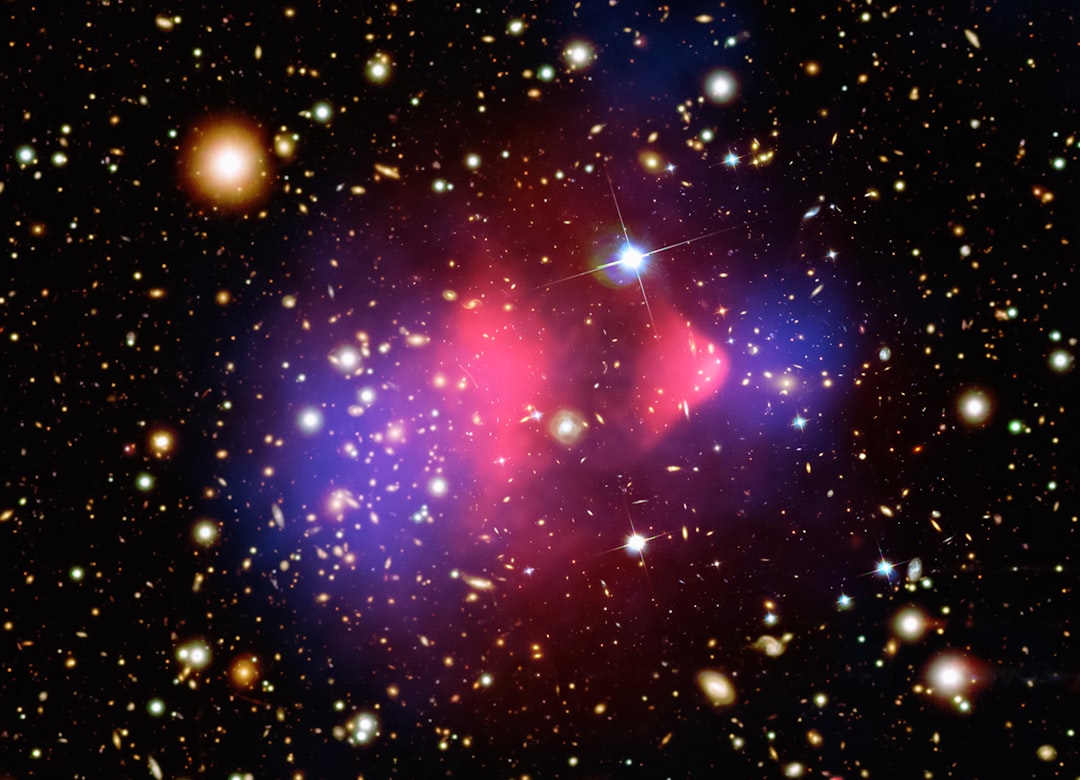
Dark matter is one of the most enigmatic components of the universe, constituting approximately 27% of its total mass-energy content. Unlike ordinary matter, which makes up stars, planets, and living organisms, dark matter does not emit, absorb, or reflect light, making it invisible and detectable only through its gravitational effects. The concept of dark matter emerged in the early 20th century when astronomers observed that galaxies were rotating at speeds that could not be explained by the visible mass alone.
This discrepancy led to the hypothesis that an unseen form of matter must exist, exerting gravitational influence on visible matter. The term “dark matter” encompasses a variety of theoretical particles and phenomena. While its exact nature remains unknown, it is believed to play a crucial role in the formation and structure of the universe.
Dark matter is thought to be responsible for the clustering of galaxies and the large-scale structure of the cosmos. Its presence is inferred from gravitational lensing, where light from distant objects is bent around massive clusters of galaxies, revealing the unseen mass. Understanding dark matter is essential for a comprehensive grasp of cosmology and the fundamental workings of the universe.
Key Takeaways
- Dark matter is a mysterious substance that makes up a significant portion of the universe’s mass but does not emit light or energy.
- Direct detection experiments aim to observe dark matter particles interacting with ordinary matter here on Earth.
- These experiments face significant challenges due to the extremely weak interactions and rare events involving dark matter particles.
- Current and future experiments use advanced technologies and international collaborations to improve sensitivity and detection capabilities.
- Understanding dark matter is crucial for cosmology, as it influences the structure and evolution of the universe.
The Search for Dark Matter
The quest to uncover the mysteries of dark matter has become one of the most significant challenges in modern astrophysics and particle physics. Researchers have employed various methods to detect and study dark matter, ranging from astronomical observations to particle collider experiments. The search is driven by the need to explain not only the gravitational effects attributed to dark matter but also to understand its fundamental properties and interactions.
As scientists delve deeper into this elusive subject, they are faced with both exciting possibilities and daunting obstacles. One of the primary motivations for studying dark matter is its potential to unlock new physics beyond the Standard Model. The existence of dark matter suggests that there may be particles and forces yet to be discovered, which could revolutionize our understanding of the universe.
As such, the search for dark matter is not merely an academic endeavor; it has profound implications for our comprehension of fundamental forces and the evolution of cosmic structures. The ongoing efforts to identify dark matter particles are a testament to humanity’s relentless pursuit of knowledge about the universe.
The Role of Direct Detection Experiments

Direct detection experiments play a pivotal role in the search for dark matter by attempting to observe interactions between dark matter particles and ordinary matter. These experiments are designed to identify potential signals produced when dark matter particles collide with atomic nuclei in highly sensitive detectors. The goal is to capture these rare interactions, which would provide direct evidence for the existence of dark matter and help characterize its properties.
The significance of direct detection experiments lies in their ability to provide empirical data that can either support or challenge existing theoretical models of dark matter. By measuring specific signatures associated with dark matter interactions, researchers can refine their understanding of its mass, spin, and interaction cross-section with ordinary matter. This information is crucial for developing a comprehensive picture of dark matter’s role in the universe and its potential connections to other fundamental forces.
How Direct Detection Experiments Work
Direct detection experiments typically involve sophisticated detectors placed deep underground or in isolated environments to shield them from cosmic rays and other background noise. These detectors are often made from materials such as germanium, xenon, or argon, which are chosen for their ability to register low-energy recoils caused by potential dark matter interactions. When a dark matter particle collides with a nucleus in the detector material, it may impart enough energy to create a detectable signal, such as scintillation light or ionization.
The design of these experiments varies widely, with some utilizing liquid noble gases while others employ solid-state detectors. Each approach has its advantages and challenges, but all share a common goal: to achieve unprecedented sensitivity in detecting potential dark matter signals. Researchers meticulously analyze data collected from these experiments, searching for anomalies that could indicate the presence of dark matter particles.
The results are then compared against theoretical predictions to assess their significance and implications.
The Challenges of Detecting Dark Matter
| Experiment | Detector Type | Target Material | Location | Exposure (kg·yr) | WIMP Mass Sensitivity (GeV/c²) | Cross-Section Limit (cm²) | Status |
|---|---|---|---|---|---|---|---|
| XENONnT | Dual-phase liquid xenon time projection chamber | Liquid Xenon | Gran Sasso, Italy | 10,000 | 10 – 1000 | 4.1 × 10⁻⁴⁷ (at 30 GeV/c²) | Operational |
| LUX-ZEPLIN (LZ) | Dual-phase liquid xenon time projection chamber | Liquid Xenon | Sanford Underground Research Facility, USA | 15,000 | 5 – 1000 | 1.4 × 10⁻⁴⁷ (at 40 GeV/c²) | Operational |
| PandaX-4T | Dual-phase liquid xenon time projection chamber | Liquid Xenon | China Jinping Underground Laboratory, China | 20,000 | 10 – 1000 | 3.1 × 10⁻⁴⁷ (at 40 GeV/c²) | Operational |
| SuperCDMS SNOLAB | Cryogenic germanium and silicon detectors | Ge, Si | SNOLAB, Canada | 1000 | 0.5 – 10 | 1 × 10⁻⁴³ (at 1 GeV/c²) | Under construction |
| DarkSide-20k | Dual-phase liquid argon time projection chamber | Liquid Argon | Gran Sasso, Italy | 100,000 | 10 – 1000 | 1 × 10⁻⁴⁷ (at 100 GeV/c²) | Planned |
Despite significant advancements in technology and methodology, detecting dark matter remains an arduous task fraught with challenges. One of the primary difficulties lies in the extremely low interaction rates expected between dark matter particles and ordinary matter. Most proposed dark matter candidates interact very weakly with normal particles, making it unlikely that any signal will be detected even after years of data collection.
Additionally, background noise from cosmic rays, radioactive decay, and other environmental factors can obscure potential signals from dark matter interactions. Researchers must employ sophisticated shielding techniques and advanced data analysis methods to differentiate between genuine signals and background events.
Current Direct Detection Experiments

As of October 2023, several prominent direct detection experiments are actively searching for dark matter particles. One notable example is the LUX-ZEPLIN (LZ) experiment located at the Sanford Underground Research Facility in South Dakota. Utilizing a large volume of liquid xenon as its detection medium, LZ aims to achieve unprecedented sensitivity to weakly interacting massive particles (WIMPs), one of the leading candidates for dark matter.
Another significant experiment is the PandaX project in China, which also employs liquid xenon technology but focuses on different aspects of dark matter detection. Meanwhile, the SuperCDMS experiment uses cryogenic solid-state detectors made from germanium and silicon to search for low-mass dark matter candidates. Each of these experiments contributes unique insights into the nature of dark matter while pushing the boundaries of detection capabilities.
Future Prospects for Direct Detection Experiments
The future of direct detection experiments looks promising as advancements in technology continue to enhance sensitivity and precision. Researchers are exploring novel materials and detection techniques that could improve the chances of observing dark matter interactions. For instance, new detector designs incorporating advanced photodetectors or novel scintillation materials may lead to breakthroughs in sensitivity.
Moreover, international collaborations are becoming increasingly important in this field. By pooling resources and expertise from various institutions worldwide, scientists can tackle the challenges associated with dark matter detection more effectively. Future experiments may also benefit from synergies with other areas of research, such as astrophysics and cosmology, leading to a more holistic understanding of dark matter’s role in the universe.
The Impact of Dark Matter on Cosmology
Dark matter has profound implications for cosmology, influencing our understanding of galaxy formation, structure evolution, and the overall dynamics of the universe. Its gravitational effects shape the distribution of galaxies and galaxy clusters, providing a framework for understanding large-scale cosmic structures. Without accounting for dark matter, current models of cosmology would fail to explain observed phenomena such as galaxy rotation curves and gravitational lensing.
Furthermore, dark matter plays a crucial role in cosmic inflation theories and models describing the early universe’s evolution. Understanding its properties could shed light on fundamental questions about the origins of cosmic structures and the fate of the universe itself. As researchers continue to investigate dark matter’s influence on cosmology, they may uncover new insights that challenge existing paradigms and reshape our understanding of reality.
Theoretical Models of Dark Matter
Numerous theoretical models have been proposed to explain the nature of dark matter, each offering different insights into its properties and interactions. Among these models, weakly interacting massive particles (WIMPs) have garnered significant attention due to their compatibility with both particle physics theories and cosmological observations. WIMPs are predicted to have masses ranging from a few GeV to several TeV and interact via weak nuclear forces.
Other candidates include axions, sterile neutrinos, and primordial black holes, each presenting unique characteristics that could account for dark matter’s elusive nature. Axions are hypothetical particles that arise from quantum chromodynamics (QCD) theories and could provide a solution to both dark matter and strong CP problem in particle physics. Sterile neutrinos are another intriguing possibility that could bridge gaps between known particles and potential dark matter candidates.
Collaborations and International Efforts in Dark Matter Research
The search for dark matter has fostered numerous collaborations among scientists across disciplines and borders. International efforts have led to groundbreaking advancements in detection technologies and theoretical frameworks. Major collaborations such as the Dark Energy Survey (DES) and the European Organization for Nuclear Research (CERN) have brought together physicists from around the globe to tackle this complex problem.
These collaborative endeavors not only enhance research capabilities but also promote knowledge sharing among scientists with diverse expertise.
Such partnerships are essential for advancing our understanding of this elusive component of the universe.
The Importance of Understanding Dark Matter
Understanding dark matter is crucial for unraveling some of the most profound mysteries of the universe. Its existence challenges our current understanding of physics and cosmology while offering opportunities for new discoveries that could reshape our comprehension of reality itself. As researchers continue their quest to detect and characterize dark matter, they stand on the brink of potentially transformative breakthroughs that could redefine fundamental concepts in science.
Moreover, comprehending dark matter has implications beyond theoretical physics; it influences our understanding of cosmic evolution, galaxy formation, and even the fate of the universe itself. As humanity seeks answers to existential questions about its place in the cosmos, unraveling the mysteries surrounding dark matter will undoubtedly play a pivotal role in shaping future scientific endeavors and philosophical inquiries alike.
Recent advancements in dark matter direct detection experiments have sparked significant interest in the scientific community. For a deeper understanding of the ongoing research and developments in this field, you can explore the article on cosmic ventures, which discusses various methodologies and technologies being employed to uncover the mysteries of dark matter. For more information, visit this article on cosmic ventures.
FAQs
What is dark matter?
Dark matter is a form of matter that does not emit, absorb, or reflect light, making it invisible to current electromagnetic observation methods. It is believed to make up about 27% of the universe’s mass-energy content and is inferred from its gravitational effects on visible matter, radiation, and the large-scale structure of the universe.
What are dark matter direct detection experiments?
Dark matter direct detection experiments are scientific efforts designed to observe interactions between dark matter particles and ordinary matter. These experiments typically involve highly sensitive detectors placed deep underground to shield them from cosmic rays and other background radiation, aiming to detect rare collisions between dark matter particles and atomic nuclei.
How do direct detection experiments work?
Direct detection experiments work by monitoring a target material for tiny energy deposits caused by dark matter particles colliding with atomic nuclei. When such a collision occurs, it can produce detectable signals such as scintillation light, ionization, or heat (phonons), which are then measured by the detector’s sensors.
What types of detectors are used in these experiments?
Common types of detectors include cryogenic detectors (using materials cooled to very low temperatures), liquid noble gas detectors (such as liquid xenon or argon), and solid-state detectors. Each type is designed to maximize sensitivity to potential dark matter interactions while minimizing background noise.
Why are these experiments conducted underground?
Experiments are located deep underground to reduce interference from cosmic rays and other background radiation that could mimic or obscure the signals from dark matter interactions. The Earth’s crust acts as a natural shield, significantly lowering the rate of background events.
Have dark matter particles been detected directly yet?
As of now, no direct detection experiment has conclusively observed dark matter particles. However, these experiments have placed increasingly stringent limits on the properties of dark matter, helping to narrow down the possible characteristics of these elusive particles.
What kinds of dark matter particles are these experiments searching for?
Most direct detection experiments focus on Weakly Interacting Massive Particles (WIMPs), a leading dark matter candidate. Some experiments also search for other candidates like axions or light dark matter particles, depending on their design and sensitivity.
How do direct detection experiments complement other dark matter research methods?
Direct detection experiments complement indirect detection (searching for dark matter annihilation or decay products) and collider searches (attempting to produce dark matter particles in particle accelerators). Together, these approaches provide a comprehensive strategy to understand dark matter’s nature.
What challenges do direct detection experiments face?
Challenges include extremely low interaction rates expected for dark matter, requiring highly sensitive detectors and ultra-low background environments. Additionally, distinguishing potential dark matter signals from background noise and other particle interactions is complex and requires sophisticated data analysis.
What is the future outlook for dark matter direct detection?
Future experiments aim to increase detector size and sensitivity, reduce background noise further, and explore a wider range of dark matter particle masses and interaction types. Advances in technology and international collaboration continue to drive progress toward the potential discovery of dark matter.