Dark matter and dark energy are two fundamental components that comprise approximately 95% of the universe’s total mass-energy content. Dark matter accounts for roughly 27% of the universe and consists of non-luminous matter that does not interact electromagnetically with ordinary matter. Scientists infer its existence through its gravitational effects on visible matter, including the rotation curves of galaxies and the large-scale structure formation of the universe.
Dark energy represents about 68% of the universe and is the theoretical force responsible for the observed accelerating expansion of the universe, first discovered through observations of distant supernovae in the late 1990s. Both dark matter and dark energy remain undetected through direct observation because they do not emit, absorb, or reflect electromagnetic radiation. Current research efforts focus on identifying dark matter particles through underground detection experiments, particle accelerators, and space-based telescopes.
Dark energy research primarily relies on observations of cosmic microwave background radiation, supernovae, and baryon acoustic oscillations to understand its properties and effects on cosmic expansion. The study of these phenomena represents one of the most significant challenges in modern cosmology and particle physics. Understanding dark matter and dark energy is essential for developing accurate models of cosmic evolution, structure formation, and the ultimate fate of the universe.
Current leading theories propose that dark matter consists of weakly interacting massive particles (WIMPs) or axions, while dark energy may be explained by the cosmological constant or dynamic scalar fields.
Key Takeaways
- Dark matter and dark energy are fundamental yet mysterious components shaping the universe’s structure and expansion.
- Scientists are actively searching for dark matter through various experiments but its exact nature remains unknown.
- Dark energy is responsible for the accelerated expansion of the universe, exhibiting strange and poorly understood properties.
- Theories about dark matter and dark energy are diverse, reflecting the challenges in studying these elusive phenomena.
- Advancing research on dark matter and dark energy could revolutionize our understanding of the cosmos and fundamental physics.
The Search for Dark Matter
The search for dark matter began in earnest in the early 20th century when astronomers noticed discrepancies between the visible mass of galaxies and their gravitational effects. The pioneering work of Fritz Zwicky in the 1930s laid the groundwork for this investigation. He observed that galaxies within clusters were moving at speeds that suggested there was far more mass present than could be accounted for by visible matter alone.
This led him to propose the existence of “dark matter,” a form of matter that does not interact with electromagnetic forces, rendering it invisible. Since Zwicky’s time, numerous experiments and observations have been conducted to detect dark matter directly or indirectly. Particle physicists have proposed various candidates for dark matter particles, such as Weakly Interacting Massive Particles (WIMPs) and axions.
These hypothetical particles are expected to interact very weakly with ordinary matter, making them challenging to detect. Experiments like the Large Hadron Collider (LHC) and underground detectors aim to uncover evidence of these elusive particles. Meanwhile, astrophysical observations continue to provide indirect evidence for dark matter’s existence through gravitational lensing and cosmic microwave background radiation studies.
The Mysterious Nature of Dark Matter

Despite extensive research, the true nature of dark matter remains one of the most profound mysteries in modern astrophysics. Its existence is inferred from gravitational effects on visible matter, but its composition is still unknown. Various theories have emerged over the years, ranging from exotic particles predicted by supersymmetry to modifications of gravity itself.
Each hypothesis presents unique challenges and implications for our understanding of fundamental physics. One of the most compelling aspects of dark matter is its apparent clustering behavior. Observations reveal that dark matter forms a web-like structure throughout the universe, influencing the formation and distribution of galaxies.
This clustering is essential for understanding how galaxies evolved over billions of years. However, the lack of direct detection raises questions about whether current models accurately describe dark matter’s properties or if new physics is required to explain its behavior.
The Impact of Dark Matter on the Universe
Dark matter’s influence extends far beyond individual galaxies; it shapes the large-scale structure of the universe itself. The gravitational pull exerted by dark matter is responsible for the formation of galaxy clusters and superclusters, creating a cosmic web that defines the distribution of visible matter. Without dark matter, galaxies would not have formed as they did, leading to a vastly different universe than what we observe today.
Moreover, dark matter plays a critical role in cosmic evolution. It acts as a scaffolding upon which ordinary matter can accumulate, facilitating star formation and galaxy mergers.
As researchers continue to study these interactions, they gain insights into not only how galaxies formed but also how they will evolve in the future.
The Hunt for Dark Energy
| Mystery | Description | Current Understanding | Significance |
|---|---|---|---|
| Dark Matter | Invisible matter that does not emit light but exerts gravitational effects. | Estimated to make up about 27% of the universe’s mass-energy content; nature unknown. | Crucial for explaining galaxy rotation curves and large-scale structure formation. |
| Dark Energy | A mysterious force causing the accelerated expansion of the universe. | Accounts for approximately 68% of the universe; properties and origin remain unclear. | Determines the ultimate fate of the universe. |
| Origin of the Universe | How and why the universe began with the Big Bang. | Big Bang theory is widely accepted; conditions before the event are unknown. | Fundamental to understanding cosmology and existence. |
| Nature of Black Holes | Regions of spacetime with gravity so strong that nothing escapes. | Event horizons confirmed; singularity nature and information paradox unresolved. | Challenges theories of gravity and quantum mechanics. |
| Multiverse Hypothesis | Possibility of multiple or infinite universes beyond our own. | Theoretical models suggest existence; no empirical evidence yet. | Could explain fine-tuning and fundamental constants. |
| Missing Antimatter | Why the observable universe is dominated by matter over antimatter. | Asymmetry observed; mechanisms like CP violation insufficiently explain it. | Essential for understanding matter creation and existence. |
| Cosmic Inflation | Rapid expansion of the universe fractions of a second after the Big Bang. | Supported by cosmic microwave background data; exact cause unknown. | Explains uniformity and structure of the universe. |
While dark matter has been a focus of research for decades, dark energy emerged as a significant area of interest in the late 1990s when observations revealed that the expansion of the universe is accelerating. This unexpected discovery prompted scientists to explore the nature of dark energy, which is thought to make up a substantial portion of the universe’s total energy density. Unlike dark matter, which exerts gravitational attraction, dark energy appears to have a repulsive effect on cosmic scales.
The hunt for dark energy involves a variety of observational techniques aimed at measuring its effects on cosmic expansion. One prominent method is through Type Ia supernovae observations, which serve as standard candles for measuring distances in the universe. By analyzing the light curves of these supernovae, astronomers can infer how quickly the universe is expanding at different epochs.
Additionally, studies of galaxy clusters and baryon acoustic oscillations provide complementary data that help refine models of dark energy.
The Strange Properties of Dark Energy
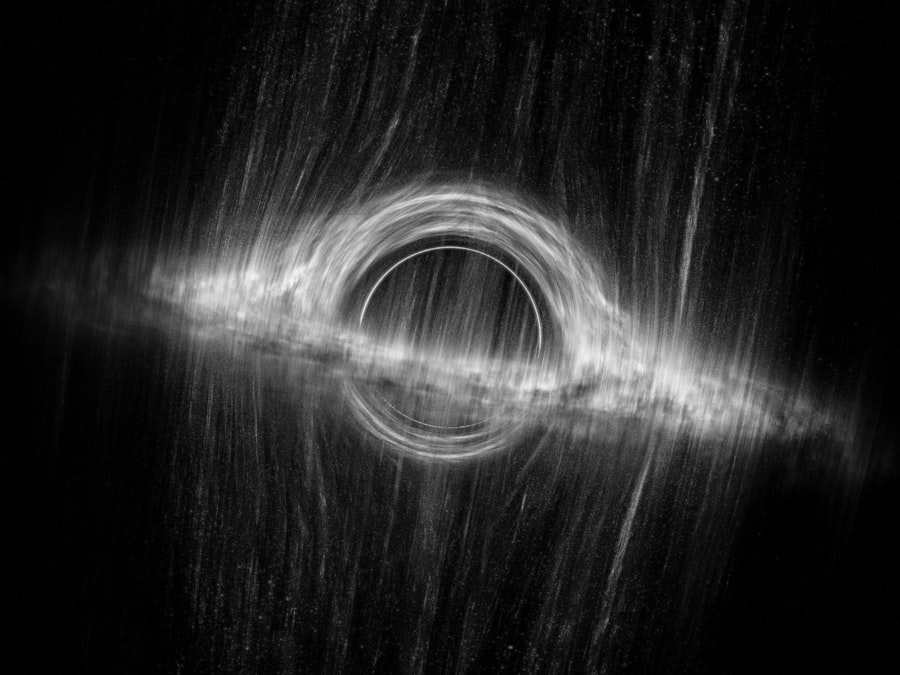
Dark energy exhibits properties that challenge conventional understanding of physics. Its most perplexing characteristic is its negative pressure, which leads to an accelerated expansion of space itself. This phenomenon defies intuitive notions about gravity and attraction; instead of pulling objects together, dark energy pushes them apart on cosmological scales.
Several theories have been proposed to explain dark energy’s properties. One leading candidate is the cosmological constant, originally introduced by Albert Einstein in his equations of general relativity.
This constant represents a uniform energy density filling space homogeneously. However, alternative models such as quintessence suggest that dark energy may vary over time and space, introducing dynamic properties that could change as the universe evolves. Each theory carries implications for our understanding of fundamental physics and cosmology.
The Role of Dark Energy in the Expansion of the Universe
Dark energy plays a pivotal role in determining the fate of the universe. Its presence influences not only how quickly space expands but also what will happen in the distant future. Current observations suggest that dark energy will continue to dominate over gravitational forces as the universe ages, leading to an ever-accelerating expansion.
This scenario raises profound questions about the ultimate fate of cosmic structures. Will galaxies drift apart indefinitely until they become isolated? Or will they eventually succumb to gravitational forces and merge into larger structures?
Understanding dark energy’s role in this process is crucial for predicting the long-term evolution of the universe and its eventual destiny.
Theories and Hypotheses about Dark Matter and Dark Energy
The exploration of dark matter and dark energy has led to a plethora of theories and hypotheses aimed at explaining their enigmatic nature. In addition to WIMPs and axions as candidates for dark matter, researchers have proposed alternative models such as Modified Newtonian Dynamics (MOND), which seeks to explain galactic rotation curves without invoking unseen mass. Similarly, various theories attempt to elucidate dark energy’s properties beyond the cosmological constant framework.
Some researchers explore modifications to general relativity or consider extra dimensions as potential explanations for cosmic acceleration. Each hypothesis presents unique challenges and opportunities for experimental validation or falsification.
The Challenges of Studying Dark Matter and Dark Energy
Studying dark matter and dark energy presents significant challenges due to their elusive nature and indirect detection methods. The lack of direct interaction with electromagnetic radiation means that researchers must rely on gravitational effects and other indirect measurements to infer their presence and properties. This reliance on indirect evidence can lead to uncertainties in interpretations and models.
Moreover, experimental efforts face technical hurdles in detecting potential dark matter particles or measuring subtle effects associated with dark energy. As technology advances, new observational techniques are being developed to enhance sensitivity and precision in these measurements. However, researchers must also contend with competing astrophysical phenomena that can complicate interpretations.
The Future of Dark Matter and Dark Energy Research
The future of research into dark matter and dark energy holds great promise as new technologies and methodologies emerge. Upcoming astronomical surveys such as the Vera Rubin Observatory’s Legacy Survey of Space and Time (LSST) aim to map billions of galaxies with unprecedented detail, providing valuable data on cosmic structure formation and evolution. Additionally, advancements in particle physics experiments may finally yield direct evidence for dark matter particles or shed light on their properties.
As interdisciplinary collaboration between astrophysicists, particle physicists, and cosmologists continues to grow, researchers are better equipped to tackle these profound questions about the universe’s composition.
Implications of Understanding Dark Matter and Dark Energy
Gaining a deeper understanding of dark matter and dark energy carries profound implications for both cosmology and fundamental physics. Unraveling these mysteries could lead to breakthroughs in our comprehension of gravity, quantum mechanics, and the fundamental forces governing the universe. Moreover, insights into dark matter’s role in galaxy formation could reshape our understanding of cosmic evolution while knowledge about dark energy may inform predictions regarding the ultimate fate of the universe itself.
As humanity continues its quest for knowledge about these enigmatic components, each discovery brings us closer to unraveling one of science’s greatest puzzles: understanding what lies beyond the visible universe.
One of the most intriguing aspects of the universe is the multitude of mysteries that remain unsolved, captivating the minds of scientists and enthusiasts alike. For those interested in exploring these enigmas further, a related article can be found at My Cosmic Ventures, which delves into various cosmic phenomena and the questions that continue to baffle researchers.
FAQs
What are some of the biggest unsolved mysteries of the universe?
Some of the biggest unsolved mysteries include the nature of dark matter and dark energy, the origin of the universe, the existence of parallel universes, the true nature of black holes, and the question of whether extraterrestrial life exists.
What is dark matter and why is it a mystery?
Dark matter is a type of matter that does not emit, absorb, or reflect light, making it invisible and detectable only through its gravitational effects. It is a mystery because it makes up about 27% of the universe’s mass-energy content, yet its composition remains unknown.
What is dark energy and how does it affect the universe?
Dark energy is a mysterious force that is causing the accelerated expansion of the universe. It constitutes about 68% of the universe’s total energy. Scientists do not yet understand its nature or origin.
Why is the origin of the universe still a mystery?
While the Big Bang theory explains the early expansion of the universe, questions remain about what caused the Big Bang, what happened before it, and how the initial conditions were set.
Are there other universes besides our own?
The concept of a multiverse suggests that there may be multiple or even infinite universes, but this idea remains theoretical and has not been proven by observational evidence.
What do we know about black holes and what remains unknown?
Black holes are regions of space with gravitational pull so strong that nothing can escape from them. While their existence is well-supported, questions remain about what happens inside them, especially at the singularity, and how they reconcile with quantum mechanics.
Is there life beyond Earth?
As of now, there is no direct evidence of extraterrestrial life. However, the vastness of the universe and the discovery of potentially habitable exoplanets keep the question open and a subject of active research.
How do scientists study these universe mysteries?
Scientists use a combination of observational astronomy, theoretical physics, particle accelerators, space telescopes, and computer simulations to study these mysteries and gather data to develop and test hypotheses.