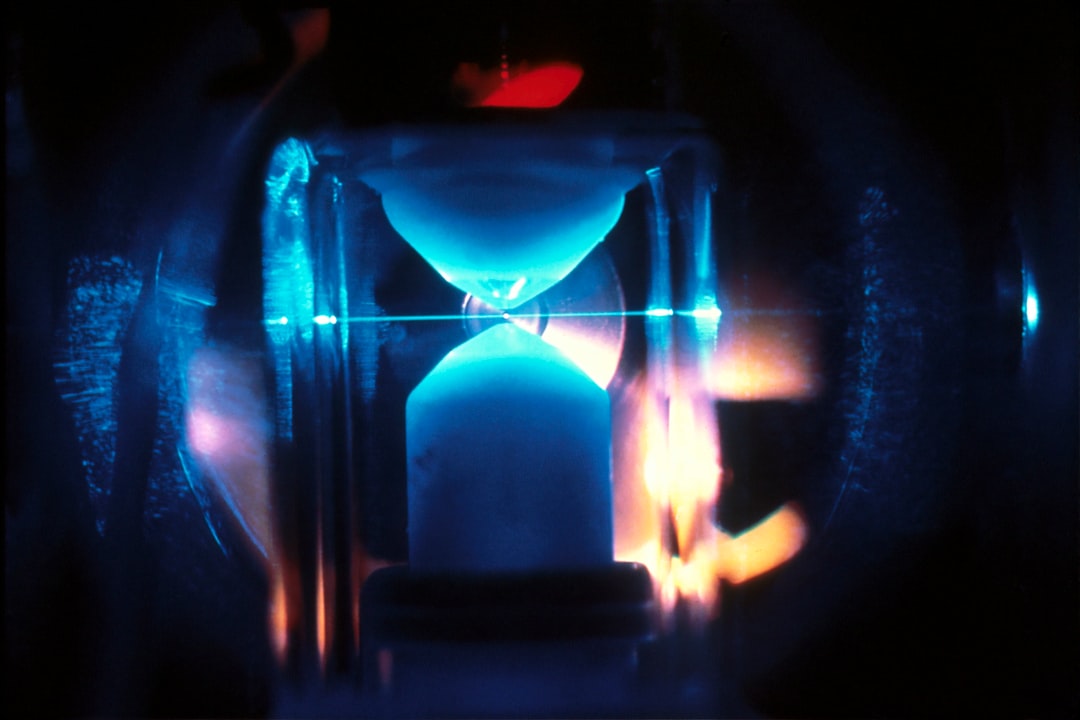
The Quantum Eraser Delayed Choice Experiment represents a significant advancement in quantum mechanics research, extending the principles of the classic double-slit experiment to examine more complex quantum behaviors. This experimental setup investigates how measurement affects quantum systems, particularly focusing on the phenomenon where particles can exhibit both wave-like and particle-like properties depending on the measurement approach. In this experiment, researchers create a system where information about a particle’s path can be obtained or erased after the particle has already been detected.
The results consistently show that the measurement choice determines whether wave or particle behavior manifests in the recorded pattern, even when this choice occurs after the particle has been registered at the detector.
It demonstrates that quantum systems behave according to probability distributions that depend on the complete experimental arrangement, including components that may only be activated after the quantum event has seemingly concluded.
While these results appear to challenge our intuitive understanding of causality, they align perfectly with the mathematical framework of quantum mechanics. Scientists continue to investigate these phenomena to develop more comprehensive interpretations of quantum mechanics and to explore potential applications in quantum information processing and communication technologies.
Key Takeaways
- The Quantum Eraser Delayed Choice Experiment explores how measurement affects particle behavior in quantum mechanics.
- It builds on the double-slit experiment, demonstrating wave-particle duality and the impact of observation.
- Quantum entanglement plays a crucial role in revealing how information influences outcomes even after detection.
- The experiment challenges classical notions of reality, highlighting ongoing debates about the nature of measurement.
- Insights from the experiment have significant implications for the future development of quantum computing and technology.
The Double-Slit Experiment and Quantum Mechanics
The double-slit experiment is often heralded as one of the most illuminating demonstrations of quantum mechanics. In its simplest form, it involves firing particles, such as electrons or photons, through two closely spaced slits onto a detection screen. When both slits are open, an interference pattern emerges, indicative of wave-like behavior.
This phenomenon suggests that each particle behaves as a wave, existing in multiple states simultaneously until measured. However, when an observer attempts to determine which slit a particle passes through, the interference pattern collapses into two distinct bands, revealing particle-like behavior instead. This duality—where particles exhibit both wave-like and particle-like characteristics—forms the foundation of quantum mechanics.
The implications of this experiment extend far beyond mere observation; they challenge the classical understanding of reality itself. The double-slit experiment illustrates that the act of measurement plays a crucial role in determining the state of a quantum system. It raises profound questions about the nature of existence and whether reality is independent of observation or intrinsically linked to it.
As scientists grapple with these concepts, they find themselves navigating a landscape where intuition often falters in the face of empirical evidence.
Understanding the Delayed Choice Experiment
The Delayed Choice Experiment takes the principles established by the double-slit experiment and pushes them further into the realm of paradox. Proposed by physicist John Archibald Wheeler in 1978, this thought experiment posits that decisions made after a particle has passed through the slits can influence its behavior retroactively. In essence, it suggests that whether a particle behaves as a wave or a particle can depend on how it is measured, even if that measurement occurs after it has already been detected.
This concept challenges traditional notions of causality and time. In classical physics, events unfold in a linear fashion; causes precede effects. However, the delayed choice aspect introduces a scenario where future actions can seemingly alter past events.
This notion is not merely theoretical; it has been experimentally validated through various implementations of the delayed choice experiment. By manipulating how measurements are conducted after particles have passed through slits, researchers have demonstrated that the outcomes can indeed reflect wave-like or particle-like behavior based on subsequent choices made by observers.
The Role of Quantum Entanglement in the Experiment
Quantum entanglement plays a pivotal role in understanding the implications of the Quantum Eraser Delayed Choice Experiment. This phenomenon occurs when two or more particles become interconnected in such a way that the state of one particle instantaneously influences the state of another, regardless of the distance separating them. Entangled particles exhibit correlations that defy classical explanations, leading to what Einstein famously referred to as “spooky action at a distance.” In the context of the quantum eraser experiment, entanglement allows for intricate manipulations of measurement outcomes.
By entangling particles and then making measurements on one while delaying decisions about how to measure its partner, researchers can observe how information is transferred and how it affects the overall system. This interplay between entangled particles underscores the non-locality inherent in quantum mechanics and highlights how entanglement can be harnessed to explore deeper questions about reality and observation.
The Concept of Wave-Particle Duality
| Metric | Description | Value/Result | Unit |
|---|---|---|---|
| Photon Source | Type of photon emitter used in the experiment | Spontaneous Parametric Down-Conversion | N/A |
| Interference Visibility | Measure of the clarity of interference pattern | ~90% | Percent |
| Delay Time | Time delay between photon passing slit and measurement choice | Up to several microseconds | Microseconds |
| Which-Path Information | Availability of path information for photons | Erased or Marked | N/A |
| Detector Efficiency | Efficiency of photon detectors used | ~70% | Percent |
| Coincidence Count Rate | Rate of simultaneous photon detection events | Several thousand counts per second | Counts/second |
| Quantum Erasure Success Rate | Probability of successfully erasing which-path info | Approximately 50% | Percent |
Wave-particle duality is a fundamental concept in quantum mechanics that encapsulates the dual nature of matter and energy. It posits that entities such as photons and electrons can exhibit both wave-like and particle-like properties depending on how they are observed or measured. This duality is vividly illustrated in experiments like the double-slit experiment, where particles create interference patterns akin to waves when unobserved but behave like discrete particles when measured.
The implications of wave-particle duality extend beyond mere experimental observations; they challenge our understanding of what constitutes reality. If particles can exist in multiple states simultaneously until observed, then what does this say about their existence prior to measurement? This question lies at the heart of many philosophical debates surrounding quantum mechanics.
Wave-particle duality forces scientists to confront the limitations of classical physics and consider alternative frameworks for understanding the universe.
The Role of Observation and Measurement in Quantum Mechanics

Observation and measurement are central themes in quantum mechanics, fundamentally altering how scientists interpret physical phenomena. In classical physics, objects exist independently of observation; their properties are well-defined regardless of whether anyone is looking at them. However, in quantum mechanics, this notion is upended.
The act of measurement collapses a quantum system’s wave function into a definite state, determining its properties at that moment. This relationship between observation and reality raises profound questions about consciousness and existence itself. Does reality exist independently of observers, or is it contingent upon observation?
The Quantum Eraser Delayed Choice Experiment exemplifies this dilemma by demonstrating that future measurements can influence past events. As researchers continue to explore these concepts, they find themselves grappling with philosophical implications that extend far beyond physics.
The Controversy and Debate Surrounding the Quantum Eraser Experiment
The Quantum Eraser Experiment has sparked considerable debate within both scientific and philosophical communities. Critics argue that its findings challenge conventional notions of causality and time, leading to potential contradictions within established scientific frameworks. Some skeptics question whether these results truly indicate retrocausality or if they can be explained through alternative interpretations of quantum mechanics.
Proponents of the experiment assert that it provides valuable insights into the nature of reality and observation. They argue that understanding these phenomena is crucial for advancing quantum theory and exploring its implications for technology and philosophy alike. As discussions continue, researchers remain divided on how best to interpret the results and what they mean for our understanding of the universe.
Applications and Implications of the Quantum Eraser Experiment
The Quantum Eraser Experiment holds significant potential for practical applications in various fields, particularly in quantum computing and information technology. By harnessing principles such as entanglement and superposition, researchers aim to develop more efficient algorithms and secure communication methods that leverage quantum properties for enhanced performance. Moreover, insights gained from this experiment may pave the way for advancements in quantum cryptography, enabling secure transmission of information that is theoretically immune to eavesdropping.
As scientists continue to explore these applications, they recognize that understanding quantum mechanics is not merely an academic pursuit; it has real-world implications that could revolutionize technology as we know it.
Quantum Eraser Experiment and the Nature of Reality
The Quantum Eraser Experiment invites profound contemplation regarding the nature of reality itself. It challenges traditional notions of time and causality while suggesting that observation plays an integral role in shaping our understanding of existence. As researchers delve deeper into these concepts, they confront questions about whether reality is objective or subjective—whether it exists independently or is contingent upon observation.
This exploration extends beyond scientific inquiry; it touches upon philosophical considerations regarding consciousness and perception. If reality can be influenced by observation, what does this imply about human experience? The Quantum Eraser Experiment serves as a catalyst for discussions about existence, prompting individuals to reevaluate their beliefs about reality’s fundamental nature.
Quantum Eraser Experiment and the Future of Quantum Computing
As quantum computing continues to evolve, insights from experiments like the Quantum Eraser will play an essential role in shaping its future trajectory. By leveraging principles such as superposition and entanglement, researchers aim to develop powerful computational systems capable of solving complex problems beyond classical capabilities.
As scientists refine their understanding of quantum mechanics through experiments like the Quantum Eraser, they unlock new possibilities for harnessing these principles in practical applications. The future of quantum computing holds promise not only for technological advancement but also for reshaping our understanding of information processing itself.
The Continuing Mysteries of Quantum Mechanics
In conclusion, the Quantum Eraser Delayed Choice Experiment encapsulates some of the most profound mysteries within quantum mechanics. It challenges conventional notions of time, causality, and reality while inviting individuals to explore complex philosophical questions about existence and observation. As researchers continue to investigate these phenomena, they uncover new layers of understanding that push the boundaries of human knowledge.
The ongoing exploration of quantum mechanics promises to yield further insights into the nature of reality itself—insights that may ultimately reshape our understanding of both science and philosophy. As scientists navigate this enigmatic landscape, they remain committed to unraveling the mysteries that lie at the heart of quantum phenomena, paving the way for future discoveries that could redefine humanity’s place in the universe.
The quantum eraser delayed choice experiment is a fascinating demonstration of the peculiarities of quantum mechanics, illustrating how the act of measurement can influence the behavior of particles. For those interested in exploring more about the implications of this experiment and its connection to the nature of reality, I recommend checking out a related article on the topic at My Cosmic Ventures. This resource delves deeper into the philosophical questions raised by quantum mechanics and the intriguing results of the quantum eraser experiment.
FAQs
What is the quantum eraser delayed choice experiment?
The quantum eraser delayed choice experiment is a variation of the double-slit experiment in quantum mechanics. It demonstrates how the behavior of particles, such as photons, can change depending on whether “which-path” information is available or erased, even after the particles have been detected. This experiment explores the fundamental nature of quantum measurement and the role of information in determining outcomes.
How does the quantum eraser experiment work?
In the quantum eraser experiment, particles pass through a double-slit apparatus, and detectors are set up to potentially record which slit each particle passes through. If the which-path information is known, the interference pattern disappears. However, if this information is “erased” or made unavailable, the interference pattern reappears. The delayed choice aspect means the decision to erase or keep the which-path information can be made after the particle has passed through the slits.
What is the significance of the “delayed choice” in the experiment?
The delayed choice aspect refers to the timing of the decision to observe or erase the which-path information. It can be made after the particle has already passed through the slits, suggesting that the particle’s past behavior is influenced by future measurement choices. This challenges classical intuitions about causality and the nature of reality in quantum mechanics.
Does the quantum eraser delayed choice experiment violate causality?
No, the experiment does not violate causality or allow for faster-than-light communication. Although it appears that future measurement choices affect past events, the results are consistent with quantum mechanics and do not enable information to be transmitted backward in time. The phenomenon highlights the non-classical correlations inherent in quantum systems.
What does the quantum eraser delayed choice experiment tell us about the nature of reality?
The experiment suggests that quantum phenomena do not have definite properties independent of measurement. The presence or absence of which-path information affects the observed behavior of particles, indicating that reality at the quantum level is fundamentally linked to observation and information. It challenges classical notions of objective reality.
Who first proposed the quantum eraser delayed choice experiment?
The concept of the quantum eraser was first proposed by physicists Marlan Scully and Kai Drühl in 1982. The delayed choice aspect builds on earlier ideas by John Archibald Wheeler, who introduced the delayed choice thought experiment in the 1970s to explore the role of measurement in quantum mechanics.
What are the practical applications of the quantum eraser delayed choice experiment?
While primarily a foundational experiment in quantum mechanics, the principles demonstrated by the quantum eraser have implications for quantum information science, including quantum computing and quantum cryptography. Understanding how information affects quantum systems is crucial for developing advanced quantum technologies.
Can the quantum eraser delayed choice experiment be performed with particles other than photons?
Yes, variations of the quantum eraser experiment have been performed using different quantum particles, such as electrons and atoms. The fundamental principles apply broadly across quantum systems, although photons are commonly used due to the relative ease of manipulating and detecting them.