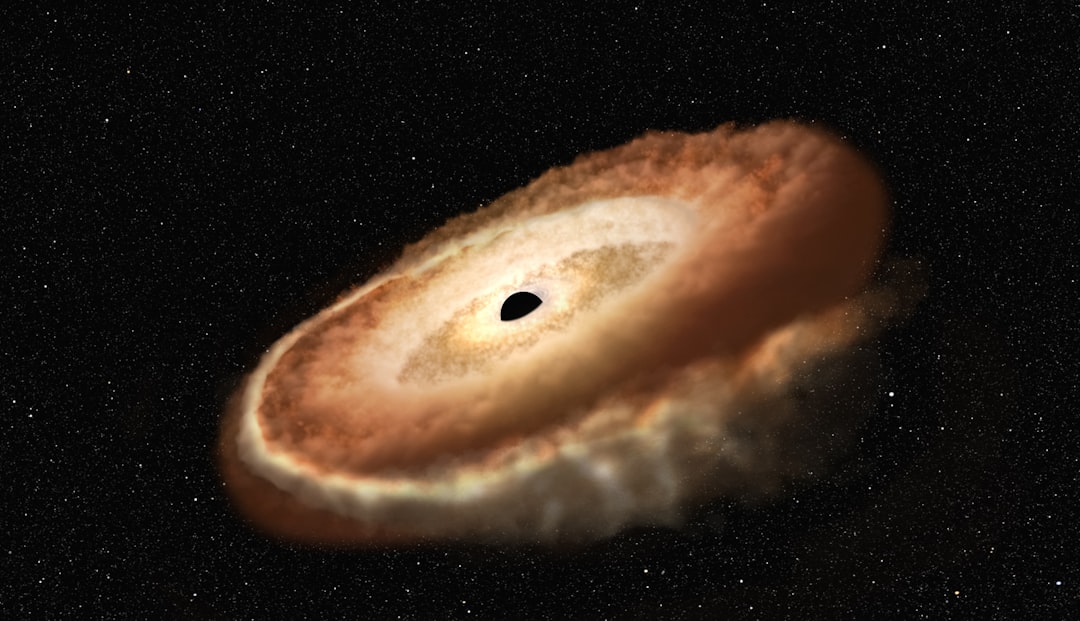
Black hole scrambling describes the theoretical process by which quantum information falling into a black hole becomes rapidly distributed and mixed throughout the black hole’s interior. This phenomenon occurs due to the extreme gravitational environment near the event horizon, where spacetime curvature causes information to spread exponentially across the black hole’s degrees of freedom within a characteristic timescale known as the scrambling time. The scrambling process creates significant challenges for information retrieval and has important implications for the black hole information paradox.
According to quantum mechanics, information must be conserved, yet classical general relativity suggests that information falling into a black hole would be destroyed when the black hole eventually evaporates through Hawking radiation. The scrambling mechanism provides a framework for understanding how information might be preserved while becoming practically inaccessible due to its highly entangled and distributed state. Current research in black hole scrambling involves studying quantum error correction, holographic duality, and the AdS/CFT correspondence to better understand information dynamics in gravitational systems.
These investigations have led to developments in quantum information theory, including insights into quantum complexity, entanglement growth, and the relationship between geometry and information in quantum field theories.
Key Takeaways
- Black hole scrambling describes how information rapidly disperses and becomes inaccessible within a black hole.
- It plays a crucial role in addressing the black hole information paradox through quantum mechanics.
- Hawking radiation and black hole entropy are key factors linked to the scrambling process.
- The holographic principle provides a theoretical basis connecting black hole scrambling to quantum information theory.
- Understanding black hole scrambling has potential applications in advancing quantum computing technologies.
Theoretical Framework of Black Hole Scrambling
The theoretical framework surrounding black hole scrambling is rooted in the principles of quantum mechanics and general relativity. At its core, this framework posits that when information crosses the event horizon of a black hole, it becomes entangled with the quantum states of the black hole itself. This entanglement leads to a rapid mixing of information, a process that can be likened to scrambling an egg—once scrambled, the original state is nearly impossible to recover.
One of the key aspects of this theoretical framework is the concept of quantum entanglement. When particles become entangled, the state of one particle is directly related to the state of another, regardless of the distance separating them. In the context of black holes, this entanglement suggests that information is not lost but rather transformed into a highly complex state that is difficult to decipher.
This idea challenges traditional notions of information conservation and raises questions about how information can be retrieved from a black hole, if at all.
Quantum Mechanics and Information Paradox

The intersection of quantum mechanics and black hole scrambling gives rise to the infamous information paradox. This paradox arises from the apparent contradiction between quantum mechanics, which asserts that information cannot be destroyed, and general relativity, which suggests that anything falling into a black hole is lost forever. The implications of this paradox are profound, as they challenge the very foundations of our understanding of physics.
As physicists grapple with this paradox, they have proposed various theories to reconcile these conflicting ideas. Some suggest that information is not lost but rather encoded in subtle correlations within Hawking radiation, while others propose that it may be stored on the event horizon itself. These theories aim to bridge the gap between quantum mechanics and general relativity, offering potential pathways to resolve the information paradox and deepen our understanding of black hole dynamics.
Hawking Radiation and Black Hole Entropy
Hawking radiation plays a crucial role in the discussion of black hole scrambling and entropy. Proposed by physicist Stephen Hawking in 1974, this phenomenon describes how black holes can emit radiation due to quantum effects near their event horizons. This radiation leads to a gradual loss of mass and energy from the black hole, ultimately resulting in its evaporation over astronomical timescales.
The relationship between Hawking radiation and black hole entropy is particularly significant. Black hole entropy, as described by Jacob Bekenstein, is proportional to the area of a black hole’s event horizon rather than its volume. This insight suggests that black holes possess a vast amount of hidden information encoded within their surfaces.
As Hawking radiation escapes, it carries away some of this information, further complicating the understanding of how information is preserved or lost in black holes.
Black Hole Scrambling and the Firewall Paradox
| Metric | Description | Typical Value / Range | Notes |
|---|---|---|---|
| Scrambling Time (t*) | Time taken for information to become thoroughly mixed within the black hole | t* ≈ (β / 2π) log S | β = inverse temperature, S = black hole entropy; logarithmic dependence on entropy |
| Black Hole Entropy (S) | Measure of the number of microstates of the black hole | S = A / (4 ℏ G) | A = horizon area; fundamental in determining scrambling time |
| Temperature (T) | Hawking temperature of the black hole | T = ℏ c³ / (8 π G M kB) | Inversely proportional to black hole mass M |
| Lyapunov Exponent (λL) | Rate of exponential growth of perturbations in the black hole system | λL = 2π / β | Maximal chaos bound; β = inverse temperature |
| Information Retention Time | Time scale over which information can be recovered from Hawking radiation | tretention ~ M³ (in Planck units) | Much longer than scrambling time; related to black hole evaporation |
The firewall paradox presents yet another layer of complexity in the study of black hole scrambling. This paradox arises from the implications of quantum entanglement and Hawking radiation on an observer falling into a black hole. According to some interpretations, an infalling observer would encounter a “firewall” at the event horizon—an intense burst of radiation that would incinerate anything attempting to cross it.
This notion challenges previous assumptions about the smoothness of spacetime at the event horizon. If firewalls exist, they would imply a breakdown in the equivalence principle, which states that falling into a black hole should be indistinguishable from free fall in flat spacetime. The existence of firewalls raises critical questions about how information is processed and scrambled within black holes, further complicating efforts to resolve the information paradox.
Quantum Information and Black Hole Scrambling

Quantum information theory provides valuable insights into the mechanisms underlying black hole scrambling. In this context, information is treated as a physical entity that can be manipulated and transformed through quantum processes. The scrambling process itself can be understood as a complex interplay between quantum states, entanglement, and thermal dynamics.
These models often involve concepts such as quantum circuits and operator growth, which illustrate how initial states evolve into highly mixed configurations over time. By studying these processes, physicists aim to uncover the fundamental rules governing information flow in extreme gravitational environments.
Experimental Evidence for Black Hole Scrambling
While much of the discussion surrounding black hole scrambling has been theoretical, recent advancements in experimental physics have begun to provide empirical evidence for these concepts. Experiments involving ultracold atoms and quantum simulators have allowed researchers to mimic certain aspects of black hole dynamics in controlled laboratory settings. These experiments have demonstrated phenomena analogous to scrambling in black holes, such as rapid thermalization and entanglement growth in quantum systems.
By observing how information spreads and becomes mixed in these systems, scientists gain valuable insights into the behavior of quantum states under extreme conditions. Such experimental evidence not only supports theoretical predictions but also paves the way for further exploration into the nature of black holes and their role in the universe.
Black Hole Scrambling and the Holographic Principle
The holographic principle offers a compelling framework for understanding black hole scrambling within a broader context. This principle posits that all information contained within a volume of space can be represented as a two-dimensional surface at its boundary. In relation to black holes, this suggests that the information about what falls into a black hole may be encoded on its event horizon rather than being lost entirely.
This perspective aligns with recent developments in string theory and quantum gravity, which propose that spacetime itself may emerge from more fundamental degrees of freedom encoded on lower-dimensional surfaces. By exploring how black hole scrambling fits within this holographic framework, researchers hope to uncover deeper connections between gravity, quantum mechanics, and information theory.
Applications of Black Hole Scrambling in Quantum Computing
The insights gained from studying black hole scrambling have potential applications beyond theoretical physics; they may also inform advancements in quantum computing. The principles underlying scrambling processes can provide valuable strategies for error correction and information processing in quantum systems.
By leveraging concepts from black hole dynamics, scientists may develop new techniques for preserving coherence and enhancing computational efficiency in quantum computers.
Future Directions in Black Hole Scrambling Research
As research into black hole scrambling continues to evolve, several promising directions are emerging. One area of focus involves further exploration of the relationship between scrambling and quantum chaos, as well as its implications for understanding thermalization processes in many-body systems. Additionally, researchers are investigating how insights from black hole scrambling can inform our understanding of cosmological phenomena such as inflation and dark energy.
Another exciting avenue involves interdisciplinary collaboration between physicists and computer scientists to develop new algorithms inspired by black hole dynamics. By bridging these fields, researchers hope to unlock novel approaches to solving complex problems in both theoretical physics and practical applications.
Implications of Unraveling the Mystery of Black Hole Scrambling
Unraveling the mystery of black hole scrambling holds profound implications for our understanding of the universe. As scientists continue to explore this enigmatic phenomenon, they are not only challenging established paradigms but also paving the way for new insights into fundamental questions about information, gravity, and spacetime. The journey toward comprehending black hole scrambling is emblematic of humanity’s quest for knowledge—a pursuit that transcends disciplinary boundaries and invites collaboration across diverse fields.
As researchers delve deeper into this captivating realm, they inch closer to unlocking some of the universe’s most profound secrets, ultimately reshaping our understanding of reality itself.
Recent discussions in theoretical physics have highlighted the intriguing concept of black hole scrambling information, which suggests that information that falls into a black hole may be irretrievably lost, yet could also be encoded in subtle correlations among the outgoing radiation. For a deeper exploration of this topic, you can read more in the related article on our website: Black Hole Information Paradox Explained. This article delves into the implications of scrambling and its significance in the context of quantum mechanics and general relativity.
FAQs
What is black hole information scrambling?
Black hole information scrambling refers to the process by which information that falls into a black hole becomes rapidly and chaotically mixed throughout the black hole’s internal degrees of freedom. This makes the original information effectively inaccessible or hidden, though not necessarily destroyed.
Why is information scrambling important in black holes?
Information scrambling is important because it relates to the black hole information paradox, which questions how information about matter that falls into a black hole can be preserved or recovered, given that black holes emit Hawking radiation and eventually evaporate.
How fast do black holes scramble information?
Black holes are believed to be among the fastest scramblers in nature. The scrambling time is proportional to the logarithm of the black hole’s entropy, meaning that information becomes thoroughly mixed extremely quickly compared to other physical systems.
Does information get destroyed in a black hole?
According to current understanding in quantum mechanics and black hole physics, information is not destroyed but rather scrambled and encoded in subtle correlations in the Hawking radiation emitted by the black hole.
What role does quantum mechanics play in black hole information scrambling?
Quantum mechanics suggests that information must be conserved. In black hole physics, this implies that the information about matter entering a black hole is preserved in a highly scrambled form, consistent with the principles of quantum theory.
What is the connection between black hole scrambling and the holographic principle?
The holographic principle posits that all information contained within a volume of space can be represented on its boundary. In black holes, this principle supports the idea that information about the interior is encoded on the event horizon, which relates to how information is scrambled and stored.
Can we retrieve information from a black hole?
In theory, information can be retrieved from a black hole through the analysis of Hawking radiation, which carries encoded information. However, the scrambling process makes decoding this information extremely complex and currently beyond practical reach.
What is the significance of the scrambling time in black hole physics?
The scrambling time sets a fundamental limit on how quickly information becomes mixed and hidden inside a black hole. It is a key parameter in understanding black hole dynamics and the resolution of the information paradox.
Are there experimental ways to study black hole information scrambling?
Direct experimental study of black hole information scrambling is currently not possible due to the extreme conditions involved. However, researchers use analog systems, such as quantum simulators and condensed matter systems, to model and study scrambling phenomena.
How does black hole scrambling relate to quantum chaos?
Black hole scrambling is closely related to quantum chaos, as the rapid mixing of information inside a black hole resembles chaotic behavior in quantum systems, characterized by sensitivity to initial conditions and complex evolution.