
Cosmic structure formation is a fundamental aspect of astrophysics that seeks to explain how the universe evolved from a nearly uniform state to the complex tapestry of galaxies, stars, and other celestial bodies observed today. This intricate process began shortly after the Big Bang, when the universe was a hot, dense soup of particles. Over billions of years, gravitational forces acted upon matter, leading to the formation of large-scale structures such as galaxy clusters and superclusters.
Understanding cosmic structure formation not only sheds light on the history of the universe but also provides insights into the fundamental forces that govern its evolution. The study of cosmic structure formation encompasses a wide range of phenomena, from the smallest scales of star formation to the vastness of cosmic filaments that connect galaxies. Researchers employ various observational techniques and theoretical models to unravel the complexities of this process.
By examining the distribution of galaxies and the cosmic web, scientists can trace the history of matter in the universe and gain a deeper understanding of its underlying principles. As they delve into this fascinating field, they confront numerous questions about the nature of dark matter, dark energy, and the fundamental forces that shape the cosmos.
Key Takeaways
- The Big Bang Theory is the prevailing cosmological model for the observable universe’s early development.
- Dark matter plays a crucial role in the formation of cosmic structures, such as galaxies and galaxy clusters.
- Dark energy is believed to be responsible for the accelerated expansion of the universe and has a significant impact on shaping cosmic structures.
- Understanding the formation of galaxies and galaxy clusters is essential for comprehending the large-scale structure of the universe.
- Black holes have a profound impact on cosmic structure formation, influencing the evolution of galaxies and galaxy clusters.
The Big Bang Theory and its Role in Cosmic Structure Formation
The Big Bang theory serves as the cornerstone of modern cosmology, providing a comprehensive framework for understanding the origins of the universe. According to this theory, approximately 13.8 billion years ago, the universe began as an infinitely small and hot point, which rapidly expanded in a cataclysmic event. This expansion marked the beginning of time and space as we know it.
As the universe cooled, matter began to form, leading to the creation of protons, neutrons, and eventually atoms. This primordial nucleosynthesis set the stage for the formation of stars and galaxies. The Big Bang theory not only explains the initial conditions of the universe but also accounts for its subsequent evolution.
As matter began to clump together under the influence of gravity, regions of higher density formed, leading to the creation of stars and galaxies. The distribution of these structures is not uniform; instead, it reflects the intricate interplay between gravitational forces and the expansion of space. Observations of cosmic microwave background radiation provide critical evidence for this theory, revealing temperature fluctuations that correspond to density variations in the early universe.
These fluctuations ultimately influenced how matter coalesced into larger structures over time.
Dark Matter and its Influence on Cosmic Structure Formation
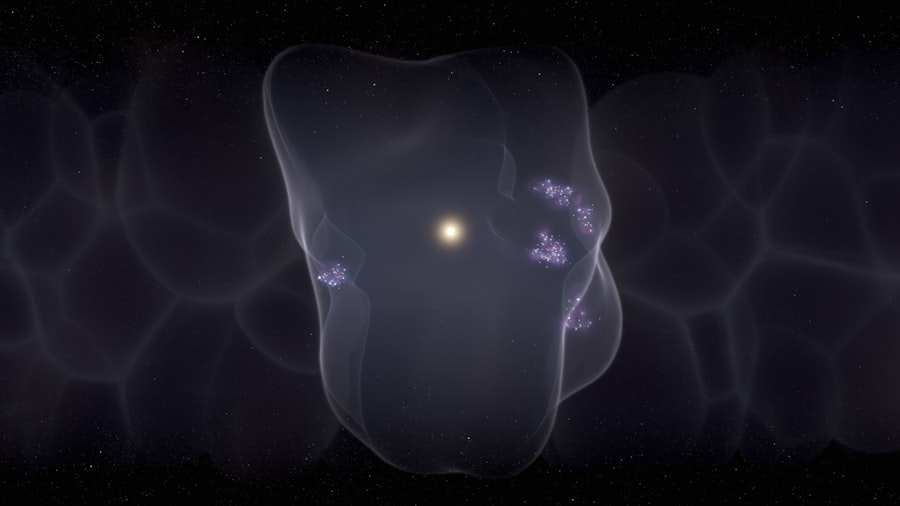
Dark matter is one of the most enigmatic components of the universe, constituting approximately 27% of its total mass-energy content. Unlike ordinary matter, dark matter does not emit, absorb, or reflect light, making it invisible to traditional observational techniques. However, its presence is inferred through its gravitational effects on visible matter.
Dark matter plays a crucial role in cosmic structure formation by providing the necessary gravitational scaffolding for galaxies and galaxy clusters to form. The influence of dark matter on cosmic structure can be observed in various ways. For instance, galaxy rotation curves reveal that stars at the edges of galaxies move much faster than expected based on visible mass alone.
This discrepancy suggests that a significant amount of unseen mass—dark matter—exists in these galaxies. Additionally, simulations that incorporate dark matter show that it acts as a framework around which ordinary matter can accumulate, leading to the formation of complex structures like galaxy clusters. Without dark matter, the universe would lack the rich diversity of structures observed today.
The Role of Dark Energy in Shaping Cosmic Structures
| Topic | Metrics |
|---|---|
| Dark Energy | 68.3% of the total energy content of the universe |
| Cosmic Structures | Formation and evolution influenced by dark energy |
| Expansion of the Universe | Accelerated by dark energy |
| Observations | Supernovae, cosmic microwave background, and large-scale structure surveys |
While dark matter is essential for structure formation, dark energy plays a contrasting role in the evolution of the universe. Comprising about 68% of the universe’s total energy density, dark energy is thought to be responsible for the accelerated expansion observed in recent cosmological studies. This mysterious force counteracts gravitational attraction on cosmic scales and influences how structures evolve over time.
As dark energy drives an accelerated expansion, it affects how galaxies interact with one another. In a universe dominated by dark energy, structures may struggle to form or grow as quickly as they would in a matter-dominated universe.
This has profound implications for our understanding of cosmic evolution; it suggests that while gravity pulls matter together to form structures, dark energy pushes them apart on larger scales. The balance between these two forces shapes not only individual galaxies but also the large-scale structure of the universe itself.
Understanding the Formation of Galaxies and Galaxy Clusters
The formation of galaxies is a central focus in cosmology, as these massive collections of stars and gas represent some of the most fundamental building blocks of the universe. Galaxies are believed to form through a combination of processes involving gravitational collapse and mergers between smaller structures. Initially, small fluctuations in density within the primordial gas led to regions where matter began to clump together under gravity’s influence.
As these clumps grew denser, they attracted more gas and dust, eventually igniting nuclear fusion in their cores and forming stars. Over time, these stars grouped together into galaxies. The interactions between galaxies also play a significant role in their evolution; mergers can lead to larger galaxies or trigger bursts of star formation as gas clouds collide and compress.
Galaxy clusters emerge from this process as groups of galaxies bound together by gravity, often containing vast amounts of dark matter that further influences their dynamics.
The Impact of Black Holes on Cosmic Structure Formation
Black holes are among the most fascinating objects in astrophysics, with their extreme gravitational fields having significant implications for cosmic structure formation. Supermassive black holes are found at the centers of most galaxies and are thought to have formed through processes such as mergers or accretion from surrounding material. Their presence can profoundly affect galaxy evolution by regulating star formation rates and influencing galactic dynamics.
The relationship between black holes and their host galaxies is complex and reciprocal.
This energy can heat surrounding gas and inhibit star formation in their host galaxies—a phenomenon known as “feedback.” Such feedback mechanisms play a crucial role in shaping galaxy morphology and can even affect large-scale structure formation by regulating how much gas is available for star formation across cosmic time.
The Role of Cosmic Microwave Background Radiation in Studying Cosmic Structures
Cosmic microwave background (CMB) radiation serves as a vital tool for understanding cosmic structure formation. This faint afterglow from the Big Bang provides a snapshot of the universe when it was just 380,000 years old—an era when protons and electrons combined to form neutral hydrogen atoms, allowing photons to travel freely through space for the first time. The CMB carries information about temperature fluctuations that correspond to density variations in the early universe.
By analyzing these fluctuations, cosmologists can glean insights into how structures formed over time. The patterns observed in the CMB reflect initial conditions that influenced subsequent gravitational collapse and structure formation. For instance, regions with slightly higher densities would eventually evolve into galaxies and clusters while lower-density regions would remain relatively empty.
The CMB thus acts as a cosmic blueprint for understanding how matter evolved into the complex structures observed today.
Observational Techniques and Tools for Studying Cosmic Structure Formation
To study cosmic structure formation effectively, astronomers employ a variety of observational techniques and tools that span different wavelengths across the electromagnetic spectrum. Telescopes equipped with advanced technology allow researchers to observe distant galaxies and cosmic phenomena in unprecedented detail. Optical telescopes capture visible light emitted by stars and galaxies, while radio telescopes detect emissions from cold gas clouds and other celestial objects.
In addition to traditional telescopes, space-based observatories like the Hubble Space Telescope have revolutionized our understanding by providing clear images free from atmospheric interference. Instruments designed to detect X-rays reveal information about hot gas in galaxy clusters, while infrared telescopes can penetrate dust clouds to observe star formation regions within galaxies. These diverse observational methods enable scientists to piece together a comprehensive picture of cosmic structure formation across different epochs in cosmic history.
Simulations and Modeling of Cosmic Structure Formation
Simulations play an essential role in advancing our understanding of cosmic structure formation by allowing researchers to model complex interactions between various components of the universe. Using powerful supercomputers, scientists can create detailed simulations that incorporate gravity, hydrodynamics, and other physical processes governing structure formation. These simulations help test theoretical predictions against observational data.
One prominent example is the Millennium Simulation, which modeled the evolution of dark matter structures over billions of years. By comparing simulation results with actual observations—such as galaxy distributions—researchers can refine their models and improve their understanding of how structures form and evolve over time. Simulations also provide insights into phenomena that may be difficult or impossible to observe directly, such as early galaxy formation or interactions between dark matter halos.
Unanswered Questions and Future Research in Cosmic Structure Formation
Despite significant advancements in understanding cosmic structure formation, many questions remain unanswered. For instance, researchers continue to grapple with understanding the precise nature of dark matter and dark energy—two components that dominate our universe yet remain largely mysterious. Additionally, questions about how supermassive black holes formed so early in cosmic history persist.
Future research will likely focus on refining existing models and developing new observational techniques to probe deeper into cosmic history. Upcoming missions like NASA’s James Webb Space Telescope aim to observe distant galaxies formed shortly after the Big Bang, providing valuable data that could shed light on early structure formation processes. As technology advances and new discoveries are made, scientists hope to unravel some of these enduring mysteries surrounding cosmic structure formation.
Implications of Understanding Cosmic Structure Formation for our Understanding of the Universe
Understanding cosmic structure formation has profound implications for humanity’s comprehension of the universe itself. It informs not only our knowledge about how galaxies and stars came into existence but also offers insights into fundamental questions about our place within this vast cosmos. By studying how structures formed over billions of years, researchers can better appreciate the intricate interplay between various forces shaping our universe.
Moreover, insights gained from cosmic structure formation research extend beyond astronomy; they touch upon fundamental physics concepts such as gravity, thermodynamics, and quantum mechanics. As scientists continue to explore these connections between different fields—linking cosmology with particle physics or astrophysics with general relativity—they pave new pathways toward understanding some of life’s most profound questions: What is dark matter? What role does dark energy play?
And ultimately, what does it mean for humanity’s existence within this grand tapestry we call the universe?
Understanding cosmic structure formation is a fundamental aspect of cosmology, as it delves into how the universe’s large-scale structures, such as galaxies and galaxy clusters, came into existence. A related article that provides insights into this fascinating topic can be found on My Cosmic Ventures. This article explores the intricate processes and forces that have shaped the universe over billions of years, offering a comprehensive overview of the theories and observations that underpin our current understanding. For a deeper dive into the mechanisms behind cosmic structure formation, you can read more about it on