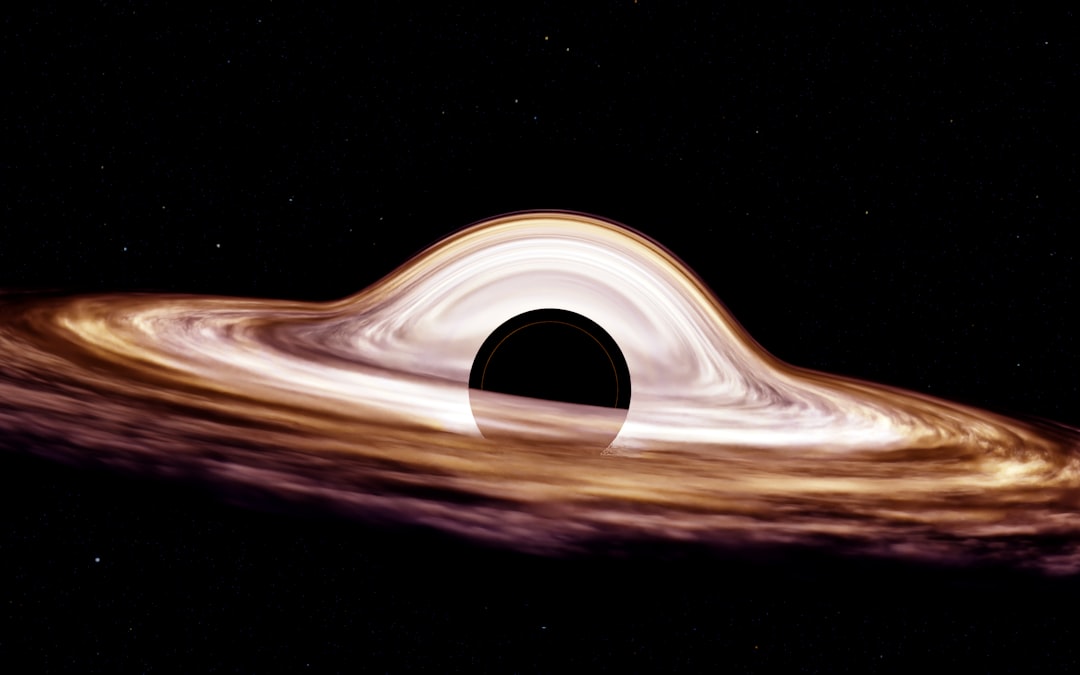
Black holes have long captivated the imagination of scientists and the public alike, serving as a profound enigma at the intersection of physics and cosmology. These celestial objects, formed from the remnants of massive stars that have undergone gravitational collapse, possess gravitational fields so intense that nothing, not even light, can escape their grasp. The study of black holes not only challenges our understanding of the universe but also raises fundamental questions about the nature of reality itself.
As researchers delve deeper into the mysteries surrounding these cosmic phenomena, they uncover layers of complexity that intertwine with concepts from various fields, including information theory. The allure of black holes lies not only in their mysterious nature but also in their implications for our understanding of space, time, and information. Theoretical physicists have proposed that black holes may hold the key to reconciling quantum mechanics with general relativity, two pillars of modern physics that have historically been at odds.
As scientists explore the intricate relationship between black holes and information, they are compelled to confront profound philosophical questions about the fate of information in the universe. This article aims to explore the theoretical framework of information theory as it relates to black holes, examining how these enigmatic entities challenge our understanding of entropy, quantum information, and the very fabric of reality.
Key Takeaways
- Black holes challenge traditional notions of information conservation, prompting new theoretical frameworks.
- Entropy plays a crucial role in understanding the information content of black holes.
- Quantum information theory offers insights into resolving black hole information paradoxes.
- Hawking radiation is a key mechanism potentially allowing information retrieval from black holes.
- Advances in black hole thermodynamics and event horizon encoding are shaping future research directions.
Theoretical Framework of Information Theory
Information theory, a mathematical framework developed by Claude Shannon in the mid-20th century, provides a foundation for understanding how information is quantified, stored, and transmitted. At its core, information theory seeks to measure uncertainty and predictability in various systems, offering insights into communication processes and data encoding. In the context of black holes, this theoretical framework becomes particularly relevant as researchers grapple with questions about the nature of information in extreme gravitational environments.
The principles of information theory can be applied to black holes in several ways. For instance, the concept of entropy, which quantifies the amount of disorder or uncertainty in a system, plays a crucial role in understanding black hole thermodynamics. The relationship between entropy and information is central to this discussion; as entropy increases, so does the amount of information required to describe a system.
In the case of black holes, this leads to intriguing implications regarding the storage and potential loss of information when matter crosses the event horizon. By examining these connections, researchers can begin to unravel the complexities surrounding black holes and their relationship with information.
Entropy and Black Holes
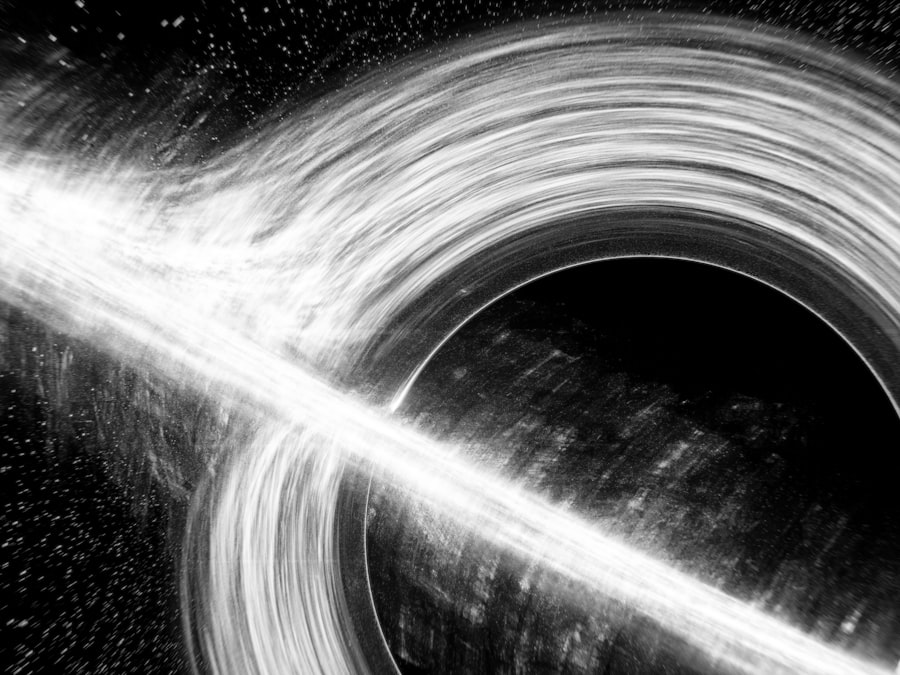
Entropy serves as a cornerstone in both thermodynamics and information theory, providing a measure of disorder within a system. In classical thermodynamics, entropy is associated with the number of microscopic configurations that correspond to a macroscopic state. When applied to black holes, this concept takes on a unique significance.
The pioneering work of physicist Jacob Bekenstein established that black holes possess entropy proportional to the area of their event horizons rather than their volume. This revelation led to the formulation of Bekenstein’s entropy formula, which posits that a black hole’s entropy is directly related to the amount of information that can be encoded on its surface. The implications of this relationship are profound.
It suggests that black holes are not merely voids in space but rather complex entities that store vast amounts of information about the matter that has fallen into them. This perspective challenges traditional notions of entropy and raises questions about how information behaves in extreme gravitational fields. As researchers continue to explore the connection between entropy and black holes, they are confronted with paradoxes that challenge our understanding of thermodynamics and quantum mechanics.
Quantum Information and Black Holes
| Metric | Description | Value / Range | Unit | Notes |
|---|---|---|---|---|
| Black Hole Entropy (Bekenstein-Hawking Entropy) | Entropy proportional to the area of the event horizon | 1/4 × (Area of event horizon) | Bits (in natural units) | Measured in Planck units; relates entropy to horizon area |
| Event Horizon Area | Surface area of the black hole’s event horizon | 16π (GM/c²)² | Square meters (m²) | Depends on black hole mass (Schwarzschild radius) |
| Hawking Temperature | Temperature of black hole radiation | ħ c³ / (8 π G M k_B) | Kelvin (K) | Inversely proportional to black hole mass |
| Quantum Information Scrambling Time | Time scale for information to become distributed in black hole | ~ (1 / (2π k_B T)) × log(S) | Seconds (s) | Depends on temperature T and entropy S |
| Page Time | Time when half of the black hole’s entropy is radiated away | ~ (G² M³) / (ħ c⁴) | Seconds (s) | Approximate time scale for information retrieval from Hawking radiation |
| Black Hole Mass | Mass of the black hole | Varies (e.g., 5 – 10 solar masses for stellar black holes) | Solar masses (M☉) | Mass affects temperature, entropy, and evaporation time |
| Evaporation Time | Time for black hole to evaporate via Hawking radiation | ~ 5120 π G² M³ / (ħ c⁴) | Seconds (s) | Longer for larger black holes |
| Quantum Channel Capacity | Maximum rate of quantum information transfer through black hole radiation | Subject to ongoing research | Qubits per second | Related to black hole complementarity and firewall paradox |
The intersection of quantum mechanics and black hole physics has become a fertile ground for theoretical exploration. Quantum information theory extends classical information theory by incorporating principles such as superposition and entanglement, which are fundamental to understanding the behavior of particles at the quantum level. When applied to black holes, these concepts raise intriguing questions about how information is processed and preserved in such extreme environments.
One significant area of research involves the idea that quantum information may be encoded on the event horizon of a black hole. This notion suggests that even as matter falls into a black hole and seemingly disappears from our observable universe, its quantum information may still be preserved on the surface. This perspective aligns with recent developments in holographic principles, which propose that all information contained within a volume of space can be represented as a two-dimensional surface.
By exploring these ideas further, researchers hope to bridge the gap between quantum mechanics and general relativity, ultimately leading to a more comprehensive understanding of black holes.
Black Hole Paradoxes and Information Loss
The study of black holes has given rise to several paradoxes that challenge our understanding of physics. One of the most famous is the black hole information paradox, which arises from the apparent conflict between quantum mechanics and general relativity. According to quantum mechanics, information cannot be destroyed; however, when matter falls into a black hole, it seems to vanish from existence, leading to questions about whether information is truly lost forever.
This paradox has sparked intense debate among physicists, with various proposed resolutions ranging from the idea that information is stored on the event horizon to suggestions that it may be released through Hawking radiation. Each proposed solution carries its own implications for our understanding of reality and raises further questions about the nature of time and causality in relation to black holes. As researchers continue to grapple with these paradoxes, they are forced to reconsider fundamental principles in physics and explore new avenues for reconciling conflicting theories.
Hawking Radiation and Information Retrieval
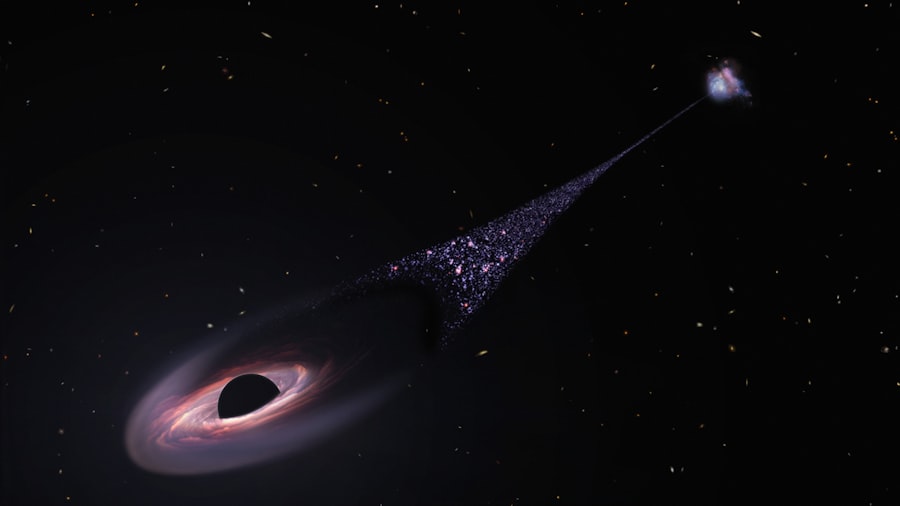
In 1974, physicist Stephen Hawking made a groundbreaking discovery regarding black holes: they are not entirely black but emit radiation due to quantum effects near their event horizons. This phenomenon, known as Hawking radiation, suggests that black holes can gradually lose mass and energy over time. As they emit this radiation, they also appear to release some form of information about the matter that once fell into them.
The implications of Hawking radiation for information retrieval are profound. If black holes can emit radiation containing information about their contents, it raises questions about whether this information can be recovered or if it is fundamentally lost. Some researchers propose that Hawking radiation carries encoded information that could potentially be deciphered, while others argue that it may lead to irreversible loss.
This ongoing debate highlights the complexities surrounding black hole physics and emphasizes the need for further exploration into how information behaves in these extreme environments.
Information Conservation in Black Hole Physics
The principle of conservation of information is a cornerstone of quantum mechanics; it asserts that information cannot be created or destroyed within an isolated system. However, when applied to black holes, this principle faces significant challenges. The apparent loss of information when matter crosses a black hole’s event horizon raises questions about whether this conservation law holds true in such extreme conditions.
Recent developments in theoretical physics have led some researchers to propose mechanisms by which information may be conserved even in the presence of black holes. For instance, some theories suggest that information could be encoded on the event horizon or released through Hawking radiation in a way that preserves its integrity. These ideas challenge traditional notions of causality and raise intriguing possibilities for how we understand the fundamental laws governing our universe.
Black Hole Thermodynamics and Information Theory
The study of black hole thermodynamics has revealed deep connections between thermodynamic principles and information theory. The laws governing thermodynamics—such as energy conservation and entropy increase—find parallels in the behavior of black holes. For instance, just as entropy tends to increase in closed systems according to the second law of thermodynamics, black hole entropy also increases as matter falls into them.
This relationship has led researchers to explore how concepts from thermodynamics can inform our understanding of information processing within black holes. By examining how energy flows and transforms within these cosmic entities, scientists can gain insights into how information is encoded and preserved. The interplay between thermodynamics and information theory offers a rich framework for exploring fundamental questions about reality and may ultimately lead to breakthroughs in our understanding of both black holes and quantum mechanics.
Information Encoding on Black Hole Event Horizons
The idea that information may be encoded on a black hole’s event horizon has gained traction among physicists seeking to resolve paradoxes related to information loss. This concept suggests that as matter falls into a black hole, its quantum state is imprinted onto the event horizon itself—a two-dimensional surface that encodes three-dimensional data. This perspective aligns with holographic principles that propose all physical phenomena can be represented as lower-dimensional surfaces.
If true, this encoding mechanism could provide a means for recovering lost information from black holes. Researchers are actively investigating how this process might work and what implications it would have for our understanding of reality. By exploring how information is stored on event horizons, scientists hope to uncover new insights into the nature of space-time and its relationship with quantum mechanics.
Information Transfer in Black Hole Mergers
The phenomenon of black hole mergers presents another intriguing avenue for exploring information transfer within these cosmic entities. When two black holes collide and merge, they create gravitational waves—ripples in space-time that carry energy away from the system. This process raises questions about how information is transferred during such events and whether it can be recovered or preserved.
Some researchers propose that during mergers, information from both black holes may become entangled or encoded in gravitational waves emitted during the collision. This perspective opens up new possibilities for understanding how information behaves in extreme gravitational environments and may provide insights into resolving longstanding paradoxes related to black hole physics.
Future Directions in Black Hole Information Theory
As research into black holes continues to evolve, future directions in black hole information theory promise exciting developments. The interplay between quantum mechanics and general relativity remains one of the most significant challenges facing physicists today. Ongoing investigations into topics such as holography, entanglement entropy, and quantum gravity will likely yield new insights into how information behaves in extreme environments.
Moreover, advancements in observational technology may allow scientists to gather more data on black holes and their interactions with surrounding matter. As researchers continue to explore these cosmic enigmas through both theoretical frameworks and empirical observations, they will undoubtedly uncover new layers of complexity that deepen our understanding of reality itself. The journey into the heart of black holes is far from over; it is an ongoing quest that promises to reshape our comprehension of the universe for generations to come.
Black hole information theory has sparked significant debate in the scientific community, particularly regarding the fate of information that falls into a black hole. A related article that delves into the implications of this theory can be found at mycosmicventures.
com/sample-page/’>this link. The article explores various perspectives on whether information is truly lost or if it can be recovered, shedding light on the ongoing discussions surrounding quantum mechanics and general relativity.
WATCH THIS! The Paradox That Broke Physics: Quantum vs. Black Holes
FAQs
What is black hole information theory?
Black hole information theory studies how information behaves in the presence of black holes, particularly addressing whether information that falls into a black hole is lost forever or can be recovered.
Why is information loss in black holes a problem?
Information loss contradicts the principles of quantum mechanics, which state that information must be conserved. If information disappears in black holes, it challenges the fundamental laws of physics.
What is the black hole information paradox?
The black hole information paradox arises from the conflict between quantum mechanics and general relativity, questioning how information can be preserved when black holes evaporate via Hawking radiation.
What role does Hawking radiation play in black hole information theory?
Hawking radiation is thermal radiation emitted by black holes, which causes them to lose mass and eventually evaporate. Understanding whether this radiation carries information is central to resolving the information paradox.
Have scientists proposed solutions to the information paradox?
Yes, several proposals exist, including the idea that information is encoded in Hawking radiation, the holographic principle suggesting information is stored on the black hole’s event horizon, and the concept of black hole complementarity.
What is the holographic principle?
The holographic principle posits that all the information contained within a volume of space can be represented as encoded data on the boundary of that space, such as the event horizon of a black hole.
Does current research confirm that information is preserved in black holes?
While there is no definitive experimental proof, theoretical advances strongly suggest that information is not lost but rather encoded in subtle correlations within Hawking radiation or on the event horizon.
Why is black hole information theory important?
It is crucial for understanding the fundamental laws of physics, reconciling quantum mechanics with general relativity, and advancing theories of quantum gravity.
Can information escape a black hole?
According to current theories, information does not escape in the classical sense but may be preserved and released through quantum effects like Hawking radiation or encoded on the event horizon.
What is black hole complementarity?
Black hole complementarity is a hypothesis suggesting that information falling into a black hole is both reflected at the event horizon and passes through it, but no observer can witness both processes simultaneously, preserving consistency in physics.