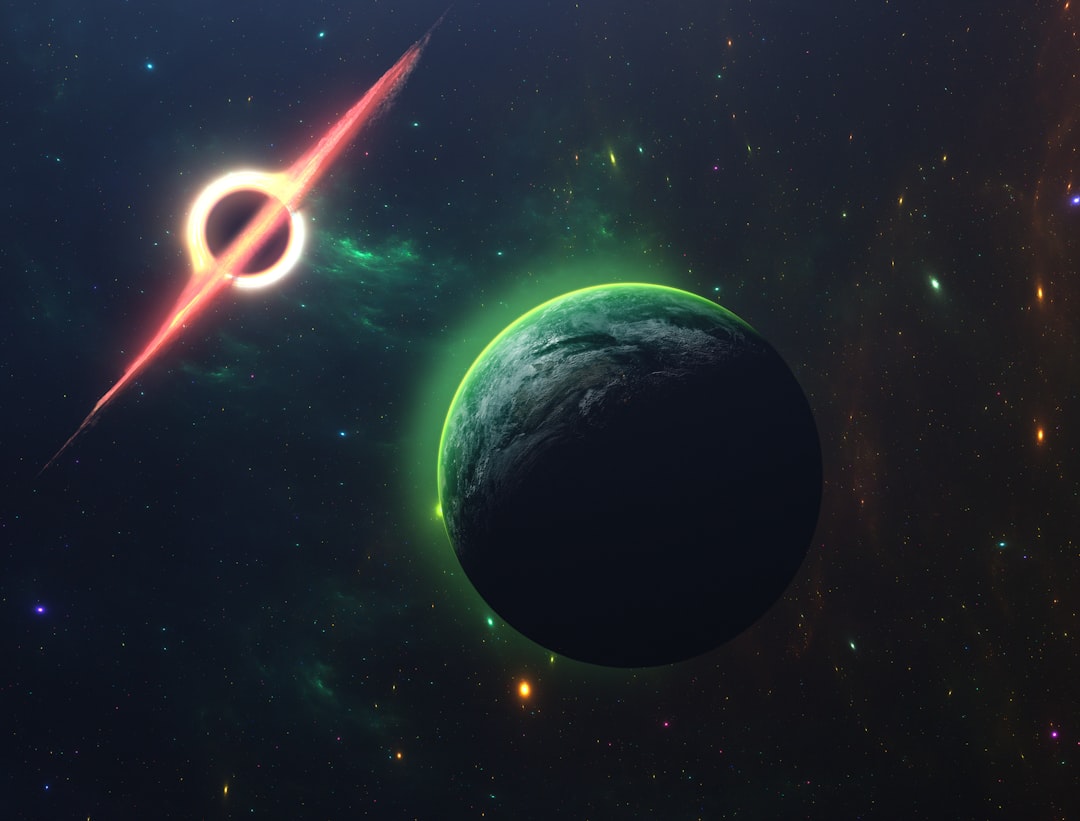
Black holes have long captivated the imagination of scientists and the general public alike. These mysterious cosmic entities, formed from the remnants of massive stars, possess gravitational forces so intense that nothing, not even light, can escape their grasp. The concept of a black hole challenges the very foundations of physics and our understanding of the universe.
As researchers delve deeper into the nature of these phenomena, they uncover layers of complexity that continue to intrigue and perplex. The term “black hole” was first coined in the 1960s, but the idea has roots that stretch back to the 18th century. Theoretical physicists like Albert Einstein laid the groundwork for understanding gravity and spacetime, which would later lead to the prediction of black holes.
Today, they are not merely theoretical constructs; they are a fundamental aspect of astrophysics, influencing the dynamics of galaxies and the evolution of the cosmos itself.
Key Takeaways
- Black holes are regions in space where the gravitational pull is so strong that nothing, not even light, can escape.
- Black holes are formed when massive stars collapse under their own gravity, or when two neutron stars merge.
- Black holes have properties such as mass, electric charge, and angular momentum, and are characterized by their event horizon and singularity.
- The event horizon is the point of no return around a black hole, while the singularity is the infinitely dense core where the laws of physics break down.
- Black holes continue to be a source of fascination and mystery, with ongoing research into phenomena such as Hawking radiation and the black hole information paradox.
The Formation of Black Holes
The formation of black holes is a process that begins with the life cycle of massive stars. When a star exhausts its nuclear fuel, it can no longer support itself against gravitational collapse. For stars with a mass greater than approximately three solar masses, this collapse leads to the creation of a black hole.
The core implodes under its own gravity, while the outer layers may explode in a supernova, scattering elements across space. There are several pathways to black hole formation. Stellar black holes arise from the remnants of massive stars, while supermassive black holes, which can contain millions or even billions of solar masses, are believed to form through different mechanisms, such as the merging of smaller black holes or the direct collapse of massive gas clouds in the early universe.
Understanding these processes is crucial for unraveling the mysteries surrounding black holes and their role in cosmic evolution.
The Properties and Characteristics of Black Holes
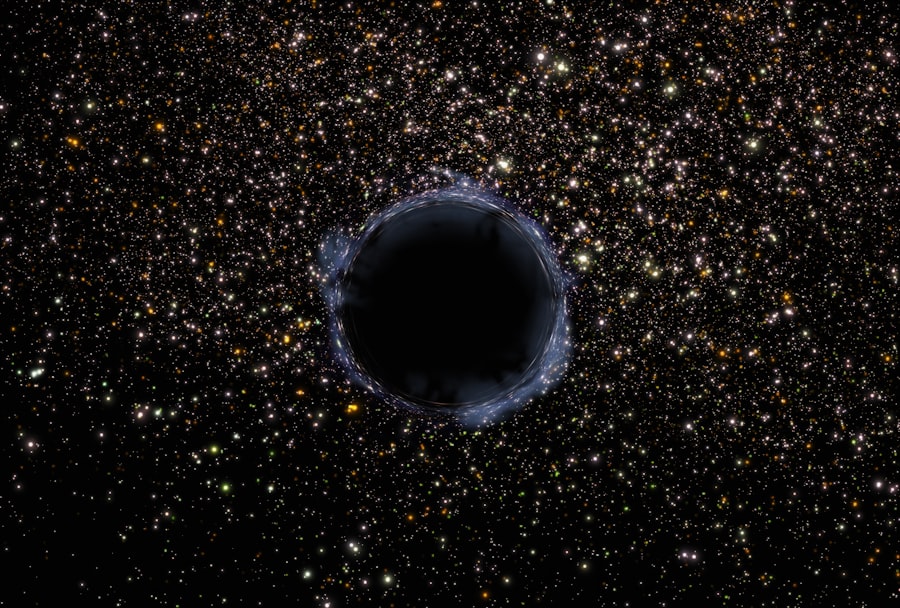
Black holes are defined by several key properties that distinguish them from other celestial objects. Their mass is perhaps the most significant characteristic, as it determines the strength of their gravitational pull. Additionally, black holes can be classified into different categories based on their mass: stellar black holes, supermassive black holes, and intermediate black holes, each with unique formation histories and implications for their surroundings.
Another important property is the spin of a black hole, which can affect its gravitational field and influence the behavior of matter in its vicinity.
These properties not only define black holes but also play a crucial role in how they interact with other celestial bodies and influence galactic dynamics.
The Event Horizon and Singularity
| Concept | Definition |
|---|---|
| Event Horizon | The boundary surrounding a black hole beyond which no light or radiation can escape. |
| Singularity | The point within a black hole where the gravitational pull becomes infinite and spacetime curves infinitely. |
| Black Hole Mass | The mass of a black hole, which determines the size of its event horizon and gravitational pull. |
| Hawking Radiation | The theoretical radiation emitted by black holes due to quantum effects near the event horizon. |
At the heart of every black hole lies a singularity, a point where gravitational forces compress matter to an infinitely small volume, leading to infinite density. Surrounding this singularity is the event horizon, a boundary beyond which nothing can escape the black hole’s gravitational pull. The event horizon marks the point of no return; once an object crosses this threshold, it is inexorably drawn toward the singularity.
The event horizon is not merely a physical boundary; it also represents a fundamental limit to our understanding of physics. Inside this region, the laws of physics as currently understood break down, leading to questions about the nature of time and space. The study of these phenomena challenges scientists to rethink established theories and explore new frameworks that could better explain what occurs within and beyond the event horizon.
The Enigmatic Nature of Black Holes
The enigmatic nature of black holes has led to numerous theories and speculations about their role in the universe. They are often described as cosmic vacuum cleaners, consuming everything in their vicinity, yet they also play a crucial role in galaxy formation and evolution. The gravitational influence of supermassive black holes at the centers of galaxies can regulate star formation and shape galactic structures.
Moreover, black holes challenge our understanding of reality itself. They raise profound questions about causality, time travel, and the very fabric of spacetime. As researchers continue to probe these mysteries, they find themselves at the intersection of theoretical physics and philosophy, grappling with concepts that defy conventional wisdom.
Hawking Radiation and Black Hole Information Paradox
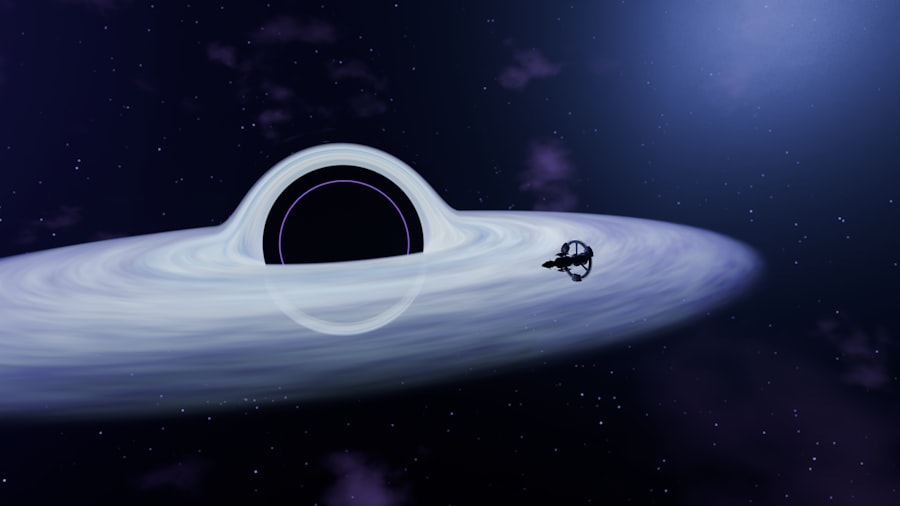
One of the most groundbreaking theories regarding black holes was proposed by physicist Stephen Hawking in 1974. He suggested that black holes are not entirely black; instead, they emit radiation due to quantum effects near the event horizon. This phenomenon, known as Hawking radiation, implies that black holes can gradually lose mass and eventually evaporate over astronomical timescales.
Hawking’s theory also gave rise to the information paradox—a conundrum that questions whether information that falls into a black hole is lost forever or if it can be recovered in some form. This paradox has sparked intense debate among physicists and has led to various proposed solutions, including ideas related to quantum entanglement and holography. The resolution of this paradox could have profound implications for our understanding of quantum mechanics and gravity.
Observational Evidence of Black Holes
Despite their elusive nature, there is substantial observational evidence supporting the existence of black holes. One of the most compelling pieces of evidence came from the Event Horizon Telescope (EHT) collaboration in 2019 when they captured an image of the shadow cast by the supermassive black hole at the center of the galaxy M87. This groundbreaking achievement provided visual confirmation of a phenomenon long predicted by theory.
Additionally, astronomers have observed stars orbiting invisible objects with immense mass, leading to strong inferences about the presence of black holes. Gravitational waves detected from colliding black holes have further solidified their existence and provided insights into their properties. These observations not only confirm theoretical predictions but also open new avenues for research into the nature and behavior of these enigmatic entities.
The Role of Black Holes in the Universe
Black holes play a pivotal role in shaping the universe as we know it. Their gravitational influence affects star formation rates within galaxies and contributes to the overall structure and dynamics of cosmic systems. Supermassive black holes at galactic centers are thought to regulate star formation by exerting pressure on surrounding gas clouds, preventing excessive star formation that could destabilize galaxies.
Moreover, black holes are integral to our understanding of cosmic evolution. They serve as laboratories for testing theories of gravity and quantum mechanics under extreme conditions. By studying their interactions with surrounding matter and radiation, scientists gain insights into fundamental processes that govern the universe’s behavior on both large and small scales.
The Future of Black Hole Research
The future of black hole research promises to be as exciting as its past. With advancements in technology and observational techniques, scientists are poised to uncover new insights into these cosmic phenomena. Upcoming missions like NASA’s James Webb Space Telescope aim to explore regions near supermassive black holes and study their impact on galaxy formation.
Furthermore, theoretical advancements may lead to new models that reconcile quantum mechanics with general relativity, potentially resolving longstanding questions about black hole behavior and their role in the universe. As researchers continue to push the boundaries of knowledge, they remain hopeful that future discoveries will shed light on some of the most profound mysteries surrounding black holes.
Black Holes in Popular Culture
Black holes have transcended scientific discourse to become cultural icons in literature, film, and art. They are often depicted as gateways to other dimensions or as harbingers of doom in science fiction narratives. Movies like “Interstellar” have brought complex scientific concepts related to black holes into mainstream consciousness, sparking public interest in astrophysics.
In literature, authors have explored themes related to time travel and existentialism through narratives involving black holes. These portrayals reflect humanity’s fascination with the unknown and our desire to understand our place in an ever-expanding universe.
Unraveling the Mysteries of Black Holes
In conclusion, black holes remain one of the most intriguing subjects in modern astrophysics. Their formation processes, properties, and enigmatic nature challenge our understanding of fundamental physics while offering insights into cosmic evolution. As researchers continue to explore these phenomena through both observational evidence and theoretical frameworks, they inch closer to unraveling some of the universe’s deepest mysteries.
The journey into understanding black holes is far from over; it is an ongoing quest that intertwines science with philosophy and imagination. As humanity seeks answers about these cosmic enigmas, it also reflects on its own existence within an expansive universe filled with wonders yet to be discovered.
In recent years, the scientific community has been abuzz with discussions challenging traditional definitions of black holes. A fascinating article on this topic can be found on My Cosmic Ventures, where the author delves into the complexities and evolving theories surrounding these enigmatic cosmic entities. The article explores how new research and observations are prompting scientists to reconsider what constitutes a black hole, potentially reshaping our understanding of the universe. For a deeper insight into these groundbreaking ideas, you can read the full article by visiting My Cosmic Ventures.
WATCH THIS! 🌌The Biggest Black Hole Is A LIE
FAQs
What is a black hole?
A black hole is a region in space where the gravitational pull is so strong that nothing, not even light, can escape from it. This occurs when a massive star collapses under its own gravity.
What are the current definitions of black holes?
The current definition of a black hole is based on the concept of an event horizon, which is the boundary beyond which nothing can escape the gravitational pull of the black hole.
Why are black hole definitions being challenged?
Some scientists are challenging the current definitions of black holes because they believe that the concept of an event horizon may not accurately capture the true nature of these cosmic phenomena. They argue that the event horizon may not be a definitive boundary and that there may be alternative explanations for the behavior of black holes.
What are some alternative theories about black holes?
Some alternative theories about black holes include the idea that they may have “soft hair” or a “firewall” instead of a traditional event horizon. These theories propose different ways of understanding the behavior and structure of black holes.
How are scientists working to better understand black holes?
Scientists are using a variety of methods to study black holes, including observing their effects on nearby objects, analyzing the gravitational waves they produce, and conducting simulations and experiments to test different theories about their nature.