
Pulsar Timing Arrays (PTAs) are networks of precisely monitored pulsars used to detect gravitational waves and study cosmic phenomena. Pulsars are rapidly rotating neutron stars that emit regular beams of electromagnetic radiation, functioning as highly accurate cosmic clocks. Scientists measure the arrival times of these pulses with extreme precision to detect minute variations caused by gravitational waves passing through space between the pulsars and Earth.
PTAs serve as sensitive detectors for low-frequency gravitational waves, particularly those generated by supermassive black hole mergers and other large-scale cosmic events.
Pulsar research began in 1967 with the discovery of the first pulsar by Jocelyn Bell Burnell.
Since then, astronomers have identified over 3,000 pulsars and developed increasingly sophisticated timing techniques. The most stable pulsars, known as millisecond pulsars, can maintain timing precision comparable to atomic clocks over extended periods, making them ideal candidates for PTA observations. Current PTA projects include the North American Nanohertz Observatory for Gravitational Waves (NANOGrav), the European Pulsar Timing Array (EPTA), and the Parkes Pulsar Timing Array (PPTA).
These collaborations monitor dozens of pulsars simultaneously, creating a galaxy-wide gravitational wave detector. Recent observations have provided evidence for a gravitational wave background, likely originating from numerous supermassive black hole binary systems throughout the universe.
Key Takeaways
- Pulsar Timing Arrays (PTAs) use precise measurements of pulsar signals to detect gravitational waves and study supermassive black holes.
- PTAs are sensitive to nanohertz-frequency gravitational waves, enabling the observation of cosmic phenomena inaccessible to other detectors.
- Collaborative global efforts enhance PTA data collection and analysis, improving detection capabilities and scientific insights.
- Challenges for PTAs include noise interference and the need for long-term monitoring to achieve accurate results.
- Future PTA research promises to deepen understanding of black hole evolution and contribute significantly to astrophysics and cosmology.
How Pulsar Timing Arrays Work
Pulsar Timing Arrays operate on the principle of timing the arrival of pulses emitted by pulsars. Each pulsar has a unique rotational period, and its emissions can be detected by radio telescopes on Earth. By monitoring multiple pulsars simultaneously, researchers can create a network that allows for highly accurate timing measurements.
The data collected from these observations are then analyzed to detect variations in pulse arrival times, which may indicate the presence of gravitational waves or other cosmic phenomena. The process begins with the selection of suitable pulsars, typically those that are stable and emit strong signals. Once identified, these pulsars are monitored over extended periods, often spanning years or even decades.
The timing data is then subjected to rigorous analysis using sophisticated algorithms designed to identify subtle deviations caused by gravitational waves. This meticulous approach enables scientists to construct a detailed picture of the gravitational wave background and its potential sources, such as supermassive black hole mergers.
Detecting Supermassive Black Holes with Pulsar Timing Arrays
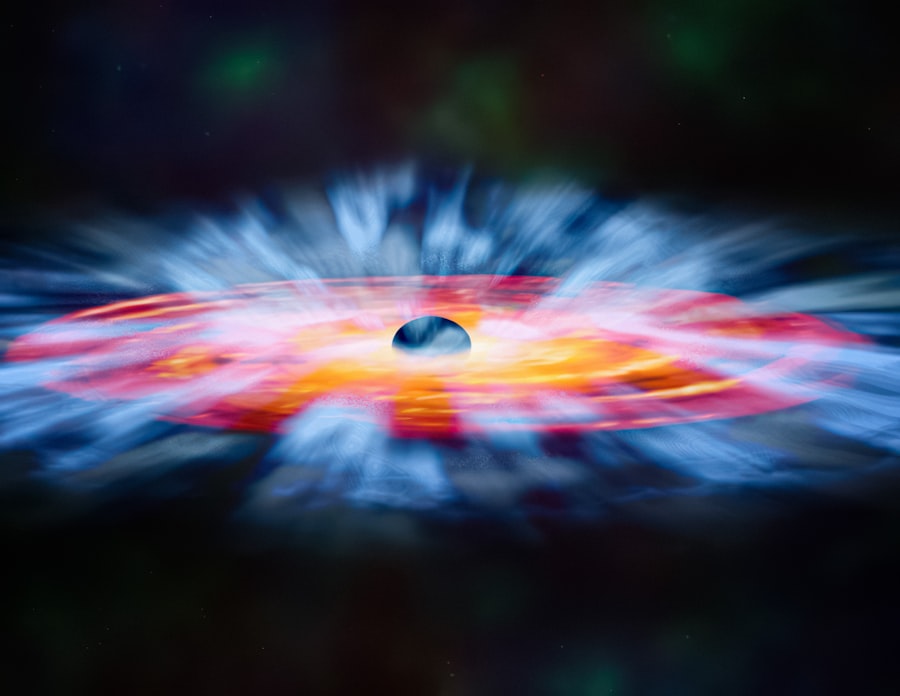
One of the most exciting applications of Pulsar Timing Arrays is their ability to detect supermassive black holes (SMBHs). These colossal entities, often found at the centers of galaxies, exert immense gravitational influence on their surroundings. By studying the timing variations in pulsar signals, researchers can infer the presence of SMBHs and gain insights into their properties and behavior.
The gravitational influence of these black holes can cause measurable perturbations in the timing of pulsar signals, providing a direct method for their detection. Moreover, PTAs can help map the distribution of SMBHs across the universe. By identifying clusters of pulsars that are affected by nearby black holes, scientists can create a more comprehensive understanding of how these massive objects interact with one another and with their host galaxies.
Using Pulsar Timing Arrays to Study Gravitational Waves
Gravitational waves, ripples in spacetime caused by accelerating masses, are another area where Pulsar Timing Arrays excel. When two massive objects, such as black holes or neutron stars, merge, they generate gravitational waves that propagate through the universe. These waves can distort the fabric of spacetime, leading to variations in the timing of pulsar signals as they pass through Earth.
PTAs are uniquely positioned to detect these minute changes, making them a vital tool in gravitational wave astronomy. The sensitivity of PTAs allows them to probe gravitational waves in the nanohertz frequency range, which is particularly challenging for other detection methods. This capability opens up new avenues for understanding the population of supermassive black hole binaries and their mergers.
By analyzing the timing data from multiple pulsars, researchers can construct a gravitational wave background spectrum that reveals information about the frequency and amplitude of these cosmic events.
Pulsar Timing Arrays and the Search for Nanohertz Gravitational Waves
| Metric | Description | Typical Value / Range | Relevance to Pulsar Timing Arrays (PTAs) |
|---|---|---|---|
| Number of Pulsars Monitored | Count of millisecond pulsars regularly timed in the array | 20 – 100+ | More pulsars improve sensitivity to gravitational waves from supermassive black hole binaries |
| Timing Precision | Root mean square (RMS) of timing residuals | ~100 ns to a few µs | Higher precision allows detection of weaker gravitational wave signals |
| Observation Timespan | Duration over which pulsars have been monitored | 5 – 20+ years | Longer timespans increase sensitivity to lower frequency gravitational waves from supermassive black hole binaries |
| Frequency Range | Gravitational wave frequencies probed by PTAs | ~1 to 100 nHz | Corresponds to orbital periods of supermassive black hole binaries of years to decades |
| Strain Sensitivity | Minimum detectable gravitational wave strain amplitude | ~10-15 to 10-14 | Determines the smallest supermassive black hole binary signals PTAs can detect |
| Supermassive Black Hole Binary Mass Range | Typical masses of binaries producing detectable signals | 108 – 1010 solar masses | Massive binaries produce stronger gravitational waves in PTA frequency band |
| Distance to Sources | Typical distances of supermassive black hole binaries detectable by PTAs | Up to a few Gpc | PTAs can probe cosmological distances for the most massive binaries |
| Current PTA Collaborations | Major international PTA projects | NANOGrav, EPTA, PPTA, IPTA | Collaborations pooling data to improve sensitivity to supermassive black hole binaries |
The search for nanohertz gravitational waves is one of the most ambitious goals of Pulsar Timing Array research. These low-frequency waves are believed to originate from supermassive black hole binaries that are slowly inspiraling due to gravitational radiation. Detecting these waves would provide crucial insights into the dynamics of such systems and their role in cosmic evolution.
To achieve this goal, PTAs rely on long-term monitoring of an extensive network of pulsars. The challenge lies in distinguishing genuine gravitational wave signals from noise and other astrophysical phenomena that can affect timing measurements. Researchers employ sophisticated statistical techniques and models to enhance signal detection capabilities while minimizing false positives.
As more data is collected over time, the likelihood of detecting nanohertz gravitational waves increases, potentially leading to groundbreaking discoveries about the universe’s most massive structures.
The Role of Pulsar Timing Arrays in Understanding the Evolution of Supermassive Black Holes
Pulsar Timing Arrays play a crucial role in elucidating the evolutionary pathways of supermassive black holes. By studying how these massive objects interact with their environments and with each other, researchers can gain insights into their formation and growth processes. The timing data collected from PTAs can reveal patterns in black hole mergers and provide clues about their mass distribution across cosmic time.
Furthermore, PTAs can help address fundamental questions about how supermassive black holes influence galaxy formation and evolution. The relationship between black holes and their host galaxies is complex; understanding this interplay is essential for constructing accurate models of cosmic evolution. By correlating pulsar timing data with observations from other astronomical surveys, scientists can build a more comprehensive picture of how supermassive black holes shape their surroundings.
Collaborative Efforts in Pulsar Timing Array Research
The field of Pulsar Timing Array research thrives on collaboration among scientists from various disciplines and institutions worldwide. This collaborative spirit is essential for advancing knowledge and overcoming challenges inherent in this complex field. Researchers share data, methodologies, and insights to enhance the collective understanding of pulsars and gravitational waves.
International collaborations have led to significant advancements in PTA research. Projects like the International Pulsar Timing Array (IPTA) bring together teams from different countries to pool resources and expertise. Such collaborations enable researchers to monitor a larger number of pulsars simultaneously, increasing the chances of detecting gravitational waves and other phenomena.
The synergy created through these partnerships accelerates progress and fosters innovation in pulsar timing techniques.
Challenges and Limitations of Pulsar Timing Arrays
Despite their immense potential, Pulsar Timing Arrays face several challenges and limitations that researchers must navigate. One significant hurdle is the need for long-term observations; detecting gravitational waves requires years or even decades of precise timing data from multiple pulsars. This lengthy timeline can be a barrier to rapid progress in research.
Additionally, environmental factors such as radio frequency interference (RFI) can complicate data collection and analysis. RFI can mask or distort pulsar signals, making it difficult to extract meaningful information from timing measurements. Researchers must develop robust techniques to mitigate these effects while ensuring that data quality remains high.
Future Prospects for Pulsar Timing Array Research
The future prospects for Pulsar Timing Array research are promising, with ongoing advancements in technology and methodology poised to enhance detection capabilities further. As new telescopes come online and existing facilities upgrade their equipment, researchers will have access to improved sensitivity and resolution for pulsar observations. Moreover, as more pulsars are discovered and added to existing arrays, the potential for groundbreaking discoveries increases exponentially.
Future research may uncover new insights into gravitational wave sources, supermassive black hole dynamics, and even fundamental physics beyond current models. The continued evolution of PTA research promises to unlock new chapters in our understanding of the universe.
Implications of Pulsar Timing Array Discoveries for Astrophysics and Cosmology
The discoveries made through Pulsar Timing Array research have far-reaching implications for both astrophysics and cosmology. By providing a new window into gravitational waves and supermassive black holes, PTAs challenge existing theories and inspire new lines of inquiry. The ability to detect nanohertz gravitational waves could revolutionize our understanding of cosmic structure formation and evolution.
Furthermore, insights gained from PTA research may inform broader questions about dark matter, dark energy, and the fundamental nature of gravity itself. As researchers continue to unravel the complexities of spacetime through pulsar timing measurements, they may uncover connections between disparate areas of astrophysics that were previously thought unrelated.
Unlocking the Universe’s Supermassive Secrets with Pulsar Timing Arrays
In conclusion, Pulsar Timing Arrays stand at the forefront of modern astrophysics, offering unprecedented opportunities to explore some of the universe’s most profound mysteries. Through meticulous timing measurements and collaborative efforts among scientists worldwide, PTAs have become essential tools for detecting gravitational waves and studying supermassive black holes. As research continues to evolve, so too will our understanding of cosmic phenomena that shape our universe.
The journey into the realm of pulsars has only just begun; each discovery brings humanity closer to unlocking the secrets held within these celestial beacons. With continued advancements in technology and methodology, Pulsar Timing Arrays will undoubtedly play a pivotal role in shaping our understanding of the cosmos for years to come.
Pulsar timing arrays (PTAs) have emerged as a powerful tool for detecting gravitational waves from supermassive black hole binaries. These arrays utilize the precise timing of pulsar signals to measure the distortions in spacetime caused by passing gravitational waves. For a deeper understanding of the implications and advancements in this field, you can read more in this related article on cosmic ventures: