
When you think of Albert Einstein, images of groundbreaking theories and complex equations likely come to mind. However, one aspect of his life that often goes unnoticed is his meticulous approach to time management. Einstein’s “Time Table” is not merely a schedule; it represents a framework through which he navigated the complexities of both his scientific endeavors and personal life.
Einstein’s relationship with time was multifaceted. He revolutionized our understanding of time through his theories, yet he also had a personal philosophy regarding how to manage it effectively.
By examining his daily routines and habits, you can glean valuable lessons on how to harness your own time for greater productivity and creativity. This article will delve into the various dimensions of Einstein’s time management, exploring how it influenced his work and shaped his legacy.
Key Takeaways
- Einstein’s time table offers insights into the daily routine and habits of one of the greatest minds in history.
- Albert Einstein’s early life and education laid the foundation for his groundbreaking work in physics and his unique perspective on time.
- The theory of relativity revolutionized our understanding of time and its relationship to space, leading to significant scientific and philosophical implications.
- Einstein’s thought experiments on time travel challenged conventional notions of time and inspired new ways of thinking about the nature of reality.
- Einstein’s daily schedule and habits reflect his philosophical views on the nature of time and its influence on his work in physics.
Early Life and Education of Albert Einstein
Born on March 14, 1879, in Ulm, Germany, Albert Einstein’s early life was marked by a curious mind and a penchant for questioning the world around him. From a young age, you can see that he exhibited an insatiable curiosity, often pondering complex concepts that would later become the foundation of his scientific theories. His family moved to Munich when he was just a year old, and it was there that he began his formal education.
However, the rigid structure of the German education system did not sit well with him. You might find it interesting that he often clashed with teachers who favored rote memorization over critical thinking. Despite these challenges, Einstein excelled in mathematics and physics, subjects that would later define his career.
He attended the Polytechnic Institute in Zurich, where he further honed his skills and developed a network of like-minded individuals. During this period, you can see the seeds of his revolutionary ideas being planted. His education was not just about acquiring knowledge; it was about fostering a mindset that questioned established norms and sought deeper understanding.
This early foundation would play a crucial role in shaping his future theories and contributions to science.
The Theory of Relativity and its Impact on Time
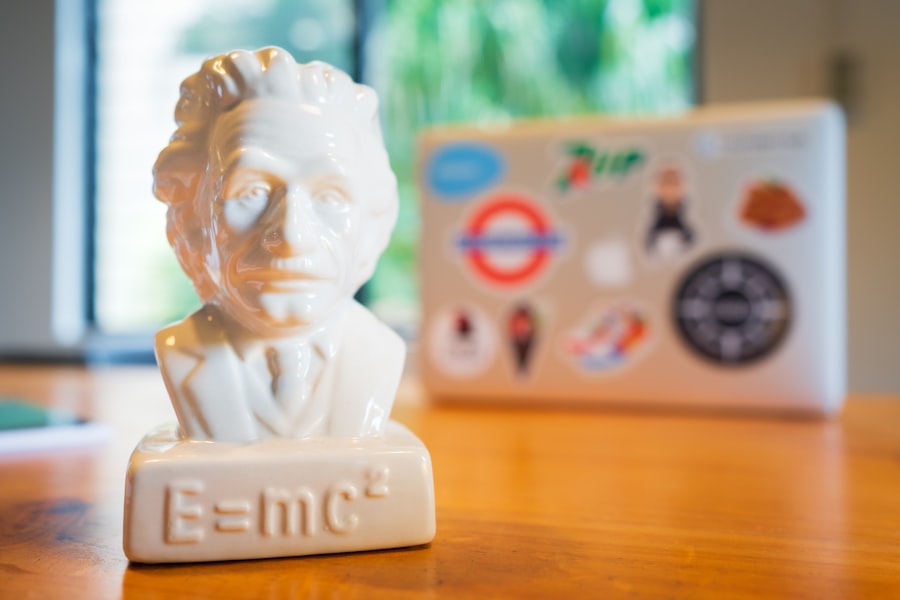
Einstein’s most famous contribution to science is undoubtedly the Theory of Relativity, which fundamentally altered our understanding of time and space. You may already know that this theory consists of two parts: Special Relativity and General Relativity. Special Relativity introduced the idea that time is not a constant; rather, it can be affected by speed and gravity.
This revelation was groundbreaking, as it challenged centuries of scientific thought that viewed time as an absolute entity. The implications of this theory are profound. For instance, if you were to travel at speeds close to the speed of light, time would pass differently for you compared to someone remaining stationary on Earth.
This concept of time dilation has been confirmed through various experiments and has practical applications in technologies such as GPS systems. By redefining time in this way, Einstein not only changed the course of physics but also influenced how you might perceive your own existence within the fabric of the universe.
Einstein’s Thought Experiments on Time Travel
| Experiment | Time Travel Concept | Outcome |
|---|---|---|
| Twin Paradox | Time dilation due to relative motion | One twin ages slower than the other |
| Light Clock | Time dilation due to speed of light | Time passes slower for moving observer |
| Wormhole | Shortcut through spacetime | Potential for time travel to the past or future |
One of the most fascinating aspects of Einstein’s work is his use of thought experiments to explore complex ideas about time and space. You might find it intriguing that many of his most significant breakthroughs were conceived not through traditional experimentation but through imaginative reasoning. For example, consider his famous thought experiment involving a train moving at high speed.
In this scenario, he illustrated how observers on the train and those standing on the platform would perceive time differently. These thought experiments allowed Einstein to visualize concepts that were otherwise difficult to grasp. They served as mental exercises that pushed the boundaries of conventional thinking.
By engaging in this form of intellectual exploration, you can see how Einstein was able to challenge existing paradigms and propose revolutionary ideas about time travel and its implications for humanity. His ability to think outside the box is a testament to the power of imagination in scientific discovery.
Einstein’s Philosophical Views on the Nature of Time
Beyond the scientific implications of his theories, Einstein held profound philosophical views on the nature of time itself. He believed that time is not merely a linear progression but rather a complex interplay between events and experiences. You may resonate with his idea that time is subjective; it can feel different depending on your circumstances or emotional state.
For instance, moments of joy may seem fleeting, while periods of discomfort can stretch indefinitely. Einstein’s philosophical musings on time also led him to question the very nature of reality. He famously stated that “the distinction between past, present, and future is only a stubbornly persistent illusion.” This perspective invites you to reflect on your own relationship with time and how it shapes your experiences.
By understanding that time is not just a rigid framework but a fluid concept influenced by perception, you can gain deeper insights into your own life and choices.
The Influence of Time on Einstein’s Work in Physics

Time played a pivotal role in shaping Einstein’s contributions to physics. His theories were not just abstract concepts; they were deeply intertwined with the fabric of reality as he understood it. You might find it fascinating that Einstein often emphasized the importance of time in understanding physical phenomena.
For instance, in his equations, time is treated as a variable that interacts with space and matter, fundamentally altering how we perceive the universe. Moreover, Einstein’s work on quantum mechanics further illustrates his intricate relationship with time. He grappled with the implications of quantum theory and its challenges to classical notions of causality and determinism.
This struggle reflects your own experiences when faced with complex problems—sometimes, you must confront uncertainties and ambiguities before arriving at clarity. In this way, Einstein’s engagement with time not only advanced scientific knowledge but also mirrored the human experience of grappling with life’s complexities.
Einstein’s Personal Habits and Routine
While Einstein’s intellectual pursuits are well-documented, his personal habits and routines also played a significant role in his productivity. You may be surprised to learn that he was known for maintaining a relatively simple lifestyle. He often eschewed material possessions in favor of intellectual pursuits, believing that simplicity allowed for greater focus on what truly mattered—his work.
Einstein was also known for his unconventional approach to daily routines. He often took long walks to clear his mind and stimulate creative thinking. These walks served as both physical exercise and mental rejuvenation, allowing him to return to his work with renewed vigor.
By incorporating such habits into your own life, you might find ways to enhance your creativity and productivity while maintaining balance.
Unlocking Einstein’s Time Table: A Look at his Daily Schedule
To truly understand Einstein’s approach to time management, it’s essential to examine his daily schedule more closely. You might be intrigued by how he allocated his time between research, teaching, and personal pursuits. His days were often structured yet flexible enough to accommodate bursts of inspiration or unexpected challenges.
Einstein typically began his mornings with focused work on scientific problems before engaging in teaching or public lectures later in the day. This prioritization allowed him to tackle complex issues when his mind was freshest. Additionally, he made time for leisure activities such as playing the violin or spending time with family—reminding you that balance is crucial for sustained creativity and productivity.
Exploring the Mind of a Genius: How Einstein’s Time Table Shaped his Thinking
Einstein’s Time Table was more than just a schedule; it was a reflection of his thought processes and priorities. By examining how he allocated his time, you can gain insights into the mindset of a genius. His ability to compartmentalize tasks while allowing for flexibility demonstrates an effective approach to managing both intellectual pursuits and personal life.
Moreover, Einstein’s emphasis on leisure activities highlights the importance of nurturing creativity outside formal work hours. Engaging in hobbies or spending time with loved ones can provide fresh perspectives and rejuvenate your mind for more focused work later on. By adopting similar practices in your own life, you may find that your creative output increases while maintaining a sense of fulfillment.
Lessons from Einstein’s Time Table for Productivity and Creativity
As you reflect on Einstein’s Time Table, several key lessons emerge that can enhance your own productivity and creativity. First and foremost is the importance of prioritization—focusing on high-impact tasks during your most productive hours can lead to significant breakthroughs in your work. Additionally, incorporating regular breaks or leisure activities into your schedule can foster creativity and prevent burnout.
Just as Einstein took long walks or played music to recharge, you too can benefit from stepping away from your work periodically to gain new insights or simply relax your mind. Lastly, embracing flexibility within your schedule allows for adaptability when unexpected challenges arise or when inspiration strikes unexpectedly. By creating a structure that accommodates both focused work and spontaneous exploration, you can cultivate an environment conducive to innovation.
The Legacy of Einstein’s Time Table
In conclusion, Albert Einstein’s Time Table serves as a testament to the profound impact that effective time management can have on creativity and productivity.
As you reflect on these lessons from Einstein’s life, consider how you can apply them to your own journey.
Whether it’s prioritizing tasks during peak productivity hours or allowing space for leisure activities that inspire creativity, embracing these principles can lead you toward greater success in your endeavors. Ultimately, Einstein’s legacy extends beyond his scientific contributions; it encompasses a holistic approach to life that values both intellectual rigor and personal well-being—a balance worth striving for in your own life.
Albert Einstein’s theories have revolutionized our understanding of time and space, leading to groundbreaking insights that continue to influence modern physics. For those interested in exploring more about Einstein’s impact on the concept of time, a related article can be found on My Cosmic Ventures. This article delves into the intricacies of Einstein’s theories and their implications for our understanding of the universe. To read more about this fascinating topic, visit the article on My Cosmic Ventures.
Why Time Freezes at Light Speed
FAQs
What is the Einstein time table?
The Einstein time table is a time management method that is based on the principles of physicist Albert Einstein. It aims to help individuals prioritize their tasks and manage their time more effectively.
How does the Einstein time table work?
The Einstein time table works by dividing the day into blocks of time and assigning specific tasks to each block. It emphasizes the importance of focusing on one task at a time and allocating time for both work and relaxation.
What are the key principles of the Einstein time table?
The key principles of the Einstein time table include prioritizing important tasks, allocating time for focused work, taking regular breaks, and maintaining a balance between work and leisure activities.
Who can benefit from using the Einstein time table?
The Einstein time table can benefit anyone who wants to improve their time management skills and increase their productivity. It is particularly useful for individuals with busy schedules and multiple responsibilities.
Are there any tools or resources available for implementing the Einstein time table?
There are various tools and resources available for implementing the Einstein time table, including time management apps, planners, and online resources that provide guidance on how to effectively use this method.