The quest for a unified theory in physics represents one of the most profound challenges faced by scientists today. This endeavor seeks to reconcile two of the most successful yet fundamentally different frameworks in modern physics: quantum mechanics and general relativity. Quantum mechanics, which governs the behavior of particles at the smallest scales, has proven to be extraordinarily accurate in predicting phenomena at the atomic and subatomic levels.
In contrast, general relativity, formulated by Albert Einstein, describes the gravitational force and the curvature of spacetime on a cosmic scale. The apparent dissonance between these two theories has led physicists to search for a comprehensive framework that can seamlessly integrate them into a single coherent model. The significance of this quest extends beyond mere academic curiosity; it touches upon the very fabric of reality itself.
A unified theory would not only enhance our understanding of the universe but also provide insights into fundamental questions about the nature of space, time, and matter. As researchers delve deeper into the complexities of both quantum mechanics and gravity, they are confronted with a myriad of challenges that highlight the limitations of current theories. The journey toward a unified theory is not just a scientific pursuit; it is a philosophical exploration that seeks to answer some of humanity’s most profound questions about existence.
Key Takeaways
- Unifying quantum mechanics and gravity remains one of the biggest challenges in modern physics.
- String theory and loop quantum gravity are leading theoretical approaches to achieve this unification.
- Experimental evidence is crucial but currently limited, making testing unified theories difficult.
- A successful unified theory would have profound implications for understanding cosmology and the fundamental nature of the universe.
- The quest for a unified theory continues to drive future research and theoretical development in physics.
The Challenges of Unifying Quantum Mechanics and Gravity
Unifying quantum mechanics and gravity presents a multitude of challenges that have stymied physicists for decades. One of the primary obstacles lies in the fundamentally different ways these theories describe reality. Quantum mechanics operates on principles of probability and uncertainty, where particles exist in superpositions and their properties are not definitively determined until measured.
In stark contrast, general relativity portrays gravity as a smooth curvature of spacetime, where massive objects dictate the motion of other objects in a deterministic manner. This dichotomy creates a conceptual chasm that has proven difficult to bridge. Moreover, the mathematical frameworks employed by both theories are inherently incompatible.
Quantum mechanics relies on complex probability amplitudes and wave functions, while general relativity is grounded in the geometry of spacetime described by differential equations. Attempts to merge these mathematical structures often lead to inconsistencies and divergences that render calculations meaningless. For instance, when physicists try to apply quantum principles to gravitational fields, they encounter infinities that cannot be resolved within the existing theoretical framework.
This mathematical impasse underscores the need for a new approach that can harmonize these disparate elements into a cohesive whole.
Historical Attempts to Unify Quantum Mechanics and Gravity
Throughout history, numerous attempts have been made to unify quantum mechanics and gravity, each contributing valuable insights while also highlighting the complexities involved. One of the earliest efforts can be traced back to the mid-20th century when physicists like Richard Feynman and Julian Schwinger developed quantum electrodynamics (QED). While QED successfully unified electromagnetism with quantum mechanics, it did not address gravitational interactions, leaving a significant gap in our understanding.
In the 1970s, the advent of gauge theories brought renewed hope for unification. The Standard Model of particle physics emerged as a robust framework that described three of the four fundamental forces—electromagnetic, weak, and strong—using quantum field theory. However, gravity remained elusive, prompting physicists like Stephen Hawking and others to explore various approaches, including quantum field theory in curved spacetime.
Despite these efforts, a comprehensive theory that could incorporate gravity into the quantum realm remained out of reach.
The Role of String Theory in Unifying Quantum Mechanics and Gravity
| Aspect | Quantum Mechanics | General Relativity (Gravity) | String Theory Contribution | Current Status |
|---|---|---|---|---|
| Fundamental Entities | Point particles | Curved spacetime | One-dimensional strings | Strings replace point particles, providing a unified framework |
| Mathematical Framework | Quantum field theory | Differential geometry | Conformal field theory and higher-dimensional geometry | Mathematically complex but promising for unification |
| Force Unification | Electromagnetic, weak, strong forces | Gravity | Incorporates gravity as a vibrational mode of strings | Potential to unify all four fundamental forces |
| Dimensionality | 4 dimensions (3 space + 1 time) | 4 dimensions (3 space + 1 time) | Requires 10 or 11 dimensions | Extra dimensions compactified, not yet experimentally verified |
| Experimental Evidence | Extensively tested and confirmed | Extensively tested and confirmed | No direct experimental evidence yet | Ongoing research, indirect tests proposed |
| Key Challenges | Measurement uncertainty, probabilistic nature | Singularities, incompatibility with quantum mechanics | Mathematical complexity, lack of testable predictions | Active area of theoretical physics research |
String theory has emerged as one of the leading candidates for unifying quantum mechanics and gravity, offering a novel perspective on fundamental particles and forces. At its core, string theory posits that the basic building blocks of the universe are not point-like particles but rather one-dimensional strings vibrating at different frequencies. These vibrations determine the properties of particles, such as mass and charge, effectively providing a framework where all fundamental forces can coexist.
One of the most compelling aspects of string theory is its ability to incorporate gravity naturally within its mathematical structure.
This unification is achieved through mechanisms such as supersymmetry and dualities, which suggest deep connections between seemingly disparate physical phenomena.
However, despite its theoretical elegance, string theory has yet to produce definitive experimental predictions that could validate its claims.
Loop Quantum Gravity and Its Potential to Unify Quantum Mechanics and Gravity
Loop quantum gravity (LQG) represents another promising approach to unifying quantum mechanics and gravity, diverging from string theory’s framework while still aiming for similar goals. LQG seeks to quantize spacetime itself, proposing that space is composed of discrete units or “loops” rather than being continuous. This perspective leads to a fundamentally different understanding of gravity, suggesting that spacetime has an atomic structure at the Planck scale.
One of the key advantages of loop quantum gravity is its ability to provide insights into black hole physics and the early universe without requiring additional dimensions or exotic constructs. LQG predicts phenomena such as black hole entropy and offers potential resolutions to singularities found in classical general relativity. By focusing on the geometric properties of spacetime and employing techniques from both quantum mechanics and general relativity, LQG presents a compelling alternative that could pave the way for a unified theory.
Quantum Gravity and the Search for a Unified Theory
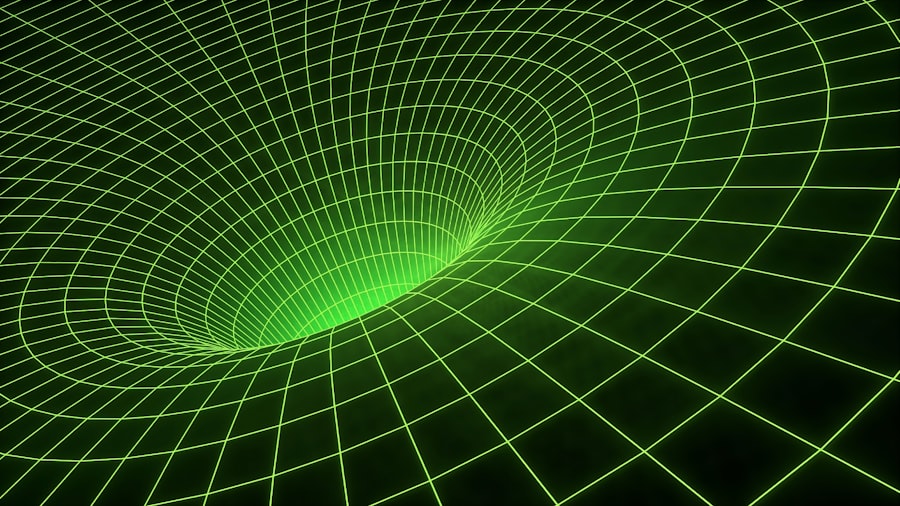
The broader field of quantum gravity encompasses various approaches aimed at reconciling quantum mechanics with general relativity. Researchers are exploring diverse methodologies, including causal set theory, asymptotic safety, and emergent gravity, each offering unique perspectives on how gravity operates at quantum scales. These approaches share a common goal: to develop a coherent framework that can describe gravitational phenomena while adhering to the principles of quantum mechanics.
As scientists delve deeper into these theories, they are uncovering intriguing connections between seemingly unrelated concepts. For instance, some researchers are investigating how entanglement—a fundamental feature of quantum mechanics—might play a role in shaping spacetime itself. This line of inquiry suggests that information may be more fundamental than spacetime geometry, challenging traditional notions about the nature of reality.
The ongoing exploration within quantum gravity continues to inspire new ideas and foster collaboration among physicists from various disciplines.
The Importance of Unifying Quantum Mechanics and Gravity for Cosmology
The unification of quantum mechanics and gravity holds profound implications for cosmology—the study of the universe’s origin, evolution, and ultimate fate. Understanding how these two frameworks interact is crucial for addressing fundamental questions about the Big Bang, cosmic inflation, and dark matter. A unified theory could provide insights into the conditions that prevailed during the early universe and help explain phenomena that remain enigmatic within current models.
Moreover, unifying these theories may shed light on the nature of dark energy—a mysterious force driving the accelerated expansion of the universe. By integrating quantum principles with gravitational dynamics, researchers may uncover new mechanisms that govern cosmic evolution. This knowledge could revolutionize our understanding of the universe’s structure and behavior, leading to groundbreaking discoveries about its past and future.
Experimental Evidence and Testing for a Unified Theory
While theoretical advancements are essential in the quest for a unified theory, experimental evidence remains crucial for validating proposed models. However, testing predictions related to quantum gravity poses significant challenges due to the extreme conditions required to probe these phenomena directly. Current experimental techniques often fall short when it comes to accessing scales where both quantum effects and gravitational forces become significant.
Nevertheless, researchers are exploring innovative methods to gather indirect evidence supporting various theories. For instance, experiments involving high-energy particle collisions at facilities like CERN may provide insights into potential signatures of new physics beyond the Standard Model. Additionally, observations from gravitational wave detectors like LIGO could offer clues about how gravitational waves behave at quantum scales.
As technology advances and new experimental avenues open up, physicists remain hopeful that empirical data will eventually guide them toward a unified understanding.
Theoretical Implications of Unifying Quantum Mechanics and Gravity
The theoretical implications of successfully unifying quantum mechanics and gravity extend far beyond mere academic interest; they could fundamentally alter humanity’s understanding of reality itself. A unified theory would challenge existing paradigms about space, time, and causality while providing a more comprehensive framework for understanding complex systems across various scales. For instance, such a theory might reveal new insights into black holes—objects traditionally viewed as enigmatic regions where classical physics breaks down.
By incorporating quantum principles into our understanding of black holes, researchers could uncover mechanisms governing their formation, evolution, and eventual evaporation through Hawking radiation. Furthermore, unification could lead to novel predictions about exotic states of matter or even new dimensions beyond our current comprehension.
The Future of Unifying Quantum Mechanics and Gravity
As physicists continue their pursuit of a unified theory, the future holds both promise and uncertainty. The landscape of theoretical physics is rapidly evolving, with new ideas emerging from interdisciplinary collaborations between mathematicians, cosmologists, and particle physicists. The exploration of concepts such as holography—the idea that information about three-dimensional space can be encoded on a two-dimensional surface—has opened up exciting avenues for research.
Moreover, advancements in technology may soon enable experiments capable of probing previously inaccessible realms where quantum effects intersect with gravitational forces. As researchers refine their models and develop innovative experimental techniques, they remain optimistic that breakthroughs will occur in their quest for unification.
The Quest for a Unified Theory in Physics
The quest for a unified theory in physics represents one of humanity’s most ambitious intellectual endeavors—a journey that seeks to unravel the mysteries underlying our universe’s fundamental workings. While significant challenges remain in reconciling quantum mechanics with gravity, ongoing research continues to illuminate pathways toward potential solutions. Whether through string theory, loop quantum gravity, or other emerging frameworks, physicists are driven by an insatiable curiosity to understand how these two pillars of modern physics can coexist harmoniously.
As this quest unfolds, it not only deepens our understanding of nature but also inspires future generations to explore the cosmos’s intricacies further. The pursuit of knowledge is an enduring human endeavor—one that transcends disciplinary boundaries and invites collaboration across diverse fields. Ultimately, whether or not a unified theory is achieved may be less important than the journey itself—a journey filled with discovery, wonderment, and an ever-deepening appreciation for the complexities of existence.
In the quest to unify quantum mechanics and gravity, researchers are exploring various theoretical frameworks that could bridge the gap between these two fundamental pillars of physics. One insightful article that delves into this complex topic is available on My Cosmic Ventures, which discusses the latest advancements and theories in the field. For more information, you can read the article [here](https://www.mycosmicventures.com/).
WATCH THIS! The Universe Has a Resolution Limit (And We’ve Hit It)
FAQs
What is the main challenge in unifying quantum mechanics and gravity?
The main challenge is that quantum mechanics governs the behavior of particles at very small scales, while gravity is described by general relativity, which explains the large-scale structure of spacetime. These two theories use fundamentally different mathematical frameworks, making it difficult to create a single theory that accurately describes both phenomena.
Why can’t general relativity and quantum mechanics be combined easily?
General relativity treats gravity as the curvature of spacetime caused by mass and energy, using a continuous geometric framework. Quantum mechanics, on the other hand, relies on probabilistic wave functions and operates in discrete quantum states. Their differing assumptions about space, time, and matter lead to incompatibilities when trying to merge them.
What are some approaches to unify quantum mechanics and gravity?
Several approaches exist, including string theory, which posits that fundamental particles are one-dimensional strings; loop quantum gravity, which attempts to quantize spacetime itself; and other frameworks like causal dynamical triangulations and asymptotic safety. Each approach tries to reconcile the principles of both theories in different ways.
What is string theory’s role in unifying quantum mechanics and gravity?
String theory suggests that all particles are vibrations of tiny strings, and it naturally incorporates gravity by including a particle called the graviton. It aims to provide a consistent quantum theory of gravity by unifying all fundamental forces and particles within a single framework.
What is loop quantum gravity?
Loop quantum gravity is an approach that attempts to quantize spacetime directly, proposing that space is made up of discrete loops woven into a fine fabric. It does not require extra dimensions and focuses on the quantum properties of gravity without unifying it with other forces.
Why is unifying quantum mechanics and gravity important?
A unified theory would provide a deeper understanding of the universe, especially in extreme conditions like black holes and the Big Bang, where both quantum effects and gravity are significant. It could also lead to new physics beyond the current models and potentially revolutionize technology.
Are there experimental tests for theories unifying quantum mechanics and gravity?
Currently, direct experimental tests are challenging due to the extremely small scales and high energies involved. However, researchers look for indirect evidence through cosmological observations, particle physics experiments, and phenomena like gravitational waves to test predictions of these theories.
What is the current status of unifying quantum mechanics and gravity?
No complete and experimentally verified theory unifying quantum mechanics and gravity exists yet. Research is ongoing, with various theoretical models being developed and refined, but a definitive solution remains one of the biggest open problems in physics.