Cosmic acceleration refers to the phenomenon where the expansion of the universe is not merely continuing but is actually speeding up over time. This intriguing aspect of cosmology has captivated scientists and astronomers alike, as it challenges traditional notions of gravitational forces and the fate of the universe. The discovery of cosmic acceleration has profound implications for our understanding of the cosmos, suggesting that there are forces at play that are not yet fully understood.
As researchers delve deeper into this enigma, they uncover layers of complexity that could reshape humanity’s comprehension of the universe’s structure and evolution. The implications of cosmic acceleration extend beyond mere academic curiosity; they touch upon fundamental questions about the nature of reality itself. If the universe is indeed expanding at an accelerating rate, what does that mean for its ultimate fate?
Will it continue to expand indefinitely, or will it eventually collapse? These questions have spurred a wealth of research and debate, leading to a rich tapestry of theories and hypotheses that seek to explain this cosmic mystery. As scientists continue to explore the depths of space and time, they are not only seeking answers but also redefining humanity’s place in the universe.
Key Takeaways
- Cosmic acceleration refers to the observed increase in the rate of expansion of the universe over time.
- The historical background of cosmic expansion dates back to the early 20th century with the work of astronomers like Edwin Hubble.
- The discovery of unexplained cosmic acceleration came as a surprise to scientists in the late 1990s, based on observations of distant supernovae.
- Theories and explanations for cosmic acceleration include the concept of dark energy, modified theories of gravity, and the presence of extra dimensions.
- Dark energy is believed to be the mysterious force driving the accelerated expansion of the universe, accounting for about 68% of its total energy density.
Historical Background of Cosmic Expansion
The concept of an expanding universe dates back to the early 20th century when astronomers began to observe that distant galaxies were moving away from Earth. This groundbreaking realization was largely attributed to Edwin Hubble, who, in 1929, formulated Hubble’s Law, which states that the velocity at which a galaxy recedes is proportional to its distance from us. This observation provided compelling evidence for the Big Bang theory, suggesting that the universe had a beginning and has been expanding ever since.
The implications of Hubble’s findings were monumental, as they shifted the paradigm from a static universe to one that is dynamic and ever-changing. As the decades progressed, further observations confirmed and refined the understanding of cosmic expansion. The discovery of cosmic microwave background radiation in the 1960s provided additional support for the Big Bang model, offering a snapshot of the universe when it was just a fraction of a second old.
However, it wasn’t until the late 1990s that astronomers began to notice something peculiar: not only was the universe expanding, but it appeared to be doing so at an accelerating rate. This revelation marked a significant turning point in cosmology, prompting scientists to reevaluate their understanding of fundamental forces governing the cosmos.
The Discovery of Unexplained Cosmic Acceleration
The unexpected discovery of cosmic acceleration emerged from observations of distant supernovae in the late 1990s. Two independent research teams, the Supernova Cosmology Project and the High-Z Supernova Search Team, were studying Type Ia supernovae as standard candles to measure cosmic distances. To their astonishment, they found that these supernovae were dimmer than anticipated, indicating that they were farther away than previously thought.
This led to the conclusion that the expansion of the universe was not only ongoing but also accelerating. The implications of this discovery were staggering. It suggested that some unknown force was counteracting gravity on cosmic scales, pushing galaxies apart at an increasing rate.
This phenomenon was dubbed “dark energy,” a term that would soon become central to discussions about cosmic acceleration. The realization that a significant portion of the universe’s energy density was composed of this mysterious dark energy raised numerous questions about its nature and origin. Scientists were faced with a profound challenge: how could something so pervasive remain so elusive?
Theories and Explanations for Cosmic Acceleration
| Theories and Explanations for Cosmic Acceleration |
|---|
| 1. Dark Energy |
| 2. Modified Gravity Theories |
| 3. Cosmic Inflation |
| 4. Quantum Vacuum Energy |
| 5. Gravitational Waves |
In light of the discovery of cosmic acceleration, various theories have emerged to explain this perplexing phenomenon. One prominent explanation is the existence of dark energy, which is thought to make up approximately 68% of the universe’s total energy density.
This constant represents a uniform energy density filling space homogeneously, exerting a repulsive force that drives galaxies apart. Another theory posits that modifications to general relativity may be necessary to account for cosmic acceleration. Some researchers have proposed alternative gravity theories, such as f(R) gravity or scalar-tensor theories, which suggest that gravity behaves differently on cosmological scales than it does locally.
These modifications could potentially explain the observed acceleration without invoking dark energy. However, these theories remain speculative and require further observational evidence to gain acceptance within the scientific community.
Dark Energy and its Role in Cosmic Acceleration
Dark energy plays a pivotal role in our understanding of cosmic acceleration. As one of the most significant components of the universe, it is believed to be responsible for driving the accelerated expansion observed in distant galaxies. Despite its prevalence, dark energy remains one of the greatest mysteries in modern cosmology.
Its nature is still largely unknown, leading scientists to explore various models and hypotheses. One popular model is the cosmological constant, which suggests that dark energy is a constant energy density inherent to space itself. This model aligns well with observations but raises questions about why its value is so small compared to other fundamental forces in nature.
Other theories propose dynamic forms of dark energy, such as quintessence or phantom energy, which could evolve over time and influence cosmic expansion differently at various epochs in the universe’s history. Understanding dark energy is crucial for unraveling the mysteries surrounding cosmic acceleration and ultimately determining the fate of the universe.
The Role of Dark Matter in Cosmic Acceleration
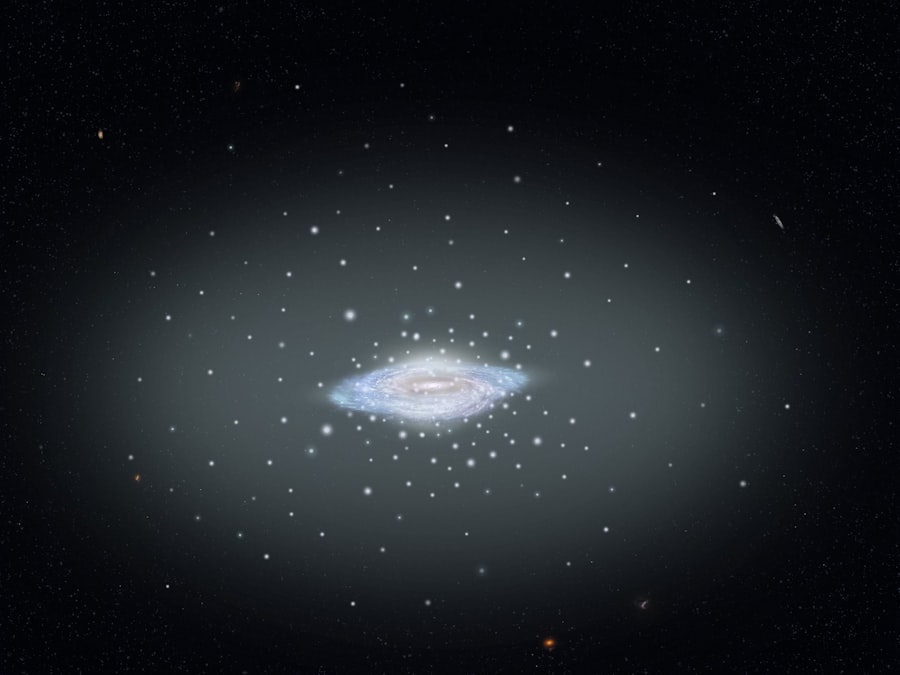
While dark energy is often highlighted in discussions about cosmic acceleration, dark matter also plays a crucial role in shaping the universe’s structure and dynamics. Dark matter is an invisible substance that does not emit or absorb light but exerts gravitational influence on visible matter. It constitutes about 27% of the universe’s total mass-energy content and is essential for explaining various astronomical phenomena.
Dark matter contributes to cosmic acceleration by influencing galaxy formation and clustering. Its gravitational pull helps bind galaxies together and affects their motion within galaxy clusters. While dark matter does not directly cause cosmic acceleration like dark energy does, its presence alters the overall dynamics of the universe, creating a complex interplay between these two enigmatic components.
Understanding how dark matter interacts with dark energy is vital for developing a comprehensive model of cosmic evolution.
Observational Evidence for Cosmic Acceleration
The evidence supporting cosmic acceleration is robust and multifaceted, stemming from various observational techniques and astronomical surveys. One of the most compelling pieces of evidence comes from Type Ia supernovae observations, which serve as standard candles for measuring cosmic distances. The dimming of these supernovae indicates that they are farther away than expected, providing direct evidence for an accelerating universe.
In addition to supernovae observations, measurements of the cosmic microwave background radiation have also contributed significantly to our understanding of cosmic acceleration. The detailed mapping of temperature fluctuations in this ancient radiation provides insights into the universe’s composition and expansion history. Furthermore, large-scale structure surveys, such as those conducted by the Sloan Digital Sky Survey (SDSS), have revealed patterns in galaxy distribution that align with predictions made by models incorporating dark energy and cosmic acceleration.
The Future of Research on Unexplained Cosmic Acceleration
As researchers continue to grapple with the implications of cosmic acceleration, future investigations are poised to deepen our understanding of this phenomenon. Upcoming astronomical missions and advancements in technology promise to provide new insights into dark energy and its role in shaping the cosmos. Projects like the Euclid space telescope and the Vera Rubin Observatory aim to map large portions of the sky with unprecedented precision, allowing scientists to probe the nature of dark energy more effectively.
Moreover, interdisciplinary collaborations between physicists, astronomers, and cosmologists will be essential for unraveling the complexities surrounding cosmic acceleration. By integrating theoretical models with observational data, researchers hope to develop a more cohesive understanding of how dark energy and dark matter interact within the framework of general relativity. The quest for answers will undoubtedly lead to new discoveries that could reshape humanity’s understanding of the universe.
The Implications of Cosmic Acceleration for the Universe
The implications of cosmic acceleration extend far beyond theoretical considerations; they fundamentally alter our understanding of the universe’s fate. If dark energy continues to dominate cosmic dynamics, it suggests a future where galaxies drift apart at an ever-increasing rate. This scenario raises profound questions about isolation and entropy in an expanding universe—will galaxies eventually become unreachable islands in an infinite void?
Furthermore, cosmic acceleration challenges traditional notions about time and space itself.
This scenario poses philosophical questions about knowledge and existence: if vast regions of space become inaccessible, what does it mean for humanity’s quest for understanding?
Alternative Explanations for Cosmic Acceleration
While dark energy remains the leading explanation for cosmic acceleration, alternative theories continue to emerge as researchers seek to explain this enigmatic phenomenon without invoking unknown forces. Some scientists propose modifications to general relativity or alternative gravity theories that could account for observed acceleration without requiring dark energy. One such alternative is known as “modified Newtonian dynamics” (MOND), which suggests that gravity behaves differently at low accelerations than predicted by Newtonian physics or general relativity.
While MOND has garnered attention for explaining certain galactic phenomena without invoking dark matter or dark energy, it struggles to account for large-scale structures and cosmic expansion observed on greater scales. Another avenue being explored involves quantum effects on spacetime itself—some theorists suggest that quantum fluctuations could lead to an effective repulsive force on cosmological scales similar to dark energy’s effects. However, these ideas remain speculative and require further investigation before gaining traction within mainstream cosmology.
Conclusion and Summary of Unexplained Cosmic Acceleration
In conclusion, cosmic acceleration represents one of the most profound mysteries in modern cosmology, challenging established paradigms and prompting new lines of inquiry into the nature of our universe. The discovery that galaxies are receding from one another at an accelerating rate has led scientists down a path filled with questions about dark energy, dark matter, and fundamental forces governing cosmic dynamics. As researchers continue their quest for understanding, they are not only unraveling the complexities surrounding cosmic acceleration but also redefining humanity’s place within an ever-expanding cosmos.
The implications extend beyond scientific inquiry; they touch upon philosophical questions about existence and knowledge itself as we grapple with a universe that may forever remain partially obscured from our view. The journey into understanding cosmic acceleration is far from over; it promises new discoveries and insights that could reshape our comprehension of reality itself. As scientists push forward into uncharted territories within astrophysics and cosmology, they carry with them humanity’s enduring curiosity about the cosmos—a curiosity that drives exploration and fuels our desire for knowledge about our place in this vast universe.
One of the most intriguing astrophysics anomalies in recent years is the discovery of fast radio bursts (FRBs), which are brief but intense flashes of radio waves from distant galaxies. These mysterious signals have sparked significant interest and research within the astrophysics community, as their origins remain largely unknown. For a deeper dive into the implications of these phenomena and their potential sources, you can read more in this related article on cosmic mysteries at My Cosmic Ventures.
WATCH THIS! The Object Defying Gravity: Is This Proof of Alien Technology?
FAQs
What is the biggest astrophysics anomaly?
The biggest astrophysics anomaly refers to a puzzling phenomenon or observation in the field of astrophysics that challenges our current understanding of the universe.
What are some examples of the biggest astrophysics anomalies?
Examples of the biggest astrophysics anomalies include the unexpected acceleration of the expansion of the universe, the existence of dark matter and dark energy, and the nature of fast radio bursts.
How do scientists approach the study of the biggest astrophysics anomalies?
Scientists approach the study of the biggest astrophysics anomalies by conducting observations, experiments, and theoretical modeling to gather data and test hypotheses that may explain these anomalies.
Why are the biggest astrophysics anomalies important to study?
Studying the biggest astrophysics anomalies is important because it can lead to new discoveries and advancements in our understanding of the universe, as well as potentially challenging or refining existing theories and models in astrophysics.
What are some potential implications of resolving the biggest astrophysics anomalies?
Resolving the biggest astrophysics anomalies could have significant implications for our understanding of fundamental physics, cosmology, and the nature of the universe, as well as potentially leading to new technologies and applications.