
The universe, a vast and enigmatic expanse, has captivated human imagination for centuries. It is a realm that encompasses everything from the smallest subatomic particles to the largest galaxies, presenting a tapestry of complexity and beauty. As humanity gazes into the night sky, it is met with a sense of wonder and curiosity about the origins and workings of this grand cosmos.
The universe is not merely a backdrop for human existence; it is a dynamic entity that has undergone profound transformations since its inception. Understanding the universe’s nature and its self-creation is essential for grasping humanity’s place within it. In recent decades, advancements in technology and scientific inquiry have propelled our understanding of the universe to new heights.
From the development of powerful telescopes that peer into distant galaxies to sophisticated particle accelerators that explore the fundamental building blocks of matter, humanity has made significant strides in unraveling the mysteries of the cosmos. This article aims to explore various aspects of the universe’s self-creation, delving into theories, phenomena, and implications that arise from this intricate process. By examining these elements, one can appreciate not only the universe’s grandeur but also the profound questions it raises about existence itself.
Key Takeaways
- The universe is a vast and mysterious entity that has intrigued humans for centuries.
- The Big Bang theory is the prevailing explanation for the beginning of the universe, suggesting it started as a singularity and rapidly expanded.
- Various theories of self-creation in the universe, such as the multiverse theory, propose different ways the universe may have come into existence.
- Dark matter and dark energy play crucial roles in the self-creation of the universe, influencing its expansion and evolution.
- The formation of stars, planets, and galaxies is a key aspect of the universe’s self-creation, shaping the cosmos as we know it.
The Big Bang Theory and the Beginning of the Universe
At the heart of modern cosmology lies the Big Bang Theory, a compelling explanation for the universe’s origin. According to this theory, approximately 13.8 billion years ago, the universe began as an infinitely dense point known as a singularity. This singularity underwent a rapid expansion, leading to the creation of space, time, and all matter as we know it.
The Big Bang marks a pivotal moment in cosmic history, setting in motion a series of events that would shape the universe’s structure and evolution. The evidence supporting the Big Bang Theory is robust and multifaceted. Observations of cosmic microwave background radiation, which is a remnant of the early universe, provide a snapshot of conditions shortly after the Big Bang.
Additionally, the redshift of distant galaxies indicates that the universe is still expanding, a phenomenon first noted by astronomer Edwin Hubble in the 1920s. This expansion suggests that all galaxies are moving away from each other, reinforcing the idea that they originated from a common point. The Big Bang Theory not only explains the universe’s beginnings but also serves as a foundation for understanding its subsequent development.
Theories of Self-Creation in the Universe
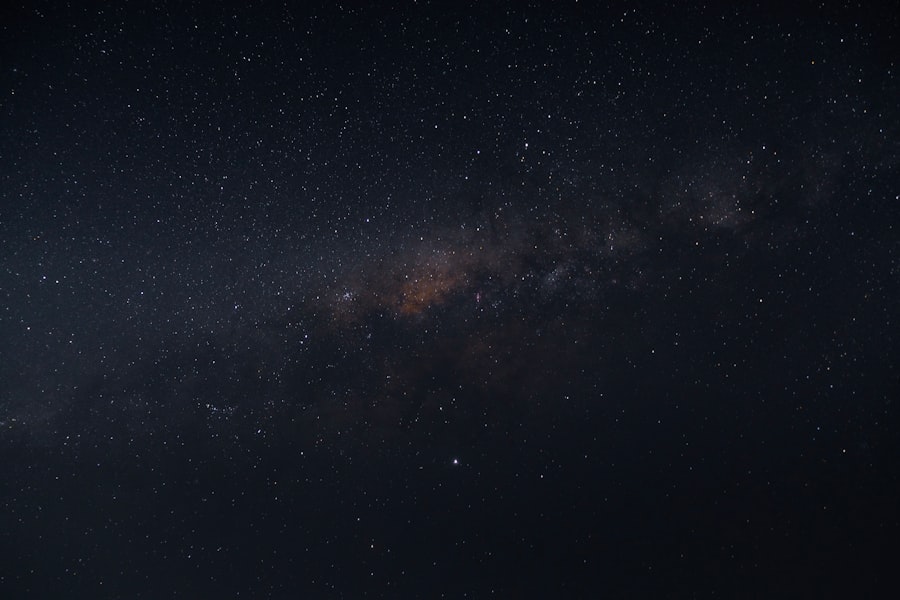
While the Big Bang Theory provides insight into how the universe began, it raises profound questions about self-creation. Various theories have emerged to address how the universe could create itself from nothing or evolve into its current state without external influence. One such theory posits that quantum fluctuations in a vacuum could give rise to particles and energy, suggesting that creation can occur spontaneously under certain conditions.
This idea challenges traditional notions of causality and existence, proposing that the universe may not require an external creator. Another intriguing perspective on self-creation comes from the concept of cyclical universes. Some theorists argue that the universe undergoes endless cycles of expansion and contraction, with each Big Bang followed by a Big Crunch.
In this model, the universe perpetually creates itself anew, suggesting an eternal process rather than a singular event. These theories invite contemplation about the nature of time and existence, prompting questions about whether the universe has always existed in some form or if it is destined to continue evolving indefinitely.
The Role of Dark Matter and Dark Energy in the Universe’s Self-Creation
| Dark Matter | Dark Energy |
|---|---|
| It makes up about 27% of the universe | It makes up about 68% of the universe |
| It interacts through gravity | It causes the universe’s expansion to accelerate |
| It is responsible for the formation of large-scale structures | It is thought to be a property of space itself |
| It has not been directly observed | It has not been directly observed |
Integral to understanding the universe’s self-creation are dark matter and dark energy—two mysterious components that constitute a significant portion of the cosmos. Dark matter, which does not emit or interact with electromagnetic radiation, is believed to account for approximately 27% of the universe’s total mass-energy content. Its presence is inferred from gravitational effects on visible matter, such as galaxies and galaxy clusters.
Dark matter plays a crucial role in shaping the structure of the universe, influencing how galaxies form and cluster together. On the other hand, dark energy is an even more enigmatic force that drives the accelerated expansion of the universe. Comprising about 68% of the universe’s energy density, dark energy acts as a repulsive force counteracting gravity on cosmic scales.
Its discovery has profound implications for theories of self-creation; if dark energy continues to dominate, it may lead to scenarios where galaxies drift apart indefinitely, altering our understanding of cosmic evolution. Together, dark matter and dark energy present a complex interplay that shapes not only the structure of the universe but also its future trajectory.
The Expansion and Evolution of the Universe
The expansion of the universe is one of its most defining characteristics, fundamentally altering its evolution over billions of years. Following the initial explosion of the Big Bang, space itself began to stretch, leading to an ever-expanding cosmos. This expansion has not only influenced how galaxies are distributed but has also affected their formation and interaction over time.
As galaxies move apart, they experience varying degrees of gravitational influence from one another, leading to complex dynamics that shape their evolution. As time progresses, this expansion continues to accelerate due to dark energy’s influence. The implications of this accelerated expansion are profound; it suggests that distant galaxies will eventually become unreachable as they recede beyond our observable horizon.
This phenomenon raises questions about isolation in an ever-expanding universe and challenges our understanding of cosmic connectivity.
The Formation of Stars, Planets, and Galaxies

Within this expansive framework lies another layer of complexity: the formation of stars, planets, and galaxies. After millions of years following the Big Bang, matter began to coalesce under gravity’s influence, leading to regions of higher density known as protogalaxies. These regions eventually gave rise to stars through nuclear fusion processes within massive clouds of gas and dust.
The birth of stars marks a significant milestone in cosmic history; they serve as factories for heavier elements through nuclear fusion, enriching their surroundings with materials necessary for planet formation. Planets emerge from these stellar nurseries as leftover material from star formation coalesces into solid bodies orbiting their parent stars. The intricate dance between gravity and angular momentum leads to diverse planetary systems with varying characteristics.
Some planets may harbor conditions suitable for life while others remain inhospitable wastelands. The formation of galaxies further complicates this picture; they are vast collections of stars bound together by gravity, often interacting with one another through mergers and collisions that can trigger new waves of star formation.
The Possibility of Multiverse and Parallel Universes
As scientists delve deeper into understanding our universe’s nature, they encounter tantalizing possibilities such as multiverses and parallel universes. The multiverse theory posits that our universe is just one among countless others—each with its own set of physical laws and constants. This idea emerges from various interpretations of quantum mechanics and string theory, suggesting that different regions of space-time could give rise to entirely distinct realities.
The implications of multiverse theories are profound; they challenge traditional notions of uniqueness and existence while raising questions about what it means for something to be “real.” If multiple universes exist simultaneously, each with its own version of reality, then humanity’s understanding of its place in the cosmos becomes even more complex. This exploration into parallel universes invites philosophical inquiries about fate, choice, and determinism—concepts that have long fascinated thinkers throughout history.
The Search for Extraterrestrial Life and its Implications for Self-Creation
The quest for extraterrestrial life represents one of humanity’s most ambitious endeavors in understanding its place within the cosmos. As scientists search for signs of life beyond Earth—whether through missions to Mars or observations of exoplanets—they grapple with profound implications regarding self-creation. If life exists elsewhere in the universe, it raises questions about how common or rare life truly is and whether it arises through similar processes across different environments.
The discovery of extraterrestrial life would fundamentally alter humanity’s perspective on existence itself; it would suggest that life is not an isolated phenomenon but rather a natural outcome within a vast cosmos teeming with possibilities. This realization could lead to new insights into self-creation—if life can emerge independently in diverse settings, what does that say about life’s inherent potential? Such discoveries would not only reshape scientific paradigms but also provoke philosophical reflections on consciousness and existence across multiple realms.
The Role of Consciousness in the Universe’s Self-Creation
Consciousness remains one of humanity’s greatest mysteries—a phenomenon that intertwines with discussions about self-creation in profound ways. Some theorists propose that consciousness itself may play an active role in shaping reality; this perspective suggests that awareness could influence physical processes at fundamental levels. This idea aligns with certain interpretations within quantum mechanics where observation appears to affect outcomes—a notion that blurs lines between observer and observed.
If consciousness indeed influences reality, it raises questions about humanity’s role within the cosmos as conscious beings capable of reflection and inquiry. Are humans mere observers or active participants in shaping their own existence? This inquiry invites deeper philosophical explorations regarding free will versus determinism while challenging conventional understandings about causality within scientific frameworks.
The Future of the Universe: Heat Death, Big Crunch, or Expansion Forever?
As scientists contemplate the future trajectory of our universe, several scenarios emerge—each with distinct implications for its ultimate fate. One possibility is heat death—a state where all energy is evenly distributed across space leading to a cold, dark cosmos devoid of activity or structure over trillions upon trillions of years. In this scenario, stars will burn out; galaxies will drift apart until nothing remains but an expanse filled with low-energy particles.
Alternatively, some theories suggest a potential Big Crunch—a reversal where gravitational forces eventually overcome expansion leading to a collapse back into singularity once again. This cyclical model implies an eternal process where creation begets destruction only for new beginnings to arise anew. Lastly, there exists speculation regarding perpetual expansion driven by dark energy—an endless journey into an increasingly empty cosmos where galaxies recede beyond reach over unimaginable timescales.
The Universe’s Self-Creation and its Implications for Humanity
In contemplating the universe’s self-creation journey—from its explosive beginnings through intricate formations to potential futures—humanity finds itself at a crossroads between science and philosophy. Each discovery unveils layers upon layers revealing not only how existence came into being but also what it means for conscious beings navigating this vast expanse. As humanity continues exploring these profound questions surrounding self-creation—whether through scientific inquiry or philosophical reflection—it becomes increasingly clear that understanding one’s place within such grandeur carries immense significance.
The quest for knowledge transcends mere curiosity; it embodies an innate desire to connect with something greater than oneself—a yearning echoed throughout history as civilizations sought meaning amidst stars illuminating their night skies. Ultimately, grappling with these concepts invites deeper introspection about existence itself—challenging individuals not only to ponder their origins but also their responsibilities within this intricate web woven by time and space—a tapestry where every thread contributes uniquely towards shaping reality itself.
A particularly intriguing article that complements this topic can be found on My Cosmic Ventures. This article delves into various theories and perspectives about the universe’s inception, offering insights that could enrich your understanding of this complex subject. For a deeper exploration, you can read more about these cosmic mysteries by visiting this article on My Cosmic Ventures.
WATCH THIS! How a Quantum Loophole Sparked Everything: The Universe Born From Nothing, Explained
FAQs
What is the concept of the universe creating itself?
The concept of the universe creating itself refers to the idea that the universe could have originated from nothing, without the need for a creator or external cause.
Is there scientific evidence to support the idea of the universe creating itself?
Currently, there is no scientific evidence to support the idea of the universe creating itself. The origins of the universe are still a topic of ongoing scientific research and debate.
What are some theories about the origin of the universe?
Some theories about the origin of the universe include the Big Bang theory, which suggests that the universe began as a hot, dense point and has been expanding ever since, and the multiverse theory, which proposes the existence of multiple universes.
Can the universe create itself according to the laws of physics?
According to the current understanding of the laws of physics, it is not possible for the universe to create itself. The laws of physics describe the behavior of matter and energy within the universe, but do not provide a mechanism for the universe to self-generate.
What are some religious perspectives on the origin of the universe?
Many religious traditions have creation stories that describe the origin of the universe as the result of a divine act or the work of a higher power. These perspectives often differ from scientific explanations of the universe’s origins.