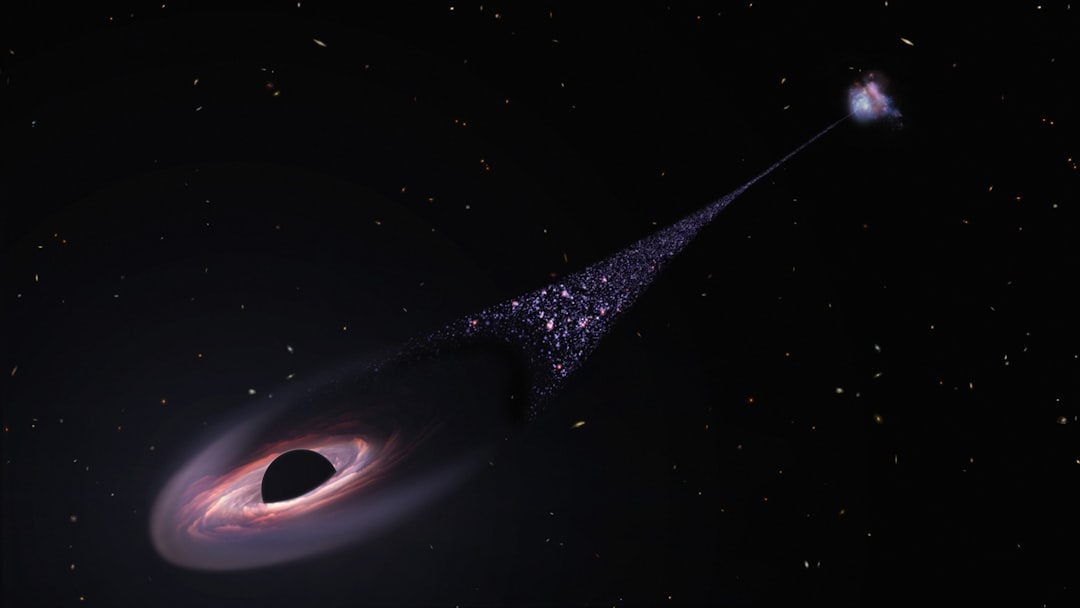
Black holes have long captivated the imagination of scientists and the general public alike, serving as a profound enigma within the realm of astrophysics. These cosmic phenomena, characterized by their immense gravitational pull, are regions in space where the gravitational force is so strong that nothing, not even light, can escape from them. The concept of a black hole challenges the very fabric of our understanding of physics, pushing the boundaries of what is known about the universe.
As researchers delve deeper into the mysteries surrounding black holes, they uncover not only their fascinating properties but also their significant role in the cosmos. The allure of black holes lies not only in their mysterious nature but also in their implications for our understanding of time, space, and the fundamental laws of physics. From the moment they were theorized in the early 20th century, black holes have sparked a plethora of questions regarding their existence, formation, and impact on the universe.
As scientists continue to explore these enigmatic entities, they reveal a complex interplay between gravity, light, and matter that challenges conventional wisdom and invites further inquiry into the nature of reality itself.
Key Takeaways
- Black holes form from collapsed massive stars and possess intense gravitational pull.
- The event horizon marks the boundary beyond which nothing can escape a black hole.
- Black holes significantly affect surrounding matter, often pulling in gas and dust.
- They cause extreme time dilation effects near their event horizons.
- Ongoing research continues to uncover the mysteries and cosmic roles of black holes.
Formation and Characteristics of Black Holes
Black holes are formed through various processes, primarily stemming from the life cycles of massive stars. When a star exhausts its nuclear fuel, it undergoes a dramatic collapse under its own gravity. For stars with sufficient mass, this collapse can lead to the formation of a black hole.
The core implodes, while the outer layers may explode in a supernova, leaving behind a dense remnant that warps spacetime to such an extent that it creates a black hole. This process highlights the intricate relationship between stellar evolution and black hole formation, illustrating how these cosmic giants emerge from the remnants of once-vibrant stars. In addition to stellar black holes, which form from collapsing stars, there are also supermassive black holes that reside at the centers of galaxies.
These behemoths can contain millions to billions of times the mass of our Sun and are believed to have formed through a combination of processes, including the merging of smaller black holes and the accretion of gas and stars over billions of years. Regardless of their origin, black holes share common characteristics: they possess an event horizon, beyond which nothing can escape their gravitational grip, and a singularity at their core, where density becomes infinite and the laws of physics as we know them cease to apply.
The Gravitational Pull of Black Holes
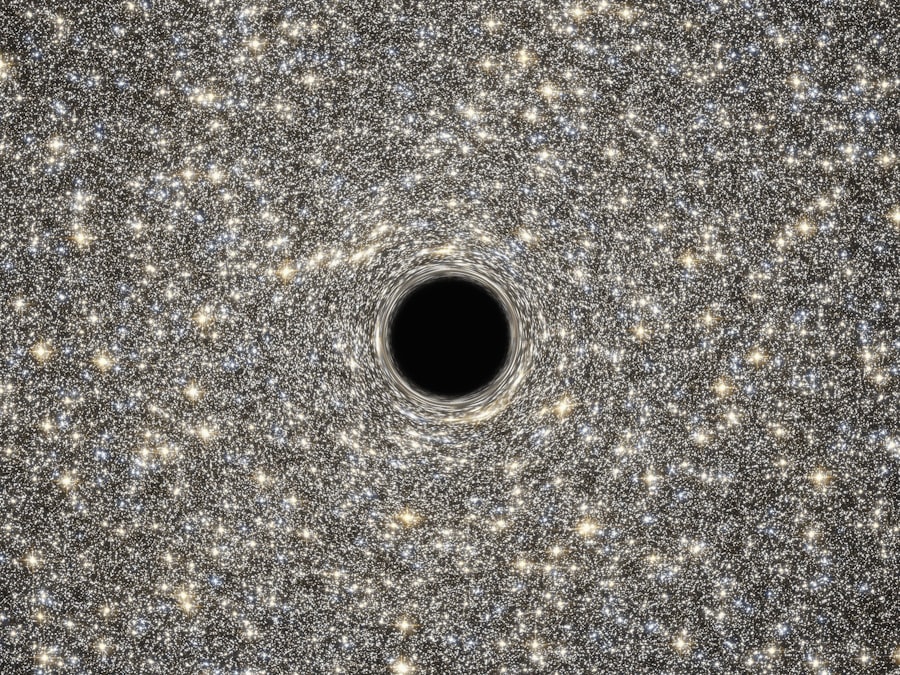
The gravitational pull exerted by black holes is one of their most defining features. This force is so powerful that it can influence the motion of nearby stars and even entire galaxies.
This phenomenon can be observed in various astronomical settings, where stars orbiting an invisible mass indicate the presence of a black hole. The gravitational influence extends far beyond the event horizon, affecting objects that venture too close to its vicinity. The effects of this gravitational pull can be both fascinating and destructive.
As matter spirals toward a black hole, it forms an accretion disk—a swirling mass of gas and dust that heats up due to friction and emits intense radiation.
The gravitational pull can also lead to tidal forces that stretch and compress objects as they approach the event horizon, a phenomenon known as spaghettification.
This dramatic effect serves as a stark reminder of the extreme conditions surrounding black holes and underscores their role as some of the most powerful forces in the universe.
The Event Horizon and Singularity
| Metric | Description | Typical Values | Notes |
|---|---|---|---|
| Event Horizon Radius (Schwarzschild Radius) | The radius defining the boundary beyond which nothing can escape a black hole | For a non-rotating black hole: \( r_s = \frac{2GM}{c^2} \) | Depends on black hole mass (M); G = gravitational constant, c = speed of light |
| Mass (M) | Mass of the black hole | Stellar black holes: 3–20 solar masses Supermassive black holes: millions to billions of solar masses |
Determines size of event horizon and gravitational effects |
| Singularity | Point at the center of a black hole where density is infinite and spacetime curvature is infinite | Radius = 0 (theoretical) | Classical physics breaks down; quantum gravity effects expected |
| Escape Velocity at Event Horizon | Velocity needed to escape gravitational pull at event horizon | Equal to speed of light (c ≈ 3 × 10^8 m/s) | Defines the event horizon boundary |
| Time Dilation at Event Horizon | Gravitational time dilation experienced near event horizon | Tends to infinity as approaching event horizon | External observer sees infalling object slow down and freeze at horizon |
| Surface Gravity (κ) | Acceleration due to gravity at the event horizon | For Schwarzschild black hole: \( \kappa = \frac{c^4}{4GM} \) | Related to black hole temperature via Hawking radiation |
| Hawking Temperature (T_H) | Black hole temperature due to quantum effects near event horizon | \( T_H = \frac{\hbar c^3}{8 \pi G M k_B} \) | Inversely proportional to mass; very low for astrophysical black holes |
At the heart of every black hole lies a boundary known as the event horizon. This critical threshold marks the point beyond which no information or matter can escape the black hole’s grasp. Once an object crosses this boundary, it is irrevocably drawn into the singularity—a point where density becomes infinite and spacetime curves infinitely.
The event horizon serves as a one-way barrier; while it is possible for light and matter to approach it, crossing this threshold leads to an inescapable fate. The singularity itself remains one of the greatest mysteries in modern physics. It represents a breakdown in our understanding of the laws governing space and time.
Current theories suggest that at this point, conventional physics fails to provide answers, leading to speculation about what occurs within a black hole. Some physicists propose that quantum mechanics may play a role in understanding singularities, while others suggest that new theories are needed to reconcile general relativity with quantum physics. The nature of singularities continues to be a topic of intense debate and research, highlighting the complexities inherent in studying these cosmic enigmas.
The Impact of Black Holes on Surrounding Matter
Black holes exert profound effects on their surroundings, influencing both nearby stars and interstellar matter. As matter falls into a black hole, it releases energy in the form of radiation, often resulting in powerful jets that can extend far beyond the event horizon. These jets are composed of high-energy particles that are ejected at nearly the speed of light and can have significant consequences for their environment.
They can trigger star formation in nearby regions or disrupt existing stellar systems. Moreover, black holes play a crucial role in galactic evolution. Supermassive black holes at the centers of galaxies are thought to regulate star formation by controlling the flow of gas and dust within their host galaxies.
Their immense gravitational pull can create dynamic interactions between stars and gas clouds, shaping the structure and behavior of galaxies over cosmic timescales. This interplay between black holes and their surroundings underscores their importance in understanding not only individual celestial bodies but also the broader dynamics of galactic systems.
Theoretical and Observational Studies of Black Holes
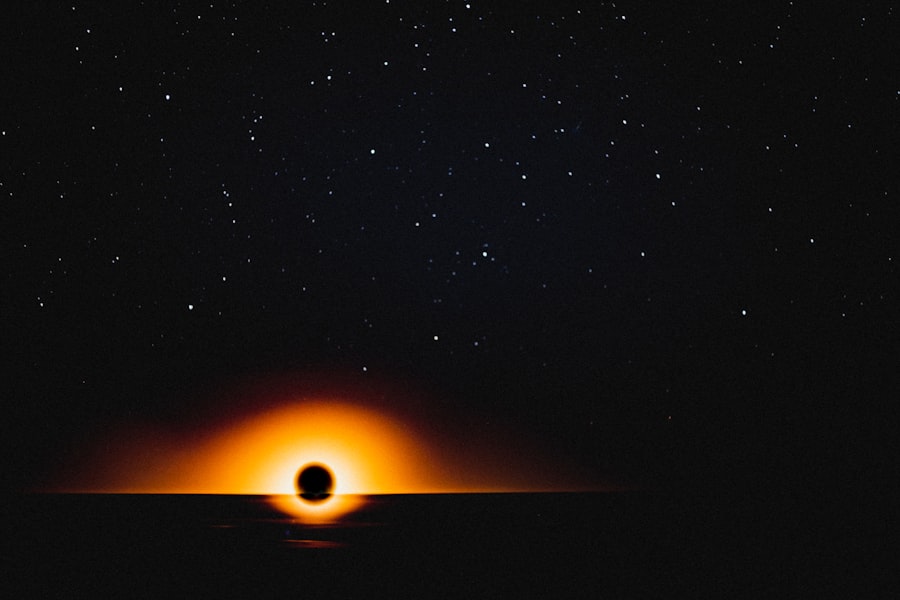
The study of black holes has evolved significantly over recent decades, driven by both theoretical advancements and observational breakthroughs. Theoretical physicists have developed models to describe black hole behavior, including Hawking radiation—a concept proposed by Stephen Hawking that suggests black holes can emit radiation due to quantum effects near the event horizon. This groundbreaking idea has opened new avenues for understanding black holes and their potential interactions with other forms of matter.
On the observational front, advancements in technology have allowed astronomers to gather compelling evidence for the existence of black holes. The Event Horizon Telescope (EHT) collaboration made headlines in 2019 when it captured the first-ever image of a black hole’s shadow in the galaxy M87. This monumental achievement provided direct visual evidence supporting theoretical predictions about black holes and marked a significant milestone in astrophysics.
Ongoing observational campaigns continue to refine our understanding of these enigmatic objects, revealing new insights into their properties and behaviors.
The Role of Black Holes in the Universe
Black holes are not merely cosmic oddities; they play an integral role in shaping the universe as we know it. Their influence extends beyond individual galaxies; they are thought to be key players in cosmic evolution on large scales. Supermassive black holes at galactic centers may regulate star formation rates within galaxies, impacting their growth and development over billions of years.
This relationship suggests that black holes are intertwined with the lifecycle of galaxies themselves. Furthermore, black holes may contribute to our understanding of dark matter and dark energy—two mysterious components that make up most of the universe’s mass-energy content. Some theories propose that interactions between black holes and dark matter could shed light on these elusive phenomena.
As researchers continue to explore these connections, they uncover new layers of complexity regarding how black holes fit into the broader cosmic tapestry.
The Dangers of Black Holes
While black holes are fascinating objects for study, they also pose significant dangers for any matter that ventures too close to them. The immense gravitational forces exerted by black holes can lead to catastrophic consequences for nearby celestial bodies. Stars that stray too close may be torn apart by tidal forces—a process known as spaghettification—resulting in their destruction before they can escape.
Additionally, if a black hole were to pass through our solar system or come too close to Earth, it could have dire implications for planetary stability and safety. While such events are exceedingly rare on cosmic timescales, they serve as a reminder that these enigmatic entities possess immense power capable of reshaping entire systems. Understanding these dangers is crucial for comprehending not only black holes themselves but also their potential impact on surrounding environments.
Black Holes and Time Dilation
One of the most intriguing aspects of black holes is their relationship with time dilation—a phenomenon predicted by Einstein’s theory of relativity. As an object approaches a black hole’s event horizon, time appears to slow down relative to an outside observer. This effect arises from the intense gravitational field surrounding a black hole, which warps spacetime itself.
For an observer falling into a black hole, time would seem to pass normally; however, for someone watching from a distance, it would appear as though time is stretching infinitely as they approach the event horizon. This paradoxical nature raises profound questions about perception and reality within extreme gravitational fields. It challenges our understanding of time itself and invites further exploration into how gravity influences temporal experiences across different frames of reference.
The Future of Black Hole Research
As technology advances and our understanding deepens, the future of black hole research holds great promise for uncovering new insights into these enigmatic entities. Upcoming missions such as NASA’s James Webb Space Telescope aim to explore distant galaxies and potentially observe supermassive black holes in unprecedented detail. These observations could provide valuable data on how black holes interact with their environments and contribute to cosmic evolution.
Moreover, ongoing theoretical work seeks to reconcile general relativity with quantum mechanics—an endeavor that could revolutionize our understanding of singularities and their implications for fundamental physics. As researchers continue to push boundaries in both observational astronomy and theoretical physics, they remain hopeful that new discoveries will shed light on some of the most profound questions surrounding black holes.
The Ongoing Mystery of Black Holes
In conclusion, black holes remain one of the most captivating mysteries in modern astrophysics. Their formation processes, gravitational effects, and interactions with surrounding matter reveal complex dynamics that challenge our understanding of fundamental physics. As researchers continue to explore these enigmatic entities through both theoretical models and observational studies, they uncover new layers of complexity regarding their role in shaping galaxies and influencing cosmic evolution.
The ongoing quest to understand black holes not only enriches our knowledge about these fascinating objects but also invites deeper inquiries into the nature of reality itself. As scientists strive to unravel these mysteries, they remind us that while we have made significant strides in understanding our universe, many questions remain unanswered—leaving room for wonderment and exploration in this vast cosmic landscape.
Recent research has shed light on the intriguing nature of black holes, suggesting that they are not as smooth as once thought. This challenges the traditional view of black holes as perfectly spherical entities. For a deeper understanding of this topic, you can read more in the article available at My Cosmic Ventures.
WATCH THIS! The Paradox That Broke Physics: Quantum vs. Black Holes
FAQs
What does it mean that black holes are not smooth?
Black holes are often depicted as perfectly smooth and spherical objects, but in reality, their event horizons can have irregularities and fluctuations due to quantum effects, gravitational waves, and interactions with surrounding matter. This means the surface of a black hole is not perfectly smooth.
Why are black holes traditionally thought to be smooth?
According to classical general relativity, black holes are described by the “no-hair theorem,” which states that black holes can be completely characterized by just three parameters: mass, charge, and angular momentum. This leads to the idea of a smooth, featureless event horizon.
What causes the irregularities on a black hole’s surface?
Quantum effects, such as Hawking radiation, and the dynamic nature of spacetime near a black hole can cause fluctuations. Additionally, infalling matter and gravitational waves can distort the event horizon, making it less smooth than classical models suggest.
How do scientists study the surface of black holes?
Scientists use theoretical models, computer simulations, and observations of phenomena like gravitational waves and black hole shadows (e.g., from the Event Horizon Telescope) to infer properties of black holes, including the nature of their event horizons.
Do these irregularities affect the black hole’s behavior?
While the overall gravitational pull of a black hole remains dominant, surface irregularities can influence the emission of radiation, the dynamics of accretion disks, and the way black holes merge or interact with their environment.
Is the concept of a “smooth” black hole outdated?
The classical idea of a perfectly smooth black hole is being refined as new research in quantum gravity and astrophysics reveals more complex structures and behaviors at the event horizon, suggesting that black holes are more dynamic and less uniform than once thought.
What implications do non-smooth black holes have for physics?
Understanding the irregularities of black holes can provide insights into quantum gravity, the nature of spacetime, and the unification of general relativity with quantum mechanics, potentially leading to new physics beyond current theories.