
The event horizon stands as one of the most intriguing and enigmatic concepts in modern astrophysics. It represents a boundary in spacetime, beyond which events cannot affect an outside observer. This threshold is most commonly associated with black holes, where the gravitational pull becomes so intense that nothing, not even light, can escape its grasp.
The event horizon serves as a critical point of no return, marking the limits of our understanding of the universe’s most extreme phenomena. As scientists delve deeper into the mysteries of black holes, the event horizon emerges as a focal point for both theoretical exploration and observational study. The fascination with the event horizon extends beyond its scientific implications; it also captivates the imagination of the public.
The idea that there exists a region in space where the laws of physics as we know them break down invites both awe and curiosity. As researchers continue to unravel the complexities surrounding black holes and their event horizons, they not only enhance our comprehension of the cosmos but also challenge our fundamental notions of reality. This article aims to explore the multifaceted nature of the event horizon, its relationship with gravity, its role in general relativity, and its implications for future space exploration.
Key Takeaways
- The event horizon marks the boundary around a black hole beyond which nothing can escape, crucial to understanding black holes.
- It plays a key role in general relativity by defining the limits of gravitational influence and spacetime curvature.
- Observing event horizons helps scientists study black hole properties and test fundamental physics theories.
- The event horizon is central to unresolved issues like the information paradox and links to quantum mechanics and Hawking radiation.
- Ongoing research on event horizons advances astrophysics and informs future space exploration efforts.
Understanding Black Holes and their Event Horizons
To grasp the significance of the event horizon, one must first understand black holes themselves. A black hole is formed when a massive star exhausts its nuclear fuel and collapses under its own gravity. This collapse leads to an incredibly dense region in space where the gravitational pull is so strong that nothing can escape from it.
The boundary surrounding this region is known as the event horizon. It is not a physical surface but rather a mathematical construct that delineates the point at which escape becomes impossible. The event horizon varies depending on the mass of the black hole.
For instance, a stellar black hole, formed from a single collapsing star, has a smaller event horizon compared to a supermassive black hole found at the centers of galaxies. These supermassive black holes can have event horizons that span millions or even billions of kilometers. Understanding these differences is crucial for astrophysicists as they study the formation and evolution of black holes across the universe.
The event horizon thus serves as a key indicator of a black hole’s characteristics and behavior.
The Relationship Between the Event Horizon and Gravity

Gravity plays a pivotal role in shaping the event horizon and defining its properties. According to Einstein’s theory of general relativity, gravity is not merely a force but a curvature of spacetime caused by mass. When a massive object like a black hole distorts spacetime, it creates a gravitational well from which nothing can escape once it crosses the event horizon.
This relationship between gravity and the event horizon highlights how fundamental forces govern cosmic structures. The strength of gravity near an event horizon is so intense that it leads to fascinating phenomena such as time dilation. For an observer far from a black hole, time appears to pass normally; however, as one approaches the event horizon, time slows down significantly relative to an outside observer.
This effect raises profound questions about the nature of time itself and how it interacts with gravity in extreme environments. The interplay between gravity and the event horizon thus not only shapes our understanding of black holes but also challenges our perceptions of time and space.
The Role of the Event Horizon in the Theory of General Relativity
| Metric | Description | Value/Range | Relevance to Event Horizon |
|---|---|---|---|
| Schwarzschild Radius (Rs) | Radius defining the event horizon for a non-rotating black hole | Rs = 2GM/c² (depends on mass M) | Determines the size of the event horizon |
| Mass (M) | Mass of the black hole | Varies (stellar mass to supermassive) | Directly proportional to event horizon radius |
| Surface Gravity (κ) | Gravitational acceleration at the event horizon | κ = c⁴/(4GM) for Schwarzschild black hole | Relates to temperature and radiation of event horizon |
| Hawking Temperature (T_H) | Temperature of black hole radiation at event horizon | T_H = ħc³/(8πGMk_B) | Shows quantum effects at event horizon |
| Event Horizon Area (A) | Surface area of the event horizon | A = 4πRs² | Used in black hole entropy calculations |
| Black Hole Entropy (S) | Entropy proportional to event horizon area | S = k_Bc³A/(4ħG) | Links thermodynamics and gravity at event horizon |
| Escape Velocity at Event Horizon | Velocity needed to escape gravitational pull | Equal to speed of light (c) | Defines the boundary of no return |
The event horizon is deeply embedded in the framework of general relativity, which revolutionized our understanding of gravity over a century ago. Einstein’s equations describe how mass influences spacetime, leading to predictions about the existence of black holes and their associated event horizons. These predictions have been confirmed through various astronomical observations, solidifying general relativity’s status as one of the cornerstones of modern physics.
In this context, the event horizon serves as a critical boundary that separates observable phenomena from those that remain hidden from view. It embodies the limitations imposed by general relativity on our ability to gather information about what lies beyond it. As researchers continue to test and refine Einstein’s theories, they find that understanding the event horizon is essential for exploring concepts such as gravitational waves and cosmic inflation.
The event horizon thus acts as both a theoretical construct and a practical tool for advancing our knowledge of the universe.
Observing and Detecting Event Horizons
Detecting event horizons presents significant challenges due to their elusive nature. Since light cannot escape from within this boundary, direct observation is impossible. However, scientists have developed innovative methods to infer their presence through indirect means.
One prominent technique involves observing the behavior of matter and radiation in close proximity to black holes. By studying accretion disks—disks of gas and dust spiraling into a black hole—researchers can gather valuable data about the dynamics occurring near the event horizon. In 2019, astronomers achieved a groundbreaking milestone by capturing an image of a black hole’s shadow using the Event Horizon Telescope (EHT).
This image provided compelling evidence for the existence of event horizons and offered insights into their properties. The EHT’s ability to combine data from multiple radio telescopes around the world allowed scientists to create a high-resolution image that revealed the silhouette of a supermassive black hole at the center of the galaxy M87. Such advancements in observational techniques continue to enhance our understanding of event horizons and their role in shaping cosmic structures.
The Information Paradox and the Event Horizon
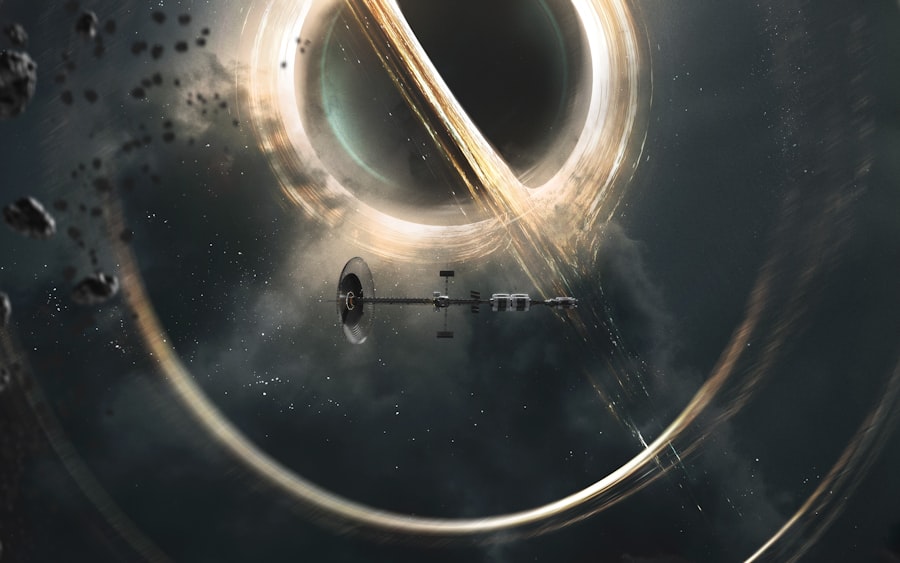
One of the most perplexing issues surrounding event horizons is known as the information paradox. This paradox arises from a conflict between quantum mechanics and general relativity regarding what happens to information when it crosses an event horizon. According to quantum theory, information cannot be destroyed; however, if something falls into a black hole, it seems to vanish beyond the event horizon, leading to questions about whether information is truly lost forever.
This dilemma has sparked intense debate among physicists, with various proposed solutions attempting to reconcile these conflicting theories. Some suggest that information may be preserved in some form on the event horizon itself, while others propose that it could be emitted as Hawking radiation—a theoretical prediction made by physicist Stephen Hawking. The information paradox remains one of the most significant challenges in theoretical physics, prompting ongoing research into how these fundamental principles can coexist.
The Event Horizon and Quantum Mechanics
The intersection between event horizons and quantum mechanics opens up new avenues for exploration in theoretical physics. Quantum mechanics introduces concepts such as superposition and entanglement, which challenge classical notions of reality. When applied to black holes and their event horizons, these principles raise intriguing questions about how quantum effects might influence gravitational phenomena.
One area of interest is how quantum fluctuations near an event horizon could lead to observable consequences. For instance, Hawking radiation suggests that particle-antiparticle pairs can form near the event horizon, with one particle escaping while its counterpart falls into the black hole. This process implies that black holes are not entirely black; they emit radiation over time, potentially leading to their eventual evaporation.
Understanding these quantum effects at play near an event horizon could provide crucial insights into unifying general relativity with quantum mechanics—a long-sought goal in physics.
The Connection Between the Event Horizon and Hawking Radiation
Hawking radiation represents one of the most fascinating implications of black hole physics and its connection to event horizons. Proposed by Stephen Hawking in 1974, this phenomenon suggests that black holes can emit radiation due to quantum effects occurring at their event horizons. As mentioned earlier, this process involves virtual particle pairs forming near the boundary; if one particle escapes while its partner falls into the black hole, it results in a net loss of mass for the black hole over time.
The implications of Hawking radiation are profound, as they suggest that black holes are not eternal entities but rather dynamic objects that can lose mass and eventually evaporate completely. This revelation has significant consequences for our understanding of cosmic evolution and challenges traditional views on black hole permanence. As researchers continue to investigate Hawking radiation and its relationship with event horizons, they uncover new layers of complexity within these enigmatic structures.
The Role of the Event Horizon in Astrophysics
In astrophysics, understanding event horizons is crucial for deciphering various cosmic phenomena. They play a vital role in shaping galaxy formation and evolution, influencing how matter interacts with gravitational fields on both large and small scales. Supermassive black holes at galactic centers are believed to regulate star formation within their host galaxies through their immense gravitational influence.
By examining how matter behaves near these boundaries, astrophysicists can test theories related to gravity, thermodynamics, and quantum mechanics in ways that push the boundaries of human knowledge. The ongoing exploration of event horizons thus serves as a gateway to understanding not only black holes but also broader questions about the nature of reality itself.
The Event Horizon and the Future of Space Exploration
As humanity looks toward future space exploration endeavors, understanding event horizons will be paramount for navigating regions influenced by extreme gravitational forces. Missions aimed at studying black holes or exploring regions near them will require advanced technologies capable of withstanding intense gravitational fields and radiation environments. Additionally, insights gained from studying event horizons may inform future theories about traversable wormholes or other speculative concepts related to faster-than-light travel.
The Continued Study and Importance of the Event Horizon in Physics
The study of event horizons remains an essential pursuit within physics, offering profound insights into some of nature’s most mysterious phenomena. As researchers continue to explore their implications across various fields—from astrophysics to quantum mechanics—the significance of these boundaries becomes increasingly apparent. They serve not only as markers delineating regions beyond which information cannot escape but also as gateways into understanding fundamental questions about reality itself.
As technology advances and observational techniques improve, scientists are poised to uncover even more about these enigmatic structures in the universe. The ongoing investigation into event horizons promises to deepen humanity’s comprehension of cosmic phenomena while challenging existing paradigms within physics. Ultimately, this journey into understanding event horizons reflects humanity’s enduring quest for knowledge about our place in an ever-expanding universe.
The event horizon plays a crucial role in our understanding of black holes and the nature of spacetime. It serves as the boundary beyond which nothing can escape the gravitational pull of a black hole, fundamentally altering our perception of physics. For a deeper exploration of this fascinating topic, you can read more in the article available at this link.
WATCH THIS! The Paradox That Broke Physics: Quantum vs. Black Holes
FAQs
What is an event horizon in physics?
An event horizon is a boundary in spacetime beyond which events cannot affect an outside observer. It is most commonly associated with black holes, marking the point at which the gravitational pull becomes so strong that nothing, not even light, can escape.
Why is the event horizon important in the study of black holes?
The event horizon defines the “point of no return” around a black hole. It helps physicists understand the limits of observable phenomena and plays a crucial role in theories about black hole thermodynamics, information paradoxes, and quantum gravity.
Can anything escape from inside the event horizon?
According to classical physics, nothing can escape from inside the event horizon because the escape velocity exceeds the speed of light. However, quantum effects such as Hawking radiation suggest that black holes can emit radiation, but this originates just outside the event horizon.
How does the event horizon relate to the concept of time?
Near the event horizon, time dilation effects become extreme due to intense gravitational fields. To a distant observer, time appears to slow down for an object approaching the event horizon, effectively freezing at the boundary.
Is the event horizon a physical surface?
No, the event horizon is not a physical surface but a mathematical boundary in spacetime. It has no thickness or material substance but represents a limit beyond which information cannot escape.
Do all black holes have event horizons?
Yes, by definition, black holes possess event horizons. However, theoretical objects like naked singularities, which lack event horizons, are hypothesized but have not been observed.
How does the event horizon affect information and causality?
The event horizon limits the flow of information, as signals from inside cannot reach an outside observer. This leads to important questions in physics about information loss and the preservation of causality in black hole environments.
Can the event horizon change over time?
Yes, the size and shape of an event horizon can change, especially if the black hole gains or loses mass through accretion or evaporation processes like Hawking radiation.
What role does the event horizon play in Hawking radiation?
Hawking radiation arises from quantum effects near the event horizon, where particle-antiparticle pairs form and one particle escapes while the other falls into the black hole, causing the black hole to lose mass over time.
How is the event horizon studied or observed?
While the event horizon itself cannot be seen directly, its effects can be inferred through observations of accretion disks, gravitational waves, and phenomena like the shadow of a black hole captured by the Event Horizon Telescope.