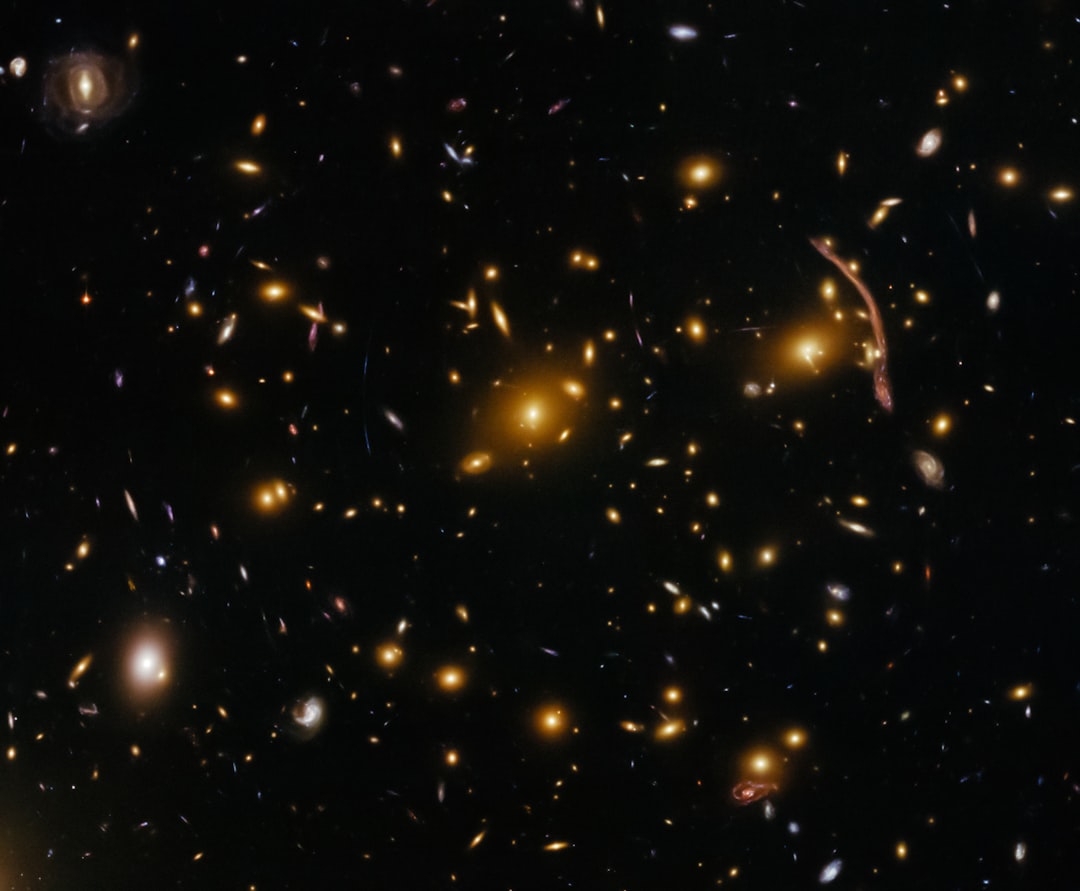
The universe, vast and enigmatic, has long captivated the minds of astronomers and physicists alike. Among its many mysteries, the phenomenon of cosmic acceleration stands out as one of the most perplexing. This acceleration refers to the observation that galaxies are moving away from each other at an increasing rate, a revelation that has profound implications for the understanding of the cosmos.
The implications of this acceleration challenge existing theories of gravity and cosmology, prompting scientists to delve deeper into the fabric of space and time. As researchers strive to unravel this mystery, they confront questions that touch upon the very nature of reality itself. The quest to comprehend the universe’s acceleration is not merely an academic exercise; it holds the potential to reshape humanity’s understanding of existence.
The discovery of this acceleration has led to the introduction of concepts such as dark energy, a mysterious force that appears to drive this expansion. As scientists continue to investigate the underlying mechanisms behind cosmic acceleration, they are not only seeking answers but also exploring the fundamental laws that govern the universe. This article will explore the historical context, discoveries, and ongoing research surrounding the mystery of cosmic acceleration, shedding light on one of the most significant challenges in modern astrophysics.
Key Takeaways
- The universe’s accelerated expansion was discovered through observations of distant supernovae.
- Dark energy is the mysterious force driving this cosmic acceleration.
- Multiple theoretical models attempt to explain the nature of dark energy, but none are conclusive.
- Observational evidence from cosmic microwave background and galaxy surveys supports the acceleration phenomenon.
- Understanding dark energy is crucial for predicting the ultimate fate of the universe.
Historical Background of Cosmic Expansion
The concept of an expanding universe traces its roots back to the early 20th century when astronomers began to observe the redshift of distant galaxies. Edwin Hubble’s groundbreaking work in 1929 provided the first empirical evidence for this expansion, demonstrating that galaxies were receding from Earth at speeds proportional to their distances. This observation led to the formulation of Hubble’s Law, which posited that the universe was not static but rather dynamic and ever-changing.
The implications of Hubble’s findings were profound, suggesting that the universe had a beginning—a moment known as the Big Bang. As the decades progressed, further advancements in technology and observational techniques allowed astronomers to refine their understanding of cosmic expansion.
However, it wasn’t until the late 1990s that a new chapter in this narrative unfolded. Observations of distant supernovae revealed an unexpected twist: not only was the universe expanding, but this expansion was accelerating. This revelation prompted a reevaluation of existing cosmological models and set the stage for the exploration of dark energy.
The Discovery of Dark Energy

The late 1990s marked a pivotal moment in cosmology with the discovery of dark energy, a term coined to describe the unknown force driving the accelerated expansion of the universe. Two independent teams of astronomers, utilizing Type Ia supernovae as standard candles for measuring cosmic distances, made this groundbreaking discovery. Their findings indicated that distant supernovae were dimmer than expected, suggesting that they were farther away than previously thought.
This unexpected result led to the conclusion that an unknown energy permeated space, counteracting gravitational forces and causing galaxies to accelerate away from one another. The implications of dark energy were staggering. It became apparent that this mysterious force constituted approximately 68% of the total energy density of the universe, overshadowing both ordinary matter and dark matter.
The realization that most of the universe was composed of something entirely unknown sparked intense interest and debate within the scientific community. Researchers began to explore various theoretical frameworks to explain dark energy’s nature and its role in cosmic evolution. As scientists delved deeper into this enigma, they faced numerous challenges in reconciling dark energy with established theories of physics.
The Nature of Dark Energy
Despite extensive research, the true nature of dark energy remains elusive. Various hypotheses have been proposed to explain its properties and behavior, yet none have garnered universal acceptance. One prominent theory suggests that dark energy is a cosmological constant—a uniform energy density that fills space homogeneously.
This idea was initially introduced by Albert Einstein in his equations of general relativity but was later abandoned when it appeared unnecessary. However, with the advent of dark energy, Einstein’s cosmological constant has regained attention as a potential explanation for cosmic acceleration. Another intriguing possibility is that dark energy may be dynamic rather than static, evolving over time and influencing cosmic expansion in complex ways.
Some researchers propose models involving scalar fields or modifications to general relativity itself. These theories suggest that dark energy could vary across space and time, leading to different rates of expansion in different regions of the universe. As scientists continue to investigate these possibilities, they grapple with fundamental questions about the nature of space, time, and gravity itself.
The Role of Dark Energy in Cosmic Acceleration
| Metric | Value/Estimate | Explanation |
|---|---|---|
| Hubble Constant (H₀) | 67.4 – 74 km/s/Mpc | Rate of expansion of the universe; discrepancies in measurements suggest new physics |
| Dark Energy Density (Ω_Λ) | ~0.68 (68%) | Fraction of total energy density attributed to dark energy causing acceleration |
| Deceleration Parameter (q₀) | Approximately -0.55 | Negative value indicates accelerating expansion |
| Equation of State Parameter (w) | Approximately -1 | Ratio of pressure to energy density for dark energy; w = -1 corresponds to cosmological constant |
| Redshift of Transition (z_t) | ~0.5 – 0.7 | Epoch when universe switched from decelerating to accelerating expansion |
| Cosmic Microwave Background (CMB) Anisotropies | Measured with precision by Planck satellite | Provide constraints on cosmological parameters including dark energy |
| Supernova Type Ia Observations | Distance measurements up to z ~ 1.5 | Key evidence for accelerating expansion through luminosity-distance relation |
Dark energy plays a crucial role in understanding cosmic acceleration, acting as a counterbalance to gravitational forces that would otherwise slow down or halt the expansion of the universe. Its presence allows for an ever-accelerating expansion, fundamentally altering our perception of cosmic dynamics. As galaxies move apart at increasing speeds, dark energy’s influence becomes increasingly significant in shaping the large-scale structure of the universe.
The interplay between dark energy and gravity raises profound questions about the ultimate fate of the cosmos. If dark energy continues to dominate over gravitational forces, it could lead to scenarios such as the “Big Freeze,” where galaxies drift apart indefinitely until stars burn out and galaxies become isolated islands in an ever-expanding void. Alternatively, if dark energy were to change its properties or diminish over time, it could result in a deceleration of expansion or even a potential “Big Crunch,” where gravitational forces ultimately prevail and pull everything back together.
Observational Evidence for Cosmic Acceleration
The evidence supporting cosmic acceleration is robust and multifaceted, stemming from various observational techniques and astronomical phenomena. One of the most compelling pieces of evidence comes from Type Ia supernovae observations, which serve as reliable indicators of cosmic distances due to their consistent luminosity. By measuring their brightness and redshift, astronomers can infer how fast galaxies are receding from Earth and how this rate changes over time.
In addition to supernovae, observations of large-scale structures such as galaxy clusters provide further insights into cosmic acceleration. The distribution and behavior of these clusters reveal how gravity interacts with both visible and dark matter in an expanding universe. Furthermore, measurements of cosmic microwave background radiation offer a snapshot of the early universe, allowing scientists to trace its evolution and understand how dark energy has influenced its expansion over billions of years.
Together, these diverse lines of evidence paint a coherent picture of an accelerating universe driven by dark energy.
Theoretical Models of Dark Energy
Theoretical models attempting to explain dark energy are as varied as they are complex. One prominent model is quintessence, which posits that dark energy is a dynamic field with varying density throughout space and time. Unlike a cosmological constant, quintessence allows for fluctuations in energy density that could influence cosmic expansion differently at various epochs in the universe’s history.
Another intriguing approach involves modifications to general relativity itself, leading to theories such as f(R) gravity or scalar-tensor theories. These models suggest that gravity may behave differently on cosmological scales than it does locally, potentially providing alternative explanations for observed phenomena without invoking dark energy as a separate entity. Each theoretical framework presents unique challenges and opportunities for testing against observational data, driving ongoing research into understanding dark energy’s true nature.
Challenges and Controversies in Understanding Dark Energy
Despite significant progress in understanding dark energy, numerous challenges and controversies persist within the scientific community. One major issue lies in reconciling observations with theoretical predictions; discrepancies between measured values and expected outcomes can lead to confusion about dark energy’s properties. For instance, some measurements suggest variations in dark energy density over time, while others indicate it remains constant.
Additionally, debates surrounding alternative explanations for cosmic acceleration continue to fuel discussions among researchers. Some scientists argue that modifications to general relativity may provide sufficient explanations without invoking dark energy at all. These controversies highlight the complexity of cosmological research and underscore the need for continued exploration and dialogue within the scientific community.
The Future of Dark Energy Research
As technology advances and observational techniques improve, the future of dark energy research holds great promise for uncovering new insights into this enigmatic force. Upcoming missions such as NASA’s Euclid satellite and ESA’s Wide Field Infrared Survey Telescope (WFIRST) aim to map large portions of the sky with unprecedented precision, providing valuable data on galaxy distributions and cosmic structures. Moreover, advancements in gravitational wave astronomy may offer complementary insights into dark energy by probing extreme cosmic events such as black hole mergers or neutron star collisions.
By combining data from multiple sources—ranging from electromagnetic observations to gravitational waves—scientists hope to build a more comprehensive understanding of dark energy’s role in shaping our universe.
Implications of Cosmic Acceleration for the Fate of the Universe
The implications of cosmic acceleration extend far beyond theoretical musings; they fundamentally alter humanity’s understanding of the universe’s fate. If current models hold true and dark energy continues to dominate cosmic dynamics, scenarios such as an eternal expansion become increasingly plausible. In this scenario, galaxies would drift apart indefinitely until stars exhaust their nuclear fuel and fade into darkness.
Conversely, if future research reveals that dark energy behaves differently than currently understood—perhaps diminishing over time or interacting with matter in unforeseen ways—the fate of the universe could take on entirely new dimensions. Such revelations would not only reshape cosmological theories but also provoke profound philosophical questions about existence itself: What does it mean for humanity if our universe is destined for isolation or eternal expansion? These inquiries underscore how deeply intertwined scientific exploration is with existential contemplation.
The Ongoing Quest to Unravel the Mystery of Universe’s Acceleration
The mystery surrounding cosmic acceleration remains one of science’s most captivating challenges—a puzzle that intertwines observational evidence with theoretical inquiry and philosophical reflection. As researchers continue their quest to understand dark energy and its role in shaping our universe, they confront fundamental questions about existence itself while pushing the boundaries of human knowledge. While significant strides have been made since Hubble first observed an expanding universe nearly a century ago, much work remains ahead.
The ongoing exploration into dark energy promises not only to illuminate our understanding of cosmic dynamics but also to inspire future generations to ponder humanity’s place within this vast and ever-evolving cosmos. As scientists strive to unravel these mysteries, they embark on a journey that transcends mere inquiry; it is a quest for understanding that resonates deeply within humanity’s collective consciousness—a search for meaning amid the stars.
The acceleration of the universe has puzzled scientists for decades, leading to various theories about the forces at play. A related article that delves deeper into this phenomenon can be found at this link. It explores the implications of dark energy and how it contributes to the universe’s expansion, providing insights that enhance our understanding of cosmic dynamics.
FAQs
What does it mean that the universe is accelerating?
The acceleration of the universe means that the rate at which the universe is expanding is increasing over time. Instead of slowing down due to gravity, galaxies are moving away from each other faster as time passes.
How was the acceleration of the universe discovered?
The acceleration was discovered in the late 1990s through observations of distant Type Ia supernovae. These supernovae appeared dimmer than expected, indicating that the expansion of the universe was speeding up rather than slowing down.
What causes the universe to accelerate?
The leading explanation is the presence of dark energy, a mysterious form of energy that permeates all space and exerts a repulsive force, driving the accelerated expansion of the universe.
What is dark energy?
Dark energy is an unknown form of energy that makes up about 68% of the total energy content of the universe. It has a negative pressure that causes the expansion of the universe to accelerate.
Is the acceleration of the universe permanent?
Current observations suggest that the acceleration will continue indefinitely, but the ultimate fate of the universe depends on the properties of dark energy, which are still not fully understood.
How does the accelerating universe affect the future of galaxies?
As the universe accelerates, galaxies outside our local group will move away faster and eventually become unreachable, making the universe appear more isolated over time.
Are there alternative theories to dark energy explaining the acceleration?
Yes, some alternative theories include modifications to general relativity or the existence of new fields or particles, but dark energy remains the most widely accepted explanation based on current evidence.
How do scientists measure the acceleration of the universe?
Scientists use observations of distant supernovae, the cosmic microwave background radiation, and large-scale structure surveys to measure the expansion rate and its acceleration.
What role does the cosmological constant play in the universe’s acceleration?
The cosmological constant, introduced by Einstein, is a simple form of dark energy representing a constant energy density filling space uniformly, which can explain the observed acceleration.
Why is understanding the universe’s acceleration important?
Understanding the acceleration helps scientists learn about the fundamental nature of the cosmos, the fate of the universe, and the physics beyond the standard models of cosmology and particle physics.