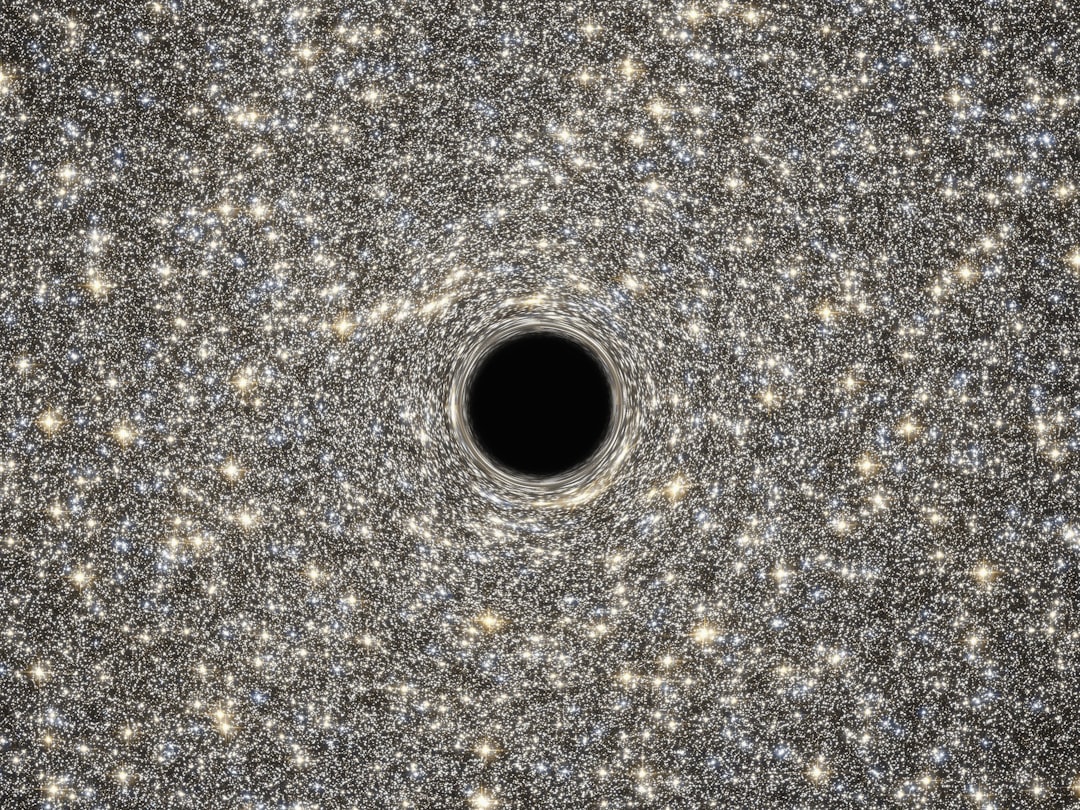
The enigmatic nature of black holes has captivated physicists for decades. These cosmic abysses, regions of spacetime exhibiting such strong gravitational effects that nothing—not even particles and electromagnetic radiation such as light—can escape from inside them, present a profound challenge to our understanding of the universe. One of the most perplexing puzzles surrounding black holes is the question of how they store information, if at all. This dilemma, deeply intertwined with the principles of quantum mechanics and general relativity, continues to drive theoretical cosmology and quantum gravity research.
The Problem of Information Loss
The standard model of black hole formation and evaporation, as described by Stephen Hawking, leads to a profound paradox concerning the fate of information.
Hawking Radiation and the Apparent Loss of Information
In 1974, Stephen Hawking theorized that black holes are not entirely black but emit a faint thermal radiation, now known as Hawking radiation. This radiation arises from quantum fluctuations near the event horizon, where particle-antiparticle pairs are constantly being created and annihilated. When such a pair forms right at the event horizon, one particle, say the positive energy one, can escape to infinity while the negative energy particle falls into the black hole. This process effectively causes the black hole to lose mass and eventually evaporate completely.
The Unitary Evolution of Quantum Mechanics
The central tenet of quantum mechanics is that information is never truly lost. This principle, known as unitarity, dictates that the evolution of a quantum system is always reversible. In essence, if one possesses a complete description of a system at one point in time, one should be able to reconstruct its past and predict its future with absolute certainty. The information content of a system, represented by its quantum state, is preserved throughout its evolution, even if it appears scrambled or encoded in a highly complex way.
The Paradox: A Contradiction of Fundamental Principles
The problem arises when considering the fate of objects that fall into a black hole. According to general relativity, anything crossing the event horizon is inexorably drawn towards the singularity, where it is ultimately crushed out of existence. If the black hole then evaporates through Hawking radiation, this radiation is thermal and appears to carry no information about the specific properties of the matter that formed the black hole or subsequently fell into it. This implies that the highly organized and specific information contained within the infalling matter vanishes completely, violating the principle of unitarity. This contradiction is known as the black hole information paradox.
Recent research has sparked intriguing discussions about how black holes might store information, challenging our understanding of physics and the nature of reality. A related article that delves deeper into this topic can be found at My Cosmic Ventures, where experts explore the implications of black hole information paradox and its potential resolutions. This exploration not only enhances our comprehension of black holes but also raises profound questions about the fundamental laws governing the universe.
Proposed Solutions and Hypotheses
The black hole information paradox has spurred numerous theoretical proposals aimed at reconciling general relativity with quantum mechanics. These solutions often venture into highly speculative realms of physics.
Firewalls and the Intense Energy Barrier
One radical proposal, put forth by several physicists, suggests the existence of a “firewall” at the event horizon. This firewall would be a region of extremely high energy density, essentially a ring of fire, that would incinerate anything attempting to cross the event horizon. If this were the case, an infalling observer would not experience the smooth passage predicted by general relativity but would instead be immediately destroyed. This scenario preserves unitarity by destroying the information at the horizon itself, preventing it from ever reaching the singularity or being lost to evaporation. However, firewalls introduce their own set of problems, primarily by violating the equivalence principle, a corner-stone of general relativity which states that gravity is indistinguishable from acceleration.
Recent studies have sparked intriguing discussions about how black holes might store information, challenging our understanding of physics and the nature of reality. For a deeper exploration of this fascinating topic, you can read an insightful article on the subject at My Cosmic Ventures. This article delves into the theories surrounding black holes and their potential role in the preservation of information, offering a glimpse into the mysteries of the universe.
Complementarity and the Observer-Dependent Reality
Another intriguing idea is black hole complementarity. This concept suggests that the information paradox arises from attempting to describe the black hole from two incompatible perspectives simultaneously: that of an outside observer and that of an infalling observer. From the perspective of an outside observer, information about objects falling into the black hole is effectively “splattered” across the event horizon, encoded in the outgoing Hawking radiation. From the perspective of an infalling observer, however, they pass through the event horizon smoothly and fall towards the singularity. Complementarity proposes that these two descriptions are both valid but mutually exclusive. One observes the information being encoded at the horizon, the other observes the smooth passage. According to this view, there is no single, unified description that can encompass both perspectives without contradiction. The information is never truly lost; it is simply perceived differently depending on the observer’s frame of reference.
Holography and the AdS/CFT Correspondence
The holographic principle, inspired by the properties of black holes, suggests that the information content of a three-dimensional region of spacetime can be entirely encoded on its two-dimensional boundary. This is analogous to a hologram where a three-dimensional image is stored on a two-dimensional surface. The Anti-de Sitter/Conformal Field Theory (AdS/CFT) correspondence, a specific realization of the holographic principle, provides a powerful tool for exploring this idea. It postulates a duality between a gravitational theory in an Anti-de Sitter space (a type of spacetime with negative curvature) and a quantum field theory living on its boundary. This correspondence suggests that a black hole in the bulk spacetime has a holographic dual description in terms of a boundary quantum field theory that is unitary. In this framework, the information seemingly lost inside the black hole is actually encoded in the boundary theory, thus preserving quantum information.
Soft Hair and the Event Horizon
Recent proposals have focused on the concept of “soft hair” on black holes. This theory posits that the event horizon of a black hole is not smooth and featureless but rather possesses a subtle, quantum imprint of the matter that has fallen into it. These “soft hairs” are quantum excitations of gravitational fields that are thought to carry information about the infalling particles. As particles fall into a black hole, their information is not lost but is instead imprinted onto the soft hair of the event horizon. This information then becomes encoded in the outgoing Hawking radiation, allowing for its eventual retrieval. This approach aims to reconcile the information paradox by demonstrating a mechanism for information to escape, even if in a highly scrambled form.
The Role of Quantum Gravity
Ultimately, a complete resolution to the black hole information paradox will likely require a full theory of quantum gravity, a framework that successfully unifies general relativity with quantum mechanics.
The Limitations of Current Theories
Both general relativity and quantum mechanics are incredibly successful in their respective domains. General relativity accurately describes gravity on large, cosmic scales, while quantum mechanics governs the behavior of matter and energy at the atomic and subatomic levels. However, these two pillars of modern physics become incompatible in extreme environments, such as the singularity of a black hole or the very early universe. The information paradox is a stark indicator of this incompatibility at the interface of these two fundamental theories.
String Theory and Loop Quantum Gravity
Several promising candidates for a theory of quantum gravity are under active development. String theory, for instance, postulates that fundamental particles are not point-like but rather tiny, vibrating strings. It naturally incorporates gravity and offers a framework for describing black holes within a quantum context. Loop quantum gravity, another prominent candidate, attempts to quantize spacetime itself, suggesting that space and time are not continuous but rather composed of discrete “loops.” While neither theory has been experimentally verified, they offer intriguing possibilities for resolving the information paradox by providing a more complete description of spacetime and matter at the Planck scale.
Entanglement and the Black Hole Interior
Quantum entanglement, a phenomenon where two or more particles become linked in such a way that they share the same fate, even when separated by vast distances, plays a crucial role in understanding the black hole information paradox. The formation of Hawking radiation itself involves entanglement between particles that escape and those that fall in. Some theories propose that the black hole interior is intricately entangled with the outgoing Hawking radiation, and this entanglement holds the key to the preservation of information. The black hole might act as a gigantic quantum hard drive, storing information not in classical bits but in the complex entanglement patterns of its constituents.
Observational Prospects and Future Directions
While the questions surrounding black hole information storage are primarily theoretical, advancements in astronomy and astrophysics may offer avenues for indirect observation or further constraints on proposed solutions.
Gravitational Wave Astronomy
The emergence of gravitational wave astronomy, particularly with observatories like LIGO and Virgo, opens new windows into the universe. While direct observation of information encoded in Hawking radiation is currently beyond our capabilities, gravitational wave signals from black hole mergers could, in principle, carry subtle imprints of exotic phenomena near the event horizon. Deviations from general relativistic predictions in these signals might indicate the presence of firewalls or other quantum gravitational effects.
The Black Hole as a Quantum Computer
Some theoretical physicists have even proposed that black holes might behave as a type of quantum computer, processing and scrambling information in a highly complex but ultimately unitary fashion. This analogy, while speculative, highlights the extreme computational power required to understand the dynamics of information within these extreme objects. The black hole is not simply a destructive sink of information but rather a highly sophisticated physical system that transforms and encodes it.
Theoretical Advances and Analog Gravity Experiments
Continued theoretical work, including the development of more sophisticated mathematical tools and computational simulations, is essential for progress. Furthermore, analog gravity experiments, which use laboratory systems (like ultracold atoms or fluid flows) to mimic aspects of black hole physics, can offer valuable insights into the behavior of horizons and the information paradox in controlled environments. While these experiments do not deal with actual black holes, they can provide a platform for testing theoretical predictions and exploring fundamental principles of quantum field theory in curved spacetime.
The information storage mystery of black holes remains one of the most compelling and challenging problems in theoretical physics. It forces physicists to confront the limitations of our current understanding of the universe and to seek a deeper, unified theory that can seamlessly merge the macroscopic world of gravity with the microscopic realm of quantum mechanics. The ultimate resolution of this paradox will undoubtedly reveal profound truths about the fundamental nature of reality, space, time, and the very fabric of existence. To understand this cosmic enigma is to approach the fundamental limits of our scientific inquiry.
WATCH NOW ▶️ STOP: Your Senses Are Just Compression Artifacts
FAQs
What is the black hole information paradox?
The black hole information paradox arises from the conflict between quantum mechanics and general relativity. It questions how information about matter that falls into a black hole can be preserved, given that black holes appear to erase all information when they evaporate via Hawking radiation.
How do black holes store information according to current theories?
Current theories suggest that information is stored on the event horizon of a black hole, encoded in a two-dimensional form known as the holographic principle. This means the information about the three-dimensional objects falling in is preserved on the black hole’s surface.
What role does Hawking radiation play in information storage?
Hawking radiation is the theoretical emission of particles from black holes, causing them to lose mass and eventually evaporate. Some theories propose that this radiation carries away the information encoded on the event horizon, thus preserving information rather than destroying it.
What is the holographic principle in relation to black holes?
The holographic principle is a concept in theoretical physics that suggests all the information contained within a volume of space can be represented as encoded data on the boundary of that space. For black holes, this means information about everything inside the black hole is stored on its event horizon.
Have scientists resolved how black holes store information?
While significant progress has been made, including developments in string theory and quantum gravity, the exact mechanism of how black holes store and release information remains an open question in physics. Research continues to explore this fundamental problem.