Global Positioning System (GPS) technology has become an indispensable tool in modern society, guiding vehicles, assisting navigation, and enabling precise timing across a multitude of applications. This ubiquitous system, however, operates under the constant influence of a profound relativistic phenomenon: time dilation. Without careful accounting for these relativistic effects, the accuracy of GPS would degrade so rapidly as to render it practically useless. This article delves into the intricate mechanisms of time dilation, exploring its two primary manifestations – special and general relativity – and elucidating their critical impact on the functionality of GPS satellites.
To understand the impact of time dilation on GPS, one must first grasp the fundamental principles of Albert Einstein’s theories of relativity. These theories, revolutionary at their inception, fundamentally altered humanity’s understanding of space, time, gravity, and the universe itself. You can learn more about the block universe theory in this insightful video.
Special Relativistic Time Dilation: The Speed Factor
Special relativity, introduced by Einstein in 1905, primarily deals with the relationship between space and time for objects moving at constant velocities relative to each other. One of its most counter-intuitive yet experimentally verified predictions is time dilation.
The Concept of Relative Time
Special relativistic time dilation posits that time passes more slowly for an object in motion relative to an observer at rest. Imagine two clocks, perfectly synchronized. If one clock is launched into space and travels at a significant fraction of the speed of light, upon its return, it will be found to be slightly behind the stationary clock. The faster the relative speed, the greater the dilation effect. This is not a malfunction of the clock, but rather a fundamental property of spacetime itself. The experience of time is not universal; it is relative to an observer’s frame of reference and their velocity.
The Lorentz Factor
The magnitude of special relativistic time dilation is quantified by the Lorentz factor, denoted by the Greek letter gamma ($\gamma$). This factor depends on the ratio of the object’s velocity ($v$) to the speed of light ($c$). The formula for the Lorentz factor is:
$\gamma = 1 / \sqrt{1 – (v^2 / c^2)}$
As $v$ approaches $c$, $\gamma$ approaches infinity, implying that time would effectively stop for an object traveling at the speed of light. For GPS satellites, which orbit Earth at approximately 3.87 km/s, this velocity is significantly less than the speed of light. However, even at these “modest” speeds, the effect is discernible and accumulates over time.
General Relativistic Time Dilation: The Gravity Factor
General relativity, published by Einstein in 1915, extends special relativity by incorporating gravity. It posits that gravity is not a force in the traditional sense, but rather a curvature of spacetime caused by mass and energy.
Gravitational Potential and Time
General relativistic time dilation dictates that clocks tick slower in stronger gravitational fields. Conversely, clocks tick faster in weaker gravitational fields. Imagine a clock placed at sea level and another on a high mountain peak. The clock at sea level, being deeper within Earth’s gravitational well, would tick slightly slower than the clock on the mountain, which experiences a weaker gravitational pull. This effect is a direct consequence of spacetime curvature; where gravity is stronger, spacetime is more “warped,” and time itself moves more slowly.
The Equivalence Principle
The equivalence principle, a cornerstone of general relativity, states that gravity and acceleration are locally indistinguishable. This principle helps conceptualize why gravitational fields affect time. An observer in a uniformly accelerating rocket would experience the same effects as an observer standing in a gravitational field. This indistinguishability extends to the passage of time; clocks in stronger gravitational fields are analogous to clocks experiencing a constant acceleration, leading to time dilation.
Time dilation is a fascinating phenomenon that plays a crucial role in the functionality of GPS satellites, as their clocks run at different rates compared to those on Earth due to their high speeds and the effects of gravity. For a deeper understanding of this topic, you can explore an insightful article that delves into the science behind time dilation and its implications for satellite technology. To read more, visit this article.
GPS Satellites in a Relativistic Universe
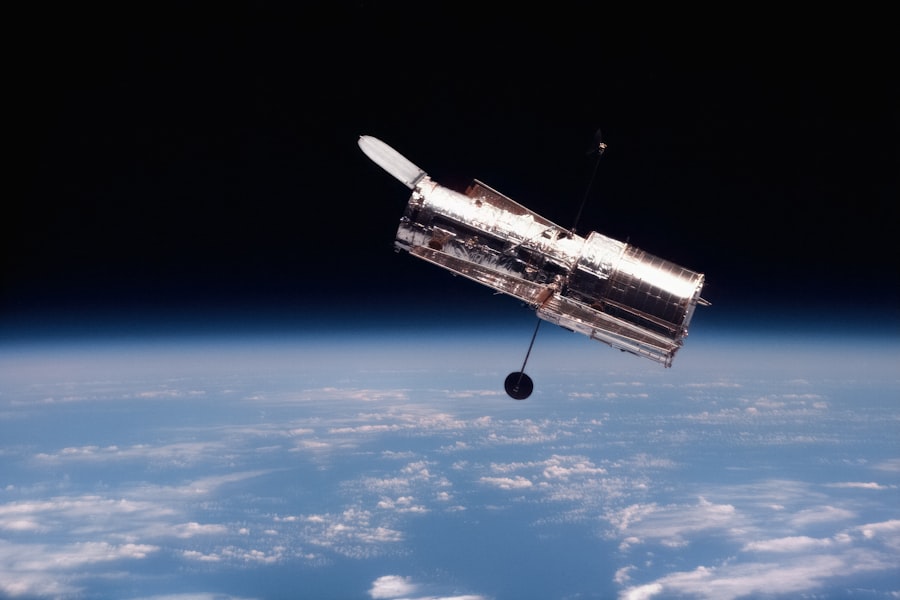
GPS satellites are not immune to these relativistic effects; in fact, they are at the forefront of demonstrating their practical implications. The combination of their high orbital velocity and their position relative to Earth’s gravitational field means that both special and general relativistic time dilation come into play.
The Combined Effect: A Relativistic Tug-of-War
GPS satellites orbit Earth at an altitude of approximately 20,200 kilometers (12,550 miles) and travel at speeds of roughly 3.87 kilometers per second (8,650 mph). Both of these factors contribute to time dilation, but in opposing directions.
Special Relativity’s Slowing Effect
Due to their high orbital velocity relative to an observer on Earth, the onboard atomic clocks of GPS satellites experience special relativistic time dilation. Compared to a stationary clock on Earth, these orbiting clocks are effectively in motion. This effect causes the satellite clocks to tick slower than ground-based clocks. Calculations show that this special relativistic effect leads to a delay of approximately 7 microseconds per day. This means that if left uncorrected, the satellite clocks would fall behind Earth-based clocks by 7 microseconds every 24 hours.
General Relativity’s Speeding Effect
Conversely, because GPS satellites are orbiting at a significant altitude, they are in a weaker gravitational field than an observer on Earth’s surface. According to general relativity, clocks in weaker gravitational fields tick faster than clocks in stronger gravitational fields. This effect causes the satellite clocks to tick faster than ground-based clocks. The general relativistic effect is more pronounced than the special relativistic effect, leading to an advancement of approximately 45 microseconds per day.
The Net Relativistic Shift
When both effects are combined, the general relativistic effect (45 microseconds per day faster) significantly outweighs the special relativistic effect (7 microseconds per day slower). The net result is that the atomic clocks on board GPS satellites tick faster than identical clocks on Earth’s surface by approximately 38 microseconds per day (45 – 7 = 38). This seemingly small difference, accumulated over a day, has profound implications for GPS accuracy.
The Critical Importance of Relativistic Correction
For GPS to function with the precision required for its myriad applications, these relativistic time dilation effects must be meticulously accounted for. Without these corrections, the system’s accuracy would quickly deteriorate, rendering it unusable within a matter of hours.
The Problem of Time Synchronization
GPS operates on the principle of precise timing. Each satellite continuously broadcasts a signal containing its precise location and the exact time the signal was sent. A GPS receiver on Earth receives signals from multiple satellites. By measuring the time it takes for these signals to reach the receiver from different satellites, and knowing the speed of light, the receiver can triangulate its position.
The Illusion of Light Speed
The speed of light is a constant, approximately 299,792,458 meters per second. Even a tiny error in time translates into a significant error in distance. An error of just one microsecond in timing corresponds to a positioning error of almost 300 meters. The daily 38-microsecond discrepancy without correction would lead to an error of over 11 kilometers (approximately 7 miles) per day – an unacceptable level of inaccuracy for any practical navigation system. Imagine trying to find a specific street address when your GPS tells you are 7 miles away from your actual location.
How GPS Mitigates Relativistic Effects
Engineers building the GPS system were acutely aware of the relativistic predictions and incorporated them into the design from the outset. This foresight was crucial for the system’s success.
Frequency Offset in Satellite Clocks
The primary method for correcting the relativistic time dilation is by intentionally setting the atomic clocks on board the GPS satellites to a slightly slower frequency before launch. The standard frequency for the onboard atomic clocks is 10.23 MHz. However, to compensate for the 38-microsecond per day relativistic speed-up, the clocks are initially calibrated to run at a lower frequency of 10.22999999543 MHz.
This tiny offset ensures that by the time the satellites reach orbit and experience the relativistic effects, their clocks effectively tick at the precise 10.23 MHz frequency relative to an Earth-based clock. It’s like setting a watch slightly behind before you embark on a journey where you know it will subtly speed up, so that by the journey’s end, it is precisely on time.
Software Adjustments and Broadcast Ephemeris
In addition to the initial frequency offset, the GPS control segment continuously monitors the performance of the satellite clocks. Any residual drifts or minor deviations from the predicted relativistic effects are accounted for through software adjustments. These adjustments are incorporated into the navigation message that the satellites broadcast, known as the ephemeris. The ephemeris data provides highly accurate orbital parameters and clock correction information, allowing GPS receivers to make fine-tuned calculations.
Beyond GPS: Relativistic Effects in Other Technologies

The principles of relativity and the necessity of relativistic corrections are not confined solely to GPS. Other high-precision technologies and future scientific endeavors also rely on these fundamental insights.
Global Navigation Satellite Systems (GNSS)
GPS is but one component of the broader family of Global Navigation Satellite Systems (GNSS). Other GNSS, such as Russia’s GLONASS, Europe’s Galileo, and China’s BeiDou, all face the identical challenge of relativistic time dilation. Each of these systems employs similar strategies to mitigate the effects of special and general relativity, incorporating frequency offsets and continuous monitoring to maintain timing accuracy. This uniformity in methodology underscores the universal nature of these physical laws.
Deep Space Communication and Interplanetary Navigation
When spacecraft embark on journeys to distant planets, the relativistic effects become even more pronounced. The vast distances involved and the differing gravitational potentials require sophisticated relativistic models for accurate communication and navigation. Signals traveling across the solar system experience gravitational time delays as they pass near massive objects like the Sun, a phenomenon famously confirmed by observations of light bending around the Sun during solar eclipses. Without accounting for these effects, missions such as the Mars Rovers or Voyager probes would quickly lose their way.
Future Atomic Clocks and Fundamental Physics
The ongoing development of ultra-precise atomic clocks, such as optical lattice clocks, is pushing the boundaries of timekeeping. These clocks are so sensitive that they can detect minute differences in gravitational potential over mere centimeters. This incredible precision means that relativistic time dilation is no longer just a consideration for high-speed or deep-space applications but a factor in terrestrial measurements. Scientists are using these clocks to test fundamental theories of physics, search for dark matter, and even explore the possibility of detecting gravitational waves with ground-based instruments. The interplay between gravity and time, as predicted by Einstein, continues to be a fertile ground for discovery.
Time dilation is a fascinating phenomenon that plays a crucial role in the functionality of GPS satellites, as their high-speed orbits and positions in varying gravitational fields affect the passage of time. To delve deeper into this topic, you can explore a related article that explains how these effects are accounted for in satellite technology, ensuring accurate positioning for users on Earth. For more insights, check out this informative piece on time dilation and GPS satellites.
Conclusion: A Testament to Einstein’s Vision
| Metric | Value | Unit | Description |
|---|---|---|---|
| Orbital Altitude | 20,200 | km | Altitude of GPS satellites above Earth’s surface |
| Orbital Velocity | 3.87 | km/s | Speed of GPS satellites in orbit |
| Gravitational Time Dilation | +45.7 | μs/day | Time gain due to weaker gravity at satellite altitude |
| Special Relativity Time Dilation | -7.2 | μs/day | Time loss due to satellite velocity relative to Earth |
| Net Time Dilation | +38.5 | μs/day | Overall time gain experienced by GPS satellite clocks |
| Clock Correction Frequency | 10.23 | MHz | Frequency of GPS satellite atomic clocks |
| Pre-Launch Clock Rate Adjustment | -4.465 | Hz | Frequency offset applied to satellite clocks to compensate time dilation |
The successful operation of the Global Positioning System stands as a monumental testament to the predictive power of Albert Einstein’s theories of relativity. Without the meticulous application of both special and general relativistic corrections, GPS would be nothing more than a curious scientific experiment, utterly incapable of providing the precise location and timing data upon which billions of people and countless industries depend daily.
The next time you use your smartphone for navigation, consider for a moment the profound physics at play. Above you, orbiting satellites are constantly experiencing a subtle dance of time, their internal clocks carefully adjusted to compensate for the effects of their speed and their position in Earth’s gravitational field. This intricate balancing act ensures that the information they transmit aligns perfectly with the passage of time on Earth. The seemingly esoteric concepts of time dilation are not merely theoretical curiosities; they are foundational to the functionality of one of humanity’s most transformative technologies, demonstrating how fundamental scientific understanding underpins technological advancement. The universe, it seems, is far more subtle and complex than our everyday intuition suggests, and it is precisely this complexity that allows us to navigate its surface with unparalleled accuracy.
FAQs
What is time dilation in the context of GPS satellites?
Time dilation refers to the difference in the passage of time experienced by GPS satellites compared to observers on Earth. Due to their high speeds and weaker gravitational field at orbit, the clocks on GPS satellites tick at a different rate than those on the ground.
Why do GPS satellites experience time dilation?
GPS satellites experience time dilation because of two main effects predicted by Einstein’s theories: special relativity and general relativity. Special relativity causes moving clocks to run slower, while general relativity causes clocks in weaker gravitational fields (like those in orbit) to run faster.
How does time dilation affect GPS accuracy?
If time dilation were not accounted for, the GPS satellite clocks would drift relative to Earth-based clocks, causing errors in position calculations. This could lead to inaccuracies of several kilometers within a day, making GPS navigation unreliable.
How is time dilation corrected in GPS systems?
GPS satellites are equipped with atomic clocks that are pre-adjusted to tick at a rate that compensates for relativistic effects. Additionally, the GPS control segment continuously monitors and corrects satellite clock errors to maintain precise timing.
What role does general relativity play in GPS time dilation?
General relativity predicts that clocks in a weaker gravitational field (such as those on satellites orbiting Earth) run faster than clocks on the surface. This effect causes GPS satellite clocks to gain about 45 microseconds per day compared to Earth clocks.
What role does special relativity play in GPS time dilation?
Special relativity predicts that moving clocks run slower relative to stationary observers. Since GPS satellites travel at high speeds (about 14,000 km/h), their clocks run slower by about 7 microseconds per day compared to Earth clocks.
What is the net effect of relativistic time dilation on GPS satellite clocks?
The net effect is that GPS satellite clocks run faster by approximately 38 microseconds per day compared to Earth clocks. This difference is corrected to ensure accurate positioning.
Can GPS satellites function accurately without accounting for time dilation?
No, without accounting for time dilation, GPS positioning errors would accumulate rapidly, making the system unreliable for navigation and timing purposes.
Are time dilation effects unique to GPS satellites?
No, time dilation affects all satellites and objects moving at high speeds or in different gravitational fields, but GPS satellites require precise timing corrections due to the critical role of accurate time in navigation.
How often are GPS satellite clocks synchronized with Earth-based clocks?
GPS satellite clocks are continuously monitored and regularly synchronized with Earth-based reference clocks by the GPS control segment to maintain accuracy.