
The Holographic Universe Theory Explained
The concept of a holographic universe suggests that the reality we perceive might be a projection, akin to a three-dimensional image appearing on a two-dimensional surface. This idea, originating from theoretical physics, posits that the universe’s entire three-dimensional information content could be encoded on a distant two-dimensional boundary. While it sounds like science fiction, the holographic principle is a serious subject of research, emerging from the intersection of quantum mechanics and general relativity, particularly in the study of black holes. Understanding this theory requires grasping some fundamental, albeit abstract, principles of physics.
The holographic principle’s genesis lies in the perplexing behavior of black holes and the long-standing “information paradox.” Black holes, regions of spacetime where gravity is so strong that nothing, not even light, can escape, have always been a fertile ground for exploring the limits of our understanding of physics.
Hawking Radiation and the Loss of Information
In the 1970s, Stephen Hawking proposed that black holes are not entirely black. Through a process now known as Hawking radiation, black holes can emit particles and slowly evaporate over vast timescales. This discovery was revolutionary, but it introduced a profound problem. According to quantum mechanics, information is never truly lost; it can be transformed, scrambled, but never destroyed. However, Hawking’s calculations seemed to suggest that as a black hole evaporates, the information about what fell into it is irretrievably lost. This creates a direct contradiction between general relativity and quantum mechanics, the two pillars of modern physics.
The Bekenstein Bound and Entropy
Prior to Hawking’s work, Jacob Bekenstein had explored the concept of entropy for black holes. Entropy, in thermodynamics, is a measure of disorder or randomness within a system. Bekenstein proposed that black holes have entropy, and remarkably, this entropy is proportional to the surface area of the black hole’s event horizon, not its volume. This was a counterintuitive finding. Generally, the entropy of a system is expected to scale with its volume because more volume means more space for particles and more possible arrangements. The Bekenstein bound stated that the maximum entropy a region of space could contain is proportional to its surface area.
Information Encoding on the Horizon
The idea that information is encoded on the surface area of a black hole, rather than its volume, was a crucial stepping stone. If all the information that falls into a black hole is somehow stored on its event horizon—a two-dimensional surface—it suggests a form of information compression. This leads to the question: if a black hole can store its information on its surface, could the entire universe be doing something similar?
The holographic universe theory posits that our three-dimensional reality is a projection of information encoded on a two-dimensional surface, challenging our conventional understanding of space and time. For a deeper exploration of this fascinating concept, you can read a related article that delves into the implications and scientific foundations of this theory. Check it out here: Holographic Universe Theory Explained.
The Holographic Principle: A Universe Projected from a Boundary
The holographic principle, first rigorously formulated by Gerard ‘t Hooft and later developed by Leonard Susskind, extends this idea beyond black holes. It proposes that the universe, in its entirety, might be a holographic projection.
Analogy: The Hologram
Imagine a credit card hologram. It’s a flat, two-dimensional surface, yet it can display a complex, three-dimensional image when illuminated correctly. The holographic principle suggests that our universe, with its three spatial dimensions and one time dimension (making it four-dimensional spacetime), could be a similar projection emanating from a lower-dimensional boundary, perhaps a two-dimensional surface at the cosmological horizon. This boundary would contain all the fundamental information that describes our universe.
Mathematical Framework: AdS/CFT Correspondence
The most concrete evidence and a major driver for the holographic principle comes from a specific mathematical framework known as the Anti-de Sitter/Conformal Field Theory (AdS/CFT) correspondence, proposed by Juan Maldacena. This duality is a powerful tool that links two seemingly different types of theories:
Anti-de Sitter Space (AdS)
Anti-de Sitter space is a type of spacetime that has a constant negative curvature. It is a theoretical construct often used in physics to explore fundamental ideas. In the context of AdS/CFT, it represents the gravitational side of the duality.
Conformal Field Theory (CFT)
A Conformal Field Theory is a quantum field theory that is invariant under conformal transformations, which preserve angles but not necessarily distances. In the AdS/CFT correspondence, the CFT lives on the “boundary” of the Anti-de Sitter space, which is of one lower dimension.
The Duality
The AdS/CFT correspondence states that a theory of gravity in a certain number of dimensions (like AdS space) is mathematically equivalent to a quantum field theory without gravity in one fewer dimension (the CFT on its boundary). This is akin to saying that a complex, gravity-filled 5-dimensional universe can be perfectly described by a simpler, non-gravitational 4-dimensional theory. The information in the higher-dimensional gravitational theory is entirely encoded in the lower-dimensional quantum field theory.
Implications of the Holographic Principle
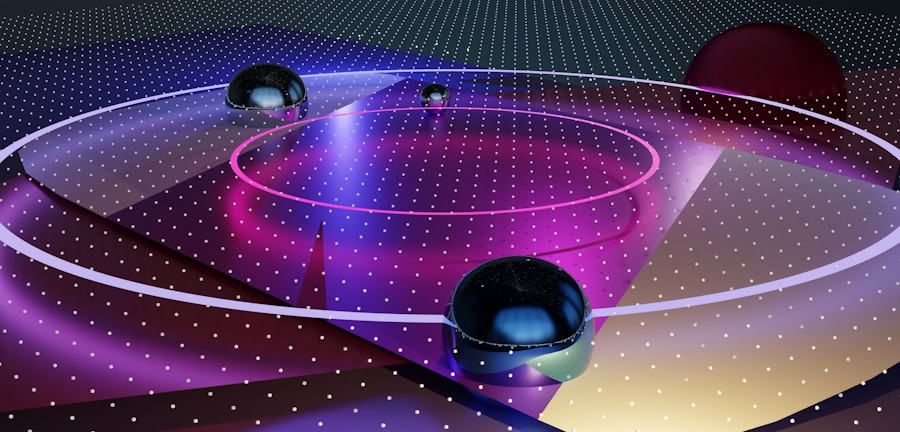
If the universe is holographic, the implications are far-reaching, challenging our intuitive understanding of reality, space, and time.
Redundancy of Information
One of the key implications is that the information describing our universe is not spread out and redundant as one might expect in a three-dimensional volume. Instead, it is packed onto a boundary, suggesting a fundamental efficiency in how reality is constructed. Think of it like a highly compressed video file. All the visual information is stored in a compact format, and when played back, it appears as a dynamic, three-dimensional experience.
Emergent Spacetime
In the holographic view, spacetime itself might not be a fundamental entity but rather an emergent property of the underlying quantum information on the boundary. Our perception of a smooth, continuous spacetime could be an illusion arising from the complex interactions of these fundamental bits of information. This is a radical departure from the traditional view of spacetime as a pre-existing stage on which events unfold.
Quantum Gravity as a Holographic Phenomenon
The holographic principle offers a potential pathway towards a unified theory of quantum gravity. By showing a duality between gravity theories and quantum field theories, it hints that gravity, which is famously difficult to quantize, might be a secondary phenomenon arising from the more fundamental quantum processes on the boundary.
Testing the Holographic Universe Theory

Directly testing the holographic principle for our entire universe is an immense challenge, as it requires observing phenomena at the furthest reaches of spacetime or probing the quantum nature of gravity. However, theoretical physicists are exploring various avenues.
Observational Signatures
One area of research looks for potential observational signatures of holography. If our universe is a projection, there might be subtle deviations from standard cosmological models or peculiar correlations in the cosmic microwave background radiation that could hint at its holographic nature. These might appear as a breakdown in certain symmetries or unexpected patterns in the distribution of matter.
Gravitational Wave Astronomy
The study of gravitational waves, ripples in spacetime caused by massive cosmic events like black hole mergers, offers another potential window. By analyzing the properties of these waves, particularly those originating from extreme gravitational environments, scientists hope to find evidence that fits predictions derived from holographic models. For instance, the way information is processed in the vicinity of black holes might reveal holographic characteristics.
Quantum Entanglement and Spacetime
Recent theoretical work has also suggested a deep connection between quantum entanglement and the structure of spacetime. Entanglement is a quantum phenomenon where particles become linked in such a way that they share the same fate, regardless of the distance separating them. Some theories propose that the very fabric of spacetime might be woven from threads of quantum entanglement, a concept that could align with the holographic paradigm where information is interconnected across a boundary.
The concept of the holographic universe theory has intrigued many, suggesting that our three-dimensional reality might be a projection of information encoded on a two-dimensional surface. This fascinating idea is explored in depth in various articles, including one that delves into its implications for understanding the nature of reality and consciousness. For a more comprehensive overview, you can read about it in this insightful piece on My Cosmic Ventures, which discusses how this theory could reshape our perception of the universe and our place within it.
Challenges and Criticisms
| Aspect | Description | Key Proponent(s) | Scientific Basis | Implications |
|---|---|---|---|---|
| Definition | The holographic universe theory suggests that all the information contained within a volume of space can be represented as encoded data on the boundary of that space. | Gerard ‘t Hooft, Leonard Susskind | Based on black hole thermodynamics and string theory | Challenges traditional 3D perception of reality; implies universe is a projection |
| Origin | Proposed in the 1990s as a solution to the black hole information paradox | Gerard ‘t Hooft (1993), Leonard Susskind (1995) | Black hole entropy proportional to surface area, not volume | Suggests information is preserved on event horizons |
| Mathematical Framework | AdS/CFT correspondence: relates gravity in Anti-de Sitter space to a conformal field theory on its boundary | Juan Maldacena (1997) | String theory and quantum gravity | Provides a calculable model supporting holographic principle |
| Experimental Evidence | Indirect; includes studies of cosmic microwave background and quantum entanglement | Various physicists and experiments (e.g., Fermilab’s Holometer) | Still inconclusive; ongoing research | Potential to unify quantum mechanics and gravity |
| Criticism | Highly theoretical; lacks direct empirical proof; some physicists remain skeptical | Various critics in physics community | Debate over interpretation and applicability | Encourages further theoretical and experimental investigation |
The holographic universe theory, while intriguing, faces significant challenges and is not without its critics.
The Nature of the Boundary
A major question is the precise nature and location of the proposed two-dimensional boundary. Is it the cosmological event horizon, beyond which we can never observe? Or is it some other fundamental surface at the Planck scale (the smallest conceivable scale in physics)? Identifying this boundary is crucial for developing testable predictions.
Mathematical Complexity
The AdS/CFT correspondence, while a powerful tool, is currently only understood in specific theoretical settings (like Anti-de Sitter space) and for specific types of quantum field theories. Extending these results to our own universe, which is not an Anti-de Sitter space but rather one that appears to be expanding and has a positive cosmological constant, is a monumental task.
Observational Verification
As mentioned, directly verifying a theory about the entire universe being a projection from a boundary is extremely difficult. The energies and scales involved are often far beyond our current observational capabilities. Scientists are looking for indirect evidence, but definitive proof remains elusive.
Alternative Explanations
It is also important to note that the phenomena that lead to the holographic principle, such as the black hole information paradox, might have other resolutions within existing frameworks of physics without necessarily invoking a holographic universe. Physicists are actively exploring these alternative explanations as well.
In conclusion, the holographic universe theory invites us to contemplate our reality from a fundamentally different perspective. It suggests that the vast cosmos we observe might be a projection from a simpler, lower-dimensional reality, much like a complex image arising from a flat surface. While this concept is rooted in rigorous theoretical physics, particularly in the study of black holes and string theory, it remains an active area of research with profound implications for our understanding of gravity, quantum mechanics, and the very nature of existence. The journey to definitively confirm or refute this idea is ongoing, pushing the boundaries of human knowledge and encouraging us to question the fundamental assumptions we hold about the universe.
FAQs
What is the holographic universe theory?
The holographic universe theory suggests that the entire universe can be seen as a two-dimensional information structure “painted” on the cosmological horizon, with the three-dimensional world we experience being a projection of this information.
Who proposed the holographic universe theory?
The theory was first proposed by physicist Gerard ‘t Hooft in the 1990s and later expanded by Leonard Susskind. It builds on earlier work related to black hole thermodynamics and quantum gravity.
How does the holographic principle relate to black holes?
The holographic principle originated from studies of black holes, where it was found that the information content of all matter falling into a black hole is encoded on its two-dimensional event horizon, rather than within its volume.
Is the holographic universe theory widely accepted in the scientific community?
While the holographic principle is a significant concept in theoretical physics and string theory, it remains a hypothesis and is not yet universally accepted or experimentally proven as a description of the entire universe.
What implications does the holographic universe theory have for our understanding of reality?
If true, the theory could revolutionize our understanding of space, time, and gravity, suggesting that the universe is fundamentally informational and that our perception of three-dimensional reality is a projection from a two-dimensional boundary.