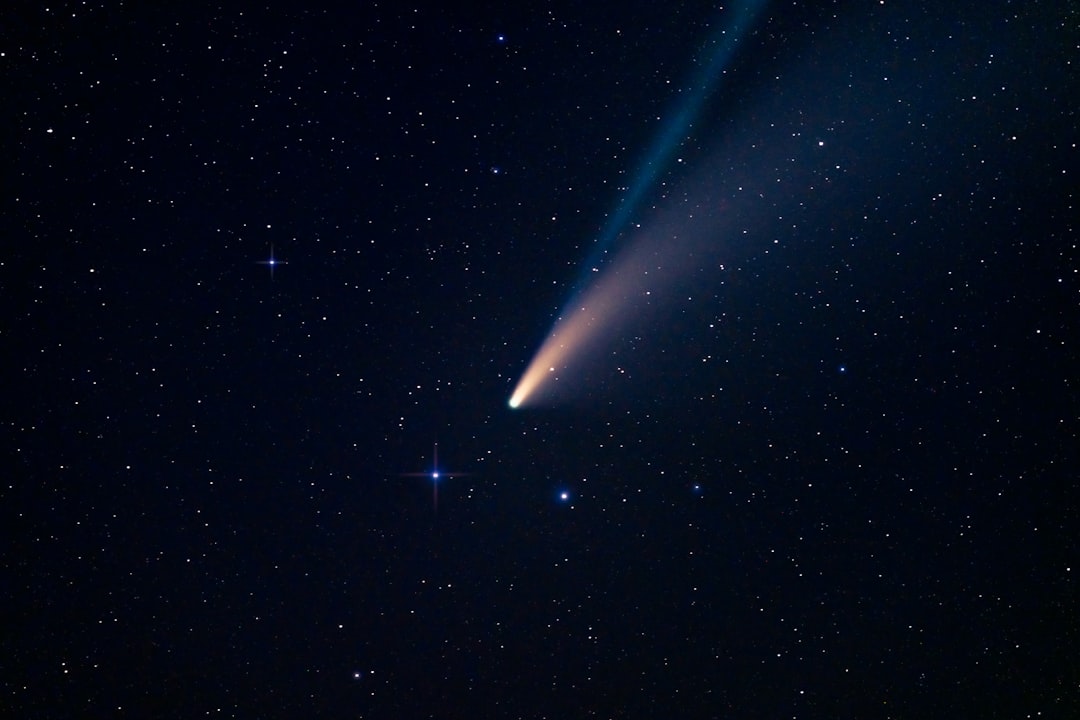
Comets have long fascinated humanity, capturing imaginations with their ethereal beauty and mysterious origins. These celestial wanderers, often described as “dirty snowballs,” are composed of ice, dust, and rocky materials. When they venture close to the Sun, they develop glowing comas and tails that can stretch for millions of kilometers, creating a spectacular display in the night sky.
The study of comets not only enriches our understanding of the solar system’s history but also provides insights into the conditions that prevailed during its formation. As they travel through space, comets serve as time capsules, preserving the primordial materials from which the solar system was born. The allure of comets extends beyond their visual splendor; they are also key players in the cosmic narrative of our solar system.
Their unpredictable appearances and trajectories have sparked both awe and fear throughout history, often being interpreted as omens or harbingers of change. In modern times, scientific advancements have allowed astronomers to study these celestial bodies in greater detail, revealing their complex structures and behaviors. As researchers continue to explore the origins and dynamics of comets, they uncover the secrets of not only these enigmatic objects but also the broader processes that govern the evolution of planetary systems.
Key Takeaways
- Comets are icy bodies that orbit the sun and have long, glowing tails.
- Comets are believed to form in the Oort Cloud, a region of icy bodies at the edge of the solar system.
- Some comets are thought to form in the Kuiper Belt, a region of icy bodies beyond Neptune.
- Gravity plays a crucial role in the formation of comets, pulling together icy particles to form the nucleus of a comet.
- Comets are composed of ice, dust, and rocky material, giving them a distinct composition.
The Formation of Comets in the Oort Cloud
The Oort Cloud is a vast, spherical shell of icy bodies that surrounds the solar system at an immense distance. It is believed to be the primary source of long-period comets, which take hundreds to thousands of years to complete an orbit around the Sun. The formation of comets in this distant region is a result of the gravitational interactions and collisions that occur among icy bodies in the early solar system.
Over time, these interactions can dislodge objects from their stable orbits, sending them on a journey toward the inner solar system. As these icy bodies are perturbed from their positions in the Oort Cloud, they begin to fall toward the Sun under the influence of gravity. This process can take millions of years, during which time the comets may undergo significant changes.
The journey from the Oort Cloud to the inner solar system is not a straightforward path; it is fraught with gravitational influences from other celestial bodies, including planets and stars. These interactions can alter a comet’s trajectory, leading to a diverse array of orbits and behaviors that make each comet unique.
The Formation of Comets in the Kuiper Belt

In contrast to the Oort Cloud, the Kuiper Belt is a region located just beyond the orbit of Neptune, populated by a plethora of icy bodies and dwarf planets. This area is thought to be the birthplace of short-period comets, which typically have orbits lasting less than 200 years. The formation of comets in the Kuiper Belt is closely tied to the dynamics of this region, where gravitational interactions among objects can lead to significant perturbations.
As with the Oort Cloud, collisions and gravitational influences play a crucial role in shaping the fate of Kuiper Belt objects. When these icy bodies collide or are nudged by nearby planets, they can be sent on trajectories that bring them closer to the Sun. This process can result in the transformation of a dormant icy body into an active comet, complete with a coma and tail as it approaches solar radiation.
The Kuiper Belt serves as a dynamic laboratory for studying how comets are formed and how they evolve over time.
The Role of Gravity in the Formation of Comets
| Aspect | Details |
|---|---|
| Gravity | Plays a key role in the formation of comets by pulling together dust, ice, and gas particles to form a nucleus. |
| Nucleus Formation | Gravity causes particles to clump together, forming a nucleus that becomes the core of the comet. |
| Orbital Path | Gravity influences the orbital path of comets, determining their trajectory and potential impact with other celestial bodies. |
| Comet Tail | Gravity plays a role in the formation of the comet’s tail, as it pulls particles away from the nucleus and creates the characteristic tail as the comet moves through space. |
Gravity is a fundamental force that governs the behavior of celestial bodies throughout the universe. In the context of comet formation, gravity plays a pivotal role in both the creation and trajectory of these icy wanderers. The gravitational pull exerted by larger bodies, such as planets and stars, can influence the orbits of smaller objects in regions like the Oort Cloud and Kuiper Belt.
This gravitational interaction can lead to significant changes in an object’s path, ultimately determining whether it will become a comet. The process begins with small icy bodies coalescing in the early solar system. As these bodies grow larger through accretion, their gravitational influence increases, allowing them to attract more material.
Over time, this accumulation can lead to the formation of larger comet nuclei. Once formed, these nuclei remain relatively stable until external gravitational forces disturb their orbits. Such disturbances can send them on a trajectory toward the inner solar system, where they may become visible comets as they approach the Sun.
The Composition of Comets
Comets are composed primarily of ice, dust, and rocky materials, making them unique among celestial bodies. Their nuclei typically contain water ice, carbon dioxide, ammonia, methane, and various organic compounds. This composition reflects the conditions present in the early solar system when these objects formed.
The presence of volatile materials means that when comets approach the Sun, they heat up and release gas and dust, creating a glowing coma and tail. The study of comet composition provides valuable insights into the building blocks of planetary systems. By analyzing the materials found in comets, scientists can infer information about the chemical processes that occurred during the formation of our solar system.
Understanding what comets are made of not only enhances knowledge about their origins but also sheds light on broader questions regarding the emergence of life in the universe.
The Launch of Comets from their Origin
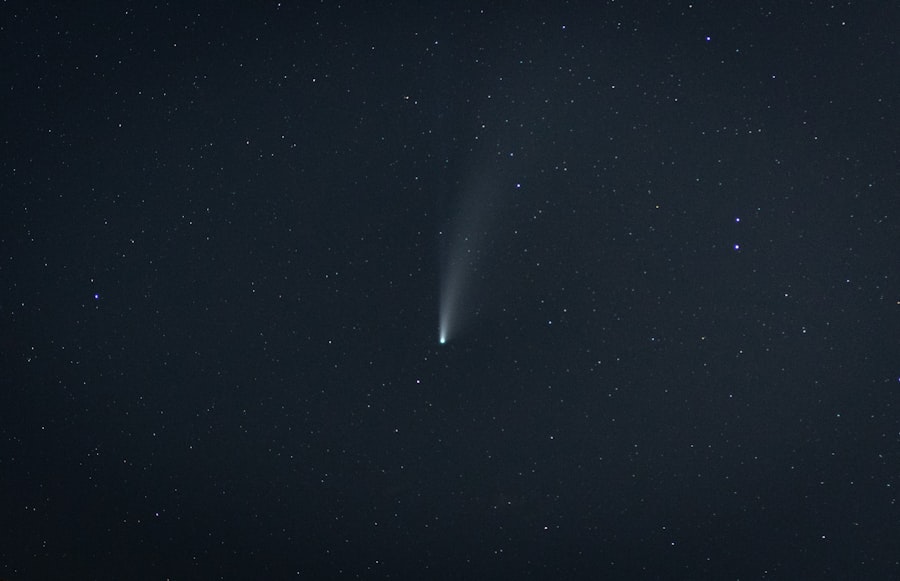
The journey of a comet from its origin to its eventual appearance in the inner solar system is a complex process influenced by various factors. Once an icy body is perturbed from its stable orbit in either the Oort Cloud or Kuiper Belt, it begins its descent toward the Sun. This launch phase can take millions of years as gravitational forces gradually alter its trajectory.
During this time, comets may encounter other celestial bodies that further influence their paths. For instance, interactions with giant planets like Jupiter can significantly alter a comet’s orbit, either sending it on a direct path toward the Sun or ejecting it from the solar system entirely. These gravitational encounters are crucial for determining which comets will become visible from Earth and which will remain hidden in distant regions of space.
The Influence of the Sun on Comet Launch
As comets approach the Sun, they undergo dramatic transformations due to its intense heat and radiation. The Sun’s gravitational pull not only draws comets closer but also plays a critical role in shaping their behavior once they enter its vicinity. When a comet nears the Sun, its surface begins to heat up, causing volatile materials within it to vaporize and escape into space.
This process creates a coma—a glowing envelope of gas and dust surrounding the nucleus—and often results in one or more tails that extend away from the Sun due to solar wind and radiation pressure. The interaction between a comet and solar radiation is a delicate balance; while it can enhance visibility and create stunning displays for observers on Earth, it also poses risks for comets themselves. Prolonged exposure to solar heat can lead to fragmentation or disintegration, ultimately determining how long a comet remains active during its journey through the solar system.
The Trajectory of Comets in the Solar System
The trajectory of a comet is influenced by various factors, including its initial velocity, gravitational interactions with other celestial bodies, and its proximity to the Sun. Once launched from its origin in either the Oort Cloud or Kuiper Belt, a comet’s path can be highly elliptical or parabolic, depending on its energy and momentum at launch. As comets travel through space, they may pass close to planets or other massive objects that can alter their trajectories through gravitational interactions.
These encounters can lead to changes in speed and direction that may result in new orbital patterns or even ejection from the solar system altogether. Understanding these trajectories is essential for predicting when and where comets will appear in our night sky.
The Observation and Study of Comet Launches
The observation and study of comet launches have evolved significantly over time with advancements in technology and astronomical techniques. Historically, comets were often viewed as omens or signs from above; however, modern science has transformed this perception into one grounded in empirical research and observation. Astronomers utilize powerful telescopes equipped with advanced imaging technology to track comets as they approach the Sun.
Space missions have also been launched specifically to study comets up close; for example, NASA’s Rosetta mission successfully orbited and landed on Comet 67P/Churyumov-Gerasimenko in 2014. Such missions provide invaluable data about comet composition and behavior during their journey through space.
The Impact of Comet Launches on Earth
While most comets pose no threat to Earth as they pass through our solar system, their launches can have significant implications for our planet’s history and future. Some scientists theorize that comets may have played a role in delivering water and organic compounds to Earth during its formative years—an event that could have been crucial for initiating life. However, there are also concerns regarding potential impacts from larger comets or fragments that could pose risks to Earth’s biosphere.
Historical records indicate that significant impacts have occurred throughout Earth’s history, leading to mass extinctions and dramatic changes in climate. Understanding comet dynamics helps scientists assess potential threats while also appreciating their role as carriers of essential materials for life.
The Future of Comet Formation and Launch Research
As technology continues to advance, researchers are poised to deepen their understanding of comet formation and launch mechanisms further.
Moreover, ongoing studies into cometary dynamics will enhance predictive models for tracking their trajectories within our solar system.
As humanity continues to explore space beyond our planet, understanding comets will remain an essential aspect of unraveling cosmic mysteries while also preparing for potential encounters with these fascinating celestial objects. In conclusion, comets are not merely beautiful phenomena gracing our night skies; they are vital components of our solar system’s history and evolution. From their formation in distant regions like the Oort Cloud and Kuiper Belt to their dynamic interactions with gravity and solar radiation, each aspect contributes to our understanding of these enigmatic wanderers.
As research continues to unfold, humanity stands on the brink of uncovering even more secrets held within these icy travelers from beyond our world.
Comets, often described as cosmic snowballs of frozen gases, rock, and dust, are fascinating celestial objects that originate from the outer regions of our solar system. These icy bodies are formed in the cold, distant reaches of space, primarily in the Kuiper Belt and the Oort Cloud. Over time, gravitational interactions with other celestial bodies can alter their orbits, flinging them towards the inner solar system where they become visible from Earth. For a deeper understanding of the intricate processes involved in the formation and journey of comets, you can explore a related article on this topic by visiting