
Dark energy is one of the most enigmatic and compelling concepts in modern cosmology. It represents a force that is believed to be responsible for the accelerated expansion of the universe, a phenomenon that has puzzled scientists since its discovery. While ordinary matter and dark matter account for a significant portion of the universe’s mass-energy content, dark energy is thought to make up approximately 68% of the total energy density of the cosmos.
This mysterious entity does not emit light or energy, making it invisible and detectable only through its gravitational effects on visible matter and the structure of the universe itself. The quest to understand dark energy is not merely an academic pursuit; it holds profound implications for our understanding of the universe’s fate and the fundamental laws of physics. The concept of dark energy emerged from observations that contradicted previous assumptions about the universe’s expansion.
Initially, it was believed that gravity would slow down the expansion over time. However, the discovery that this expansion is actually accelerating has led to a paradigm shift in cosmology. As researchers delve deeper into the nature of dark energy, they confront questions that challenge existing theories and push the boundaries of human knowledge.
The exploration of dark energy is not just about understanding a single phenomenon; it is about unraveling the very fabric of reality itself.
Key Takeaways
- Dark energy is a mysterious force that is causing the universe to expand at an accelerating rate.
- Density in physics refers to the amount of mass in a given volume, and it plays a crucial role in understanding dark energy.
- Dark energy was discovered in the late 1990s through observations of distant supernovae, which revealed the unexpected acceleration of the universe’s expansion.
- The changing density of dark energy is thought to be responsible for the accelerating expansion of the universe.
- Observations and measurements of distant galaxies and cosmic microwave background radiation have provided valuable insights into the nature of dark energy.
The Concept of Density in Physics
In physics, density is a fundamental concept that describes how much mass is contained within a given volume. It plays a crucial role in various fields, from fluid dynamics to astrophysics. The density of an object can influence its behavior under different conditions, such as buoyancy in fluids or gravitational interactions in celestial bodies.
In cosmology, density takes on an even more significant meaning as it relates to the overall composition of the universe and its evolution over time. When discussing dark energy, density becomes particularly important because it helps scientists quantify its effects on cosmic expansion. The density parameter, often denoted as Omega (Ω), is used to describe the relative contributions of different components of the universe, including ordinary matter, dark matter, and dark energy.
Understanding how these densities interact and evolve is essential for developing accurate models of cosmic dynamics. As researchers investigate the implications of varying densities, they gain insights into how the universe’s structure has changed throughout its history and how it may continue to evolve in the future.
The Discovery of Dark Energy
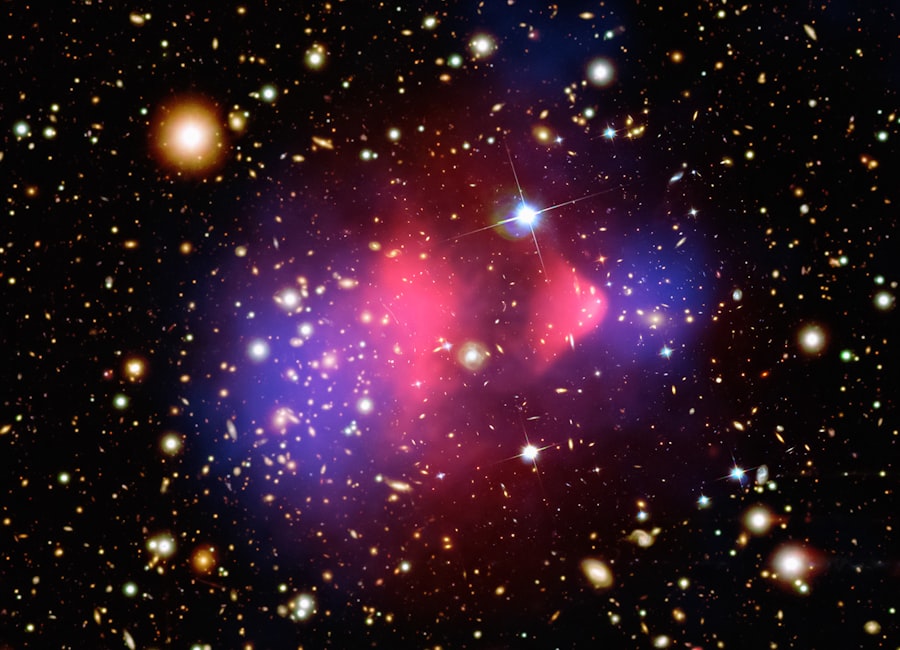
The discovery of dark energy can be traced back to the late 1990s when two independent teams of astronomers were studying distant supernovae. These teams, known as the High-Z Supernova Search Team and the Supernova Cosmology Project, aimed to measure the rate of expansion of the universe by observing these stellar explosions. To their astonishment, they found that instead of slowing down as expected, the universe’s expansion was accelerating.
This groundbreaking revelation prompted a reevaluation of existing cosmological models and led to the introduction of dark energy as a necessary component to explain this unexpected behavior. The implications of this discovery were profound. It suggested that there exists a form of energy permeating space that exerts a repulsive force, counteracting the attractive pull of gravity on cosmic scales.
This realization not only transformed our understanding of cosmic evolution but also raised new questions about the nature and origin of dark energy itself. As scientists sought to comprehend this elusive force, they began to explore various theoretical frameworks that could account for its properties and effects on the universe.
The Expansion of the Universe
| Year | Discovery |
|---|---|
| 1929 | Edwin Hubble discovers the expansion of the universe |
| 1998 | Discovery of the accelerating expansion of the universe |
| 2011 | Nobel Prize in Physics awarded for the discovery of the accelerating expansion of the universe |
The expansion of the universe is a fundamental aspect of modern cosmology, rooted in the observations made by Edwin Hubble in the 1920s. Hubble’s law demonstrated that galaxies are moving away from each other at speeds proportional to their distances, indicating that the universe is expanding. This expansion has been a cornerstone of cosmological theory, leading to the development of models such as the Big Bang theory, which describes the universe’s origin from an extremely hot and dense state.
However, the discovery that this expansion is accelerating has added complexity to our understanding. Initially thought to be slowing due to gravitational attraction, the acceleration suggests that some unknown force—dark energy—is at play. This acceleration has profound implications for the fate of the universe.
If dark energy continues to dominate cosmic dynamics, it could lead to scenarios such as the “Big Freeze,” where galaxies drift apart indefinitely, or even a “Big Rip,” where the fabric of space-time itself is torn apart by this mysterious force.
The Changing Density of Dark Energy
One of the intriguing aspects of dark energy is its changing density over time. Unlike ordinary matter and dark matter, which have densities that decrease as the universe expands, dark energy appears to maintain a constant density regardless of cosmic expansion. This characteristic leads to a unique dynamic in which dark energy becomes increasingly dominant as the universe grows larger.
The concept of a constant density for dark energy is often associated with the cosmological constant (Λ), introduced by Albert Einstein in his equations of general relativity. However, some theories propose that dark energy may not be constant but could evolve over time. This evolving nature raises questions about how dark energy interacts with other components of the universe and what implications it may have for future cosmic evolution.
Understanding whether dark energy remains constant or changes could provide critical insights into its fundamental nature and its role in shaping the universe’s destiny.
Observations and Measurements
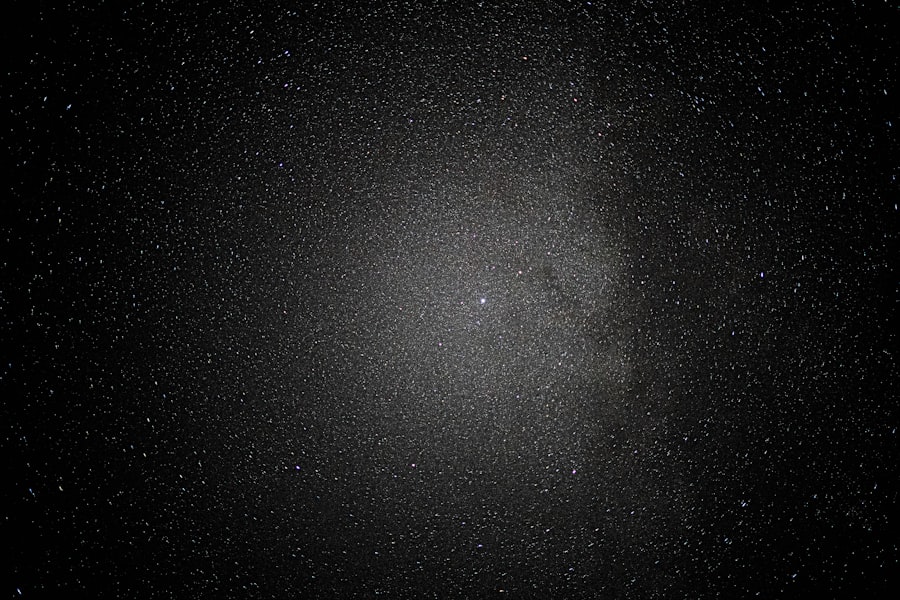
Observations and measurements play a crucial role in advancing our understanding of dark energy. Astronomers utilize various techniques to gather data on distant supernovae, galaxy clusters, and cosmic microwave background radiation to infer properties related to dark energy. One prominent method involves measuring Type Ia supernovae, which serve as standard candles due to their consistent brightness.
By analyzing their light curves and redshifts, researchers can determine distances and infer the rate of cosmic expansion. In addition to supernovae observations, large-scale surveys such as the Sloan Digital Sky Survey (SDSS) and upcoming projects like the Euclid mission aim to map the distribution of galaxies across vast regions of space. These surveys provide valuable information about how matter is distributed in the universe and how it evolves over time.
Theoretical Explanations
Theoretical explanations for dark energy range from simple models like the cosmological constant to more complex frameworks involving dynamic fields or modifications to general relativity. The cosmological constant posits that dark energy is a fixed property of space itself, providing a straightforward explanation for its observed effects on cosmic expansion. However, this model struggles to account for certain observations and raises questions about why its value is so small compared to theoretical predictions.
Alternative theories propose that dark energy may arise from scalar fields or other exotic forms of matter that evolve over time. These models introduce concepts such as quintessence or phantom energy, which allow for varying densities and interactions with other components in the universe. While these theories offer intriguing possibilities, they also complicate our understanding and require further investigation through observations and experiments.
Implications for the Future of the Universe
The implications of dark energy for the future of the universe are profound and far-reaching. If current models hold true and dark energy continues to drive cosmic acceleration, it could lead to scenarios where galaxies drift apart indefinitely, resulting in an increasingly isolated cosmos.
Conversely, if dark energy behaves differently than currently understood—perhaps evolving or interacting with other forces—it could lead to alternative outcomes for cosmic evolution. Scenarios such as a “Big Rip,” where dark energy becomes so dominant that it tears apart galaxies, stars, and even atomic structures, present dramatic possibilities for the ultimate fate of existence itself. These considerations highlight not only the importance of understanding dark energy but also its potential impact on fundamental questions about life, time, and reality.
The Role of Dark Energy in Cosmology
Dark energy occupies a central role in contemporary cosmology, shaping our understanding of both large-scale structure formation and cosmic evolution. Its discovery has prompted a reevaluation of established theories and has led to new paradigms in our comprehension of gravity and spacetime dynamics. As researchers continue to investigate this mysterious force, they are forced to confront fundamental questions about the nature of reality itself.
Moreover, dark energy serves as a bridge between various fields within physics, connecting cosmology with particle physics and quantum mechanics. The search for a unified theory that encompasses both gravity and quantum phenomena has gained urgency as scientists strive to understand how dark energy fits into this broader framework. The implications extend beyond theoretical physics; they touch upon philosophical inquiries about existence and humanity’s place within an ever-expanding universe.
Current Research and Future Directions
Current research on dark energy encompasses a wide range of approaches and methodologies aimed at unraveling its mysteries. Ongoing observational campaigns continue to refine measurements related to cosmic expansion rates and galaxy distributions while exploring new techniques such as gravitational lensing—where massive objects bend light from distant sources—to probe dark energy’s effects on large scales. Future directions in dark energy research include ambitious projects like NASA’s Wide Field Infrared Survey Telescope (WFIRST) and ESA’s Euclid mission, both designed to provide unprecedented insights into cosmic acceleration through detailed surveys of galaxies and supernovae across vast distances.
These missions aim not only to measure properties related to dark energy but also to test competing theories against observational data. As technology advances and new observational techniques emerge, researchers remain hopeful that they will uncover deeper insights into dark energy’s nature and its role within our universe. The quest for understanding this elusive force continues to inspire scientists across disciplines as they seek answers to some of humanity’s most profound questions.
The Mysteries of Dark Energy
In conclusion, dark energy remains one of the most profound mysteries in modern cosmology—a force that shapes our understanding of the universe while simultaneously challenging our grasp on fundamental physics. Its discovery has transformed our perception of cosmic evolution and raised critical questions about existence itself. As researchers delve deeper into its properties through observations and theoretical explorations, they inch closer to unraveling its secrets.
The journey toward understanding dark energy is not merely an academic endeavor; it reflects humanity’s innate curiosity about the cosmos and our place within it. Each new discovery brings with it both excitement and uncertainty as scientists grapple with concepts that defy intuition yet hold immense significance for our understanding of reality. Ultimately, whether through continued research or unexpected breakthroughs, humanity’s quest for knowledge will persist—driven by an insatiable desire to comprehend one of nature’s most enigmatic forces: dark energy.
Recent studies in cosmology have sparked intriguing discussions about the possibility of dark energy density changing over time, a concept that could significantly alter our understanding of the universe’s expansion. An article on this topic, which delves into the implications of a dynamic dark energy density and its potential effects on cosmic evolution, can be found on My Cosmic Ventures. For a deeper exploration of these groundbreaking ideas, you can read the full article by visiting