The universe is a vast and enigmatic expanse, filled with phenomena that challenge human understanding. Among these, black holes stand out as some of the most intriguing and perplexing objects in astrophysics. The black hole size paradox, in particular, raises fundamental questions about the nature of these cosmic giants.
How can black holes, which are regions of spacetime exhibiting such strong gravitational effects that nothing—not even light—can escape from them, possess such immense mass? This paradox invites both curiosity and skepticism, prompting scientists to delve deeper into the mysteries of black holes and their formation. As researchers continue to explore the cosmos, the size paradox of black holes has become a focal point of study.
The sheer scale of these entities often defies conventional understanding, leading to a myriad of theories and hypotheses. The implications of this paradox extend beyond mere curiosity; they touch upon the very fabric of our understanding of physics, gravity, and the evolution of galaxies. In this article, the complexities surrounding the black hole size paradox will be examined, shedding light on the current state of knowledge and the ongoing quest to unravel these cosmic enigmas.
Key Takeaways
- The size paradox of black holes raises questions about how such massive objects can exist in the universe.
- Understanding the concept of black holes involves grasping the idea of a region in space where gravity is so strong that nothing, not even light, can escape.
- The size paradox challenges our current understanding of physics and the limits of how massive black holes can be.
- The mystery of massive masses in black holes prompts scientists to explore theoretical explanations and observational evidence to unravel the paradox.
- Gravitational waves play a crucial role in helping us understand the sizes of black holes and their connection to the evolution of galaxies.
Understanding the Concept of Black Holes
To grasp the intricacies of the black hole size paradox, one must first understand what black holes are. At their core, black holes are formed when massive stars exhaust their nuclear fuel and undergo gravitational collapse. This process results in a singularity—a point where density becomes infinite and the laws of physics as we know them cease to function.
Surrounding this singularity is the event horizon, a boundary beyond which nothing can escape the gravitational pull of the black hole. The concept of black holes challenges traditional notions of space and time, as they warp the very fabric of the universe. Black holes can be categorized into several types based on their mass.
Stellar black holes, which form from collapsing stars, typically range from three to several tens of solar masses. In contrast, supermassive black holes, found at the centers of galaxies, can possess millions to billions of times the mass of our Sun. The existence of these supermassive black holes raises further questions about their formation and growth, particularly in relation to their size.
Understanding these categories is crucial for comprehending the broader implications of the black hole size paradox.
The Size Paradox: How Can Black Holes Be So Massive?
The size paradox surrounding black holes stems from their extraordinary mass relative to their formation processes. While it is understood that stellar black holes form from the remnants of massive stars, the existence of supermassive black holes poses a significant challenge to current astrophysical models. How can such colossal entities exist in a relatively short time frame in cosmic history?
This question lies at the heart of the size paradox, as it suggests that there must be mechanisms at play that allow for rapid growth and accumulation of mass. One possible explanation for the existence of supermassive black holes is that they may have formed from the merging of smaller black holes or through the direct collapse of massive gas clouds in the early universe. However, these theories raise additional questions about how such processes could occur efficiently enough to produce the observed masses within a limited timeframe.
The size paradox thus highlights a gap in understanding regarding the mechanisms that govern black hole formation and growth, prompting researchers to explore alternative scenarios and models.
Exploring the Mystery of Massive Masses in Black Holes
| Black Hole | Mass (Solar Masses) | Distance from Earth (light-years) |
|---|---|---|
| NGC 1277 | 17 billion | 220 million |
| TON 618 | 66 billion | 10.37 billion |
| S5 0014+81 | 40 billion | 12.5 billion |
The mystery surrounding the massive sizes of black holes extends beyond their formation; it also encompasses their growth and evolution over time. One intriguing aspect is how supermassive black holes can accumulate such vast amounts of matter without being hindered by their own gravitational forces. As matter spirals into a black hole, it forms an accretion disk—a swirling mass of gas and dust that emits intense radiation as it heats up due to friction.
This process not only contributes to the growth of the black hole but also raises questions about how efficiently matter can be converted into gravitational energy. Additionally, researchers are investigating whether supermassive black holes play a role in regulating star formation within their host galaxies. The energy output from accretion processes can influence the surrounding environment, potentially stifling or enhancing star formation rates.
This interplay between black holes and their galactic surroundings adds another layer of complexity to understanding their massive sizes and growth patterns. As scientists continue to unravel these connections, they may uncover new insights into the fundamental nature of black holes and their impact on cosmic evolution.
Theoretical Explanations for the Size Paradox
Several theoretical frameworks have been proposed to address the size paradox associated with black holes. One prominent theory suggests that supermassive black holes may have originated from primordial black holes—tiny black holes formed in the early universe due to density fluctuations during cosmic inflation. These primordial black holes could have grown over time through mergers and accretion processes, eventually evolving into the supermassive giants observed today.
Another avenue of exploration involves examining the role of dark matter in black hole formation. Dark matter constitutes a significant portion of the universe’s mass but remains elusive in terms of direct detection. Some researchers propose that dark matter could facilitate the rapid growth of supermassive black holes by providing additional gravitational influence during their formative stages.
This hypothesis opens up new possibilities for understanding how massive black holes can exist within relatively short cosmic timescales.
Observational Evidence of Massive Black Holes
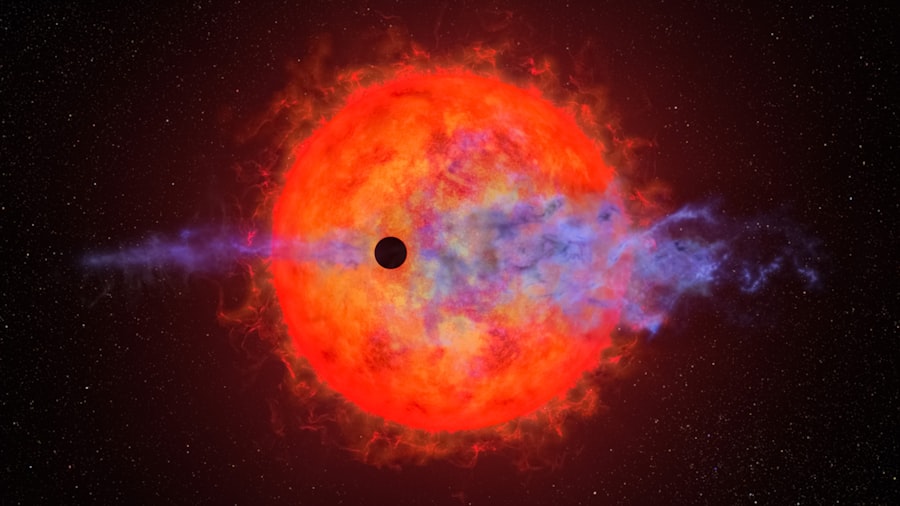
The study of massive black holes has been significantly bolstered by advancements in observational technology.
One landmark achievement was the Event Horizon Telescope’s imaging of a black hole’s shadow in 2019, providing direct visual evidence of its existence and offering insights into its size.
Observational data has revealed that supermassive black holes are not only prevalent but also exhibit a remarkable correlation with their host galaxies’ properties. For instance, studies have shown that there is a relationship between a galaxy’s bulge mass and its central black hole mass—a phenomenon known as the M-sigma relation. This correlation suggests that supermassive black holes may play a crucial role in shaping their host galaxies over cosmic timescales, further complicating our understanding of their sizes and growth mechanisms.
The Role of Gravitational Waves in Understanding Black Hole Sizes
Gravitational waves have emerged as a revolutionary tool for studying black holes and their sizes. These ripples in spacetime, first detected by LIGO in 2015, are produced by cataclysmic events such as black hole mergers. By analyzing gravitational wave signals, scientists can infer critical information about the masses and spins of merging black holes, providing valuable insights into their formation and evolution.
The detection of gravitational waves has opened new avenues for exploring the population of stellar-mass black holes and their potential contributions to supermassive counterparts. As more gravitational wave events are cataloged, researchers can refine models related to black hole formation and growth, shedding light on how these massive entities evolve over time. The interplay between gravitational wave astronomy and traditional observational methods promises to enhance our understanding of the size paradox surrounding black holes.
The Connection Between Black Hole Sizes and Galaxy Evolution
The relationship between black hole sizes and galaxy evolution is a topic of intense research within astrophysics. Observations indicate that supermassive black holes are often found at the centers of galaxies, suggesting a co-evolutionary process between these two entities. As galaxies form and evolve over billions of years, their central black holes may influence star formation rates, galactic dynamics, and even feedback mechanisms that regulate galaxy growth.
One hypothesis posits that active galactic nuclei (AGN)—the luminous regions surrounding supermassive black holes—can drive powerful outflows that impact star formation within their host galaxies.
Understanding this connection is crucial for unraveling not only the size paradox but also broader questions about galaxy formation and evolution in the universe.
The Implications of the Black Hole Size Paradox for Astrophysics
The implications of the black hole size paradox extend far beyond individual objects; they challenge fundamental principles within astrophysics itself. The existence of supermassive black holes raises questions about our understanding of gravity, spacetime, and cosmic evolution. If current models cannot adequately explain how such massive entities form and grow, it may necessitate a reevaluation of established theories or even lead to new paradigms in physics.
Moreover, addressing the size paradox could have profound implications for cosmology as a whole. Insights gained from studying massive black holes may inform our understanding of dark matter, dark energy, and other fundamental components of the universe. As researchers continue to grapple with these challenges, they may uncover new connections between seemingly disparate areas of astrophysics, ultimately enriching our comprehension of the cosmos.
Current Research and Future Directions in Studying Massive Black Holes
Current research on massive black holes is vibrant and multifaceted, encompassing theoretical modeling, observational campaigns, and technological advancements. Scientists are employing cutting-edge telescopes and instruments to probe deeper into cosmic history while developing sophisticated simulations to explore various formation scenarios for supermassive black holes. Collaborative efforts across disciplines are fostering innovative approaches to tackle unresolved questions surrounding these enigmatic entities.
Looking ahead, future directions in studying massive black holes will likely involve an integration of observational data with theoretical frameworks to create more comprehensive models. The upcoming generation of telescopes—such as the James Webb Space Telescope—promises to provide unprecedented insights into early galaxy formation and supermassive black hole growth. Additionally, continued advancements in gravitational wave astronomy will enhance our understanding of binary systems and merger events involving massive black holes.
Unraveling the Mystery of Massive Masses in Black Holes
The mystery surrounding massive masses in black holes remains one of astrophysics’ most captivating puzzles. The size paradox challenges existing theories while inviting new lines of inquiry into cosmic evolution and fundamental physics. As researchers continue to explore this enigma through observational evidence, theoretical modeling, and innovative technologies, they inch closer to unraveling the complexities inherent in these cosmic giants.
Ultimately, understanding the nature and origins of massive black holes will not only illuminate their role within galaxies but also enhance our comprehension of the universe itself. As scientists strive to bridge gaps in knowledge regarding these enigmatic entities, they contribute to a broader narrative about our place within an ever-expanding cosmos—one filled with mysteries waiting to be uncovered.
The black hole size paradox, which delves into the intriguing question of how black holes can vary so dramatically in size, has been a topic of much debate and research in the astrophysics community. A related article that explores this paradox in depth can be found on My Cosmic Ventures. This article provides insights into the mechanisms that might explain the vast differences in black hole sizes, from stellar-mass black holes to the supermassive giants at the centers of galaxies. For a comprehensive understanding of this cosmic mystery, you can read more about it here.
WATCH THIS! 🌌The Biggest Black Hole Is A LIE
FAQs
What is the black hole size paradox?
The black hole size paradox refers to the discrepancy between the size of a black hole’s event horizon and the size of the object that collapsed to form the black hole.
How is the size of a black hole’s event horizon determined?
The size of a black hole’s event horizon, also known as the Schwarzschild radius, is determined by its mass. The formula to calculate the Schwarzschild radius is 2GM/c^2, where G is the gravitational constant, M is the mass of the black hole, and c is the speed of light.
What causes the black hole size paradox?
The black hole size paradox arises from the fact that the size of the event horizon of a black hole is determined solely by its mass, regardless of the object that collapsed to form it. This leads to a paradox when considering the size of the original object and the resulting black hole.
Can the black hole size paradox be resolved?
There are various proposed solutions to the black hole size paradox, including the idea that the information about the original object is encoded on the event horizon, or that the size of the event horizon is not a true representation of the black hole’s interior.
What are the implications of the black hole size paradox?
The black hole size paradox has implications for our understanding of black hole formation and the preservation of information in the universe. Resolving the paradox could lead to new insights into the nature of black holes and the laws of physics.