
The cosmos, a vast expanse of mystery and wonder, has captivated humanity’s imagination for centuries. Among its many enigmas, the formation of the first stars stands as a monumental event in the history of the universe. These celestial bodies, born from primordial gas and dust, marked the dawn of a new era in cosmic evolution.
The first stars not only illuminated the dark void of space but also played a crucial role in shaping the universe as it is known today. Their existence heralded the end of the cosmic dark ages and set the stage for the formation of galaxies, planets, and ultimately, life itself. Understanding the first stars is essential for grasping the evolution of the universe.
They were not merely points of light in an otherwise dark sky; they were powerful engines of change that transformed their surroundings. The study of these ancient luminaries offers insights into fundamental questions about the origins of matter, energy, and the very fabric of reality. As astronomers and astrophysicists delve deeper into this subject, they uncover layers of complexity that reveal how these early stars influenced everything from chemical composition to cosmic structure.
Key Takeaways
- The first stars in the universe formed from the primordial gas left over from the Big Bang.
- During the cosmic dark ages, there were no stars, and the universe was filled with neutral hydrogen gas.
- The birth of the first stars was a result of the gravitational collapse of dense regions within the early universe.
- The first stars had a significant impact on the universe, enriching it with heavy elements and influencing the formation of galaxies.
- Observing the first stars is challenging due to their distance and faintness, but breakthroughs in technology have allowed for some observations.
The Early Universe and the Formation of the First Stars
In the aftermath of the Big Bang, the universe was a hot, dense soup of particles. As it expanded and cooled, hydrogen and helium emerged as the primary constituents of matter. For millions of years, this primordial gas drifted through space, forming vast clouds that would eventually give rise to the first stars.
The conditions necessary for star formation were not immediately favorable; it took time for regions of higher density to develop within these clouds, leading to gravitational instabilities that would trigger collapse. As these dense regions began to contract under their own gravity, they heated up, creating protostars. This process was not uniform; variations in density and temperature led to a diverse array of stellar masses.
Some regions collapsed more rapidly than others, resulting in massive stars that burned brightly but briefly, while others formed smaller, longer-lived stars. This initial diversity set the stage for a complex interplay of stellar evolution that would shape the universe’s future.
The Cosmic Dark Ages: A Time of Starless Skies
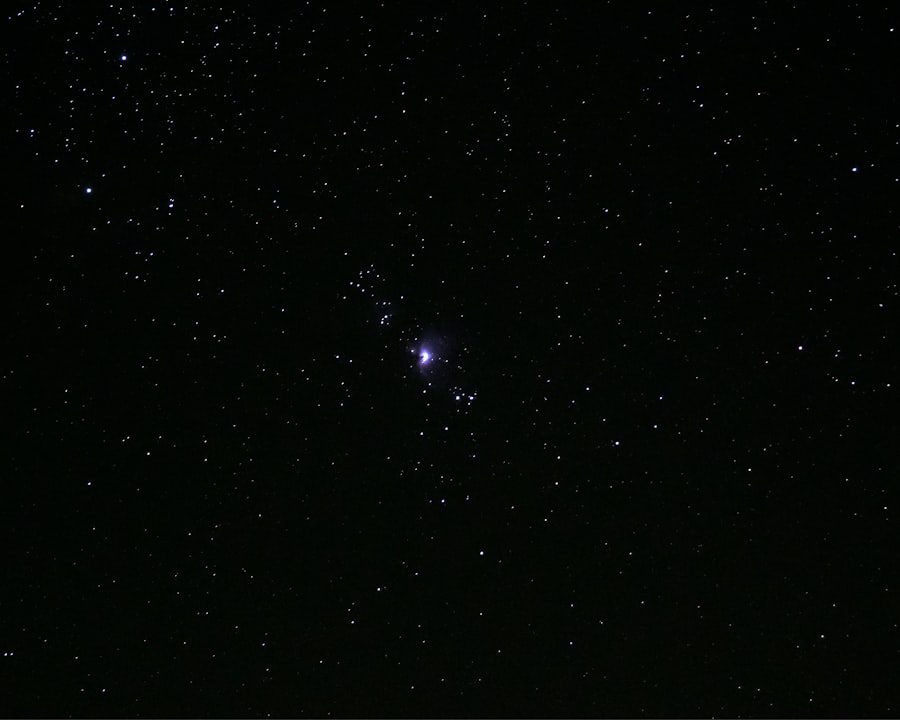
Before the first stars ignited, the universe experienced a period known as the cosmic dark ages. During this epoch, which lasted for hundreds of millions of years, the universe was devoid of light-emitting objects. It was a time characterized by a cold and dark expanse where matter existed primarily in its simplest forms.
The absence of stars meant that there were no sources of illumination to break through this darkness, leaving the universe shrouded in mystery. The cosmic dark ages were not merely a void; they were a crucial phase in cosmic history. During this time, matter continued to coalesce under gravity’s influence, setting the stage for future star formation.
The dark ages were punctuated by fluctuations in density that would eventually lead to the birth of stars and galaxies. Understanding this period is essential for comprehending how the universe transitioned from a featureless expanse to a vibrant tapestry filled with light and structure.
The Birth of the First Stars: How Did it Happen?
| Event | Details |
|---|---|
| Time of Occurrence | Approximately 100 million years after the Big Bang |
| Formation Process | Hydrogen and helium gas coalesced due to gravity, forming the first stars |
| Size of the First Stars | Estimated to be much larger than the stars in the present universe |
| Composition | Primarily composed of hydrogen and helium |
| Energy Source | Nuclear fusion in their cores, converting hydrogen into helium |
The birth of the first stars was a complex process driven by gravitational forces and thermodynamic principles. As regions within primordial gas clouds became denser, they began to collapse under their own weight. This collapse generated heat, leading to the formation of protostars.
Once temperatures reached critical levels, nuclear fusion ignited in their cores, marking the transition from protostar to fully-fledged star. The first stars were likely massive and short-lived, burning through their nuclear fuel at an astonishing rate. Their intense radiation and stellar winds had profound effects on their surroundings, dispersing elements into space and enriching the interstellar medium with heavier elements forged in their cores.
This process not only contributed to the chemical diversity of the universe but also influenced subsequent generations of stars and galaxies.
The Impact of the First Stars on the Universe
The impact of the first stars on the universe was nothing short of transformative. Their formation marked the end of the cosmic dark ages and ushered in an era filled with light and energy. These early stars emitted vast amounts of ultraviolet radiation, ionizing surrounding hydrogen gas and creating bubbles of ionized plasma that expanded throughout space.
This process is known as reionization and played a critical role in shaping the large-scale structure of the universe. Moreover, the death throes of these massive stars were equally significant. When they exhausted their nuclear fuel, they exploded in supernovae, scattering heavy elements across vast distances.
This stellar recycling enriched the interstellar medium with elements like carbon, oxygen, and iron—building blocks for future stars, planets, and even life itself. The legacy of these first stars is woven into the very fabric of galaxies that followed.
Observing the First Stars: Challenges and Breakthroughs
Observing the first stars presents significant challenges due to their immense distance and faintness. These ancient luminaries are located billions of light-years away, making them difficult to detect with current telescopes. The light from these stars has traveled through space for billions of years, often redshifted beyond visible wavelengths due to the expansion of the universe.
As a result, astronomers must rely on advanced techniques and instruments to study them indirectly. Recent breakthroughs in technology have opened new avenues for exploration. Instruments like the James Webb Space Telescope (JWST) are designed to observe infrared wavelengths, allowing scientists to peer deeper into space than ever before.
By capturing light from distant galaxies and their constituent stars, researchers hope to gather clues about their formation and evolution. These observations are crucial for piecing together the timeline of cosmic history and understanding how early stars influenced subsequent generations.
The Evolution of the First Stars: From Birth to Death
The life cycle of the first stars was marked by rapid evolution due to their massive sizes. Unlike smaller stars that can burn for billions of years, these early giants had lifespans measured in mere millions of years. They underwent various stages of nuclear fusion, transitioning from hydrogen burning to helium and eventually to heavier elements like carbon and oxygen.
This rapid progression led to dramatic changes in their structure and behavior. When these massive stars reached the end of their lives, they exploded in spectacular supernova events. These explosions not only marked their demise but also played a crucial role in dispersing heavy elements into space.
The remnants left behind could form neutron stars or black holes, further contributing to cosmic evolution. Understanding this evolutionary path provides insights into how early stars influenced later generations and contributed to the chemical richness observed in contemporary galaxies.
The First Stars and the Formation of Galaxies
The formation of galaxies is intricately linked to the existence of the first stars. As these early luminaries ignited within primordial gas clouds, they began to influence their surroundings through radiation pressure and gravitational interactions. The energy released by these stars helped to heat surrounding gas, preventing it from collapsing too quickly while also triggering further star formation in nearby regions.
Over time, clusters of stars formed within these gas clouds, leading to larger structures that would evolve into galaxies. The gravitational pull exerted by these early stars helped bind matter together, fostering an environment conducive to galaxy formation. As galaxies began to coalesce and merge over billions of years, they carried with them traces of those first stars—elements forged in their cores that would eventually contribute to planets and life.
The Legacy of the First Stars: Their Influence on the Universe Today
The legacy of the first stars is evident in every corner of the universe today. Their explosive deaths enriched the interstellar medium with heavy elements essential for planet formation and life as we know it. The chemical fingerprints left behind by these ancient luminaries can be found in contemporary stars and galaxies, providing astronomers with valuable information about cosmic history.
Moreover, understanding these early stars helps scientists piece together fundamental questions about our origins and place in the universe. The processes initiated by these first luminaries laid down a framework for cosmic evolution that continues to unfold today. Their influence extends beyond mere chemistry; it encompasses structure formation, galaxy dynamics, and even our understanding of dark matter and dark energy.
The Search for the First Stars: Current and Future Missions
The quest to uncover more about the first stars is ongoing, with current missions pushing technological boundaries to explore deeper into space than ever before. Telescopes like JWST are at the forefront of this exploration, equipped with advanced instruments capable of detecting faint signals from distant galaxies where these ancient stars may reside. Future missions aim to build upon these discoveries by employing even more sophisticated technologies designed to probe earlier epochs in cosmic history.
Concepts such as space-based observatories equipped with next-generation spectrographs could provide unprecedented insights into star formation processes during critical periods like reionization. As astronomers continue their search for these elusive objects, each new discovery brings humanity one step closer to understanding its origins.
The First Stars and the Quest for Understanding the Origins of the Universe
The study of the first stars is intrinsically linked to humanity’s quest for understanding its origins within a vast universe. These ancient luminaries serve as beacons illuminating not only cosmic history but also fundamental questions about existence itself. By unraveling their mysteries, scientists hope to gain insights into how matter organized itself into complex structures capable of supporting life.
As researchers continue to explore this fascinating field, they confront profound philosophical questions about creation, existence, and our place within an ever-expanding cosmos. The journey toward understanding begins with those first stars—celestial pioneers that ignited a chain reaction leading to everything that followed. In this pursuit lies not just scientific inquiry but also a deeper connection between humanity and the universe it inhabits—a reminder that we are all part of an intricate tapestry woven from stardust across time and space.
The formation of the first stars is a pivotal event in the history of the universe, marking the end of the cosmic dark ages and the beginning of the reionization era. These stars, often referred to as Population III stars, are believed to have formed around 100 to 200 million years after the Big Bang. For a deeper understanding of this fascinating topic, you can explore a related article on the subject by visiting